
Perversion of Justice: The Jeffrey Epstein Story
By Julie K. Brown
The crime:
A full accounting of the crimes of Jeffrey Epstein will probably never be made, both because he’s dead now and because any accomplices (of which there must have been many) will want to keep the details hidden. At the very least he was involved for many years in underage sex trafficking and sexual assault. He died in prison, under mysterious circumstances, in 2019 while awaiting trial.
 The book:
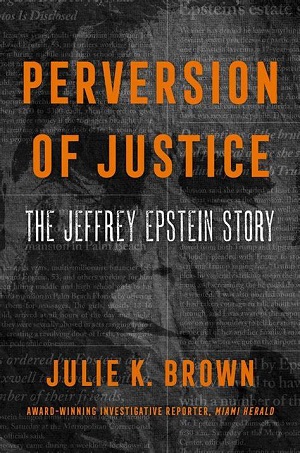
True crime has a cathartic function, in the Aristotelian sense of a purging of the emotions of pity and fear. But a book like Perversion of Justice aroused another feeling in me: anger. I got so angry reading it that it was hard to finish. What Julie K. Brown, the reporter for the Miami Herald who broke the story (or re-broke, by not letting it slip away), chronicles is an outrage to any understanding of justice or decency. Much of what was going on remains hidden by people intent on covering their own asses, but enough corruption has now been revealed to make you sick.
Even basic questions like how rich Epstein actually was and what he did to get so rich remains a mystery. How did he make his money? As his extensive Wikipedia entry puts it: “The exact origin of Epstein’s wealth is unknown.” Apparently he was a kind of money manager, but it’s not clear what this entailed, how good he was at it, or whether what he did was all legal. Some of it at least was very shady.
What really seemed to be going on was that he operated as a kind of parasite on the very rich. As one early observer remarked: “He was very smart and he knew how to woo people, how to schmooze. He’s personable and makes good company.” Not the sort of skill that one would have thought paid so well, but rich people are as susceptible to flattery and being manipulated as anyone else. A lot of them just gave Epstein their money. And I don’t mean gave it to him to manage, but just . . . gave it to him. Of course, to outsiders this made no sense. “I tried to find out how did [Epstein] get from a high school math teacher to a private investment adviser,” one unimpressed businessman remarks, “There was just nothing there.” Was there something suspicious then in his attachments to rich and powerful men, especially given all that later came out? Indeed there was, but all we can do is speculate now.
Epstein himself was a creepy guy who did nothing to conceal his perversions, which is another thing that makes you question why people would associate with him. An arrogant social climber, his hyperactive sex drive makes one wonder when he could have done any real work, had this ever been his ambition. Brown reports that girls were being brought to him “morning, noon, and night” and he was having sex “three or four times a day.” Which may sound nice to some, but really isn’t healthy.
But massages (which is how things usually got started, if they weren’t just a euphemism) were only a perk. The very rich, and even the semi-rich, have two abiding anxieties that always have to be addressed. In the first place, they have to feel secure in their lives of affluence and privilege. Private islands and offshore accounts can help with this. You certainly don’t want the government getting their dirty hands on your stash. Second, their wealth has to be justified in some way. This is mainly the work of staffers and a pliant press. Epstein knew the game here very well, presenting himself as a sort of intellectual philanthropist, despite having little claim to either title. Particularly nauseating were his forums on how to save the world from such challenges as climate change, which involved jetting celebs to the private Caribbean island that he’d had bulldozed in order to build his pedo playpen, paying off fines or donating to charity to get around environmental regulations.
In short, Epstein was a phoney. But isn’t great wealth always a bit of a fraud? Thinking about Epstein’s rise to a position of such wealth and status reminded me of how completely the myth of a meritocracy has been exploded in our own day. This is a subject I’ve written about in recent book reviews, most notably of Christopher Hayes’s Twilight of the Elites and Michael Sandel’s The Tyranny of Merit. But it goes back to such cases as the collapse of Enron (see my review of Power Failure: The Inside Story of the Collapse of Enron by Mimi Swartz and Sherron Watkins). Were the corporate heads of Enron The Smartest Guys in the Room? Only at being frauds. Which, granted, does require a certain kind of intelligence. But Team Enron were heralded as financial geniuses!
The belief that rich people have to be smart is hard to kill (though I’ve tried). That the emperor has no clothes is, I think, the defining fable of our time. But who was going to point out Epstein’s nakedness? Wealth provides a high degree of insulation, both from the media and the police. Epstein even bragged of owning the police, and it was not an empty boast, while Brown’s book shows how much of an effort it was just to bring Epstein’s case back into the public eye of the mainstream media.
“I didn’t really, at the time, believe that any media network would have succumbed to pressure to ignore or drop such an important story,” Brown confesses at one point. “I was, however, naïve and wrong.” It’s because of all the hard work she did, and the risks she took, that I cut Brown some slack for injecting so much of herself into the narrative. There’s a lot of me-journalism here, with most of it irrelevant to Epstein’s story. The way newsrooms were being squeezed in the twenty-first century is an important point worth addressing, but do we really need to know about Brown’s dating life with her Mr. Big? Or her kids getting into college? None of this adds anything to the book, even in just telling us where Brown is coming from as a reporter.
A final way that the Epstein case was emblematic of the times we live in was how it fit with the explosion of interest in pedophile sex rings. I’ve also written about this before, and it really is a cultural curiosity. Of course it would fully flower around the same time in the base mythology of the QAnon movement, but I can’t explain its roots given that Epstein is probably the closest reality has come to the kinds of stories that were so big in contemporary novels and TV shows. But Epstein’s crimes weren’t as lurid: he didn’t kill anyone (that we know of), and it’s hard to say if he was only part of a larger ring of rich and well-connected predators. Were his pals just casual acquaintances? Marks? Co-conspirators? Guilt by association went a long way with Epstein.
Even if his posse weren’t all onboard the Lolita Express (the name soon given Epstein’s private jet), the fact remains that Epstein had no shortage of powerful enablers. The most grating of these being in the criminal system and legal profession. Of course, the excuse made by criminal defence lawyers who have clients like Epstein is well rehearsed. Even if lawyers know their clients are guilty of terrible crimes an accused still has the right to a full and fair defence in a legal system that rightly puts the burden of proof on the state. The problem in this case was that Epstein had, at least in practical terms, greater resources than the state prosecuting him, and he used those resources to run a defence that while not breaking any formal rules involved the wholesale corruption of the system of justice: hiring friends of the prosecutors, essentially bribing others, attacking witnesses and complainants even before the case came to court or tampering with them in other ways. This is the sort of behaviour that I should have thought lawyers would have been bothered by or even refused to be involved in. I’m not sure if any of them demurred in the slightest.
Noted in passing:
Epstein was Jewish, which for some reason means he has to be linked to the Holocaust. But really, why? His grandparents on both sides were Eastern European Jews who emigrated to the U.S. around 1900. Some forty years later, as Brown reports, many of his maternal grandparents’ extended family were executed by the Germans. This seems a tenuous connection to me, and it’s never said what effect this might have had on Jeffrey. In A Convenient Death: The Mysterious Demise of Jeffrey Epstein the authors go further, describing Epstein’s parents as among “the lucky few from their respective families who had not perished in the Holocaust.” But both of Epstein’s parents were natives of Brooklyn, his father and mother born in 1916 and 1918 respectively. Of what significance is it to Epstein’s story to make them into Holocaust survivors?
Takeaways:
“This is not unique to one party over another. The divide is not Republican versus Democrat; it’s the rich and powerful versus everyone else.”
 Alex Good
So I did a bit of reading on Sound of Freedom and I think I can skip it; if they’re courting the QAnon crowd, then they’re not serious about what they’re doing. Of course, those guilty of sex crimes want to accuse everyone else of sex-crimes; with Trump officially a ‘rapist’ after this week’s judicial adjustment, it seems like there’s no rush to cancel him, and a faction of America seem to feel that sex-crimes actually qualifies him to run for office. The punchline is that predators like Epstein and Trump can run riot in a system where money beats morality, and there’s no sign of the moral decline ending…
LikeLike
Oh, they’re courting the QAnon crowd, and they’re serious about what they’re doing. Which is making boatloads of money. I doubt they believe much in the mythology.
LikeLiked by 1 person
Odious man, (Epstein not you).
LikeLiked by 1 person
What makes it worse is the number of his enablers. That’s the part that gets me in all these stories.
LikeLiked by 2 people
So many sickos. Its depressing how much of it goes on.
LikeLiked by 1 person