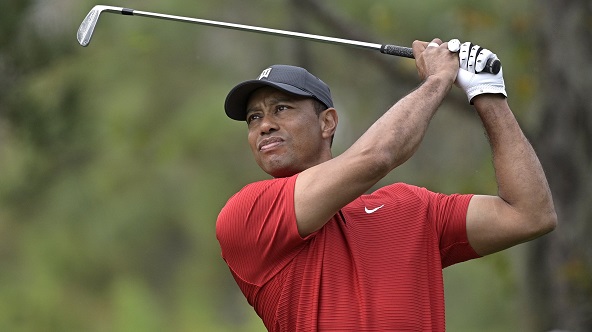
Why does anyone still care about Tiger Woods?

Still going strong, at least in terms of ratings. (AP – Phelan M. Ebenhack)

Years ago I was assigned to review a little book about Tiger Woods. At the time Woods was the best golfer in the world and in the running for being considered the greatest of all time. His father spoke of him, without irony, as having been sent by God and as potentially being the most important human ever. Not, as the author of the book noted, “the most important golfer or the most important athlete, but the most important human.” As in, bigger than Jesus.

Woods was young and good-looking and multi-racial and seemed on his way to overturning a lot of the old stereotypes of professional golfers as wealthy white retirees while he was re-writing the record books. But that was all a long time ago. Since then Woods survived a messy divorce, the disintegration of his body (he just recently had his fifth back surgery), and a car crash that fractured his leg. His game, as you might expect, has suffered. But for his surprise victory in the 2019 Masters he hasn’t been great for nearly a decade.

None of this is very surprising. Top athletes usually only stay at the top of their sport for about a decade. Golf is a little more forgiving than professional football, but no one beats Father Time. This makes it all the more surprising to me that whenever Tiger Woods picks up a golf club he is still treated as front-page news.

This weekend was the 86th Masters Tournament and Woods got off to a good start. Which meant that he was the top story not only for sports channels but even for news programming. A writer for USA Today called the story of Woods’s “transcendent game” “much more than a sports headline.” On CNN the Breaking News followed up events in Ukraine with Tiger’s miraculous comeback.

As it turned out, Woods crashed at the Masters, quickly falling out of contention with some disastrous rounds that ranked as his worst ever at the Masters. But that seems not to have diminished him as a draw, with commentators insisting that his performance was must-see viewing.

I can understand some of this, since everyone likes a comeback story and Woods overcoming his long list of injuries is inspiring. But lots of older athletes have had to do the same. The continuing attention given to everything Woods does, so long after his becoming just another golfer, doesn’t make sense to me. Why, on broadcasts of these events, are they even still following him?

The reason this disturbs me is that professional athletics is one of the few public spectacles where you can still count on achievement and ability trumping mere celebrity. It doesn’t matter how famous you are or how much money you make from endorsements if you can’t run faster or jump higher or hit harder than the competition. For years now, however, Tiger Woods has put a lie to that. He is without question the world’s most famous golfer, but is far removed from being the best. And yet the media continue to build him up, with their coverage making him the main focus of interest.

I don’t follow golf, but I am a sports fan. And as a sports fan I feel the same sense of despair at this as when MMA fighter Conor McGregor fought Floyd Mayweather, a publicity stunt that had the second-highest pay-per-view buy rate in boxing history. If this is the future of sport — and Mayweather’s next fight was against YouTuber Logan Paul, which also did over a million buys — where achievement means nothing and we’re just paying to watch famous people perform (and not always perform well) then what’s the point? We might as well be watching Dancing with the Stars.

Maigret: Maigret’s Doubts

It’s an interesting enough idea. A married couple come to see Maigret during the dog days at Quai des Orfèvres (which happens to be mid-January). The fact that they make separate visits tells you something’s wrong. He sells toy trains and thinks his wife is planning to kill him. She sells lingerie and thinks her husband is going crazy. They may both be right. Complicating matters – a lot – is the fact that her sister is also living with them, and she’s “the sort of woman who turns men’s heads in the street.” Well, we know this isn’t going to end very happily.

Quite readable, as always, but this one didn’t speak to me. Maigret refers to some professional literature but “none of the textbooks on psychology, psychoanalysis and psychiatry [are] of any use to him.” And an arrogant psychiatrist who’s introduced in the early going is simply dropped as things go on. It seems that what all these shrinks “expressed in difficult language and complicated phrases was in the end merely human.” The human, of course, being Maigret’s favoured hunting ground, he just has to sit back and observe how the players interact with each other to understand what’s really going on.

Maigret index

A conversation on American politics

I only recently heard the sad news of the death of the visual artist Tom Moody, a frequent commenter on my blog here and at Alex on Film. I never met Tom, but we had some great discussions online and I always appreciated getting his unique point of view. We can have a real connection and attachment to people we only interact with online, something that Tom’s death brought home to me.

The last set of posts Tom put up on his blog were responses to things I had written, which he put in the form of a dialogue. Since I don’t know how much longer that material will be kept up, I thought I’d repost a bit of those conversations here with some light editing.

Alex Good (from my review of Michael Sandel’s The Tyranny of Merit): Sandel and [David] Brooks are right in seeing in the myth of meritocracy a mighty engine for the generation of mass resentment. Meritocratic hubris leads to smug self-congratulation among the fortunate and anger among the left behind. “There is reason to think,” Sandel opines, “that popular antipathy toward meritocratic elites played a part in Trump’s election, and in the surprising vote in Britain, earlier that year, to leave the European Union.” People were confused at Trump’s railing against elites when he was himself, at least by his own reporting, a billionaire. But Trump, unlike Hillary Clinton, didn’t talk about merit. He talked about winners and losers. And what Trump’s supporters recognized was that Trump was actually a giant loser: a serial bankrupt, serial divorced male, clinically obese, deeply ashamed of being bald, and acting out his various insecurities in giant rages on the most public of stages. His favourite word with which to tag anyone he hated was “loser.” This, like everything else about him, was pure projection. That loser rage, however, struck a mass chord. His anger – and he was anger incarnate – was a kind of therapy. His fear of being laughed at and humiliated was something everyone suffering from a loss of social esteem could relate to.

Tom Moody: This is an interesting take on Trump but omits his smart mouth that appealed to many Americans. Trump heckled loser Jeb about his sainted mother — who was actually a battle-ax and mediocre dynasty-builder, much kidded by Dems in the Bush years for talking about her “beautiful mind” that would not be cluttered with Iraq war details. While Jeb was waxing sentimental about her during the Republican debates Trump wisecracked that “she should be running” (as a candidate herself, annoying the clearly-not-ready-for-prime-time Jeb).

Calling Bush Jr.’s Iraq war a mistake based on lies, on the national debate stage, is something the media would expect from a Jesse Ventura or Mike Gravel or Ron Paul but here it was being voiced by a juggernaut candidate on his way to the presidency (though no one knew that yet). The US public wasn’t just thrilled to hear the Iraq truth spoken aloud because they identified with Trump as a “fellow loser,” as Alex Good suggests, but rather because it was true and no establishment debater or media figure up to then had the courage to speak it. Later, as President, Trump wanted to know what could possibly justify the U.S. presence in Syria post-ISIS. (Fighting a dirty war on behalf of some sleazy U.S. “allies”? Or was it the instantly-manufactured defense of “the Kurds! the Kurds!”? it depended on the politics of who answered.) Eventually Trump’s handlers reeled him back in and he made his laughable claim that the US was there to “protect the oil” (that is, Syrian oil in the ground coveted by other countries).

If Bush Jr were still president, the “left” would have applauded all these “outrageous” Trump statements. With the onset of Trump Derangement Syndrome in 2016 (a term borrowed from Bush Jr.), the antiwar faction immediately discounted Trump’s few sensible/courageous statements simply because he was Orange Hitler. The MAGA crowd was paying attention, though, including many families of maimed veterans, and appreciated hearing those occasional, inconsistent truth bombs from the mouth of their chosen “loser.” If you want to understand the election, understand that at least — it wasn’t all about bullying and “racism.” It was straight talk people forgotten could be spoken.

Tom Moody: One thought on why the US succeeded postwar and began failing after Reagan’s election. It was actually due in part to a system the US Republicans would say was the opposite of merit: the US Civil Service.

In order to execute the New Deal programs you needed a dedicated, mostly not corrupt caste of worker bees. These people weren’t paid super-well but had good pensions and benefits.

The US Republicans spread the propaganda meme of “lazy government workers” in order to justify dismantling and privatization of Civil Service positions, carnage that is still ongoing. As government gets noticeably less competent, this justifies further cuts.

Alex Good: Agree completely. What the Republicans stand for more than anything today is hatred of the government. The more old-school “conservatives” will describe this as “limited government” but what it really amounts to is what Sarah Kendzior refers to as stripping the state down and selling it off as spare parts/scrap. Michael Lewis’s The Fifth Risk is a popular take on this, but it’s really everywhere. Big Government is now so evil that it can’t even be trusted to handle things like rolling out a vaccine. Meanwhile, the rhetoric of tearing down the government has always been there (Grover Nyquist’s line about shrinking government to the point where it can be drowned in the bathtub), but it’s been taken to a new level, and new seriousness, with the program of people like Bannon, who talk explicitly and enthusiastically about destroying the state.

My own theory here is that the Republicans are basically looking at what happened to post-Soviet Russia as a model to be followed. Single-party rule, one state-owned media outlet, and control of the economy by a group of oligarchs who represent a government-business partnership. It’s not far removed from China either. It’s something that a lot of the old Cold Warriors seem to be missing. These guys aren’t the commies any longer, with a godless, evil system that’s a rival of or threat to capitalism. They have a better system of capitalism that America’s oligarchs want to emulate.

Tom Moody: Post-Soviet Russia had a lot of interference from Milton Friedman types in the US. That stopped under Putin and Russia seems to be evolving its own hybrid system. China has a better safety net than the US and actively funds its rural areas under Xi. Both countries are autocratic but seem to be run by a government as opposed to a handful of private corporations and CEOs.

I mentioned the US Civil Service in response to Michael Sandel’s statement “Over the past four decades, meritocratic elites have not governed very well. The elites who governed the United States from 1940 to 1980 were far more successful.” The 1940-1980 elites created the social programs but left them for non-elites to run. I haven’t read Sandel’s book so I don’t know if he makes that distinction.

Alex Good: The private sector in Russia and China is very much subordinate to the government. But I think that’s actually the system that the right wants in the U.S. because it’s not a communist or socialist government but one where a bunch of rich families and oligarchs own everything, whether they’re members of the (only) party or friends of people who are. Putin is reportedly the richest man in the world for being czar of what is not a wealthy country. What politician wouldn’t want a slice of that? Think of how much money can be made from dismantling the American state.

I think the endgame the Republicans, or Western elites more generally, seem to be aiming for is something very similar to these formerly communist countries: control the media, get rid of democracy and replace it with one-party rule by a class of oligarchs who control the government, and then work together with the private sector to enrich themselves.

Tom Moody: Trump and Bannon (I know we don’t agree on this) are bugbears for the real villains: the “liberals” that internalized Chicago School talking points about budget-balancing and the free market. There is almost no space between Bill Clinton and Paul Ryan on the issue of so-called entitlements. They think social spending threatens to drain the country and they don’t care at all about the cost of military spending. (There is actually a video somewhere of Clinton and Ryan having a tête-à-tête backstage at some event, where Clinton is assuring Ryan that on the “next vote” — whatever that was — they would have support for the cuts Ryan wanted.) Of course the right believes in “markets” but the Dems have actually been able to turn this ideology into policy. I would say on the “need” to cut Social Security and Medicare, Clinton, Obama, and the hated Trump are in near-complete agreement. Biden currently has an appointee inside Medicare (Elizabeth Fowler) who is working to privatize the system as much as possible.

Alex Good: I’d agree with that, but what I think the Trump phenomenon revealed to the Republicans (and elites more generally) was that they could go a step further. For example, as bad as Clinton and the neoliberal Dems were (and are) I don’t think they believe in getting rid of democracy entirely and turning the U.S. into an authoritarian state run by the Party, with all other parties being deemed illegitimate. After Trump I think the Republicans saw that this was possible and it’s what they’re working toward. As for Trump himself, I don’t think he has any political ideology at all, or goals beyond using the office to get attention, make money, and stay out of jail. But he’s been useful for pushing things along in this direction faster and further than anyone thought possible. Or at least that I thought possible.

Tom Moody: The Republicans (Trumpist and otherwise) and Democrats all benefit from the appearance of a working two-party system as cover for the orgy of looting by the oligarchs (tech, Wall Street, Pharma, etc) who back both parties. Trump’s flaw was “he gave the game away” with his flaky outspokenness (Iraq was a mistake, we’re in Syria for the oil, CNN is fake news — the latter of which is certainly true, as evident from their “Russian aggression” narratives concerning Ukraine). All those truth bombs meant Trump had to go — hence the Russiagate propaganda blitz and weak cases for impeachment.

Hitler/Trump comparisons never persuaded me — Hitler was a fanatic and control freak; Trump likes his golf and luxury. The MAGA hat rallies apparently scare people outside the US. These are conservative people who fear change and Modernity (not without reason) — there may be brownshirts at the rallies but it’s mostly about solidarity among the working class and rural population.

Alex Good: Yes, Trump is no Hitler. As one historian pointed out a couple of years back (I can’t remember his name), Trump is what the German conservatives wanted Hitler to be: a demagogue buffoon who would get people to vote for him but who would have no interest in actually governing. Instead he (Hitler) turned out to be something more dangerous. Trump, on the other hand, really is a moron just trotted out to play to the rubes, with no political platform at all. The tax cuts and stacking the judiciary were things he didn’t understand or care about, though he’d brag about them all the same. That was all Ryan and McConnell.

I agree that fear of change is a big part of his appeal, especially among older voters. I think we have a difference of opinion on Russia. As far as I can tell Trump’s only real business for the last twenty years or so has been money laundering for Russians. I actually thought he did enough to get impeached the first time, and the second time should have been a slam dunk. The Ukraine phone call really was a hundred times worse than Watergate.

Tom Moody: I don’t think Trump was trotted out — I think he trotted himself out in a wild-card year of working class rebellions. We started 2016 with the depressing news that the media had decided the election was going to be Jeb vs Hillary — two utterly mediocre dynasties — and ended 2016 with the certainty that both those fools were gone from the world stage. I found this uplifting but by that point most of nt friends were far gone into Trump Derangement Syndrome and couldn’t share my joy.

The news outside the CNN bubble is the world is realigning to a tri-polar situation after 30 years of US control. If de-dollarization continues the US will have to act less like The Hegemon bully to other countries and will have to get its own house in order. Riots, COVID, woke destruction of standards, offshoring, etc.

Alex Good: I agree with you that Trump wasn’t initially trotted out. He was seen as a party crasher. I think Republicans hated him from the start, and from all the reporting I’ve read they still do. Even the ones who kiss his ass the most.

But despite that hate they find him a useful idiot for the reasons I mentioned: he fires up the base and has no interest whatsoever in actually governing, giving the party establishment a free hand to do pretty much whatever they want. Some may grumble about trade wars and the rest, but when push comes to shove — and that was the tax cut bill — they drew a hard line in the sand. The donors were insisting on that. And after tax cuts and stacking the judiciary there really wasn’t much else on the agenda. The Republicans are a party without a platform. Building a wall, infrastructure, a big beautiful new healthcare bill . . . these were things they didn’t even attempt. It got to the point where they finally didn’t even bother publishing a platform for Trump’s second nomination. I don’t think so much because they were just deferring to “whatever Trump says” as that they didn’t have much they really wanted.

Ah, we do part ways on Russia. I am not in the NeoCon camp and think Russia had plenty of legitimate grievances with NATO expansion etc. Nor do I think Trump is a Manchurian candidate figure. I do, however, think Putin thinks of him as (again) a useful idiot to have in the White House (he publicly stated he wanted Trump to win), and I don’t think there’s any denying that Russia did intervene in the election to help Trump. I don’t know how big a part that played in the election (Clinton was probably the very worst candidate the Dems could have put forward), but it was an issue. I’m disturbed by writing off the connections that were made as a hoax or a fraud. The two sides were meeting. They were working together. They were trying to keep it secret. We don’t know how much of it they did keep secret.
Maigret: Maigret Travels

In Maigret Enjoys Himself our hero

felt a bit jealous of Janvier, not because of his success, but for a silly reason. Every time an investigation at the Police Judiciaire incurred certain costs, such as travel, they had to fight a battle with the accountants, who went through every expense claim with a fine-tooth comb.

How had Janvier managed to swing a flight to Cannes? They must be attaching a singular importance to this case, that they should have loosened the purse strings so much.

I don’t know if it was in reaction to this, but Maigret gets to score some major frequent-flier points (as well as riding in a Rolls-Royce for the first time) in this next adventure as he flies off to Nice, Monte Carlo, and Lausanne while investigating the case of a billionaire drowned in a bathtub. Being a billionaire in 1957 was, I suspect, a pretty big deal. But it’s important to get the currency right. In this instance, “If you count in francs, it’s correct. Not in pounds.” In any event, I’m not sure what the exchange was at the time, but the deceased was rich.

As things turn out, Maigret doesn’t dislike members of the elite set, but they upset him.

These people irritated him, that much was a fact. Faced with them, he was in the position of a newcomer in a club, for example, or a new pupil in a class who feels awkward and embarrassed because he doesn’t yet know the rules, the customs, the catchphrases, and assume the others are laughing at him.

Of course, putting a chip on Maigret’s shoulder isn’t a good idea if you want to get away with murder, and aside from all the flying about he handles this one pretty easily. In fact, there’s really only the one suspect. It’s not much of a mystery. The best part of the book is a lengthy psychological analysis Maigret performs on the super-rich, finding them mostly as fearful of falling out of a lifestyle to which they’ve become accustomed and spoiled by. Spoiled meaning no longer capable of functioning with any kind of independence.

. . . all those who led this kind of existence – wouldn’t these people feel lost, helpless, naked somehow, as powerless, clumsy and fragile as babies, if suddenly they were plunged into everyday life?

Are “these people” still with us? Not the super-rich, they’re obviously still around, but a class that is totally dependent on a servant class to exist? For all the rhetoric adopted by today’s upper class, of being alphas and hard-nosed masters of the universe, I think most of them are probably the same. What’s more, their fear is greater than ever, as it’s an even longer way down.

Maigret index

Gilded Age kinksters

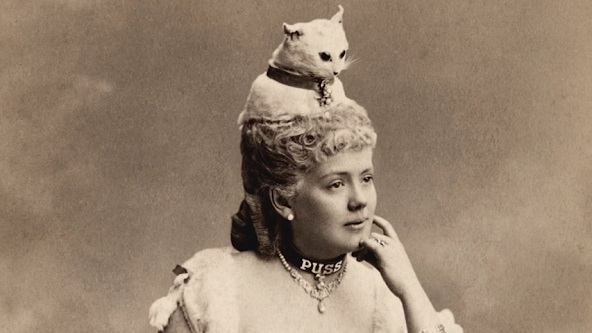
I was recently watching the PBS documentary The Gilded Age and was struck by an image of a partygoer at the 1883 ball thrown by Alva Vanderbilt as a housewarming for the newly completed 5th Avenue Vanderbilt mansion (since demolished, alas). This was a gathering of the crème de la crème of New York society at the time, all of them competing with each other in a display of wealth and privilege (the newspapers even promoted the event with headlines about “The Amount of Wealth to be Displayed”). But it was the “youthful and precocious” Kate Fearing Strong who showed everyone up in her Catwoman costume.

The idea of a society lady attending such a party wearing a collar with her nickname “Puss” on it struck me as wonderfully 50 Shades. Animal lovers should cringe, however, at the fact that her headpiece was a real taxidermied cat and her skirt had seven real white cat tails sewn against a black background. I don’t know if Strong was the inspiration for Cruella de Vil, but the connection is pretty obvious. All-in-all a pretty disgusting costume then, though the collar is timeless.

Bogle hunting

Over at Alex on SF I’ve added my review of the H. G. Wells classic tale of body horror The Island of Doctor Moreau. I start off by saying how this is a book that I took on board at an early age and that I’ve regularly come back to. On this most recent re-reading, however, I found I’d been getting something wrong. When he comes back from his first excursion about the island, the narrator Prendick is trying to get Montgomery to explain what it is he (Prendick) encountered in the jungle:

“Montgomery,” said I, “what was that thing that came after me. Was it a beast, or was it a man?”

“If you don’t sleep tonight,” he said, “you’ll be off your head tomorrow.”

I stood up in front of him. “What was that thing that came after me?” I asked.

He looked me squarely in the eyes and twisted his mouth askew. His eyes, which had seemed animated a minute before, went dull. “From your account,” said he, “I’m thinking it was a bogle.”

I felt a gust of intense irritation that passed as quickly as it came. I flung myself into the chair again and pressed my hands on my forehead.

The first time I read this, and on every subsequent reading up until now, I’d always thought “bogle” a made-up word or pet-name that Montgomery used to refer to a particular type of Beast Man. His answer then registers as nonsense to Prendick, who collapses in exasperation. He’s just never going to get a straight answer out of Monty.

I was reading the Penguin Classics edition this time though and saw “bogle” tagged with an endnote, which informed me that bogle refers to “a phantom or creature of one’s own imagining.” So bogle wasn’t just a nonsense word.

Consulting a dictionary, I found bogle defined as a goblin or specter. The Oxford English Dictionary has “a phantom; a goblin; an undefined creature conjured up by superstitious dread.” Meanwhile, Wikipedia has this to say:

A bogle, boggle, or bogill is a Northumbrian and Scots term for a ghost or folkloric being, used for a variety of related folkloric creatures including Shellycoats, Barghests, Brags, the Hedley Kow and even giants such as those associated with Cobb’s Causeway (also known as “ettins”, “yetuns” or “yotuns” in Northumberland and “Etenes”, “Yttins” or “Ytenes” in the South and South West). They are reputed to live for the simple purpose of perplexing mankind, rather than seriously harming or serving them.

I guess the Penguin note is correct in how Montgomery is using the word (“you were just seeing things”) but I was interested in knowing that it was a word Prendick would have understood, and that Prendick’s exasperation derives from being told that he’d only imagined seeing the bogeyman.

Maigret: Maigret Enjoys Himself

The Dunning-Kruger effect is one of most cited in the field of psychology, to the point where it’s become an all-purpose media touchstone. At its most basic level it refers to the tendency of people to be overly confident of their knowledge and competence in an area where they have little ability or expertise. The initial study was published in 1999. And here is an observation made by Detective Chief Inspector Maigret in Maigret Enjoys Himself (1957):

The less knowledge or experience some people have to back [their opinion] up, the more certain they are that they know what they are talking about.

Part of the work of science is to establish on an empirical basis what everyone already knows.

Maigret is enjoying himself in this book because he’s on vacation. Except that he doesn’t want to take on the crowds at all the usual French getaway spots so he and Madame Maigret opt for a staycation in Paris (“In August everyone will be away, and we’ll have the place to ourselves”). Alas, when the naked body of a prominent doctor’s wife is found stuffed in a cupboard, a crime that immediately becomes headline news, he can’t help but get his hand back in the game. He’ll remain an observer, relying mainly on newspaper reports for information on the case, but he’ll try to nudge his temporary replacement Janvier along in the right direction by way of some anonymous tips.

This is a bit awkward, as the news reports have to be novelistically detailed in order to give Maigret (and us) the information necessary to move things along. Was this style of writing typical of French newspaper reporting in the 1950s? I have doubts. Then there’s the doctor’s personal assistant/nurse, who is described in the following manner: “She is unmarried, and from the sight of her it is difficult to imagine her ever having had a man in her life.” Was this sort of drive-by smear of an innocent party typical of French newspaper reporting in the 1950s? Perhaps it’s a little more likely.

Overall this is an enjoyable change-up that has fun with its working-vacation premise. One of the more interesting parts, and one that says something about how things were changing over the years Simenon was writing these books, comes in a chapter where Maigret eavesdrops on a pair of young lovers. “The boy’s hair was too long; the girl’s, too short.” Get used to it Jules! Long hair for boys and short for girls was coming. But even worse comes when the couple get up to leave and pass by Maigret’s table.

As they passed, the girl gave Maigret’s hat an amused look, even though there was nothing the slightest bit ridiculous about it. It was true that she wasn’t wearing a hat herself, and her hair was cut short like that of a Roman emperor.

Ouch! Not only do they have modish haircuts, but hers explicitly suggests a male authority figure. Meanwhile she finds hats ridiculous! Even if there’s “nothing the slightest bit ridiculous about it”! In Cécile is Dead Maigret had been disturbed at his American visitor not wearing a hat. But that was 1942. The times they were a-changing.

Maigret index

Biblical babes

I just watched the National Geographic special on The Gospel of Judas. Interesting subject, though it was handled in a pretty remedial way. As with most documentaries the parts I liked best were the interviews with experts (a.k.a., talking heads). I don’t like dramatic re-enactments of historical events. I often wonder if there’s any point to these at all. I guess they liven things up a bit, but they always seem a little silly to me and not very instructive.

If you’ve seen many Bible-themed movies you get used to it being a story — the greatest ever told! — that’s prettied up. Even the gore of Mel Gibson’s The Passion of the Christ has a glamorous quality to it, and Jim Caviezel is the usual “close but kind of meatless” actor playing Jesus. That’s the handsome-hippy way he’s also presented in the re-enactments here, with Judas equally good looking but with a dirty beard.

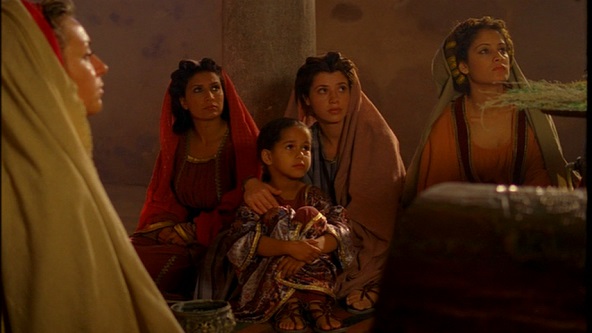
I tend to just roll my eyes at movie Jesuses now. They all look the same and I doubt they’re even that accurate. Even the idea that Jesus had a beard is debatable, as it was actually quite a late addition to his iconography (in the earliest depictions he was a beardless youth). But where I really had to laugh watching The Gospel of Judas was when I saw the women. Here are some early Christians listening to a reading of the gospels.

Come on. These ladies are beautiful. I don’t think many working-class women in first-century Palestine looked like this. And here is the martyr Blandina about to die for the faith in the arena at Lugdunum (modern Lyon).

A model martyr, if you will.

Again Mel Gibson’s movie can be taken as setting a high bar for this sort of thing, with Monica Bellucci playing Mary Magdalene. I guess it makes sense that a pretty Jesus should be surrounded by Biblical babes but this can be taken too far, even by Hollywood.

Maigret: Maigret’s Failure

I haven’t said anything yet about the covers of these Penguin translations of the Maigret series. The photos are credited to Harry Gruyaert. I think they work really well, though I don’t like the lettering they used for Simenon’s name. In any event, most of the time they aptly capture the post-War Parisian scene, though not as much in the earlier books, which are set in the 1930s. I also wonder why they had a horse on the cover of Inspector Cadaver.

The cover for Maigret’s Failure presents us with the imposing façade of what looks to be a very swank address. I think it nicely captures the messaging of Ferdinand Fumal’s fancy digs on Boulevard de Courcelles: the stolid architecture, complete with closed shutters, reflects an abiding concern in the series with what lies behind respectable bourgeois appearances. Thirty years earlier a young Maigret and his wife had enjoyed walking past this same address, dreaming of moving on up.

“When I’m detective chief inspector . . . ,” he had joked.

And both of them had looked through the railings, with their gilded spikes glinting in the sun, at the opulent townhouses around the park, imagining the elegant, harmonious lives people must be living behind their windows.

If there was anyone in Paris who had gained first-hand experience of life’s brutal realities, who had learned, day after day, how to discover the truth of appearances, it was him, and yet he had never entirely grown out of certain fantasies from his childhood and adolescence.

Hadn’t he once said that he would have liked to be a “mender of destinies,” such was his desire to restore people to their rightful places, the places they would have occupied if the world were a naïve picture postcard version of itself?

Conflict rather than harmony probably reigned in eight out of ten of the still magnificent houses that surrounded the park. But he had rarely had the opportunity to breathe such a strained atmosphere as the one between these walls.

Or, as the cook later puts it when she’s being interviewed: “If you’d seen what I’ve seen in well-to-do houses!”

The actual mystery here will be a familiar one to genre fans, though I can’t remember Simenon using it before. It’s the murder victim who was such a loathsome individual that everyone wanted to kill him. Indeed this is something he was aware of, asking for Maigret’s protection. His murder thus constitutes Maigret’s initial failure, the first of several.

There are a plethora of suspects, all with motive, means, and opportunity. So does it even matter who’s guilty? Not much. The solution comes to Maigret in a dream and the killer’s apprehension, years later, is only worth a shrug.

One of Maigret’s oddities is that he can’t drive (in Maigret in Court we’ll be told that he never wanted to learn how to). He gets police cars to carry him about Paris most of the time, though in a pinch Madame Maigret can get behind the wheel. The fact that his wife drives and he can’t struck me as signaling that his inability to drive was something exceptional. And yet here the super-rich Monsieur Fumal can’t drive either. Nor can his manservant. All three of these fellows hail from the country, so maybe that was typical of Frenchmen of peasant stock at the time. But it’s also probably wrong to think of an ability to drive as being universal. I remember hearing that when filming Get Carter (1971) they had to work around the fact that Michael Caine, in his mid-30s then, didn’t know how to drive. Bringing the story up to date, apparently many young people today are choosing to go car-less, mainly for economic reasons, which, along with the advent of self-driving cars, means that the ability to drive may be about to go into steep decline. Now we just need better public transit and more walkable cities.

Maigret index

Boyhood crush revealed!

The wreck of the Endurance has been discovered 3000 meters beneath the Weddell Sea.

The story of the doomed Endurance expedition, headed by Sir Ernest Shackleton, is considered (at least by Wikipedia) “to be the last major expedition of the Heroic Age of Antarctic Exploration.” As it turned out, Shackleton never even set foot on the continent. The Endurance got stuck in and then crushed by ice, leading to heroic efforts made by the crew to survive.

Arctic and Antarctic exploration has always fascinated me. I remember reading every book there was about these expeditions when I was a kid. It was big news for me when the wrecks of the Erebus and Terror were found in 2014 and 2016 respectively. Because of where they sank, these wrecks are in remarkably good condition today. The pictures are amazing and only add to the romance.