TCF: Slenderman

Slenderman: Online Obsession, Mental Illness, and the Violent Crime of Two Midwestern Girls
By Kathleen Hale

The crime:

Three Waukesha, Wisconsin girls — Morgan Geyser, Anissa Weier, and Payton Leutner – went into the woods on May 31, 2014. Geyser and Weier had planned beforehand to kill Leutner as a sacrifice to the Internet bogeyman Slenderman (or Slender Man). Geyser stabbed Leutner 19 times and then ran off with Weier. Leutner fortunately survived the attack. Geyser and Weier, who were both 12 years old at the time, were quickly apprehended and found not guilty by reason of insanity at trial.

The book:

This is a story that became a media sensation at the time, which rarely does anyone any good. A lot of the reporting was misleading. For example, Kathleen Hale mentions the false impression received by many (and I can raise my own hand here) that Leutner had been killed in the woods. Also, the focus of a lot of the coverage was on the idea that the girls had been corrupted in some way by the Internet. But there were shocking crimes like this long before the Internet, or even television, and as Hale convincingly argues Geyser in particular was already in a bad way before she ever met up with Weier and started visiting the Creepypasta site, source of the Slenderman mythos.

I doubt this will be a crime that has the staying power in the popular imagination as more celebrated cases involving children, like the Parker-Hulme murder (which the film Heavenly Creatures was based on), Mary Bell strangling two even smaller children in Newcastle, Robert Coombes killing his mother (the subject matter of Kate Summerscales’ The Wicked Boy), and the murder of James Bulger by Robert Thompson and Jon Venables. For purposes of comparison, Hulme and Parker were 15 and 16 respectively, Bell just turned 11, Coombes was 13, and Thompson and Venables were both 10. Now that they’ve played out, is there a lesson we can learn from those earlier crimes?

If you believe that the primary purpose of the justice system is rehabilitation, then crimes involving young people provide the most instructive test cases. Let’s face it, by the time you’re 30 or 40, you are what you are. I’d even say you’re mostly set well before that. But children can change, unless they’re truly bad by nature. So what does the evidence of those previous cases tell us? Julie Hulme went on to become the famous mystery writer Anne Perry and Pauline Parker started running a children’s riding school. Mary Bell, her identity still concealed, has apparently gone on to live an incident-free life. Robert Coombes moved to Australia and would serve with distinction in the First World War as a stretcher-bearer at Gallipoli before settling down to operate a market garden. Robert Thompson, considered by authorities to have been the dominant partner in the Bulger slaying, hasn’t re-offended since being released from a young offender’s institution in 2001. Only Jon Venables has turned out to be incorrigible, continuing to have several serious run-ins with the law relating to the possession of child pornography and disorderly conduct.

In other words, even the most violent and dangerous kids can get better. Slenderman foregrounds the question of what to do with two young offenders, one of whom (Geyser) was clearly suffering from some form of mental illness (Anissa Weier’s defence of folie à deux, on the other hand, didn’t fully convince me). To what extent are such individuals a risk to themselves and others if they get early release? How can they best be treated? There’s a lot of disagreement even among experts when it comes to matters like these, but the bottom line is that any way of dealing with the problem is going to take a lot of time and money, and the general public can’t be expected to feel particularly generous toward such types.

Hale, who has written a couple of YA novels, is a responsible reporter of the events, extending sympathy to everyone caught up in the tragic whirlpool of events. It’s heartbreaking to read her account of the assault and the events leading up to it. She doesn’t have to do anything to work up the pathos, and aside from a few minor and forgivable touches (like the victim’s blood staining the words “love,” “hope,” and “justice” on her t-shirt in a fading red) I didn’t think she was trying to tell the story slant. But what I found most interesting in her account was the shadow cast not by Slenderman but of what has become an American nightmare.

What I mean is the pervasive sense Hale gives of a nation not just in decline but almost in ruins. There’s the collapsing justice system that has seen underfunded mental health institutions and the prison-industrial complex being crudely bolted together in a merger made in hell. There’s Leutner’s parents struggling to pay her astronomical hospital bills and Geyser’s parents (and grandparents) cashing out their savings and going into debt to pay for her legal defence. And then there’s the book’s strange final vignette, which has the lead defence lawyer going for a jog by a river declared officially toxic due to poisonous water runoff from local paper mills and seeing a group of three men making a video of themselves having public sex. The lawyer has a hunch the three are opium addicts hooked on drugs dispensed by predatory pain clinics.

We are told, in passing, that Waukesha is “one of the most conservative counties in what was becoming an increasingly conservative state – one that by around twenty thousand votes would swing the 2016 election in Donald Trump’s favor.” So American carnage then, all the way.

Noted in passing:

The book spells Slenderman as all one word. Wikipedia designates him as Slender Man with Slenderman as an alternative spelling. Apparently he was described as “The Slender Man” in his first appearance online. It’s testimony to how completely the Internet has taken over our sense of orthography that I figured Slenderman must be right. We smush all our words together now as a matter of course. I wonder where this will eventually lead. Perhaps we’ll go back to the style of ancient times with whole pages of text unbroken by any spaces between words. Then, in some future renaissance, we’ll rediscover Carolingian minuscule . . .

The cover shows what seems to be a very upscale suburban street, with pretty houses and a big flag flying from a front porch. Is this Waukesha? In any event, Geyser and Weier were both condo kids, and not fancy condos either. I guess the publisher was trying to sell the idea that these were all-American girls, and that beneath the pristine surface of American life all sorts of evil is bubbling away, but I found it misleading.

In my notes on Obsessed by William Phelps I made some remarks on the decline of cursive handwriting. Whatever else one thinks of its loss, being able to write cursive can be a useful skill, especially when having to write quickly because you don’t have to lift your pen up from the paper as often. I think it would have helped the detective here who took down Anissa Weier’s confession in all-uppercase handwriting. I can’t imagine how awkward that must have been.

There’s one moment of black humour that I loved. At one point the budding psycho Anissa is described as taking “a field trip with her FLIGHT class to talk to her third grade ‘buddy’ about the difference between right and wrong.” And it gets better:

In FLIGHT (facilitating learning through integration, guidance, high expectations, and technology), she [Anissa] was studying PBI (positive behavior intervention), helping younger students at the nearby elementary school make good decisions and stay out of trouble. Earlier that year, Anissa had confided in another girl in FLIGHT that she had found a way to become a proxy [a murderous disciple] of Slenderman, saying, “You have to kill one of your friends.” The other girl, identified in court by her initials, K. N., would later testify, “And when I looked at her like ‘What are you talking about?’ She was like, ‘Don’t worry, it’s not you – and I was kind of like, confused? But I didn’t think she actually was like, gonna do it because she didn’t seem like that kind of person.”

I could add this to the list of background evidence of a nation in decline. Oh, the horror of what grade school has become. The horror.

Takeaways:

Hale makes a strong case for the importance of understanding and being sympathetic toward mental health issues. My own advice, however, is this: Unless you’re a professional you should stay away from these people. Interaction with them should be limited to steering them toward someone who can help.
True Crime Files

Batwoman: Volume 1 Hydrology

Batwoman: Volume 1 Hydrology

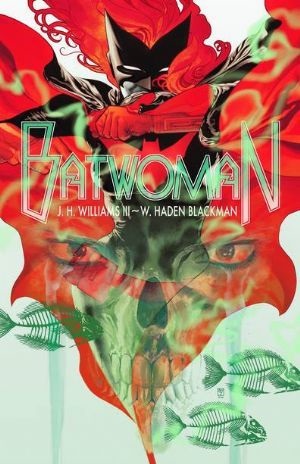
This version of Batwoman was part of DC’s New 52 reset that launched in 2011 (the “zero” issue that kicks this collection off came out in 2010, but details). As such it has to introduce us to a bunch of new versions of some old characters and define their relations to each other. This is always busy work that distracts us from any main storyline, which is what happens here. And that’s a shame because I was interested in the La Llorona plot and the whole merging of superhero and horror elements and I thought this got short shrift in the end.

Overall though I thought it was a really good comic. I did want more of the spooky La Llorona but all the world-building stuff was great. Kate Kane could have been a platform figure as a proud lesbian superhero but that part just plays as perfectly normal and not a big deal. She’s still a total sex bomb anyway, with an outfit that gives her torpedo tits with the high beams always on. The Department of Extranormal Operations feels like Hellboy’s B.P.R.D. rebranded and is a good fit for Director Bones. Batman remains a shadowy figure so he doesn’t take over, which was nice for a change. I thought the action scenes got confusing through shattered page layouts, but the fight between Flamebird and the Hook scored points for its brutal realism.

I didn’t know what to expect from this one since Batwoman isn’t a character I’ve ever followed much but Hydrology was a pleasant surprise and made me want to check out the next volume anyway. You can’t ask for much more from stuff like this.

Graphicalex

Bad calls

Over the last ten or so years I think there are very few amateur political commentators who can claim to have been so consistently wrong in their predictions, about pretty much everything, as I’ve been. That said, it seems as though one of my hot takes has blown up in record time with the recent announcement from Premier Doug Ford’s Ontario government that they are reversing the controversial Greenbelt land swap. In an earlier post I concluded that the land was never going back into the Greenbelt, but now it look as though it might.

At least for a while. I still think it’s likely to end up being rezoned after the next official Greenbelt review, but for now Ford seems to have made a political calculation to sacrifice the interests of the developers to shore up some of the political damage he’s been taking. But given the amount of money at stake I think this is a story we’ve yet to hear the last of.

Jumping the gun

Last week I noticed a couple of houses in my neighbourhood had Halloween decorations out. One clever one I liked had a full-size skeleton pushing a lawnmower. But isn’t mid-September a bit early? I don’t know what the rules are for these things, or if there are rules, but I would have thought three weeks or a month in advance would be the limit.

TCF: Lost and Found

Lost and Found
By John Glatt

The crime:

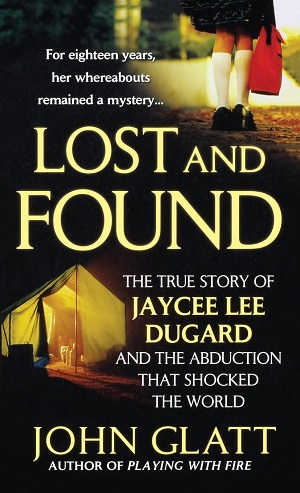
In 1991 11-year-old Jaycee Lee Dugard was grabbed off the street by convicted kidnapper and sex offender Phillip Gorrido and Gorrido’s wife Nancy. Dugard would be kept by Gorrido as a prisoner in a backyard compound he had specially prepared for the next 18 years, during which time she was repeatedly raped and bore two daughters (the first at the age of 14). In 2009 Gorrido, who had become increasingly erratic in his behaviour, was apprehended and Dugard and her two daughters freed.

The book:

I’ve talked before about how a lot of true crime writing takes the form of timely reporting, with instant books trying to cash in on the notoriety of a particular case that has been in the headlines. That was certainly the case here, as the book ends abruptly just before Gorrido’s trial was set to begin (they would both plead guilty, with Phillip receiving a sentence of 431 years to life and Nancy 39 years to life). This is unfortunate, because while John Glatt does a respectable job covering the case, including taking a very full look at Gorrido’s first conviction for kidnapping and rape and interviewing a number of people who knew him during the years he was keeping Dugard a prisoner, you don’t feel like you’re getting the full story, even if what’s missing is what turned into a lot of confusing legal maneuvering. I think it’s still a book worth reading, but you’d be advised to supplement it with further research on the Internet.

You’ll find a lot of information online. This case was huge at the time, though as per usual I think it’s been mostly forgotten today. It was one of three “captivity” cases that made headlines within a few years of each other, the other two being a pair of sensational stories out of Austria: the abduction and imprisonment of Natascha Kampusch (subject of the book Girl in the Cellar), and Josef Fritzl’s house of horrors (subject of another book, also written by Glatt, called Secrets in the Cellar). For her 18 years of hell Dugard received a modicum of fame, a book deal, and a $20 million payout from the State of California (they had been slack in following up on Gorrido’s parole). But I think it’s probably been a blessing to her that the spotlight moved on, as it always does.

Anyway, even for someone steeped in crime writing I find these stories particularly disturbing, and the offenders representative of a particularly unconscionable expression of evil. There’s more to it than just the violence. It’s the demonic inversion of family values, and most notably the abuse and betrayal of a position of authority and trust. But there’s something more to it as well. Serial killers are driven by uncontrollable urges that explode into sexual violence and then go into remission for a while. They are like werewolves: temporarily possessed but the rest of the time able to at least pass as normal. Fiends like Wolfgang Priklopil, Josef Fritzl, and Phillip Gorrido made their evil into a lifestyle. I think that may be why they tend to be such terrible people in all regards. I’ve followed up my hot take on Priklopil with a couple of posts (see here and here) on the foul psychology of the booby or man-baby, enabled by submissive women. There’s a reason these people don’t have any friends. I also noted in my review of Secrets in the Cellar how Fritzl’s wickedness didn’t end with what he did to his daughter:

Not only was he selfish and cruel, he was also cheap: not tipping at the bordellos he frequented, trying to nickel-and-dime the tenants in his apartment building, and even fostering his own children instead of adopting them because it got him a bigger government cheque. Despite this streak of vicious mean-spiritedness he was a lousy businessman and was deep in debt at the time of his arrest. Of course being a miser was far from his worst personal failing, but it just goes to show how some people are bad all the way through.

I was reminded of this as I read Lost and Found. Gorrido was also a mama’s boy, living at home with his aged mother all the time he had Dugard penned in the backyard (like Priklopil, he would first let his captive out only so she could clean the house). Meanwhile, his wife Nancy became a mindless domestic servant who “worshipped” Gorrido and took care of his mom. In short, he was doubly enabled. And like Fritzl his meanness was of a piece. In addition to satisfying himself sexually on Dugard he also used her as slave labour in a print company he started up, and befriended an elderly neighbour who he swindled for thousands of dollars. Gorrido was one of those people you just can’t find any good in, and who the wickedness runs right through.

From being the crazed head of a captive “family,” where does one go? Naturally, to creating one’s own religion and becoming a cult leader. When Gorrido came up with an idea for a black box that would allow the user to listen to angels as well as cure schizophrenia and sex addiction (it was just an amplifier that you could plug headphones into), it’s hard not to think of L. Ron Hubbard’s E-meter machine. But of course the stronger connection to Scientology was that it was just a cynical way of turning religion into cash. Gorrido quickly incorporated his God’s Desire Church and boasted to his brother that it was going to make him rich. And of course there would be the payoff that’s at the core of most cults, something that burns even hotter than the desire to get rich: a fanatic obsession with sex as a weapon of domination and procreation. As Stephen Singular put it in his book on Killer Cults: “a common thread in almost all [cults] is an attempt to control sexual behavior.” What most cult leaders seem to want more than anything is possession of an exclusive harem and the ability to make lots of babies.

Noted in passing:

There’s a reason sex offenders have to be in a registry that’s accessible to the public. That sort of behaviour is in the blood and there’s not much you can do to change it except by the most drastic measures. And while I don’t think it’s right to persecute or stigmatize such people, a red flag is still a red flag. Unfortunately, Gorrido’s home near Antioch, California, affectionately dubbed a “shithole” here by one resident, was a magnet for people with such flags since laws prohibited sex offenders from living near schools, churches, and parks, and his immediate neighbourhood had none of these. As a result there were apparently some 1,700 registered sex offenders living in the county. Gorrido fit right in.

That being the case, I’m actually not as critical of the parole officers in this case as many were. To be sure they could have done a more strict follow-up at various times, but you could probably say that about most of the parolees they were managing. Was Gorrido behaving in a manner that was especially suspicious? In many ways he must have seemed like a successful case of rehabilitation: married, living with his mother, and running a successful small business. I mentioned in my post on Anne E. Schwartz’s Monster that Jeffrey Dahmer’s parole officer didn’t even go to visit him at his apartment because Dahmer lived in a bad part of town. I raised an eyebrow at that, but I wouldn’t be surprised if that was more the norm than an exception.

Takeaways:

Priklopil and Fritzl kept their captives in basement dungeons, expertly concealed. I don’t believe in being a nosey neighbour, and it’s true that Gorrido’s was a bad neighbourhood to begin with, but at some point you have to be suspicious as to why the guy next door is doing putting up eight-foot fences around the back half of his backyard.

True Crime Files

Joseph Conrad’s Heart of Darkness

Joseph Conrad’s Heart of Darkness

I don’t envy Peter Kuper taking on the challenge of adapting Heart of Darkness. It’s one of those classic works that every well-read person knows forward and back. Not only are there a half-dozen famous scenes and dramatic lines that readers will already have their own imaginative reconstruction of, but there’s also Coppola’s Apocalypse Now playing somewhere in the background. Even if Marlon Brando’s plus-sized Colonel Kurtz doesn’t correspond to the emaciated figure in Conrad, I think it likely that most people see Brando when Marlow finally gets to the Inner Station, the end of the line.

Put another way, everyone has their own Heart of Darkness and all you can really ask is that an illustrator not colour outside the lines too much. For example, Kuper takes a couple of what I think are minor items from the text and leans on them pretty heavily. First there’s Marlow’s pipe, which he’s seen handling throughout. There is I think only one reference to Marlow smoking a pipe in the Conrad’s book, and that comes in one of the moments that takes us back outside of the main narrative. At the beginning of the story he doesn’t have a pipe because both his hands are described as placed palms outward like an idol. The other image is that of crocodiles in the jungle. I believe Conrad mentions alligators (which must be wrong) only once. In any event, I didn’t think of them as having as big a presence as they do here.

There was only one point though that I strongly disagreed with. This is Kuper’s rendering of the ship shelling the coast. I think Conrad makes it clear that the shelling, like the fusillade of gunfire that the pilgrims launch into the riverside jungle later, is totally useless. The jungle is like a giant green sponge that absorbs cannon- and gunfire without being affected in any visible way. But Kuper includes a panel from the native point of view that has Africans in the jungle running away from the cannon shells. This made no sense at all to me.

The visual motif that stood out the most was that of the spiral. This is the way the sun is presented throughout, and it’s also used for people’s eyes to show madness (as with the doctor who examines Marlow before his setting out, and for Kurtz at the end). It’s also the spiral snake that is the Congo River, and so gives the impression of a vortex that’s swallowing Marlow just as it’s already consumed Kurtz. My favourite motif though was the way the jungle is presented as a tapestry of foliage of faces and figures. This wallpaper effect works especially well because there’s no sharp distinction between blacks and whites but only shades of grey, giving the forest an urban-camouflage effect.

But overall I have to say I felt a lack of punch to the proceedings. Giving “The horror! The horror!” two double-page spreads seemed like Kuper was trying too hard to make up for something he really wasn’t feeling. But then, as Marlow insists, Kurtz is a voice, and how can any narrator, or artist, render that?

So it’s a responsible adaptation, but I came away thinking Kuper wasn’t a great fit for this material, as he was for his Kafka adaptations. It seems to me that Heart of Darkness needs something like that fantastic, psychedelic note of expressionism that Coppola and cinematographer Vittorio Storaro brought to it. Conrad’s prose can be maddeningly vague and ambiguous, but (and at the same time) it can also be precise, emotionally fraught, lurid, and bombastic. I wouldn’t call Kuper’s approach conservative here, but there’s something in Conrad he wasn’t reaching.

Graphicalex

Catholic tastes

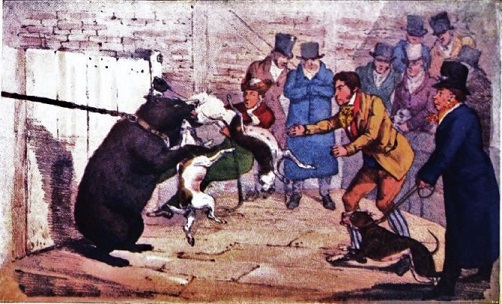
At one point in his biography of William Shakespeare, Anthony Burgess goes on a bit of a digression on the subject of bear-baiting:

In its classic form, a bear was put in a ring, sometimes tethered to a stake, and set upon by mastiffs; but bears were expensive investments, so other animals (such as bulls and horses) were commonly substituted. One variation was to put a chimpanzee on the back of a horse and let the dogs go for both together. The sight of a screeching ape clinging for dear life to a bucking horse while dogs lept at it from below was considered about as rich an amusement as public life could offer. That an audience that could be moved to tears one day by a performance of Doctor Faustus could return the next to the same space and be just as entertained by the frantic deaths of helpless animals may say as much about the age as any single statement could.

I don’t know why anyone should find this surprising. Sensational, exploitative, and cruel forms of entertainment have always been popular, and not just among the unwashed masses. Why should people who enjoy Renaissance drama not be as fond of sex and violence as anyone else? And how pure was Renaissance drama anyway? Titus Andronicus is pretty rough.

And it’s not just audiences that are like this. Lots of great artists have been individuals of low morals and lower taste. Personally I don’t think I would have ever gone to see gladiators, bear-baitings, witch burnings, or public executions back in the day, but I do like to watch stuff that a lot of people (and I wouldn’t always disagree) would consider to be crap that’s both offensive and immoral. I think Burgess probably did too. I also, like Burgess, enjoy reading Shakespeare. I don’t think that tells us anything about our current age so much as it’s a comment on human nature.

TCF: Pizza Bomber

Pizza Bomber: The Untold Story of America’s Most Shocking Bank Robbery
By Jerry Clark and Ed Palattella

The crime:

On August 28, 2003 a pizza delivery man named Brian Wells robbed a bank in Erie, Pennsylvania with a bomb locked to a collar around his neck. He was almost immediately apprehended by the police and the bomb detonated while he was in custody, killing him instantly. After years of investigation a rough outline of the robbery plot was pieced together, principally involving a mentally ill woman named Marjorie Diehl-Armstrong, a superficially genial but disturbed handyman named Bill Rothstein, and a couple of junky lowlifes named Barnes and Stockton. Diehl-Armstrong was the only one who would go to trial for the crime, as Rothstein died of cancer before he could be charged with anything, Barnes pled guilty for a reduced sentence, and Stockton was granted immunity for testifying against Diehl-Armstrong. Barnes and Diehl-Armstrong both died in prison.

The book:

I’d forgotten all about the Pizza Bomber case. At the time it was headline news, receiving national (and some international) coverage and having seven episodes devoted to it on America’s Most Wanted. But the churn of new and shocking crimes is endless and it took reading this book, which was published in 2012, to bring the story back to me. I then went and watched the four-part Netflix documentary Evil Genius that came out in 2018, which brought the story up to date. But more on that in just a bit.

Both authors were involved in the case – Jerry Clark being the lead FBI agent in charge of the investigation and Ed Palattella covering the story for the Erie Times-News – and there’s a bit of a joke near the end of the book where the lawyer for one of the conspirators tells Clark that his client is looking for a book or movie deal. “Get in line,” Clark tells him. “Everyone who’s touched this wants that.”

Indeed, and it was a “line” that Clark himself was near the front of.

The reason there was such a line is that the story is true crime gold. All of the essential elements are here: a cast of eccentric characters, a strange and sensational crime, and a mystery remaining at the end as to what exactly was going on. As the judge at Diehl-Armstrong’s trial put it, “This case represents the unfortunate combination of the incredibly bizarre and the sadly tragic.”

The biggest question has to do with how much Brian Wells knew about the plot in advance. Was he a total innocent, grabbed nearly at random, or was he a semi-willing co-conspirator in the bank robbery? Did he know the bomb around his neck was real? Law enforcement at the time felt that he was involved in the plot to some degree, and they had grounds for thinking so. One witness put him together with Rothstein the day before the robbery, and his behaviour leading up to his death was very strange. On the other hand, in the Evil Genius documentary a prostitute Wells associated with confesses that she basically set him up as the stooge (this is, by the way, perhaps the bit of information that Clark thought she was holding back at the end of the book). Is she a credible witness? No. Is she more credible than the other participants in the scheme? Yes.

It seems unlikely we’ll ever know what was going on now. But the question of Wells’ involvement underlines a bigger mystery relating to the case: Just how smart were these guys?

Clark and Palattella go out of their way to make the argument that Diehl-Armstrong, Rothstein, and even Wells were smarter than average. Perhaps. Wells, however, was a middle-aged man delivering pizzas and using prostitutes. Diehl-Armstrong and Rothstein both came from privileged backgrounds and were recognized as intelligent, but they had both bottomed out: living in hovels, with no jobs and not only associating with criminals but being engaged in various criminal activities themselves. That they considered themselves to be intellectuals and the smartest people in whatever room they happened to be in is pretty strong evidence of the contrary. Being smart is not something that really smart people brag about.

They might have been “fractured intellectuals,” to use the term Rothstein adopted for one of his clubs. Diehl-Armstrong in particular was mentally ill. But it’s probably as accurate, and more to the point, to just describe them as bitter losers, experiencing the full measure of downward mobility with the next stop being homelessness and a potter’s field. As Clark and Palattella observe, “their avarice fit with their obsession to hang on to the past, to the prosperity their families once enjoyed.” The robbery they planned made no sense whatsoever except as a way of lashing out at forces they felt had conspired against them.

So, intelligent? I guess it depends on how you define intelligence. Clark and Palattella mention IQs on occasion, but I don’t think that means much. Criminal masterminds? Hardly. In my notes on Julie K. Brown’s Perversion of Justice I brought up the subject of criminal intelligence, but I don’t think even by those loose standards anyone here qualifies. “For people who were supposed to be brilliant,” the authors write, “Diehl-Armstrong and Rothstein did a lot of stupid things.” Perhaps the best assessment came from Diehl-Armstrong herself, describing Rothstein: “as very stupid but very, very intelligent and dangerous.” A good example is the collar bomb itself, considered by one of the agents as “the most sophisticated improvised explosive device (IED) he had ever seen.” Despite all its cleverness though, it was also a Rube Goldberg doohickey that only half worked as it was supposed to. Or was it supposed to work at all?

I do have to credit the gang with one very notable accomplishment though. The hardest part in any conspiracy is getting everyone involved to keep a secret. This never works out. So how did this gang of broken and burned-out cases manage to maintain so much solidarity in silence? Even Brian Wells, wearing the collar, played his part until the end, making up some story about being shanghaied by a bunch of Black guys.

I guess fear was the main motivator. In the documentary, Diehl-Armstrong says all the co-conspirators were afraid of the death penalty and so watched each other’s backs. They may also have been afraid of each other, and Diehl-Armstrong in particular. She’d already killed a couple of partners. In Evil Geniuses it’s suggested that Rothstein was still carrying a torch for Diehl-Armstrong, but since he’d already dropped the dime on her for Roden’s murder I have trouble squaring that.

Still, it’s impressive that there was so much solidarity. Even after copping pleas, Barnes and Stockton clearly didn’t want to rat their partners-in-crime out.

So there you have it: violence, weirdos, and mystery. True crime in its purest form.

Noted in passing:

There are often moments when you’re reading the description of some action in a book that you have to stop and wonder just what’s happening because it’s so hard to visualize. For example, in the authors’ brief recounting of the stormy relationship between Diehl-Armstrong and then-boyfriend Jim Roden (she ended up killing him and stuffing his body in Rothstein’s freezer) this little nugget is served up: “Violence plagued their relationship for a decade. He cut her thigh by pushing her into a broken glass panel of a stove door in July 1994.”

Now just how did this work? Stove doors are usually pretty low to the ground and Diehl-Armstrong was a very tall woman. How would he push her thigh into a stove door? Or was the glass panel completely detached from the stove door and located somewhere else?

Takeaways:

Dead men tell no tales. But dying men can be liars even on their death bed. Clark and Palattella talk about the admissibility of “dying declarations” as evidence (they are considered an exception to the rule against hearsay) because the circumstances under which they are made support their credibility. But Bill Rothstein repeatedly lied that he’d had no involvement in Wells’ killing, even just hours before his death. Does it make sense to believe that someone’s character is going to change in their final days, or even minutes? Thinking like that seems to belong in a time when there was widespread belief in deathbed conversions and sneaking into heaven by a whisker. I don’t think it applies very much today.

True Crime Files

Swamp Thing: The Bronze Age Volume One

Swamp Thing: The Bronze Age Volume One

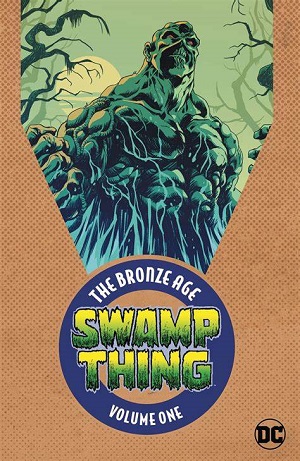
The roots of Swamp Thing, to make use of an appropriate metaphor, are in horror comics. This first Bronze Age collection actually gives us two origin stories though, with the creature’s first slightly hang-dog appearance in the DC horror/dark fantasy/mystery comic House of Secrets and then the reworked version when he was given his own series a little over a year later.

But even after rebranding as a superhero, the world he inhabited would continue to be that of genre horror. After the first issue of the regular series he’s immediately whisked away to a castle with “Caligarian corridors” that’s located in Transylvania (or Universal’s backlot, or somewhere thereabouts) where he meets the mad scientist Arcane, his Plasticine creations the Un-Men, and a Frankenstein’s monster called the Patchwork Man. Then it’s off to the Scottish moors and a date with a werewolf. Still to come are a killer robot, an alien, and even a Lovecraftian Ancient One called M’Nagalah. Somehow they skipped vampires.

That probably sounds terribly derivative, and it is, but I thought the stories were all pretty interesting, and Len Wein isn’t averse to lathering up some of that purple comic-book prose to paint a scene with. Get a load of this scene setting: “The darkness cries – a long mournful wail that writhes through the gnarled cypress branches like a breath of Hades’ wing, skipping over the placid surface of the stagnant mire below . . .” And Bernie Wrightson’s art also has a feel for the grotesque that sets the right note.

The Swamp Thing himself makes a great hero. At least he’s always been a favourite of mine. Blown up in a lab experiment, the Nobel Prize-winning scientist Alec Holland runs into the swamp, where his bio-restorative formula brings him back to life as an anthropomorphic moss-man, 89 inches tall and 547 pounds – “apparently all muscle!” Bullets don’t have any effect on him and if a limb gets sliced off it grows back in no time. I liked the idea of him not being able to communicate and so being mistaken as the monster that killed Alec Holland who then gets hunted by the series Ahab, Matt Cable, even though this later gets tossed away.

As for the wild, globe-hopping adventures, I don’t think sales were very strong and they may have just been trying to find something that would stick. There’s even a Batman cameo thrown in with one of the less fanciful episodes. You’ve always gotta work the crossovers.

In sum it’s a crazy and colourful mix of the surreal with a whack of different genre tropes, from horror to SF to dark fantasy to your standard superhero fare. You can see why so many different creators have been drawn to such a protean figure over the years, without ever being able to pin him down.

Graphicalex

Graphicalex

Graphicalex: Adventures in the Illustrated Zone

Here’s an index of my brief reviews of comic books and graphic novels that I’ve been reading.

A

Afterlife with Archie: Escape from Riverdale
Alien: Black, White & Blood
Alien: Bloodlines
Alien: Descendant
Alien: Icarus
Alien: The Illustrated Story
Alien: Revival
Alien: Thaw
Aliens: Dead Orbit
Aliens: Dust to Dust
Aliens: The Original Years
Aliens: The Original Years Volume 2
Aliens: What if . . . ?
All-New X-Men: Here to Stay
All-New X-Men: Out of Their Depth
All-New X-Men: Yesterday’s X-Men
Amazing Fantasy Omnibus
Ant-Man/Giant-Man: The Man in the Ant Hill
Apocalypse Nerd
The Approach
Archie Horror Presents Chilling Adventures
Archie vs. Predator
Asterix the Gaul
Asterix and the Golden Sickle
Asterix and the Goths
The Avengers: Earth’s Mightiest Heroes
The Avengers: Four
Avengers: Revelations

B

Bartman: The Best of the Best
Batman Arkham: Hugo Strange
Batman Beyond: 10,000 Clowns
Batman: Cacophony
Batman: Damned
Batman: The Detective
Batman: His Greatest Adventures
Batman: Justice Buster Vol. 1
Batman: Justice Buster Vol. 2
Batman: Justice Buster Vol. 3
Batman: Reptilian
Batman R.I.P.
Batman/The Shadow: The Murder Geniuses
Batman: Year 100
Batwoman: Volume 1 Hydrology
Beowulf
Big Trouble in Little China (Legacy Edition Book One)
Big Trouble in Little China (Legacy Edition Book Two)
Birches
Bleedout
Bone: Out from Boneville
Bone Parish: Volume One
Bone Parish: Volume Two
Bone Parish: Volume Three
Brave New World
BRZRKR: Volume One
BRZRKR: Volume Two
BRZRKR: Volume Three

C

Captain America/Black Panther: Flags of Our Fathers
Cemetery Beach
Chew Volume One: Taster’s Choice
Chew Volume Two: International Flavor
Chew Volume Three: Just Desserts
Chew Volume Four: Flambé
Chew Volume Five: Major League Chew
Chilling Adventures of Sabrina: The Crucible
Classics Illustrated: The Murders in the Rue Morgue and Other Tales by Edgar Allan Poe
Cla$$war
Clive Barker’s Hellraiser: Pursuit of the Flesh
Contagion
Crime and Punishment

D

Daredevil: Chinatown
Daredevil: Dark Art
Daredevil: Identity
Daredevil: Know Fear
Daredevil: Supersonic
DCeased
Demon Slayer Volume 1: Cruelty
Demon Slayer Volume 2: It Was You
Do Androids Dream of Electric Sheep? Volume 1
Doctor Strange Omnibus Volume 1
Doctor Strange: A Separate Reality
Doctor Strange: Strange Origin
Druuna: Carnivora
Druuna: Creatura
Druuna: Morbus Gravis I
Druuna: Morbus Gravis II

E

1872
The Emperor’s New Clothes
The Empty Man
The Empty Man: Manifestation
The Empty Man: Recurrence

F

Fighting MAD
5 Days to Die
Foul Play!

G

Garbage Man
Gideon Falls Volume 1: The Black Barn
Gideon Falls Volume 2: Original Sins
Gideon Falls Volume 3: Stations of the Cross
Gideon Falls Volume 4: The Pentoculus
Gideon Falls Volume 5: Wicked Worlds
Gideon Falls Volume 6: The End
Godzilla: Complete Rulers of Earth
Gotham City Monsters
Grass Kings: Volume One
Grass Kings: Volume Two
Grass Kings: Volume Three
Green Lantern Corps Volume 1: Fearsome
Green Lantern Corps Volume 2: Alpha War
Green Lanterns Volume 1: Rage Planet

H

Hailstone
The Haunt of Fear Volume 1
The Highwayman
The Hound of the Baskervilles
The Hound of the Baskervilles (pop-up book)

I

The Immortal Hulk Volume 1: Or is He Both?
The Immortal Hulk Volume 2: The Green Door
The Immortal Hulk Volume 3: Hulk in Hell
The Immortal Hulk Volume 4: Abomination
The Immortal Hulk Volume 5: Breaker of Worlds
The Immortal Hulk Volume 6: We Believe in Bruce Banner
The Immortal Hulk Volume 7: Hulk is Hulk
Indestructible Hulk: Agent of S.H.I.E.L.D.

J

Joseph Conrad’s Heart of Darkness
Jughead: The Hunger Volume One

K

Kill or Be Killed: Volume One
Kill or Be Killed: Volume Two
Kill or Be Killed: Volume Three
Kill or Be Killed: Volume Four
Kill Shakespeare: A Sea of Troubles
The King in Yellow

L

Lady Killer Volume 1
Lady Killer Volume 2
The Lady of Shalott
The Last Days of American Crime

M

MAD’s Al Jaffee Spews out More Snappy Answers to Stupid Questions
MAD Book of Almost Superheroes
The MAD Book of Mysteries
Malignant Man
The Mammoth Book of Best Crime Comics
Man-Bat
Marvel Comics: Timeless Tales
Marvel Zombies Volume 1
Marvel Zombies 2
Marvel Zombies 3
The Metamorphosis
Mighty Marvel Masterworks: The Avengers Volume 4
Mighty Marvel Masterworks: The Black Panther Volume 1
Mighty Marvel Masterworks: Daredevil Volume 1
Mighty Marvel Masterworks: Daredevil Volume 2
Mighty Marvel Masterworks: Daredevil Volume 3
Mighty Marvel Masterworks: The X-Men Volume 1
Monster & Madman

N

1984

O

The Object-Lesson
Old Man Logan
Old Man Logan: Warzones
Old Man Logan 1: Berserker
Old Man Logan 2: Bordertown
Old Man Logan 3: The Last Ronin
Old Man Logan 4: Old Monsters
Old Man Logan: Past Lives
The Owl and the Pussycat

P

Phoenix
The Pitiful Human-Lizard: Far from Legendary
Plants vs. Zombies: Zomnibus Volume 1
Plunge

Q

R

The Raven
The Raven (pop-up book)
Ravencroft
The Return of a MAD Look at Old Movies
Road of the Dead: Highway to Hell
Ruins of Ravencroft

S

Saga of the Swamp Thing Book One
Saga of the Swamp Thing Book Two
Saga of the Swamp Thing Book Three
Saga of the Swamp Thing Book Four
Saga of the Swamp Thing Book Five
Saga of the Swamp Thing Book Six
Scooby Apocalypse Volume 1
Scooby Apocalypse Volume 2
Shaft: Imitation of Life
Sherlock Holmes: The Final Problem
Simpsons Comics Colossal Compendium: Volume One
Simpsons Comics Colossal Compendium: Volume Two
Simpsons Comics Colossal Compendium: Volume Three
Simpsons Comics Colossal Compendium: Volume Four
Simpsons Comics Unchained
The Simpsons Treehouse of Horror: Hoodoo Voodoo Brouhaha
Solo: The Deluxe Edition
The Superior Spider-Man: Goblin Nation
Superior Spider-Man Team-Up: Superior Six
Superior Spider-Man Team-Up: Versus
Swamp Thing: The Bronze Age Volume One
Swamp Thing: The Bronze Age Volume 2
Swamp Thing: The Bronze Age Volume 3
Swamp Thing: Protector of the Green
Swamp Thing: Volume One
Swinging MAD

T

Tag
Talent
Tales from the Crypt Volume 1
Thor: First Thunder
300
Titans: The Lazarus Contract
Titans Vol. 1: The Return of Wally West
Titans Vol. 2: Made in Manhattan
Titans Vol. 3: A Judas Among Us
Token MAD
Torso
Trashed

U

The Uncanny X-Men: Red Wave
Underworld Unleashed: The 25th Anniversary Edition
Utterly MAD

V

The Vault
The Vault of Horror Volume 1
Velvet Volume 1: Before the Living End
Velvet Volume 2: The Secret Lives of Dead Men

W

X

Xerxes: The Fall of the House of Darius and the Rise of Alexander

Y

Z

The Zombie Night Before Christmas
Zomnibus