DNF files: Wild Massive

Wild Massive

By Scotto Moore

Page I bailed on: 62

Verdict: I actually started out getting into this. I liked the idea of Carissa zipping between the infinite floors of the Building in her elevator, and when a stranger came knocking he (or ze, as ze is a shapeshifter with no gender) was nicely introduced.

But then the next few chapters had me feeling like I was drowning in pages and pages of backstory and exposition that I gave up any hope of keeping straight. This overload was something I didn’t like in Moore’s previous book, Battle of the Linguist Mages, and I felt like there was going to be even more of it here. Add in other annoyances like the messy mix of science, theoretical physics, and magic and the heavy use of trendy gender pronouns that nobody is likely to recognize ten years from now and it wasn’t long before I just couldn’t take any more. I don’t like magic in my SF, and I don’t want to sound anti-trans or anti-woke but it’s hard reading sentence like this:

Ze had been nude when ze first dropped into the elevator, but now ze seemed to be constructing clothing for zirself, style yet to be determined, zir skin rippling this way and that.

The DNF files

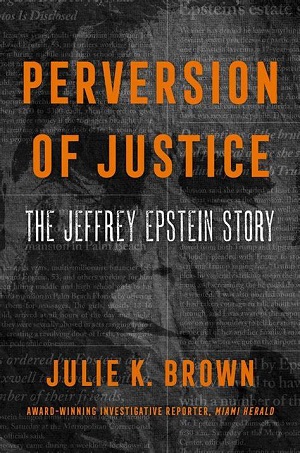
TCF: Perversion of Justice

Perversion of Justice: The Jeffrey Epstein Story
By Julie K. Brown

The crime:

A full accounting of the crimes of Jeffrey Epstein will probably never be made, both because he’s dead now and because any accomplices (of which there must have been many) will want to keep the details hidden. At the very least he was involved for many years in underage sex trafficking and sexual assault. He died in prison, under mysterious circumstances, in 2019 while awaiting trial.

The book:

True crime has a cathartic function, in the Aristotelian sense of a purging of the emotions of pity and fear. But a book like Perversion of Justice aroused another feeling in me: anger. I got so angry reading it that it was hard to finish. What Julie K. Brown, the reporter for the Miami Herald who broke the story (or re-broke, by not letting it slip away), chronicles is an outrage to any understanding of justice or decency. Much of what was going on remains hidden by people intent on covering their own asses, but enough corruption has now been revealed to make you sick.

Even basic questions like how rich Epstein actually was and what he did to get so rich remains a mystery. How did he make his money? As his extensive Wikipedia entry puts it: “The exact origin of Epstein’s wealth is unknown.” Apparently he was a kind of money manager, but it’s not clear what this entailed, how good he was at it, or whether what he did was all legal. Some of it at least was very shady.

What really seemed to be going on was that he operated as a kind of parasite on the very rich. As one early observer remarked: “He was very smart and he knew how to woo people, how to schmooze. He’s personable and makes good company.” Not the sort of skill that one would have thought paid so well, but rich people are as susceptible to flattery and being manipulated as anyone else. A lot of them just gave Epstein their money. And I don’t mean gave it to him to manage, but just . . . gave it to him. Of course, to outsiders this made no sense. “I tried to find out how did [Epstein] get from a high school math teacher to a private investment adviser,” one unimpressed businessman remarks, “There was just nothing there.” Was there something suspicious then in his attachments to rich and powerful men, especially given all that later came out? Indeed there was, but all we can do is speculate now.

Epstein himself was a creepy guy who did nothing to conceal his perversions, which is another thing that makes you question why people would associate with him. An arrogant social climber, his hyperactive sex drive makes one wonder when he could have done any real work, had this ever been his ambition. Brown reports that girls were being brought to him “morning, noon, and night” and he was having sex “three or four times a day.” Which may sound nice to some, but really isn’t healthy.

But massages (which is how things usually got started, if they weren’t just a euphemism) were only a perk. The very rich, and even the semi-rich, have two abiding anxieties that always have to be addressed. In the first place, they have to feel secure in their lives of affluence and privilege. Private islands and offshore accounts can help with this. You certainly don’t want the government getting their dirty hands on your stash. Second, their wealth has to be justified in some way. This is mainly the work of staffers and a pliant press. Epstein knew the game here very well, presenting himself as a sort of intellectual philanthropist, despite having little claim to either title. Particularly nauseating were his forums on how to save the world from such challenges as climate change, which involved jetting celebs to the private Caribbean island that he’d had bulldozed in order to build his pedo playpen, paying off fines or donating to charity to get around environmental regulations.

In short, Epstein was a phoney. But isn’t great wealth always a bit of a fraud? Thinking about Epstein’s rise to a position of such wealth and status reminded me of how completely the myth of a meritocracy has been exploded in our own day. This is a subject I’ve written about in recent book reviews, most notably of Christopher Hayes’s Twilight of the Elites and Michael Sandel’s The Tyranny of Merit. But it goes back to such cases as the collapse of Enron (see my review of Power Failure: The Inside Story of the Collapse of Enron by Mimi Swartz and Sherron Watkins). Were the corporate heads of Enron The Smartest Guys in the Room? Only at being frauds. Which, granted, does require a certain kind of intelligence. But Team Enron were heralded as financial geniuses!

The belief that rich people have to be smart is hard to kill (though I’ve tried). That the emperor has no clothes is, I think, the defining fable of our time. But who was going to point out Epstein’s nakedness? Wealth provides a high degree of insulation, both from the media and the police. Epstein even bragged of owning the police, and it was not an empty boast, while Brown’s book shows how much of an effort it was just to bring Epstein’s case back into the public eye of the mainstream media.

“I didn’t really, at the time, believe that any media network would have succumbed to pressure to ignore or drop such an important story,” Brown confesses at one point. “I was, however, naïve and wrong.” It’s because of all the hard work she did, and the risks she took, that I cut Brown some slack for injecting so much of herself into the narrative. There’s a lot of me-journalism here, with most of it irrelevant to Epstein’s story. The way newsrooms were being squeezed in the twenty-first century is an important point worth addressing, but do we really need to know about Brown’s dating life with her Mr. Big? Or her kids getting into college? None of this adds anything to the book, even in just telling us where Brown is coming from as a reporter.

A final way that the Epstein case was emblematic of the times we live in was how it fit with the explosion of interest in pedophile sex rings. I’ve also written about this before, and it really is a cultural curiosity. Of course it would fully flower around the same time in the base mythology of the QAnon movement, but I can’t explain its roots given that Epstein is probably the closest reality has come to the kinds of stories that were so big in contemporary novels and TV shows. But Epstein’s crimes weren’t as lurid: he didn’t kill anyone (that we know of), and it’s hard to say if he was only part of a larger ring of rich and well-connected predators. Were his pals just casual acquaintances? Marks? Co-conspirators? Guilt by association went a long way with Epstein.

Even if his posse weren’t all onboard the Lolita Express (the name soon given Epstein’s private jet), the fact remains that Epstein had no shortage of powerful enablers. The most grating of these being in the criminal system and legal profession. Of course, the excuse made by criminal defence lawyers who have clients like Epstein is well rehearsed. Even if lawyers know their clients are guilty of terrible crimes an accused still has the right to a full and fair defence in a legal system that rightly puts the burden of proof on the state. The problem in this case was that Epstein had, at least in practical terms, greater resources than the state prosecuting him, and he used those resources to run a defence that while not breaking any formal rules involved the wholesale corruption of the system of justice: hiring friends of the prosecutors, essentially bribing others, attacking witnesses and complainants even before the case came to court or tampering with them in other ways. This is the sort of behaviour that I should have thought lawyers would have been bothered by or even refused to be involved in. I’m not sure if any of them demurred in the slightest.

Noted in passing:

Epstein was Jewish, which for some reason means he has to be linked to the Holocaust. But really, why? His grandparents on both sides were Eastern European Jews who emigrated to the U.S. around 1900. Some forty years later, as Brown reports, many of his maternal grandparents’ extended family were executed by the Germans. This seems a tenuous connection to me, and it’s never said what effect this might have had on Jeffrey. In A Convenient Death: The Mysterious Demise of Jeffrey Epstein the authors go further, describing Epstein’s parents as among “the lucky few from their respective families who had not perished in the Holocaust.” But both of Epstein’s parents were natives of Brooklyn, his father and mother born in 1916 and 1918 respectively. Of what significance is it to Epstein’s story to make them into Holocaust survivors?

Takeaways:

“This is not unique to one party over another. The divide is not Republican versus Democrat; it’s the rich and powerful versus everyone else.”

True Crime Files

Maigret: Maigret and Monsieur Charles

As the annoying sticker on the cover of this one says, Maigret and Monsieur Charles is “the last Maigret novel.” Which made for a tidy 75. A good number to go out on, but I don’t know if Simenon knew it was going to be the last. He’d only announce his retirement from writing (fiction) a year later and at this point he might have just been feeling burnt out.

It doesn’t read like any kind of farewell. Sure, Maigret is closing in on retirement, but he’d been thinking about that forty years earlier. He’s basically one of those iconic fictional characters who exist in a time warp where they’re always the same age while the world around them changes, like Archie’s gang or the family on The Simpsons.

Things get started with a discussion about kicking the detective chief inspector upstairs so that he can become head of the Police Judiciaire, but our hero doesn’t want to go that route and nothing more is said of it after the opening chapter. So instead of feeling like the final novel in the series it just seems like another day at the office, and not a particularly interesting one either.

Madam Sabin-Levesque shows up at Maigret’s office to report that her husband has been missing for over a month. As Maigret soon learns, it was an unhappy marriage, with Madam being an alcoholic and Monsieur, a successful lawyer gadding about Paris with a series of “hostesses” under the assumed name of Monsieur Charles. The usual tell-tale sign of a married couple sleeping in separate bedrooms is here taken to an extreme. “On this side of the main drawing room, you are in my half of the apartment,” Madam Sabin-Levesque explains as she gives Maigret a tour. “The other side is my husband’s territory.” That’s bad.

It’s also a dead giveaway, and the fact that there’s really only one suspect in play, and that the explanation for how everything went down is just thrown at us in the final few pages, makes this a pretty limp effort. It’s the usual peek behind closed doors at family dysfunction in the “outmoded, inward-looking world” of Parisian affluence, with a perp who is more pathetic than villainous. And once again Maigret is left wondering what the point is. I suppose Simenon was wondering too.

Maigret index

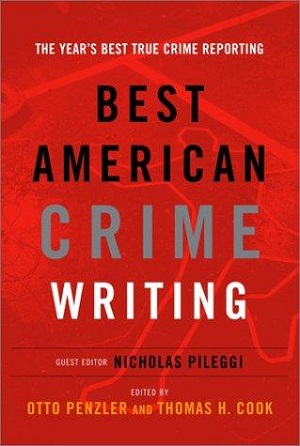
TCF: Best American Crime Writing

Best American Crime Writing
Guest editor Nicholas Pileggi

The crimes:

“The Cheerleaders” by E. Jean Carroll: the tragic lives of cheerleaders at a high school in Upstate New York.

“Our Man in Mexico” by Charles Bowden: a DEA agent working on the Mexican border gets dirty. It comes with the job.

“Should Johnny Paul Penry Die?” by Alex Prud’homme:  a brutal rapist and murderer with a mental disability sits on death row.

“The Outcast” by Pat Jordan: hanging out with O. J. Simpson in Florida.

“Fatal Bondage” by David McClintick: J. R. Robinson escalates from a life of fraud to kinky sex and serial killing.

“Flesh and Blood” by Peter Richmond: ex-NFL player Rae Carruth puts a hit out on his pregnant girlfriend.

“A Prayer for Tina Marie” by Robert Draper: a young woman with lots of personal issues kills her two small children by throwing them off a cliff.

“Bad Cops” by Peter J. Boyer: the L.A.P.D.’s Rampart scandal (bad cops involved with drugs and murder).

“The Chicken Warriors” by Mark Singer: a look into Oklahoma’s cockfighting subculture.

“The Crash of Egyptair 990” by William Langewiesche: a depressed pilot crashes the plane he’s flying, killing everyone on board. Under political pressure, Egyptian authorities don’t accept that narrative.

“Judgment Day” by Doug Most: a man who killed a convenience store clerk twenty-five years earlier faces his parole board.

“The Killing of Alydar” by Skip Hollandsworth: a famed racehorse breaks its leg in what was probably not an accident and then has to be put down.

“The Chicago Crime Commission” by Robert Kurson: an ex-cop now working for the Chicago Crime Commission is still committed to taking down the Outfit, which in the twenty-first century is seen by many as a quixotic quest.

“Under Suspicion” by Atul Gawande: thoughts on delivering better justice through science.

“X Files” by Julian Rubinstein: an Israeli-American TV salesman becomes a high-profile ecstasy dealer but his gangsta life implodes.

“The Day of the Attack” by Nancy Gibbs: an on-the-ground account of the 9/11 terrorist attacks.

“Anatomy of a Jury” by D. Graham Burnett: a university prof serves on the jury of a murder trial in New York City.
The book:

I was sorry to see this series canceled. This was the first volume (2002), and it was still called Best American Crime Writing. In 2007 it would change its title to Best American Crime Reporting. I’m not sure, but I think 2010 was their last year. When I went to look it up, I couldn’t find any mention of it on the Best American Series Wikipedia page, even under titles “formerly included in the series.” It’s like they hadn’t just canceled the series but tossed it down a memory hole.

That’s too bad, as it was an excellent annual anthology. There was always a good mix of stuff from top-shelf publications like The New Yorker, The Atlantic, and GQ as well as less well-known regional outlets. The different sorts of crime, and perspectives on them, were also enjoyable, even if some stories seemed to go outside the series’ remit. In this book, for example, there’s a story on cockfighting but cockfighting, however disreputable, isn’t a crime, or at least wasn’t in Oklahoma at the time.

Because these are examples of crime reporting they are very much of the moment, which led me to go to the Internet to find out how some of them turned out. For example, in 2008 Penry reached an agreement where he is now serving three consecutive life sentences and is off death row. Subsequent U. S. Supreme Court jurisprudence has held that executing individuals with intellectual disabilities is unconstitutional, but the question of defining intellectual disability and whether a person is eligible for the death penalty remains the tricky part.

Some of the stories I didn’t care for. The 9/11 piece by Nancy Gibbs felt slapdash and overly dramatic, but apparently it was written in a day or two on a tight deadline after the attack. Something about Burnett’s account of jury duty sounded familiar and when I checked (I had to check) I found I’d reviewed his book-length treatment of the same material over twenty years ago. I called it “pretentious, self-dramatized nonsense” then, and reading over my review I’m inclined to agree with my younger self. With the benefit of hindsight, it also stands as an early example of the genre of true-crime memoir that I’ve since come to despise so I’d probably be even harsher on it today. But that’s a judgement I won’t be putting to the test as reading the story sure didn’t want me to go back and take another look.

For a collection like this it’s hard to point to much in the way of connecting threads. At least among the early stories though I did find the recurring theme of bad fathers to be interesting. In the O. J. Simpson story the refrain that he’s a family man becomes a sort of punchline delivered by his lawyer at regular intervals. When J. R.  Robinson was released on parole in 1991 (he’d been convicted of a series of frauds) his supervising psychiatrist described him as “a devoted family man who has taught his children a strong value system.” That wasn’t meant as a joke, but it registers as bitter irony. Tina Marie may have been sexually abused by her stepfather, and is, at least on some level, described as searching for a father for her young children before giving up on the quest, and them. And Rae Carruth is the ultimate bad dad, thinking nothing of having his latest baby mommy murdered. I’m sure being a father isn’t always easy, but these are all examples of epic fails. And bad parenting is really what gets a lot of things rolling downhill.

It’s a first-rate collection, and as I said at the top I’m sad the series didn’t stick. With most news media, “if it bleeds, it leads” is still a good rule of thumb that especially holds true in cases of crime writing/reporting. Maybe what this series needed was more violence. Honestly, I don’t understand why it wasn’t more successful. Perhaps the writing, which only on a couple of occasions strays into “literary” territory, was a little too polished and highbrow. When targeting a genre audience it’s important to know your market.

Noted in passing:

In 1993 Robinson moved into a mobile home development in Missouri named Southfork after the family ranch on the TV show Dallas, which had ended its run a couple of years earlier. The streets were all named after characters on the show: Sue Ellen Avenue, Cliff Barnes Lane, etc. I thought this was so bizarre I went online to see if it still existed. I’m not sure if it does, but there are apparently other such communities in other states even today. I just can’t imagine.

Everyone, or nearly everyone, who has had the misfortune of actually having to deal with an insurance company (aside from just giving them money) knows how difficult and unpleasant a process it can be. No, they don’t just show up on your doorstep with a cheque to compensate you for your loss. They’d like to, but there’s some fine print that says they can’t. And then there’s the deductible and other issues like if you’re going to replace whatever it is you’ve lost and with what. So whatever money you do get turns out to be a joke.

That is, unless the payout is really, really big. Then they don’t care at all. They’ll just give you a boatload of money, no questions asked. This is the standard operating procedure that at least one insurer pushed back against in Dead in the Water, while others just figured it was easier to give the scuttled ship’s owner whatever he wanted, despite the fishy circumstances. It was also the case in the story here about the racehorse Alydar. Again there was plenty of reason to be suspicious, but the insurer made no attempt to investigate or challenge the initial findings with regard to Alydar’s death and simply paid off the claim.

“It was as if those who made a living off the big horse farms – like the insurance adjusters and the veterinarians – realized it was not in their best interests to rock the boat,” Tomala [the FBI agent who pursued the case] says now. “Why risk losing any future business by asking too many questions?”

This is exactly the line taken by the ship insurance companies. Basically they’re fine with eating huge losses from rich clients but will rarely miss the chance to nail the little guy to the floor. That’s the way the system works. It’s the way it’s designed to work.

Takeaways:

You should probably be suspicious of anyone who presents himself as a devoted family man. Devoted family men are not that common, and they certainly don’t brag about it.

True Crime Files

What every girl wants on her wedding day

From Natasha’s Dance: A Cultural History of Russia by Orlando Figes (2002):

Tolstoy loved to be among the peasants. He derived intense pleasure — emotional, erotic — from their physical presence. The ‘spring-like’ smell of their beards would send him into raptures of delight. He loved to kiss the peasant men. The peasant women he found irresistible — sexually attractive and available to him by his ‘squire’s rights’. Tolstoy’s diaries are filled with details of his conquests of the female serfs on his estate — a diary he presented, according to custom, to his bride Sonya (as Levin does to Kitty [in Anna Karenina]) on the eve of their wedding.*

* Similar diaries were presented to their future wives by Tsar Nicholas II, the novelist Vladimir Nabokov and the poet Vladimir Khodasevich.

Shakespeare on film

This is an index to my Shakespeare notes, on the plays at this site and on movie adaptations over at Alex on Film. I’ll keep updating this page as I go along.

General

Theater of Blood (1973)
The Dresser (1983)
Shakespeare in Love (1998)
Anonymous (2011)
Last Will & Testament (2012)
The Dresser (2015)
All Is True (2018)

The Comedy of Errors

Love’s Labour’s Lost

Henry VI

The Hollow Crown: The Wars of the Roses (2016)

Richard III

Richard III (1911)
Richard III (1912)
Tower of London (1939)
Richard III (1955)
Tower of London (1962)
Richard III (1995)
Looking for Richard (1996)
The Hollow Crown: The Wars of the Roses (2016)

Titus Andronicus

Titus (1999)

The Taming of the Shrew

Kiss Me Kate (1953)
The Taming of the Shrew (1967)
10 Things I Hate About You (1999)
The Taming of the Shrew (2005)

The Two Gentlemen of Verona

Romeo and Juliet

West Side Story (1961)
Romeo and Juliet (1968)
Romeo + Juliet (1996)
Gnomeo and Juliet (2011)
Warm Bodies (2013)

Richard II

Richard II (2012)

A Midsummer Night’s Dream

A Midsummer Night’s Dream (1935)
A Midsummer Night’s Dream (1999)
A Midsummer Night’s Dream (2005)
A Midsummer Night’s Dream (2017)

King John

King John (1899)

The Merchant of Venice

The Merchant of Venice (2004)

1 and 2 Henry IV

Chimes at Midnight (1966)
My Own Private Idaho (1991)
Henry IV, Part One (2012)
Henry IV, Part Two (2012)
H4 (2012)

The Merry Wives of Windsor

Much Ado About Nothing

Much Ado About Nothing (1993)
Much Ado About Nothing (2005)
Much Ado About Nothing (2012)

Henry V

Henry V (1944)
Henry V (1989)
Henry V (2012)

Julius Caesar

Julius Caesar (1908)
Julius Caesar (1953)
Julius Caesar (1970)
Caesar Must Die (2021)

As You Like It

As You Like It (1936)
As You Like It (2006)
As You Like It (2019)

Twelfth Night

Twelfth Night (1910)
Twelfth Night (1988)
Twelfth Night (1996)
She’s the Man (2006)

Hamlet

Hamlet (1910)
Hamlet (1913)
Hamlet (1948)
The Bad Sleep Well (1960)
Hamlet (1964)
Hamlet at Elsinore (1964)
Strange Brew (1983)
Hamlet (1990)
Rosencrantz & Guildenstern are Dead (1990)
The Lion King (1994)
Hamlet (1996)
Hamlet (2000)
Prince of the Himalayas (2006)
Hamlet (2009)
Ophelia (2018)
The Northman (2022)

Troilus and Cressida

All’s Well That Ends Well

Othello

Othello (1922)
A Double Life (1947)
Othello (1951)
Othello (1965)
Othello (1995)
O (2001)

Measure for Measure

Measure for Measure (2006)

King Lear

King Lear (1909)
King Lear (1910)
King Lear (1916)
King Lear (1970)
Ran (1985)
King Lear (1987)
King Lear (2018)

Macbeth

Macbeth (1948)
Joe Macbeth (1955)
Throne of Blood (1957)
Siberian Lady Macbeth (1962)
Macbeth (1971)
Macbeth (1979)
Scotland, Pa (2001)
Macbeth (2005)
Macbeth (2010)
Macbeth (2015)
The Moving Forest (2015)
Lady Macbeth (2016)

Antony and Cleopatra

Timon of Athens

Coriolanus

Coriolanus (2011)

Pericles

Cymbeline

Cymbeline (1913)
Cymbeline (2014)

The Winter’s Tale

The Winter’s Tale (1910)
A Tale of Winter (1992)

The Tempest

Yellow Sky (1948)
Forbidden Planet (1956)
The Tempest (1979)
Prospero’s Books (1991)
The Tempest (2010)

Henry VIII

The Two Noble Kinsmen


TCF: In the Wake of the Butcher

In the Wake of the Butcher: Cleveland’s Torso Murders
By James Jessen Badal

The crime:

A serial killer stalked Cleveland in the 1930s, leaving chunks of his dismembered victims scattered about in different places. He was never captured, and to this day it’s still debated how many people he may have killed, though he’s usually credited with an even dozen.

The book:

In his Introduction to what is still the most comprehensive and authoritative account of the Cleveland killings, James Jessen Badal mentions how he complained to a newspaper staff writer “about the sheer amount of digging sometimes required to nail down relatively minor facts,” and how he “could work for days hunting information that would yield only half a sentence of finished text.” “‘You’re writing a book of record,’ he [the staff writer] remarked casually – his way of reminding me such frustrations went with the territory.”

In the Wake of the Butcher is the kind of book that true crime aficionados really appreciate, being “a book of record” on the famous series of killings that rocked Cleveland in the 1930s. Badal mentions Philip Sugden’s masterful The Complete History of Jack the Ripper as a sort of model, which is aiming high indeed but I don’t think he’s far off. A later, more popular book, American Demon: Eliot Ness and the Hunt for America’s Jack the Ripper by Daniel Stashower, covers a lot of the same ground (while putting more of a focus on Ness), but I still prefer Badal’s work not just as a source but for its quickness and readability.

Of course, being a book of record does involve the odd “just the facts” data dump. For example, this isn’t how you want to set a scene:

Monday, September 23, was a pleasant fall day in Cleveland with a high of 71 degrees. After school at about 5:00 in the afternoon, two young boys – sixteen-year-old James Wagner of 4511 Gallup Avenue and twelve-year-old Peter Kostura of 4465 Douse Avenue – tossed a softball back and forth along the upper edge of Jackass Hill, a sixty-foot slope on the south side of Kingsbury Run where short stretches of both East 49th and East 50th meet the gully.

Thankfully, there isn’t too much of this. Instead, Badal moves things along briskly and the material is well organized around chapters dealing with each of the discovered bodies followed by a round-up of the possible suspects.

There’s no denying it’s a puzzling case. There was an abundance of evidence, but it pointed in different directions and the police didn’t have the forensic capabilities to test it as thoroughly as they would today. And so questions proliferate.

So, for starters: “When he disposed of his victims, the Butcher seemed to manifest an odd combination of obsessive neatness and casual sloppiness. Or, despite appearances, was everything carefully arranged? Was there some dark, obscure personal meaning behind every detail of the scenes he left behind?”

Moving on to other basic questions: Was there any significance to the way the bodies were cut into pieces, or was that just something the killer did to make their disposal easier? Was there a sexual element to the killings, given that some of the male victims had been emasculated? But then women were killed as well and there was no evidence of specifically sexual violence. Some heads were never found – did the killer keep them, or just dump them some place where they were less likely to turn up? And why did the killer drop off body parts, even from the same body, in different places? Why were they wrapped up or put into boxes? “Is there some pathological explanation for this,” Badal asks, “or are the reasons purely practical?” Why was there evidence that some of bodies had been chemically treated? Did the Butcher kill all of them or were some of the bodies stolen from a morgue? Was there a single killer, or a pair of killers at work? Or perhaps a killer cult? Were the victims linked in some way? And who were the victims? Only two, possibly three, were ever identified. Were they all transients?

All of these questions have to be kept in mind when evaluating the various suspects. Though in fact there seems to have been only one suspect  who was seriously considered. Despite the arrest and eventual police murder (as it almost certainly was) of the pathetic Frank Dolezal, he almost assuredly had nothing to do with the killings. Nor did any of the other individuals Badal mentions. Which leaves us with Dr. Francis (Frank) Edward Sweeney.

Sweeney fit the very basic profile that detectives came up with, ticking the boxes of being a former doctor, a big man, and mentally disturbed. Eliot Ness, for one, seemed convinced of his guilt. But despite hauling him in for extensive (and extra-legal) questioning, there was never any hard evidence connecting him to the murders. One thinks of the oft-quoted wisdom of Sherlock Holmes (oft-quoted by Holmes himself): that when you have eliminated all which is impossible, then whatever remains, however improbable, must be the truth. I’ve never understood this, as when you rule out the impossible all you’re left with is the possible, which is not necessarily the truth, or the actual.

The reason such an aphorism is misplaced in the case of the Butcher is that it suggests that when you rule out all the other suspects, the only one left, Sweeney, must be the perp. But this is a step that goes much too far. Sweeney is only the most likely of the available suspects. “I roughly estimate that we have checked approximately 7300 suspects in connection with these crimes,” the lead detective on the case, Peter Merylo, would relate in his memoirs, “and it is very doubtful whether the real torso killer was ever amongst them.” Of course, at this distance, and with all of the original police reports having disappeared, it’s impossible to be conclusive, but I’m inclined to agree.

I’ll end with just a couple of notes on the supporting material. On the plus side, for those with strong stomachs there are lots of pictures, including grisly shots of body parts both in situ and at the morgue. On the other hand, there are only a few maps and these are lousy: difficult to read (unless you’re already familiar with Cleveland streets) and with none of the key locations marked (accompanying text tells you where to look). So a hit and a miss there.

Noted in passing:

Americans have gotten bigger over the last several generations, growing both taller and wider. Obesity has been described as an epidemic, affecting some 1/3 of the population and contributing to a decline in average lifespans for the first time since they started keeping records of such things.

What has also changed is the public perception of obesity. Once upon a time appearing to be well fed was a sign of one’s affluence, which it may still be in certain parts of the world. But in the U.S. being overweight is now largely seen as a marker of lower class lifestyles involving little exercise and lots of junk food.

Given this sad state of affairs, it was interesting to return to the world of yesteryear when people, and especially poor people like the denizens of Kingsbury Run, were smaller. This is where Badal’s attention to detail turned up something interesting. Here are the height and weight of some of the Butcher’s (adult male) victims: 5’11”, 150 pounds; 5’11”, 165 pounds; 5’5”, 145 pounds; 5’10”, 145 pounds; 5’5”, 155 pounds; 5’7”, 145 pounds. No evidence of super-sizing there.

By comparison, in 2020 the average U.S. man’s weight was 195-200 pounds.

Takeaways:

There are suspects in any unsolved crime. And some of those suspects may seem more likely than others. But you have to keep in mind that the “most likely suspect” can only be a judgment made from a line-up of available suspects, and in many cases, “none of the above” might be likelier still.

True Crime Files

Forbidden films

Hunting for something good to watch.

Anyone who’s been visiting this site for a while probably knows that I’m a Luddite. I’m inclined to think that the Internet was a wrong turn, and I’m convinced social media has been a disaster. Despite still reviewing new books regularly, I don’t have an e-reader and I only buy “real” books, which not only furnish a room but fill up an entire house.

When it comes to movies I’m the same way. I watch movies on DVD. Not Blu-Ray, but DVD. And I’ve never signed up with any of the streaming platforms.

But streaming is, clearly, the way studios want to go. They’ve given up on cinemas, are grudging about DVD releases, and want to shepherd as many viewers as possible into their proprietary pens, paying monthly fees. This has led to some curious results. Like, for example, how expensive DVDs have become. I would have thought that as they became out of date they would fall in price because nobody wanted them, but instead I find most titles on Amazon (the store, not the streaming platform) now running anywhere from two to five times as much as they cost five or ten years ago. Is it because they aren’t making them anymore? Luckily, I already have a pretty good collection and get almost all the new DVDs I watch from the library. I think I’ve only bought a couple in the last few years.

But another result of the studios switching to streaming is that some movies, including major releases, aren’t coming out on DVD at all, so that I can’t see them. I’ll just take two examples from last year: Prey (a.k.a. Predator 5) and Glass Onion: A Knives Out Mystery. Both of these were what I would consider to be big titles: one the well-received latest instalment in a popular action franchise and the other a sequel to a popular star-studded hit from a few years earlier. I would like to see both, but still haven’t seen either because they haven’t been released on DVD and I’m not sure if they ever will be. Prey was released on Hulu in the U.S. and Disney+ internationally. Glass Onion was a Netflix original. These companies want subscribers, they don’t want you buying DVDs. The latter is a market, and a technology, they’ve declared war on.

I don’t know how this will play out for future audiences. Effectively everything is turning into pay-per-view, and I’m not going to go there. But then I’m getting older, and I’m comfortable with what I have. There are more books and movies in my house than I’ll ever be able to re-read and re-watch. As for the new stuff, well: I didn’t give up on movies, they gave up on me.

Update, January 3 2023:

Prey finally did come out on DVD over a year later. I reviewed it here.

The last taboo

From Shakespeare: The Biography by Peter Ackroyd (2005):

The apparent ordinariness of extraordinary men and women is one of the last great taboos of biographical writing. It would not do to admit that nineteen-twentieths of a life, however great or enchanted, is plain and unexciting and not to be distinguished from the life of anyone else. But there should be a further admission. The behaviour and conversation of even the most powerful writer, or statesman, or philosopher, will in large part be no more than average or predictable. There is not much to differentiate the mass of humankind, except for some individual action or production.

The monkeys in charge

Over at Good Reports I’ve added a review of Max Fisher’s The Chaos Machine, an excellent overview of the social evil that is social media. Better to stay off it entirely, but if you really must you should at least be aware of how damaging, manipulative, and deliberately addictive it is.

I think I was on Facebook for about a month ten years ago, and I’ve never been on Twitter or paid much attention to it. I’ve even wondered if blogging is all that innocent. There are days I’m pretty sure the whole Internet was a path we shouldn’t have gone down. The costs have been huge, and did it do that much to improve our lives? Made shopping easier mainly.