TCF: The Wicked Boy

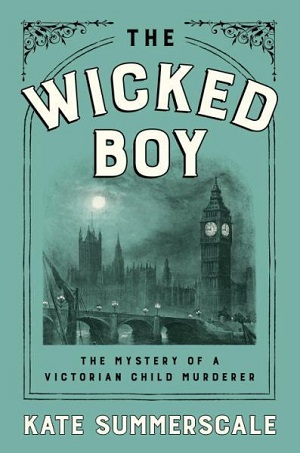
The Wicked Boy: An Infamous Murder in Victorian London
By Kate Summerscale

The crime:

IN 1895 13-year-old Robert Coombes killed his mother. His father was away at the time, and after the murder Robert spent the next week and a half living with his younger brother Nattie and entertaining a simple-minded friend of the family while his mother’s corpse rotted in an upstairs bedroom. Eventually, concerned neighbours and family members came to investigate and the smell gave everything away. Robert would stand trial and be found not guilty by reason of insanity. After 17 years in Broadmoor Hospital for the Criminally Insane he was released and immigrated to Australia. He would subsequently serve with distinction in the Australian army in the First World War and, after the war, settled down as a small farmer.
The book:

I’m on record as having been underwhelmed by Kate Summerscale’s much-lauded second book The Suspicions of Mr. Whicher. She seemed to me to be a dry writer a little too given to information dumps, and I didn’t have much, or really any interest in the back half of that story, which tried to reconstruct Constance Kent’s subsequent life in Australia after the Road Hill House murder trial. Nevertheless, it was a surprise bestseller and Summerscale has gone on to become a big name in the genre of historical true crime.

I’m not knocking her success. She puts the work in and picks interesting subjects to explore. With The Wicked Boy she follows a very similar case to that earlier book. Once again we have the sensational case of a killer child in Victorian days, and once again the killer immigrates to Australia after the dust settles. That said, I thought The Wicked Boy a better book.

I think this is primarily because Coombes himself is such a fascinating figure. Fascinating and downright impressive in many ways. It’s a cliché that kids had to grow up faster in days of yore, and that life among the working poor in Victorian England was no picnic, but it’s still worth keeping in mind the fact that Coombes grew up in a working class family at a time and in a place when working class meant something really horrible. Already at 13 Robert had finished with his schooling and was employed in an East End dockyard as a “plater.” I’m not sure all of what this entailed, but it sounds like it would involve a lot of pretty strenuous physical labour, especially for a 13-year-old. Primarily, Summerscale tells us, they would “run errands and mind machines” but also help out in “cutting and shaping sheets of iron on a lathe, placing them on moulds and bending them into shape.”

Kids were just more capable, not to mention independent, in that day. A year earlier, when he was 12, Robert had left the house and journeyed 40 miles down the Thames on his own just to see the court appearance of a notorious murder suspect. Three years earlier, when he’d been only 10, he’d robbed money from his parents’ cashbox and run away with Nattie all the way to Liverpool. It’s hard to imagine many 10-year-olds managing for themselves that well today, even with better rail service.

This competence and independence was something characteristic of those times. I don’t want to make it sound like a golden age, because it certainly wasn’t, but you simply can’t fail to be impressed at Coombes’s many achievements. As noted, his schooling was done by 13, by which age he was already a smoker. He did not come from a background of any wealth or privilege. After killing his mother he was sent to a criminal asylum and then a Salvation Army halfway-house program before leaving to Australia. And yet through all this he learned to be an efficient tailor, was a better-than-average musician (playing various instruments from violin to cornet and leading his unit’s band while in service), won several medals in the military as a stretcher-bearer while participating in some of the First World War’s worst campaigns (Gallipoli and Passchendaele), played chess at a very high level, and then after the war, without having any kind of a background in agriculture or animal husbandry, ran a dairy farm and was a highly-regarded raiser of vegetables that he sold locally. When his house burned down he was able on his own to build a cabin, however rudimentary, to replace it.

These are accomplishments that today I couldn’t match. I grew up on a dairy farm and did a fair bit of gardening so I might be able to shuffle by with that part out of muscle memory. But I can’t play any musical instrument, couldn’t sew on a button, and my chess is barely at a beginner’s level despite playing a lot online. I’m not a handyman and so probably couldn’t put up much in the way of a shack even with an unlimited account to draw on for supplies from a home hardware store. Would an online tutorial help? I was briefly in the reserves, but imagine that if I’d ever been at Gallipoli or the Western Front I would have been blown up pretty quickly (though admittedly, survival in this regard would mostly come down to luck).

I’m reluctant to invoke labels like the “greatest generation,” but when I think back to my father’s and grandfather’s generations (my father was born in 1923) and look at their accomplishments I can’t help but notice a pretty steep drop off. It’s not just that adversity builds character, since they were reasonably well off, but rather that more was expected of them. Then with the dread Boomers and John Kenneth Galbraith’s affluent society everything went to hell. But just thinking about this gets me down.

Getting back to the book, it follows Summerscale’s interest in the major social and cultural questions of the day, from what was seen as the malign influence of the penny dreadfuls that Coombes was fond of reading (the violent videogames of their day) to the slapdash state of criminal psychology. But then, even by today’s standards it’s hard to tell what led Coombes to kill his mom. I guess a “psychotic episode” (the modern diagnosis that’s offered) is a bit more convincing than “homicidal mania” (a contemporary one), but that may only be because I’m more used to the newer terms.

What makes this a special book though is the revelation at the end of the character of Robert’s life in Australia and the big difference he made in the life of a neighbouring boy. It’s not just that he came out the other side of all he experienced intact. More than that, his is a dramatic tale of redemption. Which leads to another troubling reflection about then vs. now. Did the justice system, at least in some cases, actually do a better job of rehabilitation in those dark ages than it does now? Would a Robert Coombes today turn out as well?

Noted in passing:

When dad was away, 13-year-old Robert slept in bed with his mother.

Summerscale doesn’t get into a discussion of how typical this was of family sleeping arrangements at the time, but it certainly struck me as weird. It’s not like there wasn’t another bed he could sleep in (presumably with his brother). It was at this same time that Freud came up with his theory of an Oedipal complex.

Takeaways:

Your neighbour might be a killer or a hero. Or both. And you’d never know.
True Crime Files

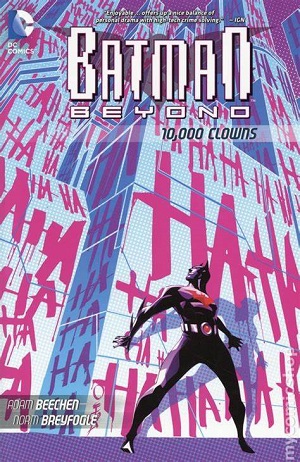
Batman Beyond: 10,000 Clowns

Batman Beyond: 10,000 Clowns

One of the defining characteristics of today’s comic book franchises is their employment of the multiverse concept. The way this works, there’s no one single Batman or Superman or Spider-Man but a host of alternative heroes of this name existing in different timelines and with different backstories and relationships. They might even die in a particular, short-lived universe and it makes no difference because all the other universes remain unaffected.

Batman Beyond is one such Batman universe, which had its beginning as a TV show and then branched into comics. The basic premise is that it’s sometime in the near future (mid twenty-first century) and Gotham is now filled with hovercars and there’s a new generation of crime-fighters and criminals afoot. Most notably, a kid (he’s 18) named Terry McGinnis, who is Bruce Wayne’s biological son, has taken over the role of Batman because Bruce is finally too old and beat-up a warhorse for the job. Meanwhile a gang of hoods dressed in clown costumes and calling themselves the Jokerz are basically a cult of you-know-who.

I liked the depth of the villains and anti-heroes here. Dana’s brother Doug is good as the violently bitter number-one son who hasn’t lived up to high parental expectations and so becomes the Joker King. The Vigilante is a bit of a bore in terms of his powers, but he’s a real person in his armoured suit. Mad Stan and his dog Boom-Boom were effective as semi-comic relief. The new Catwoman was the only real misfire here as she just looks like another robot and she wasn’t needed at all in this storyline.

So a good story then with some good new characters. I wasn’t as keen on the art, as there are some really lazy pages here, especially when the action flags. But I mainly just felt a little cool toward the whole project. In many ways it seemed like an essay on Wannabeism. Terry is a wannabe Batman and there’s a whole city full of wannabe Jokers. And in being a younger, wannabe Batman Terry basically becomes Robin, doesn’t he? I know he has to have a different look so he’s a lot skinnier and almost as rubbery as Plastic Man, but he just doesn’t have any of Batman’s weighty angst (though, to be sure, few comic-book characters do). The way he can fly now with his jet boots adds to the feeling of him just being something flightier than Batman should be. Again, it’s clearly a direction they wanted to go in, with Batman as battle tank being replaced by Terry as sleek speedster, and they try to even things out in this and other Batman Beyond titles by having Terry getting the crap beaten out of him fairly often. But in the end, and just to repeat my earlier point, he feels like Robin redux more than Batman reborn.

Graphicalex

The progress trap

I was recently reading Vaclav Smil’s book How the World Really Works: The Science Behind How We Got Here and Where We’re Going when I came across a passage that both made me nod my head in agreement and set me to wondering. It comes at the start of a chapter where Smil is talking about what he calls the four pillars of modern civilization, meaning that without any one of them the whole works would collapse. These four pillars are cement, steel, plastics, and ammonia (used as fertilizer for its nitrogen). Not included are any of the special materials (like silicon) or tools that have empowered what’s become known as the digital age:

First things first. We could have an accomplished and reasonably affluent civilization that provides plenty of food, material comfort, and access to education and health care, without any semiconductors, microchips, or personal computers: we had one until, respectively, the mid-1950s (first commercial applications of transistors), the early 1970s (Intel’s first microprocessors), and the early 1980s (first larger-scale ownership of PCs). And we managed, until the 1990s, to integrate economies, mobilize necessary investments, build requisite infrastructures, and connect the world by wide-body jetliners without any smartphones, social media, and puerile apps.

This is the part that had me nodding my head. And made me a little sad at the thought that I belong to what I think may be the last generation able to remember such a time. I wondered if it’s even possible to explain to a young person today that life before the Internet wasn’t a Dark Age. Given the amount of time we spend looking at screens (two days ago I had a business appointment where the person I was meeting with literally didn’t lift their eyes up from their tablet to look at me), would young people even be able to understand what life used to be like if I told them?

Then I started to wonder if Smil was right. I’d agree that his four pillars probably are more essential to life, but I was also put in mind of Ronald Wright’s A Short History of Progress (inspiration for the documentary Surviving Progress), which sets out the notion of a “progress trap.” The basic idea of a progress trap is that with technological advance humanity also paints itself into a comfortable corner. The development of agriculture is perhaps the best example. Once we started growing our food, leading to an increase in population, we could never go back to hunting and gathering.

So while a prosperous, advanced civilization is not only possible without all our wonderful new toys but is indeed something many of us can still remember, is it not also true that these same toys have now become essential? Could we ever go back to living without them? Would the end of the Internet mean the end of civilization as we know it? I’m inclined to think it would be. It’s an odd feeling to have lived through such a profound revolution, and realize at the same time that we can never go back to living the way we did just thirty years ago.

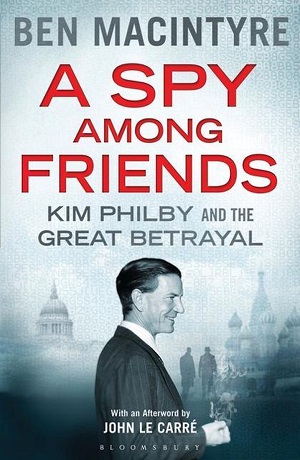
TCF: A Spy Among Friends

A Spy Among Friends: Kim Philby and the Great Betrayal
By Ben Macintyre

The crime:

Throughout the Second World War and much of the Cold War Harold Adrian Russell (Kim) Philby was a member of Britain’s Secret Intelligence Service or MI6. He was, however, during the same period a double agent working for the Soviets as part of what has become known as the Cambridge Spy Ring. When finally exposed in 1963 he defected and lived in Russia until his death in 1988.

The book:

If lives hadn’t been at stake it might have all been very funny. This late in the day the British class system had become a ridiculous anachronism, and the account of these public-school toffs playing at being spies is full of wonderful Wodehouse moments. (Philby himself had a whole shelf of Wodehouse novels in his Moscow apartment when he died, while John Le Carré thought Nicholas Elliott, Philby’s friend/nemesis, “looked like a P. G. Wodehouse man-about-town, and spoke like one.”) What are we to make of the tale of the waitress who set fire to a diner’s hair while attempting to flambé an omelet, requiring Elliott to douse her head with three glasses of white wine? Do I think that actually happened? No, but it’s a great story.

But it’s a great story that’s of a piece with a certain kind of broad humour. I mentioned Wodehouse but it’s actually something lower than that. Almost Benny Hill at times. Philby was part of what was dubbed the Cambridge Spy Ring or Cambridge Five because that’s where they all went to school, which doesn’t say anything good about Cambridge. It’s truly remarkable how, even into middle age (which, given their lifestyles, was old age for them) they were still trading in the same leering, juvenile schoolboy jokes and pranks that nobody else around them thought were funny.

What strikes one the most, however, is the sheer amateurism of British intelligence at the time. To take just a few examples: (1) While getting the teams of special operatives ready for insertion into Albania it turned out that none of the trainers spoke Albanian and none of the “Pixies” knew English. So training was done by sign language. (2) Donald Maclean (one of the Cambridge Five) was able to escape because surveillance teams didn’t work on evenings or over the weekends, and wouldn’t travel outside of London. (3) In the book’s climactic interview with Philby, Elliott, at the time one of MI6’s highest ranking and most experienced field agents, couldn’t even set up a tape recording system that worked (a window was left open so that street noises made the conversation mostly inaudible).

As I began by saying, this is great comic material. The names, of course, are also part of the fun. “Kim” was a nickname taken from Kipling, while it would be hard to best James Jesus Angleton for the Anglophile CIA counterintelligence chief. Among the supporting case we get the likes of Sarah Algeria Marjorie Maxse, Valentine Vivian, Sir Hughe Montgomery Knatchbull-Hugessen, and someone named (“unimprovably” in Macintyre’s estimation) Engelbertus Fukken. How could you take such people seriously?

I don’t even know how seriously they took themselves. Many of the old-boys’ club of spies that did so much to enable Philby thought all of this was fun. Maybe not just fun, but fun nevertheless. But in the twenty-first century I think we can look back on the English public-school educated gentleman and be more critical. These well-educated twits weren’t just eccentric but privileged to a point where they were a danger to themselves and others. By the time of the Cold War the aristocracy were already an anachronism, and the Philby case could be seen as the Altamont to their Summer of Love. It’s not just that they couldn’t be indulged anymore, but that they were a threat to national security and even social order.

Macintyre does make an effort, and this is an excellent book in almost every regard, but at the end I still couldn’t figure Philby out. On the one hand, like his friend/enemy Elliott he seems to have thought of spying as a game. But what were his motivations? There is much talk of loyalty to one’s friends and one’s country, and the potential for conflict between the two, but the fact is that Philby seems not to have felt any great loyalty to either (that is, if he even had any friends). He initially had some excuse for getting involved with the Russians, but why he doubled down after the end of the war is anyone’s guess. He never talked politics with others, leading Macintyre to describe him not as an ideologue or loyalist but as “a dogmatist, valuing only one opinion, his own.” But what dogma did he adhere to? He doesn’t seem to have been interested in anything much, and mainly wanted to lead a life of luxury with lots of drinking.

Macintyre suggests various explanations for his treachery. Maybe it had something to do with Philby’s relationship with his father. And maybe it had something to do with Eton. Maybe it connected to what C. S. Lewis describes as the British obsession with belonging to an “inner ring.” Perhaps he liked putting things over on people he felt superior to. And perhaps it did become, as Macintyre finally suggests, a kind of addiction. However you slice it, Philby comes off as both a terrible person and representative of his class.

Noted in passing:

One marker of his class was the fact that Philby, and a lot of the men (and women) around him, drank like fish. I suppose a bit of this comes with the territory of being a spy and having to attend a lot of social gatherings and liquid lunches, but even so this lot took it to excess. In Beirut, Philby was essentially a drunken wreck, but still functioning as a spy. What’s most impressive is that even when dead drunk he never had loose lips. As Elliott remarked to Le Carré, “He never said anything when he was pissed.” I thought that strange, as his level of drunkenness was often at a point where his mental functioning must have been severely impaired. But maybe this illustrates a deeper point: that underneath his mental armour and his layers of dissimulation and disguise there really wasn’t anything there. It’s often said that when people are drunk they don’t turn into someone different but only show you who they really are, only more so. When Philby got drunk there was nothing to reveal.

Takeaways:

You can’t trust a spy.

True Crime Files

Brave New World

Brave New World

Aldous Huxley’s Brave New World has been a popular book for nearly a century now, but its television and film adaptations haven’t been very successful. I blame the source material. While it’s a fascinating book it doesn’t lend itself to being filmed because it’s talky, and disjointed in terms of its action. Huxley himself seems to have changed his mind about some of the characters as he was going along.

I don’t think Fred Fordham overcomes any of these difficulties. A lot of illustrated classics have a bland and generic look and I didn’t think this was much different, though it sort of fit with the Fordian state itself being founded on principles of blandness and the mass production of a generic form of humanity. I also figure that the publishers probably wanted a PG rating, so the novel’s violent and pornographic passages are softened. This was kind of disappointing to me, not because of any prurient interest on my part but because I think it’s important to show how the brave new social order controls our still extant animal urges by indulging them through various surrogates.

Overall this is a very literal adaptation. Almost too literal in places. The series of conversations the World Controller Mustapha Mond (suggested to be gay, or bisexual now) has with Bernard Marx, Helmholtz Watson, and John the Savage just get transcribed in fifteen pages of dialogue bubbles. That much talk really needs some better packaging. But Fordham wasn’t given (or didn’t give himself) a lot of latitude. Though some items I didn’t remember being in the book, like Bernard and Lenina wearing full spacesuits with glass helmets when they visit the Savage Reservation in New Mexico. And I also found Lenina’s face to be disconcerting. Was she supposed to have a mask of freckles? Because it just looks like she has a really unfortunate skin rash. Meanwhile, the figure of Linda, who is grotesque in the book, is presented as being just a little overweight.

So it’s faithful and pretty thorough, but I don’t think I’d recommend it as a crib or alternative to reading Huxley. Even if many of the problems with any adaptation go back to him too.

Graphicalex


Celebrity bios: then and now

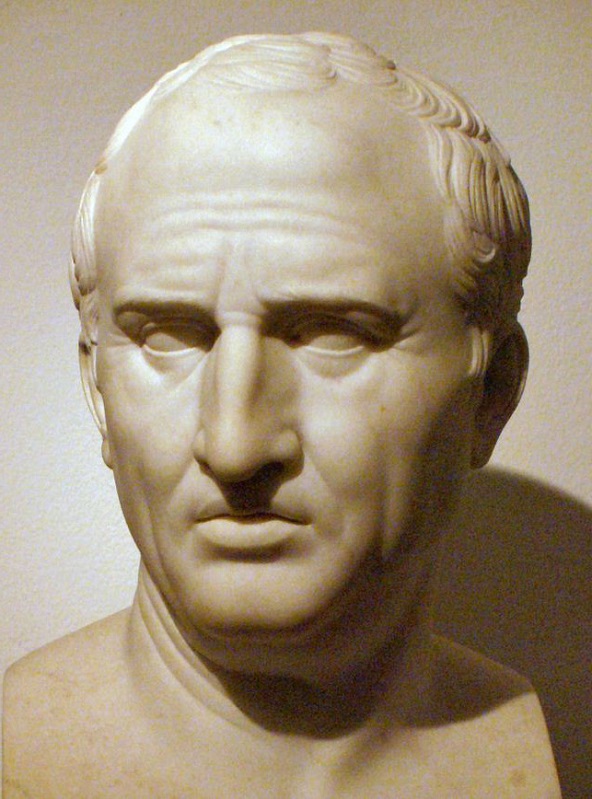
“Waive the laws of history.” Cicero

Long-time readers of this site will know I have a pet peeve about celebrity bios, and the way people who enjoy wealth, power, and fame use them to carefully fashion their image and brand. See, for example, the posts here and here. I also had a post a while back mentioning how old a story this is, and how Michelangelo, upset at the (worshipful, not to mention truthful) account of his life written by Vasari, got one of his students to write a more flattering, inaccurate portrait.

But the great tradition of phoney, fawning biography goes back further than this. I recently came across this little gem while reading Anthony Everitt’s Cicero:

Aware that his public image needed burnishing but sensing the public would not welcome any more self-praise from his own pen, Cicero tried to interest a respected historian, Lucius Lucceius, in writing a history of his Consulship, exile and return, the main purpose of which would be to expose the “perfidy, artifice and betrayal of which many were guilty towards me.” He was candid about his expectations, and asked Lucceius to write more enthusiastically than perhaps he felt. “Waive the laws of history for once. Do not scorn personal bias, if it urge you strongly in favour.” Lucceius agreed, although for some reason the books seems never to have appeared.

Maybe it just wasn’t any good, much like Cicero’s own self-indulgent epic poetry. And for that we may be thankful.

What brought this to mind again was the publication this past month of a couple of instant bestsellers written by two of the most prominent biographers working today: Elon Musk by Walter Isaacson and Going Infinite: The Rise and Fall of a New Tycoon (on Sam Bankman-Fried) by Michael Lewis. I haven’t read either book, but reviews have called out both authors for an overly deferential attitude taken toward their subjects, accompanied by a shrug at their various “demons” (the handmaid of “genius”) and other failings.

I would have thought that the mere fact of the special access they were given in writing “authorized” bios would have been enough to set off all kinds of alarms. In her New York Times review of Going Infinite, Jennifer Szalai criticizes Lewis for being “stubbornly credulous” and for having “a front-row seat — from which he could apparently see nothing.” This is, just to repeat the point I’ve been banging on in all these posts, to mistake the reason why someone is given access, or “a front-row seat,” in the first place. It’s precisely so the author won’t see anything, or at least want to talk about it.

Making matters even more embarrassing, Isaacson and Lewis were going into print when their subjects were on the verge of imploding, leading some to question the divine status of figures like Musk and Friedman as masters of the universe.

What can I do but keep repeating myself? So I will: “if you’re reading the bio of a living celeb (meaning one who still has the ability to have any influence over what someone is writing about them) you have to assume that it’s going to be, at best, only the loosest facsimile of the truth. It has always been thus.” Remember: if you’re not reading something that the subject of the biography didn’t want written, it’s just an ad.

TCF: Maniac

Maniac: The Bath School Disaster and the Birth of the Modern Mass Killer
By Harold Schechter

The crime:

In 1927 Andrew P. Kehoe blew up a primary school in Bath, Michigan. He also blew up his house and burned his wife’s body in ritualistic fashion after killing her with a blow to the head. Later, while rescuers were working at the school to try to find any survivors, he arrived at the scene and blew himself up in his truck, killing several more people. In total 45 people died, including 38 children.

The book:

A first-rate account of one of the less well-known atrocities in the annals of true crime. Indeed, the fact that it is so little known today is a point that Harold Schechter (a fellow I once referred to as “the dean of American true crime writing”) spends some time unpacking in his Introduction.

Why is it that some crimes grab and maintain a fierce hold on the public imagination when others, equally bloody or sensational, are almost immediately forgotten? “Horrific violence,” even approaching “the sublime of horror,” “isn’t enough to ensure that a crime will become an ongoing media sensation, let alone a permanent part of our cultural mythology.” There has to be more. It seems that “for a murder to really take hold of the communal imagination and exercise an enduring grip, something else is necessary.” But what?

It’s a point Schechter returns to at the end of the book when considering why the Bath bombing was only a “seven-day horror” pushed off the front page by Lindbergh’s trans-Atlantic flight and then “relegated to obscurity,” Shechter puts forward an intriguing thesis. In order to become a cultural touchstone a crime has to resonate with contemporary public fears. It has to be “a story with a particular meaning, speaking to an issue that was a source of growing social concern at the time.” So around the turn of the twentieth century poisoners were big news because in

a pre-FDA age, when people could never be certain of what they were putting into their mouths – when medicines were made of strychnine and arsenic, bakers preserved their dough with sulfur of copper, babies consumed “swill milk” from cows fed on distiller waste, and soldiers received rations of “embalmed beef” – the poisoner was the nightmarish symbol, the personified projection, of a pervasive cultural anxiety.

Just so, Leopold and Loeb became embodiments of a fear of immoral youth (and affluent decadence) in the 1920s, while the “family” of Charles Manson “became the living realization of Middle America’s worst nightmares about sex-and-drug-crazed hippies” in the 1960s. If anyone remembers the Snyder-Gray case today it’s probably for the famous shot of Ruth Snyder being electrocuted in 1928, but at the time it was big news for other reasons.

In an era of radical social change, [feminist scholars] argue, when young women were kicking over the traces of Victorian morality and breaking free of their traditional domestic roles, Ruth came to embody everything that a sizable portion of the population most hated and feared: the sexually emancipated, self-indulgent flapper, symbol of a modern society run amok. In short, for Jazz Age America, the Snyder-Gray case resonated with powerful social and psychological meanings, becoming, in the words of culture critic Ann Jones, the decade’s “most important morality play.”

Schechter doesn’t bring the point up here, but the same has been argued about horror films. In the 1950s we got giant ants, spiders, and people mutated by nuclear explosions. Post-Watergate we got conspiracy thrillers. In the 1980s during the AIDS crisis we got “venereal horror” and slasher films where promiscuous teenagers were slaughtered. Each generation summons its own demons.

Interest in the Bath school bombing tracks this same movement. Following the long ascendancy of serial killers as the kings of true crime, we’ve gradually lost interest in them. As Shechter points out, the revelation in 2018 of the crimes of Samuel Little, who may have killed more than 90 people over five decades, “barely made a dent in public awareness.” The era we’ve entered into, however, has brought the Bath bomber back into the collective consciousness. Andrew Kehoe was a mass (not serial) murderer, a suicide bomber, an anti-government terrorist, a school killer. References to the Bath school bombing would increasingly appear in the media, “cited as a grim harbinger of the wholesale slaughters besetting the nation” in the twenty-first century.

And Kehoe wanted to kill a lot more. Over 500 sticks of dynamite and pyrotol that he had planted remained unexploded, enough to destroy the entire school and everyone in it. Which leads me to a quick digression. We’re lucky that making bombs isn’t easy. It’s not widely known, but Eric Harris and Dylan Klebold made a pair of propane bombs that they stuck in duffel bags and set to go off in the Columbine cafeteria on the day they went on their shooting rampage. Their attack was planned primarily as a school bombing, after which they would shoot any survivors. But the bombs failed to detonate. That’s not too surprising, as they were both 17 years old with no experience in such matters, but even a skilled handyman like Bill Rothstein’s elaborate (probably too elaborate) collar bomb only detonated one of the two pipe bombs it contained. Kehoe was known as a highly skilled mechanic and trained electrician, but most of the explosives he’d planted in the Bath Consolidated school building failed to go off.

Overall then I’d rate this as not just a great read – punchy and lean, with little of the novelistic or autobiographical flourishes that have become so prevalent in the genre – but a book that has something important to say about our two-way relation to true crime reporting. Another reminder that when we look into the abyss, the abyss is looking back at us.

Noted in passing:

Kehoe married into an established and prosperous family that he soon found himself in conflict with. Just for starters, they held the mortgage on the farm where he lived. For me this recalled All That is Wicked by Kate Winkler Dawson and what happened when Edward Rulloff married into the Schutt family, a blessed event that led to disastrous results. Considering the matter a little more, I also thought of Blood & Ink and Edward Hall marrying an heiress.

There is a lesson here that fits with some of what I’ve observed over the course of my own life. “Hypergamy” is a word that gets tossed around a lot these days when discussing female relationship choices. Basically it just means mating up, and among some online communities it’s considered to be an iron law, driven by evolutionary psychology (women seeking a mate with resources adequate to provide for them and their children). While some may call it gold-digging, casting it in these terms just makes it seem natural. And in the real world you don’t see women being criticized for it except in the most egregious situations.

Male hypergamy, however, is traditionally seen as quite unnatural, and men who marry for money are almost always looked upon with distaste if not outright disgust. I think of the killer Chigurh’s startled reaction to the Texaco gas station owner telling him that the station and the home out back is his “wife’s father’s place” in the coin-toss scene from the movie No Country for Old Men. “You married into it?” Chigurh chokes in disbelief. The owner’s immediate loss of status is palpable, and his attempt to save face doesn’t fly with Chigurh for a second (“I don’t have a way to put it. That’s the way it is.”).

The fact that this is how society looks upon men who marry up no doubt gives a turn of the screw to the domestic situation here and in the other cases I mentioned. And I imagine this was especially so in the 1920s. I don’t think the fact that all these men had wives with money from “good” families drove them to murder, but at the same time it probably didn’t help them stay on an even keel.

Another connection to the Hall-Mills murder case that struck me was the public fetishizing of souvenirs. In that earlier case the poor crab apple tree the bodies had been discovered under was stripped bare by trophy hunters. In this case a local reporter complained of how disaster tourists came to the ruins of the schoolhouse and “whittled it away and carried away bricks until there’s nothing left to tear down.” But even more remarkable was “one particularly ghoulish sightseer” who, in the immediate aftermath of Kehoe blowing himself up in his car, “deftly snipped a section of intestine from the steering column, placing it carefully in a jar of apparent alcohol.”

Why? The existence of “murderabilia” has always mystified me. What do people even do with these trophies? Put them on display in their homes? I guess it’s just a fact that collectors will collect anything, and celebrity/fame/notoriety has the effect of touching any part of our mundane, material reality with some aura of arcane value. Even so, you’d think people would have some sense of shame.

Takeaways:

Kehoe left a “note” (a sign wired to a gate at his farm) saying “CRIMINALS ARE MADE, NOT BORN.” He apparently targeted the school because he didn’t like being taxed to support it. Americans really do hate anything to do with taxes. Always have, and probably always will.

True Crime Files

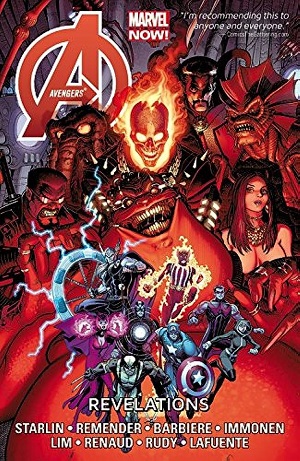
Avengers: Revelations

Avengers: Revelations

I’m not sure what the point was here, or what revelations are being referring to. What we have are four completely unrelated stand-alone comics. They’re each pretty good, but also different not only in the characters involved but also in the tone and art. So I really have to look at each separately.

Thanos Annual #1: the weakest story in the group has Thanos, just after being defeated in the fight over the Cosmic Cube, being visited by an avatar of the Thanos of the Infinity Gauntlet series who introduces him to his possible fate. Or a possible fate. Because anything is possible. Which means it’s not really fate. This was the lead-in to a new storyline but it’s all heavy breathing about infinity and eternity and the multiverse, with no action.

Uncanny Avengers Annual #1: a whole bunch of Avengers and X-Men (the Avengers Unity Division) and the Avengers of the Supernatural (their first appearance) are whisked off to the Mojoworld to be part of one of Mojo’s failing TV shows, this one with the show-stopping title “Martian Transylvania Super Hero Mutant Monster Hunter High School.” But then Ghost Rider goes off script. Lively and funny, but something about Mojo just doesn’t work for me.

New Avengers Annual #1: Dr. Strange saves a Tibetan princess who has been possessed by a demon, which he fights while having flashbacks to a past experience where he failed to save a man’s life in a brain operation. Marco Rudy’s art is the real draw here, as it gives the rather simple story an epic, phantasmagoric feel.

Avengers Annual #1: Christmas at Avengers HQ, and a loitering misfit girl starts making cos-playing doppelgangers of herself impersonating the rest of the Avengers. I thought this was the best story in the book, moving very quickly and being full of smart and funny twists. Captain America helping out at the soup kitchen was a bit hokey, but otherwise everything went down well.

Some good reading then, but a grab-bag because there’s nothing connecting any of the stories. It’s probably best taken as a sort of sampler to see if any of the titles appeals enough to hook you on them, and I think a couple might.

Graphicalex

TCF: All That Is Wicked

All That Is Wicked: A Gilded-Age Story of Murder and the Race to Decode the Criminal Mind
By Kate Winkler Dawson

The crime:

A drifter named Edward Rulloff landed in Upstate New York in the early 1840s, where he married into the prominent Schutt family. He didn’t get along with his wife or her family, and may have been responsible for killing his sister-in-law and her child. He then killed his own wife and child, though their bodies were never found. He was convicted only of kidnapping his wife and sent to prison, from which he escaped. In 1870 he shot and killed a guard when he robbed a dry goods store with a couple of other men (both of whom drowned while trying to escape). In 1871 he was hanged.

The book:

A nice bit of work, making a case for why Edward Rulloff, whose crimes were as ordinary as they were callous and cruel, is worth attending to. In short, Winkler Dawson sees him as “the first high-profile killer to inspire neuroscientists to dig deeper into the criminal mind.”

Rulloff’s brain is currently part of the Widler Brain Collection at Cornell University, not for being a prime example of a criminal type (since there doesn’t seem to be such a type) but for its immense size, which apparently puts it in the largest 1% on record, and possibly one of the largest ever. This in turn leads not only to a discussion of early debates on the physiology of a criminal mind, but also into the matter of criminal, or evil, “genius.” As the book kicks off we’re told that many of his contemporaries considered Rulloff to be “perhaps, the most intelligent killer in American history.” As we keep reading, however, that’s a judgment that gets qualified.

Was Rulloff a criminal genius? Not because of the size of his brain. I don’t think Einstein’s brain was found to be particularly large. As Winkler Dawson concludes, “we now know that brain size is no indication of intellect or morality, or of belonging to a privileged group with claims of superior intelligence – it’s the quality of the brain, not the quantity.”

Was Rulloff a genius only by reputation? He was at least in some ways an impressive autodidact with a thing for languages. I’m not sure that being able to understand a lot of different languages is any great sign of intelligence though, any more than being good at math is (as I’ve argued elsewhere). Furthermore, his claim to have discovered a key to understanding the origin of all human language was investigated by authorities at the time and found to be nonsense. Horace Greeley would call him “too curious an intellectual problem to be wasted on the gallows” and “one of the most industrious and devoted scholars our busy generation has given birth to.” But that doesn’t mean he was smart. The same goes for Mark Twain calling him (with tongue in cheek) “one of the most marvellous intellects that any age has produced.” Being a curious and marvellous intellect, as well as an industrious and devoted scholar, carefully avoids comment on his actual intelligence.

A criminal genius? Hardly. Our best guess is that he killed his wife in a fit of rage. He would be sent to the hangman for killing a night watchman during a miserably planned and badly bungled break-in. I don’t see any evidence for thinking him a mastermind. Winkler Dawson argues for his being a psychopath, but even here I think he’d have to be considered a low-functioning one. He certainly tried to charm people, for example, but few people seem to have been fooled. In fact, most anyone who got to know him seems to have been repelled by him. He did fool some people, some of the time, but mainly those who were weak and vulnerable.

We want so badly to believe there’s some link between intelligence, however eccentric, and crime – what’s apparently known in the academic literature as the Hannibal Lecter myth (I’ve included a cover image where the alternative title points to this). Rulloff was an early example of this sort of thinking, but he’s also someone who should have made experts question the connection. Rulloff certainly considered himself to be a genius, but in this he was only a typical narcissist (or, less professionally, an asshole). Ramp up one’s delusions of grandeur and sense of entitlement far enough and you get someone whose brakes are off.

This is a good read, with Winkler Dawson structuring the story around Rulloff sitting in his cell awaiting execution and being visited by various people (journalists, academics, medical men) while his story is teased out through flashbacks much like you’d imagine being done in a docudrama. The parallel to Stevenson’s The Strange Case of Dr Jekyll and Mr Hyde, however, with chapter headings taken from that work, left me scratching my head. I really didn’t see Rulloff as being anything like that kind of a divided personality.

In other ways too I found Rulloff himself to be a lot less compelling a figure than he was made out to be, but as an origin story for today’s “mindhunters” his case does have a lot of historical interest. In 1871 investigators didn’t have the same tools we do today – our big data, for example, and ability to look inside the brain – but they still made a lot of very perceptive observations of criminal behaviour, like the district attorney here who noted how “It is a well understood fact that there is a kind of indescribable fascination to a criminal about the place where he has committed a crime, and however far he may go away still he wants to come back.” They were doing the best they could just working from the general, observable facts of the cases they were working on, and for the most part they seem to have done pretty well.

Noted in passing:

Was this the Gilded Age? I think the Gilded Age is usually seen as starting sometime in the late 1870s with the end of Reconstruction, or in 1880 to take a convenient round date. I tend to be inclined towards giving it a later starting-off point, but some historians place its beginnings as early as the end of the Civil War in 1865. For what it may be worth, the label is taken from a novel written by Mark Twain and Charles Dudley Warner titled The Gilded Age: A Tale of Today, which was published in 1873. Given that Rulloff killed his wife and child in 1844 and was executed in 1871, I don’t think this really counts as a “Gilded-Age Story.” But it’s interesting that publishers seem to think that adding “Gilded Age” to a title is a real selling point. This is not the first time I’ve seen it invoked when I didn’t think it was appropriate.

At Rulloff’s final trial it was observed that among the many people attending “a great portion of them [were] women.” This leads Winkler Dawson to make the following observation:

For generations, women have been the dominant consumers of true crime; in current times, most readers, listeners, or viewers of these crime stories are female. Experts say many women hope to learn from the mistakes of victims, to absorb themselves in a world they never hope to enter. In some cases, they change their behavior based on that knowledge – they’re more skeptical of male suitors and more cautious about venturing out alone. This was certainly the case of mostly proper ladies in Binghamton in 1871.

A footnote expands on this further, linking it to the pathology of hybristophilia, where women develop a sexual interest in serial killers and other “bad boys.” Leaving that aside, what Winkler Dawson says about today’s audience for true crime, whether in the form of books or podcasts, is certainly true and I’m not aware of any full explanation for it.

Takeaways:

If your whole family is against you marrying someone, best give the matter further consideration. If they become even more insistent that you leave your spouse when the marriage goes south, you should admit you made a mistake and get out before things get any worse. Because they will.

True Crime Files

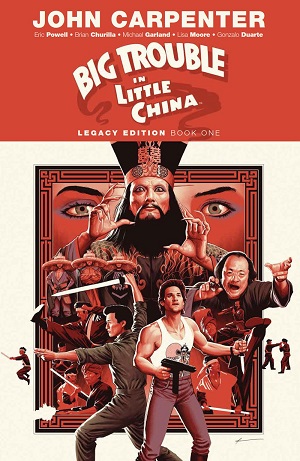
Big Trouble in Little China (Legacy Edition Book One)

Big Trouble in Little China (Legacy Edition Book One)

Ever since its cult status began to grow there’s been talk of a sequel to John Carpenter’s 1986 action flick Big Trouble in Little China. It’s never happened, but there were other spin-offs like various games (card, board, and video) as well as this comic-book series, which Carpenter himself had a hand in writing. Would a second movie, should it ever happen, be based on these comics? I don’t think so, though I’m sure they could (and likely would) do worse.

Fans of the movie will be pleased with what they’ve done here. I know I was. Things pick up literally right where the movie ends, beginning with Jack delivering his envoi from the cab of the Pork-Chop Express about what Jack Burton always says on a night when “the poison arrows fall from the sky, and the pillars of heaven shake.” Then the ape creature attacks but it turns out he’s actually bonded with Jack now. Jack calls him Pete and gives him a t-shirt and baseball cap to wear.

Before long all the rest of the original cast are in play as well. Jack’s buddy and his lady love Miao Yin (now revealed to be a kick-ass martial artist too). Egg Shen, dispensing various bits of arcane knowledge and smoke bombs. And of course Lo Pan as the evil wizard. The only character missing is Gracie Law, though she’s briefly shown to be in Tibet “campaigning for the ethical treatment of livestock” amongst some uncomprehending yak herders.

You may have figured that Lo Pan was dead at the end of the movie, and he was. But when you die in this universe you only go to one of many hells – in Lo Pan’s case it’s the Hell of Those Killed by Idiots – from whence you can be summoned back by various rites. So basically there’s a lot more supernatural action in these comics as Lo Pan and Jack shuttle back and forth from various infernal realms, bickering with each other all the way.

I think they did a great job with these comics. The art is fun, though I didn’t think Jack looked much like Kurt Russell. There’s an interesting plot filled with familiar jokes like the “Who?” “Me, Jack Burton!” exchange and lots of novel monsters and mythological beasts inhabiting the demonic realm, including a sidekick Jack adopts and names Slinky who looks a bit like Dave Sim’s Cerebus. The new wrinkles are mostly pretty good too, including some flashbacks to Jack’s disastrous early marriages (wives three and four were a vampire and a witch respectively), and a jarringly sentimental first Mrs. Burton who I didn’t think was needed. Finally, as things wind up a nice final panel introduces Jack to the twenty-first century and what are sure to be more great adventures. This wasn’t a series I was expecting much out of, but it left me looking forward to more.

Graphicalex