
Not sure who gave this to me, or when. But it’s very pretty. The texture doesn’t come out well in the picture. It’s a paper bookmark, but rough and felt-like.
Book: The Americans: The Colonial Experience by Daniel J. Boorstin
Not sure who gave this to me, or when. But it’s very pretty. The texture doesn’t come out well in the picture. It’s a paper bookmark, but rough and felt-like.
Book: The Americans: The Colonial Experience by Daniel J. Boorstin
I was recently reading a volume in Oxford’s Very Short Introduction series on the New Testament by Bible scholar Luke Timothy Johnson. In Johnson’s discussion of the Gospel of Mark he mentions the scene where Jesus is arrested and how “Among those following [Jesus] was a young man with nothing on but a linen cloth. They [the Roman soldiers] tried to seize him; but he slipped out of the linen cloth and ran away naked.”
I must have read this before but it’s not a detail I remembered. According to a footnote in the Oxford Study Edition of the New English Bible (the one I keep on hand for consulting on such matters) “The young man appears only in Mk. and his identity is unknown.” Turning to the Internet I found a wealth of further commentary on the passage. Over the years the young man has been identified as (and this is not a complete list): Lazarus (the young man’s “linen cloth” or sindon is the same as that used for the burial of the dead), the owner of the garden of Gethsemane (only rich people had linen cloth), and even Mark himself (according to the Cambridge Bible for Schools and Colleges: “The minuteness of the details given points to him [Mark]. Only one well acquainted with the scene from personal knowledge, probably as an eyewitness, would have introduced into his account of it so slight and seemingly so trivial an incident as this.”)
What I didn’t find except in one other source was the spin Johnson puts on it, identifying the young man with the figure (he’s not said to be an angel in Mark) who the women later find at the empty tomb of Jesus:
Careful readers recognize the messenger at the tomb. He is described by Mark as “a young man sitting at the right side, clothed in a white robe” (16:5). Mark wants readers to understand that the young man who fled naked (14:51) is already restored, as the first human witness to the resurrection.
I don’t think Johnson means that the young man sitting in the empty tomb is literally the same young man who fled naked from Jesus’s arrest. Though maybe he does. The same Greek word for a young man, neaniskos, is used to describe them, but that seems a generic label to me. In any event, I think you’d have to be a careful reader indeed to recognize the association. If this is what Mark wanted readers to understand from the incident I think he might have tried harder, as it doesn’t seem as though many readers over the years have made the connection. I raised the matter to a pair of retired ministers I know and they’d never heard of it, though they were familiar of the identification of the naked man with Mark.
Well, the Bible is a big house with many mansions and I don’t think there’s any end to the various interpretations and meanings that have been put on it. And I’m not saying I disagree with Johnson’s reading. I only flagged it because it struck me as odd, and because Johnson presents it so matter-of-factly. Also, having gone through the effort of looking into it, it’s probably going to be stuck in my head forever now.
In my notes on The Empty Man I made reference to a page in the comic where a woman pulls back a shower curtain to reveal her infected husband seeming to decompose or be transformed before her eyes. But as I said in my notes, I couldn’t be sure what was actually happening because of the way it was drawn. Curious minds in the comments wanted to be able to judge for themselves, so I give you the page in question and allow you to draw your own grisly conclusions. I still think my own guess of explosive diarrhea is probably closest to the mark.

What do you think is going on?
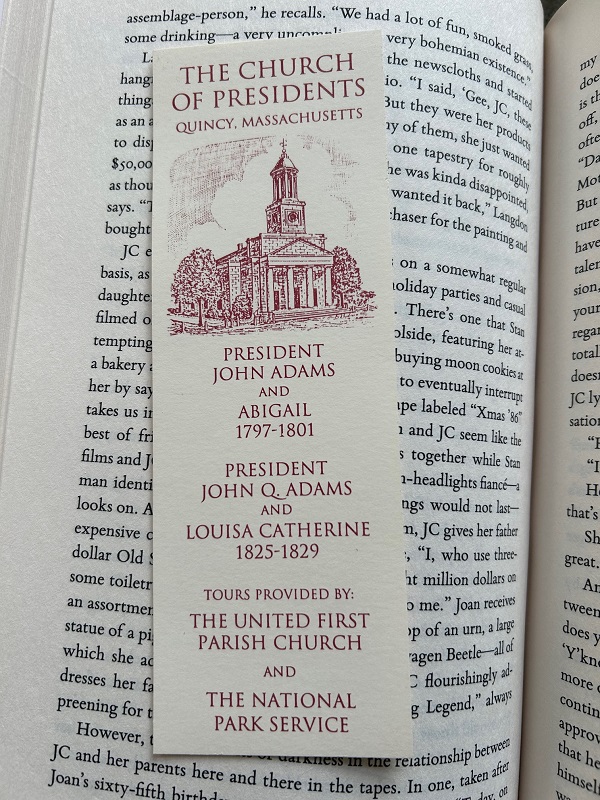
One of the great things about collecting bookmarks is that wherever you go as a tourist you can usually pick up a bookmark to commemorate your visit. Sometimes they can just be a simple paper one that doesn’t cost anything. This is one I got on a visit to Boston and environs back in 1996 or thereabouts.
Book: True Believer: The Rise and Fall of Stan Lee by Abraham Riesman
A week ago I had a Dangerous Dining post talking about breakfast cereals, in the course of which I mentioned how Quaker’s Harvest Crunch granola cereal was one of my go-to favourites. Just a day or two later a recall was announced by Quaker that had that same cereal listed as possibly contaminated with salmonella.
Ouch!
Usually I don’t pay any attention to grocery recalls because they seem to always involve brussels sprouts or instant ramen. This one took me a bit by surprise, and not just for coming from such a major brand as Quaker. I mean, I’m sure it’s not impossible to get salmonella from granola, but isn’t it strange?
Salmonella is a bacteria most often found in poultry, eggs, raw and undercooked meat, and dairy products. At the end of several lists of foods most likely to be contaminated with salmonella I also found things like nut butters, some processed foods, and infant formula.
Not granola.
Even stranger was the wire story on the recall:
The U.S. Food and Drug Administration has received at least 24 reports of adverse events related to the products initially recalled, but no illnesses have been confirmed to be linked to the foods, an agency spokesperson said Friday. Adverse events can include medical problems, but also complaints about off taste or color of a product, defective packaging or other non-medical issues, the official said. FDA will continue to investigate the reports.
So no illnesses confirmed to have been linked to the foods? And “adverse events”? That sounds really vague. It even includes “complaints about off taste or color of a product, defective packaging or other non-medical issues.” Defective packaging?
I don’t know how much of this recall is due to an excess of caution, and how big the actual risk might be. In any event, seeing as I had several boxes of the suspect cereal this has become the first product recall that I’ve actually taken part in. I filled out a form online, attached a picture of the unopened boxes I had in my cupboard, and was told my request would take up to 8 weeks to process.
I’m curious to see what happens. Do manufacturers actually pay out when they have a recall? You’re on the clock, Quaker! I’m not expecting anything, but let’s see how you do.
Update, May 27 2024:

The crime:
On the night of November 14, 1996 14-year-old Reena Virk was attacked by a group of six teenage girls and one boy under the Craigflower Bridge in the town of View Royal on Victoria Island. Virk managed to walk away from the initial beating but was followed across the bridge by two of the gang – 15-year-old Kelly Ellard and 16-year-old Warren Glowatski – who then proceeded to further assault and then drown her.
 The book:
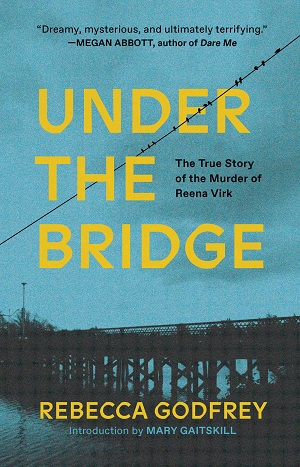
Rebecca Godfrey came to this book with solid credentials for the job, being raised in Victoria and having previously published a novel called The Torn Skirt about teenage girls in Vancouver who are involved in drugs, gangs, and prostitution. Under the Bridge isn’t what I’d call “novelistic” though, and its main literary flourishes are relatively subtle ones like the use of repetition for rhythmic effect. It’s a good read, and as a work of true crime it also indulges a more subjective point of view than you’d expect from say a journalist. But at the end of the day I wasn’t sure if this was a plus, or even if Godfrey really understood these kids all that well.
Moral judgment comes with the territory when writing true crime. One expects condemnation of the wicked and sympathy for their victims. And in what I have to say here I don’t want to be mistaken as saying that the wicked here weren’t truly wicked, and Virk not a tragic victim. But I felt that Godfrey was telling the story slant or leaving things out. Virk herself, for example, was a very troubled kid, but Godfrey doesn’t go into any of her history at all.
Obviously Godfrey despises the two main “bad girls”: Ellard and Nicole Cook (whose name is changed to “Josephine Bell” for legal reasons here). But Cook’s explanation of her initial motive for attacking Virk wasn’t “embarrassing and petty.” Apparently Virk had stolen an address book that belong to Cook and was phoning up Cook’s friends and spreading rumours about her, including that she had AIDS. “Her anger at Reena’s transgression,” Godfrey writes, “seemed to Josephine a perfectly normal response.” I think it was. Obviously things went much too far, but I can’t find fault with Cook being very angry at Virk. These things don’t just matter to high-school girls.
Then, much later, a big deal is made out of the low-cut red top Ellard wore to court the day she was granted a new trial. Most of the shock and outrage over this comes from the report of a journalist who attended the court that day, but Godfrey quotes it approvingly. And I wasn’t sure why. I see girls wearing more revealing outfits at the mall or walking around downtown all the time. Isn’t this just slut-shaming?
Godfrey’s loathing of Ellard and Cook is justifiable, though in examples like these I found her oddly out of touch with the lives of the people she was writing about. But what makes her telling of the story even more slant is that her attitude toward the girls is in marked contrast with the way she treats Warren Glowatski. She seems charmed by Glowatski, which is in keeping with the effect he is said to have had on many women, both girls his own age as well as teachers and parents. Was Godfrey another of his conquests? I can’t see why he gets off so easy here otherwise, as he seems to have been just as culpable as Ellard in Virk’s death. The main difference is that he appeared to be remorseful after the fact, but one can question how big a difference that should make or how sincere it was. Certainly Ellard didn’t do herself any favours with her long denial of any responsibility, but what are we to make of this description of Glowatski leaving the courtroom after the announcement of the verdict against him: “When he looked at the little boy [Virk’s brother], it was then that Warren knew, as if for the first time, what it was that he had really done.” How does Godfrey know this? Is it something Glowatski told her? It seems a sneaky way to enlist our sympathy and I wasn’t buying it.
That said, Godfrey does an exemplary job getting us through the many trials of Ellard quickly and efficiently, though the various police interviews come across as just pages of transcripts and the description of the high-school milieu and the personalities involved in the case struck me as missing something. Or a couple of things in particular . . .
Noted in passing:
Among the things Godfrey doesn’t talk about, I found it very odd that she didn’t explore the issues of race and sex more. Indeed, they’re both avoided entirely. I didn’t have any prurient interest, and wasn’t looking for salacious details, but I was wondering how sexually active these kids were. The suggestion is certainly made that boyfriends and girlfriends were having sex, but it’s just left at that.
Then the race of the various actors is also left largely unmentioned. The police would later declare that Virk’s murder wasn’t racially motivated (she was of Indian ethnicity), but this was later called into question. Meanwhile, the various high school gangs modeled a lot of their behaviour after American “gangsta” or rap culture, with one group even calling themselves the Crips. This all seems ridiculous now but probably really did mean something at the time to the kids in question. But what? Were these mostly white high schools? Was the girl (Godfrey names her “Dusty”) who wrote “Niggers rule” on the group-home wall in strawberry jam even Black? Or was this just the kind of thing white suburban kids said in the 1990s?
I don’t think Godfrey needed to go into these matters very deeply, but leaving race and sex totally out of the book seemed like quite an omission. I’m sure they both played a part in what happened.
A more minor point I flagged came when the school guidance counselor asked Glowatski if he’d come in with his girlfriend and talk to some of her other students about “being a couple. A nonviolent couple.” She wanted them to present as role models that “worked out their problems non-violently.”
Really? They were 15 years old. It reminded me of Anissa Weier, one of the girls involved in the Slenderman assault, being part of a program in her high school “helping younger students . . . make good decisions and stay out of trouble.” Would Glowatski be a better role model than her? But I guess the guidance counselor adored Warren, so thought it would be a good idea.
In any event, I understand kids listen to their peers more than they listen to adults, but this still struck me as weird. Were there that many “violent couples” among these adolescents that this was an issue needing to be addressed? Again I have to think that Godfrey might have gone into more detail about the nature of these relationships in order to provide some context.
Takeaways:
It’s easy for adults to forget, or just not appreciate, how truly hellish an experience high school is for many kids.
 This one left me with mixed feelings.
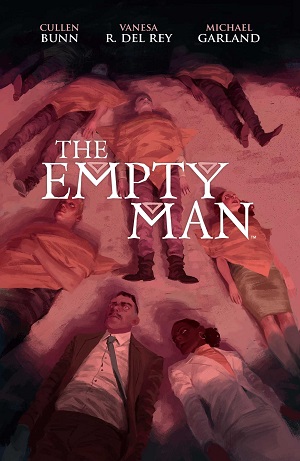
The main problem I had with it is that it’s murky. What I mean by that is two things. In the first place, Cullen Bunn’s story is so vague (not to mention unresolved at the end) that I honestly had no idea what was going on. There’s an outbreak of suicidal dementia that gets dubbed the Empty Man virus because that’s something the victims are heard to mention. There’s a preacher who thinks this might be a sign from or manifestation of God. Or it might be aliens. Or it might be some actual psychic virus, one that began with a possessed patient zero who the Empty Man cult is keeping alive. I don’t know. I’m not sure anyone in the comic understands either. A pair of FBI agents are investigating, and so is the CDC. They have visions and receive messages, but are these just hallucinations? Again, I don’t know. And we’re never told.
(I should add as an aside here that they made a movie “based on” this comic that was released in 2020. From what I’ve heard, it only has the loosest connection to the comic.)
Then there’s the art by Vanesa R. Del Rey. It’s very sketchy and rough. Which you could say makes it a perfect complement to Bunn’s story: you can’t understand what’s going on and you can’t see what’s going on either. What the hell is happening to the woman’s husband in the first issue? Explosive diarrhea? There’s no amount of looking at that picture that makes it clear to me. In other places the drawing is so crude and the colouring so dark I literally couldn’t locate faces, much less read them. No question Del Rey has her own style, but it wasn’t my thing even if it did give the book a really distinctive feel.
These caveats entered, I still found myself enjoying it, or at least committed to reading along. Bunn and Del Rey do, somehow, conjure up an effectively grimy vision of madness, and if it’s all a mess, well, that could just be the way things fall apart in the end times. But don’t ask me to explain any of it.

I don’t remember where I got this, or how long ago. It looks neat though.
Book: Mary Queen of Scots by Antonia Fraser

It may be cold, wet, and snowy, and the holidays are all gone, but if the bins are out you know everything’s going to be alright.
Tim Hortons Apple Fritter Cereal
Overview: An iconic Canadian brand enters the breakfast cereal market with a Post crossover of one of their best-loved donuts. At least I’m calling their apple fritters a donut because they’re baked. But some people would argue the point.
Label: Well, this really is the story isn’t it? The day before posting this review there was a story on the CBC website headlined “Bowled over: Why some Canadians are feeling duped by their breakfast cereal.” The big sticking point with labels on breakfast cereal is, and always has been, whether they include the milk you put on it with the total. Now some companies do you the courtesy of stating if the nutritional values are including milk, and in the case of this box of Apple Fritter cereal they have two columns, with and without a half cup of skim milk (yeah, as if I have any skim milk in my house). However, a lot of cereal packaging does not, which might confuse some people, especially if they’re expecting a big whack of protein. The other bit of misleading information that’s often included has to do with the presence of real fruit in fruit cereals. That can be trickier. I mean, this box says there are “no artificial flavours,” which didn’t make any sense to me. According to the ingredients listed there aren’t any apples in it so . . .
I guess it depends how you define artificial and natural. I take it these words have a technical or legal meaning, but I’m not sure what it is.
Since I always add fruit to my breakfast cereal and I sure wasn’t expecting anything healthy out of the box for a cereal based on apple fritters, this didn’t bother me. But what did was that comparing labels for different cereals is so hard. This is because they are all based on the nutritional values per one cup of cereal. But one cup is 32 grams of Apple Crisp, 43 grams of Honey Bunches of Oats, 55 grams of Shreddies, and a whopping 102 grams of Honey Nut Harvest Crunch (these are all drawn from what I have in my cereal cupboard currently). So if you want to compare them you have to get out a calculator.
I did my best with the math and was actually a bit surprised to see that Apple Fritter Cereal didn’t come off badly at all. Basically most of these cereals are pretty close in terms of sugar. Shreddies does better with fibre, which Apple Fritter Cereal has almost none of. But the bottom line is that this wasn’t as bad as I was expecting. A lot better for you than an actual Tim Hortons Apple Fritter. Donuts are deadly. With (skim) milk, a bowl of this cereal is 170 calories, with 2-3 grams of fat. An apple fritter donut at Tims is 330 calories with 11 grams of fat. Look, nobody thinks breakfast cereal is good for you. But compared to donuts or a muffin, it’s a lifesaving choice.
Review:
The flipside of this being not as devastating as I was expecting nutritionally is that the taste was quite disappointing. I thought I was going to be blown away by apple cinnamon flavour, but in this regard it doesn’t hold a candle to Apple Cinnamon Cheerios. In fact, I didn’t think there was much taste here at all. In shape and texture, the individual “fritters” closely resemble pieces of Cap’n Crunch, but that’s where the resemblance ends. Say what you want about Cap’n Crunch, but that cereal has zip. This was bland, and not in the least filling. I’m not hating on it or saying it’s inedible, but given that I have a list now of a half-dozen or so go-to breakfast cereals I can’t imagine I’ll try it again.
Price: $2.88 on sale.
Score: 4 / 10
 Alex Good