Mighty Marvel Masterworks: The X-Men Volume 1

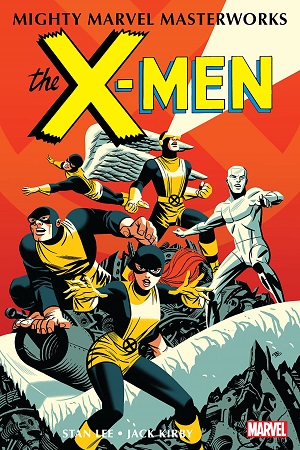
Mighty Marvel Masterworks: The X-Men Volume 1

The Mighty Marvel Masterworks volumes present the early days of familiar heroes and in the case of the X-Men we’re talking about a clean start because they aren’t heroes who made guest appearances in other comics before getting their own. They debuted with The X-Men #1 in September 1963 as something totally new. They also didn’t have any kind of origin story because Stan Lee was apparently tired of those so he just made up the idea of them being mutants (the original name of the comic was going to be The Mutants).

But I just exaggerated when I called them something totally new. We hadn’t heard these names or seen these faces before, but as the covers of the first two issues made clear, this was a superhero team that was very much “in the sensational Fantastic Four style!” So there’s a brainy leader (Reed Richards, Mr. X/Cyclops), a pretty girl with psychokinetic powers (Invisible Woman, Marvel Girl), some muscle (the Thing, the Beast), and a Mr. Cold (Iceman) instead of a Mr. Hot (the Human Torch). I guess the main difference here is that the whole team are supposed to be teens. Or, as the cover again heralds, “the most unusual teen-agers of all time . . .” I never thought of the X-Men as teens because they weren’t in the comics I read as a kid. But again they were just starting out here (the volume collects X-Men #1-10) and Marvel was appealing directly to a teen audience. Even Namor and Professor X have faces that make them look all of about 15 years old. Iceman is the youngest, for which he is mocked and even addressed as a “teen-age brat of a mutant” by Unus the Untouchable, but I don’t see how he can be much younger than the others if they are all teens. We’re told at one point that he’s 16, so he might still be in high school whereas the others are the equivalent of college freshmen, if any of them actually go to a real school.

So the “gang” (as they refer to themselves) were still finding their way. That’s clearest in the character of the Beast, who begins not as the blue gorilla he later transformed into but a wisecracker more like Ben Grimm. But then starting in X-Men #3 he’s shown reading an Advanced Calculus textbook and his vocabulary takes a big jump up. As a character he’s found his voice, and it won’t be long before he’ll be calling Namor a “piscatorial pirate.” That’s the Beast we all know.

Given how much I like (1) early Marvel comics, and (2) the X-Men franchise, I thought I would enjoy this a lot more. The thing is, I didn’t know the early X-Men well, aside from the odd costumes. But I think you would have been hard pressed in the mid-1960s to see anything in this series. They just aren’t very good comics. A lot of the super powers on display – like the psychokinesis of Marvel Girl and Magneto, the thought projections of Professor X, and the repulsion force of Unus – are invisible energy fields that can only be represented by squiggly lines. I think every issue has a page or two or three set in the training area of the Danger Room, and these are dull and repetitive filler. The budding love between Scott (Cyclops) and Jean (Marvel Girl) is schmaltzy true romance stuff. He thinks: “If only I could tell her the words I really want to say! How gorgeous her lips are . . . how silken her hair is . . . how I love her! But, I dare not . . .” She thinks: “I can’t listen to my own heart! I must be detached . . . unemotional!” When he is injured she indulges further: “Oh, Scott! My heart just breaks when I see you so pale, so shaken! If only I could comfort you with my arms . . . my lips . . . But I know I mustn’t! As our acting leader, you’ve no time for thoughts of romance! If only we were ordinary humans . . . free to follow the urgings of our hearts! But, I mustn’t allow myself such hopeless dreams.” And he thinks: “When she stands this close to me, I forget everything but my desire to reach out . . . to embrace her!”

They definitely don’t write comics like that anymore. And that’s progress. I mean, in one startling aside we even find out that Professor X is pining after Jean but dares not express his love for her. And that’s creepy.

So here’s the first ten issues of The X-Men and they’re really not very good. There are a surprising number of typos in the text. There’s more interesting drama going on in Magneto’s League of Evil Mutants than there is among the gifted teens. And when your best villain is a truculent, unmoveable force like the Blob and supplemental figures like the Tarzan rip-off Ka-Zar are your guest headliners, then it just feels like a lot of B-listers are duking it out. I mean, get a load of the Vanisher’s costume! Is he supposed to be dressed as a flower? Even the source of the team’s name is kind of dumb: “I call my students . . . X-Men, for Ex-tra power!” Sheesh. They really needed Wolverine.

I did get a smile though out of the Vanisher demanding ten million dollars “tax-free” from the government. Because what supervillain wants to pay taxes on his blackmail money?

Graphicalex

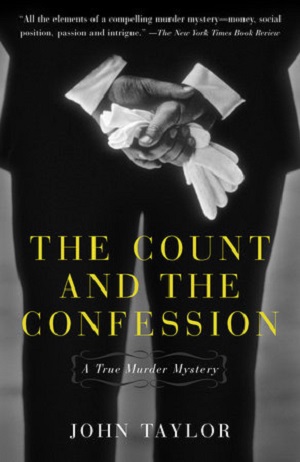
TCF: The Count and the Confession

The Count and the Confession
By John Taylor

The crime:

On the morning of March 5, 1992 the body of 60-year-old Roger Zygmunt de la Burde was discovered lying on a couch in the library of his Virginia estate with a revolver next to him and a bullet in his head. Originally considered a suicide, police investigators began to suspect Burde’s lover, Beverly Monroe, of being his killer. Monroe had been with Burde the previous evening and was the last person known to have seen him alive. After a long battery of coercive interrogation Monroe seemed to confess to killing him. Upon being formally charged she denied having been involved and claimed to have been brainwashed by the police. She was convicted at trial, but the decision was reversed on appeal in 2003 and Monroe was released from prison. It’s still unknown who killed Burde, or if it was a case of suicide.

The book:

A year or so ago I did a bunch of research into the culture that has grown up online that deals out supposed “hard truths” about dating and relationships grounded in evolutionary psychology and big data.  A lot of this on the male side – the manosphere or red-pill community – is openly misogynist, though there are similar hard truths, culled from the same sources, for women to take aim at men with.

I found myself thinking about these findings when reading The Count and the Confession because they provided a helpful paradigm for thinking about the relationship between Roger de la Burde and Beverly Monroe. Helpful in the sense of making understandable what, on the face of it, made little sense to me. This isn’t to say that I took the book as endorsing any of these paradigms, whose validity I find open to question in various ways, but I do think they provide an interesting entry point to the case. With that caveat registered, let’s dig in.

In the first place you have the question of what men want. At the most basic biological level this can be boiled down to reproductive success for young men and end-of-life health care for older ones. Burde wanted both. In terms of reproduction this was mixed in with a twist of Old World chauvinism, as only a male heir would do. He had daughters but they really didn’t count. He wanted someone to carry on his (made-up) family name. This became nothing short of an obsession in his final years, as he took to basically looking for any available womb and inquiring if it might be for rent. And I very much don’t mean he was looking for sex with younger women. He wanted a woman who was capable of having children and that was it. When he found one it was straight off to the fertility clinic and drawing up a legal agreement laying out how all this was going to work (Item 3: “Child/children will carry de la Burde name. This name cannot be changed until maturity or marriage.”).

The last part of the written arrangement, however, also provided for the second biological imperative. Item 6 states that the surrogate “obliges herself to help care and cater to R. B. in his advancing age.” One suspects this is why he kept Monroe around as well. She was past child-bearing age but could still function adequately as a nurse. Oh, those selfish genes!

Then you have the question of what women want. Again staying at the most basic level, this is usually reduced to resources. In cultural terms this translates as status, which is something that even outlives the reproductive imperative. Which is to say, even after menopause women are still mating for status.

But the thing about status is that it isn’t a real thing. The perception of status is the reality. This, at least, is the only explanation I had for Monroe’s attraction to Burde. As far as can be gleaned from the story here, Burde wasn’t just a complete phoney (his claims to being a Polish aristocrat were entirely bogus and even some of his much ballyhooed art collection was apparently forged) but someone who alienated many of the people who knew him best, including his own kids. Despite living in a big house he wasn’t that rich, and money troubles may have been one of the things weighing on him at the end. But he was educated and he did go to swank parties and he dressed well and he lived on that big estate. In short, he had status.

I wasn’t the only one scratching my head over Monroe’s attraction. Even she had to sit down and write out her thoughts on why she stayed with him to try to understand. Meanwhile, the jury found Burde “so despicable a person” that while finding Monroe guilty of murder “it was almost justifiable homicide.” The incredulity of one lawyer at the trial sums the matter up pretty nicely:

Warren Von Schuch, who had not known what Krystyna’s testimony would be [Krystyna was the woman Burde had gotten pregnant just before his death], listened with mounting incredulity to her story. The feminist movement would not be pleased, he decided. Beverly with her master’s degree  and Krystyna with her Ph.D. in biochemistry and they’re fighting over Roger de la Burde. Twenty-five years of feminism and this was far as they’d gotten.

Even Monroe’s defence lawyer had to go out of his way to address the point. “You may ask yourself why . . . why did this lady, this nice-looking lady sitting behind me, why did she put up with all this malarkey, this junk? Why didn’t she say, ‘I want out of here,’ ‘Hit the road,’ ‘Forget it fellow’? And the answer is . . . she loved him.”

And I’m sure she did. But this begs the question of what is meant by “love.” Wasn’t what Roger felt for the future mother of his children love? Wasn’t it love he felt for the woman, or women, who would promise to “care and cater” to him in his old age? This is where I find the harsher, evolutionary psychology approach to relationships comes into things. It’s incredible to me that Monroe could have loved someone like Burde, but if you translate “love” as an attraction to a man who had status and presumably some charm, however false, then it makes sense. One of the harsher mantras among the red-pill community is that women don’t fall in love with a man but a lifestyle. The lifestyle is something Burde had. The man was worthless.

I don’t know if that’s what was going on. It’s just a way of viewing the personalities involved through a particular lens. But in a “true murder mystery” like this you naturally start looking around for guideposts. For what it’s worth, it seems highly unlikely to me that Monroe killed Burde. Her behaviour after the fact, especially in relation to the police, doesn’t make any sense if she did. Her “confession,” such as it was, was so obscure as to seem almost surreal even when placed in context. It also appears to have been co-opted, and the behaviour of the police went beyond the usual (and inevitably disastrous) tunnel vision into something altogether darker. One of the investigators hired by the defence made a note on how he thought the agent in charge might even have been insane.

John Taylor provides a very full reckoning of the case. Indeed, I thought there was more here than I cared to have, especially with regard to Monroe’s family (one of her daughters played a key role in her appeals). Though not a particularly long book, it feels heavier than its page count and I could have wished it a hundred pages shorter. It does read well, however, and for anyone interested in the psychology of the false confession, or just looking for a true crime story that has the drama of a well-scripted podcast without playing fast and loose with the facts, it can be heartily recommended.

Noted in passing:

Why are polygraph devices or “lie detectors” (I have to put the scare quotes on such a name) still in use? Just to manufacture evidence in cases where the police have nothing else to go on? I think they must be like diet pills for obese people: a magic bullet that will make the problem go away without having to actually do the hard work of losing weight/investigating a crime. They’ve never been shown to have any significant scientific validity and yet they’re still widely employed by law enforcement.

So why are they still with us? Wikipedia provides one answer:

In 2018, Wired magazine reported that an estimated 2.5 million polygraph tests were given each year in the United States, with the majority administered to paramedics, police officers, firefighters, and state troopers. The average cost to administer the test is more than $700 and is part of a $2 billion industry.

Takeaways:

Innocent or guilty, you have nothing to gain by talking to the police. It won’t do you any good and could get you in a lot trouble.

True Crime Files

Batman: His Greatest Adventures

Batman: His Greatest Adventures

Batman: His Greatest Adventures is a collection of standalone titles from Batman Adventures, which was the tie-in comic to the Batman: The Animated Series show. That’s where the style of artwork comes from, which you either love or hate. Personally, I love it. It’s highly stylized, with exaggerated but simplified forms. Batman’s face is represented as a flat plane like the side of an office building, and the Penguin (who in one story arc becomes mayor of Gotham) has the appearance of an Art Deco paperweight. Even Cat Woman, who looks more like a cartoon mouse with giant ears than a cat, is lots of fun.

The Joker and Riddler also show up, as well as Spellbinder in the final story, which is set in the Batman Beyond universe. Two villains you won’t see though are Two-Face and Poison Ivy, who are the two figures standing behind Batman on the cover. Talk about false advertising! How do comics get away with this?

Things start off great, with the first story being the best. It seems the Penguin has taken over Gotham Zoo with a flock of radio-controlled birds. I didn’t care as much for the other episodes. The Cat Woman story was good and the rest were only so-so. I thought the Batman Beyond episode had too much going on to fit into one comic, and the Scarecrow comic was just weak. All of the stories tend to wrap up quickly, but that’s the format.

Neither as dark as Batman too often gets, nor overly complicated in plot terms, this is just a bit of throwback comic fun. I haven’t read widely enough in the Batman Adventures to know if the stories collected here are the best in that series, but I had a real good time.

Graphicalex

Quarter-century round-up

I started my book review site Good Reports in 1998, which I believe makes it one of the longest-running personal book sites in the history of the Internet. I’ve just finished putting a quarter-century in. I launched Alex on Film and this site in 2014, so I’m wrapping up my first decade with both of them. A good time then to take a look back, and ahead.

For the last several years I’ve talked about how I’d like to do more book reviewing at Good Reports, but it’s been hard. Between the regular science-fiction reviewing I do (at Alex on SF) and new features I’ve started on this site like the True Crime Files and Graphicalex, I’ve moved my book commentary around a bit. But I also read less literary stuff, especially fiction. As I’ve said before here, I’ve fallen into “old man” reading habits: mainly history and politics. And at this point I really don’t see that changing. Another old-man habit is wanting to re-read favourites, or spend more time with the classics. You give up a bit on newer stuff that, even if you think it’s well done, doesn’t speak to you as much. And finally there is the fact that some of the reviews I’ve been doing at Good Reports have been a lot of work. My omnibus review on books about evangelical support for Trump was 2,500 words, and the one on the “Road to Trump” clocked in at over 7,600 words. I find these subjects fascinating, but still that’s a big commitment, for both me and the reader.

Alex on Film continues to get the most traffic of any of my sites now, which makes sense because it’s (1) the site that updates the most, and (2) it’s about movies. That said, I haven’t been writing as much there either. After a while, you feel like you’ve said all you have to say and you’re stuck repeating yourself. There’s also the problem that I don’t care much for new movies and old movies come with so much baggage they feel like a burden to write about. What’s the point of doing up my notes on Citizen Kane or Vertigo or Blade Runner? I’m pretty sure everything that not only needs to be said but could be said about these movies is already out there.

And of course weighing down on all of this there has been the burden of real life. 2023 was a horrible year. I was actually a bit surprised I managed to get through it in one piece. Having made it to the finish line I know I’ll be taking some time off in 2024. I’m very much in need of it. Moving forward, I think I’ll just be updating whenever I can or have something to say. There will be fewer regular postings. At some point in 2024 I hope to start a showcase for my bookmark collection, but that’s the only big new development I see happening. A return to movie quizzes will probably have to wait until 2025, if I manage to last that long.

So there you have it with 25 years online. 1,250 book reviews at Good Reports, another 370 at Alex on SF,  just over 2,000 film reviews at Alex on Film with 200 quizzes, and then lots of other stuff that I’ve posted on here to pass the time. This has always been just a hobby and I think the main thing that’s kept me going is that I’ve only followed my own interests and never taken any of it very seriously. That mindset might see me sticking around for another 25 years, or walking away. You never can tell.

TCF: The Missing Cryptoqueen

The Missing Cryptoqueen
By Jamie Bartlett

The crime:

In 2014 OneCoin became just another one of the many newly minted cryptocurrencies looking to cash in on the success of Bitcoin and the much ballyhooed blockchain revolution. What made OneCoin, the brainchild of Bulgarian-born Ruja Ignatova, different was its promotion through a multi-level marketing (MLM) scheme and the fact that there may never have been any actual, or virtual, OneCoins in the first place.

After years of muttering from sceptics over whether OneCoin was a Ponzi or pyramid scheme (in fact it was both, a combination that “rendered facts and logic irrelevant”), the system eventually broke down, a victim of its own success. Billions of “real-world” dollars disappeared, along with tens of billions of “fictitious losses” (an accounting based on what OneCoin was supposed to be worth). Most of the higher-ups in the organization would end up convicted of various financial crimes, but Ignatova herself disappeared in October 2017 and remains missing. Some reports say that she is dead, killed by Russian or Bulgarian mobsters, while others have it that she’s swanning about the Mediterranean on a yacht (which is the conjectural conclusion that’s reached here). As of this writing, she is the only woman on the FBI’s Ten Most Wanted list.

The book:

I made a post a couple of years ago expressing my scepticism of all things crypto. My feeling at the time was that it was mainly a tool being used by bad actors or the very rich to hide their financial dealings. But I also said I didn’t understand the first thing about blockchains and mining. And, since one of my maxims is to not invest in things I don’t know anything about, I’ve always stayed away from crypto. Which I think is pretty good advice for anyone.

The people who put their faith (and life savings) into crypto thought differently. In the digital economy it’s never been a problem if “what exactly investors were buying was vague and unclear.” But never mind the investors. It’s doubtful if Ignatova understood what she was doing either. Her OneCoing co-founder certainly didn’t. Nor did anyone in their MLM network. As Jamie Bartlett puts it when telling the story of one befuddled OneCoin promoter, his “job wasn’t to understand OneCoin, it was to sell it.” Or take this account of OneCoin’s launch:

The genesis block was now launched and the first set of new coins was being “mined.” People in the room must have wondered what that phrase actually meant. Oh, they all repeated the words – genesis block, mining, algorithms – but few had any idea about the technology behind it all. What exactly was happening? Bitcoin’s mining was transparent and distributed – anyone could join, and thousands did. But OneCoin’s mining process was mysterious and secretive. Some in the crowd had heard rumors that two “supercomputers” at hidden locations were cracking puzzles and getting the newly generated coins, which would then be sent to investor accounts, depending on how many packages they’d bought. Most people didn’t care about the finer details though. They’d just heard it was the next Bitcoin.

“Good scams aren’t about facts or logic.” What could possibly go wrong?

Meanwhile, the psychology behind OneCoin’s success is worth unpacking, which is something Bartlett does a good job with:

Greed or desperation alone doesn’t explain why OneCoin hit momentum so fast because those emotions are present in every MLM company, including the ones that fail. Something more powerful was at play: the fear of missing out . . . FOMO. Most OneCoin investors who put money in around this time said the same thing: They didn’t understand the technology but they’d heard of Bitcoin and regretted having not invested. When Bitcoin went stratospheric in 2013, stories proliferated of ordinary people making life-changing money not because of any particular skill or specialized knowledge, but because they got in early. The majority of these early investors weren’t destitute, but they were often just getting by. OneCoin felt like, for once in their life, they’d finally got a break.

Not so different then from buying lottery tickets, only shadier. “FOMO is driven by a desire to get rich quick, a willingness to replace work or effort with a risky bet.” As Glenn Frey sang in “Smuggler’s Blues”: “It’s the lure of easy money, it’s got a very strong appeal.” You don’t need “any particular skill or specialized knowledge.” It’s all a matter of timing. And this is a point that I think is worth underlining. Timing is everything precisely because you know the next big thing isn’t going to last. At some fundamental level you don’t believe in what you’re investing in. You know it’s a scam. You just think it’s a scam that you’ll be able to walk away from, leaving the proverbial “greater fool” holding the bag.

Of course none of it could stand very much looking into, but then who could look into it? Even if you were one of the dozen or so people in the world capable of figuring out their blockchain, OneCoin was a black box. An empty black box, at that. In any event, for investors, “It was nicer to dream than to think.”

“Money has a funny way of fencing off difficult questions and incentivizing strategic and defensible ignorance.” Because what would you rather believe? You can see how magical thinking feeds into stories like this. Just keep the faith and you too can be a crypto millionaire. You only need what a Bernie Madoff biographer described as a “well-defended mind.” And this isn’t all make-believe. With enough money you really can make your own reality and build a wall between yourself and a world that doesn’t play by your rules.

Given how complicated a story this is on anything but the most basic, crypto gold-rush level, it’s not too surprising that I had trouble keeping up with Bartlett’s narrative in places. The financial shenanigans were as opaque, and as deliberately opaque, as the crypto stuff. The whole enterprise was shell companies inside shell companies and money stuck into hidey-holes in secret accounts in tax havens all over the world. Curacao in the Caribbean, Vanuata in Oceania, Dubai. Again I had to wonder if even the experts who set some of this stuff up understood what they were doing. But complexity was the point.

The global reach of the scheme was amazing. Obviously there have been global criminal operations before, but the Internet really kicked this kind of thing into overdrive. All of Europe went into making Ruja: born in Bulgaria, raised in Germany, and with a master’s degree in Comparative European Law at Oxford (the prestige of which helped a lot). When OneCoin took off (or achieved “momentum,” as they say) it hit hardest in Malaysia, Singapore, and Hong Kong. From there it spread quite literally everywhere. “Nowhere symbolized the OneCoin craze better than Uganda,” Bartlett writes. The company grew in almost every country on earth, “but nowhere was quite like China.” Then, as the mature markets dried up in Europe, America, and Asia, growth continued in places like Colombia, Malawi, South Africa, Brazil, Trinidad, and Argentina.

As with global financial crises, a scam like OneCoin had no borders.

Despite a lot of it going over my head, I thought Bartlett did a great job telling the story and relating the essential points. He is sympathetic to some of the lower-rung investors while at the same time registering their culpability. He even draws a brief, devastating portrait of “MLM people”:

Despite their ostentatious conviviality, Konstantin [Ruja’s brother] noticed there was an emptiness to the MLM people he was introduced to. All they talked about was money: their cars, their new recruits, their Dolce & Gabbanas, their rank. Conversations revolved around the new downline they’d just opened or their weekly business volumes. Normal human interactions had been hijacked by a commissions parasite that turned everything meaningful into plastic talk disguised by self-help mantras about “first helping others.” They talked about the books they had read, not for enjoyment but to learn how to win friends and influence people. They met relatives for coffee, not to catch up but to propose an exciting new opportunity. Years in MLM does that to people.

Eventually it does it to Konstantin too. He starts out as a somewhat likeable guy but ends up infected with the dirt of the grift. It’s like another fall of man.

Noted in passing:

At one point Bartlett refers to Bulgaria as “the most corrupt country in Europe.” I can’t say this surprised me, but it did make me want to do a fact check since I don’t know what the most corrupt countries in Europe are.

There are different rankings and metrics available. It does seem that Bulgaria was ranking near the top of the corruption chart a few years ago (2019), but has since improved. Or maybe its change in position is more a relative thing. The most recent tables I found had Lithuania, Russia, and Ukraine all rating as more corrupt.

I’d also note that Europe scores well on these indexes and that globally the most corrupt nations are far more likely to be found in Africa, the Middle East, and Latin America.

This is another podcast that’s been turned into a book. There seems to be a lot of this happening, especially in the case of true crime. I’m not complaining, as it makes sense as a way of building interest and some of the books with such an origin have been pretty good (though most, at least in my experience, have been below average to downright poor). I just flag it here because it’s now become such a significant part of the evolution of publishing.

Takeaways:

Obviously, if it seems too good (the money too easy) to be true, then it probably is. Alas, this is a lesson that’s undercut by the everyday operation of our lottery economy. Why shouldn’t the legendary “little guy” get rich off the crypto gold rush? Why shouldn’t they get a break? Because, as a very wealthy investor once told me several decades ago about how to get rich in the stock market, the little guy is always the first to lose when there’s a correction and the market flushes out all the suckers.

True Crime Files
Birches

Birches

Robert Frost is one of my favourite poets. I think he’s a favourite poet for a lot of people. A few years back (well, I guess it was a quarter-century ago, because time does fly) the American poet laureate Robert Pinsky ran something called the Favorite Poem Project and Frost had a half dozen poems in the mix, with “The Road Not Taken” being the clear winner among the more than 18,000 entries.

“Birches” isn’t quite as well known, but it’s still popular among what the critic David Orr refers to as Frost’s two audiences: poetry devotees and the great mass of readers. To these two (obviously not mutually exclusive) groups I’d add a third: those versed (as Frost would put it) in country things. This seems obvious to me because I grew up on a farm, close to nature. This was both a good and a bad thing, as Frost himself knew, but more than that it’s also a very rare thing in today’s world. I think something like 5% of the current population of North America grew up on farms. So most people aren’t versed, or at least as versed, in country things.

When I read “Birches” I like what it gets right. Like when, after a storm, the trees are encased in an enamel of ice that melts in the next day’s sun, the “crystal shells / Shattering and avalanching on the snow crust.” Why the snow crust? Because there’d been an ice storm and that means the surface of the snow is a hardened carapace that the broken ice bounces off. Or take the whimsical evocation of “some boy”

As he went out and in to fetch the cows – Some boy too far from town to learn baseball,
Whose only play was what he found himself, Summer or winter, and could play alone.

Damn. That really was me growing up. Even walking out to fetch the cows.

I mention all this only as a way of bringing up the fact that I have never heard of anyone riding birches the way Frost describes the activity here. I even have trouble imagining how it would be possible. I looked on the web and couldn’t find any videos of it. And more to the present point, despite it being what the poem is, on the surface, “about,” Ed Young doesn’t illustrate any kids doing it. Perhaps he didn’t know what it looked like either.

What Young’s paintings do re-create is the peculiar forest camouflage of the distinctly patterned birch trees. The way their short horizontal stripes balance the long verticals of their trunks and the spangle of their canopy, a very dome of sky flecked with shimmering fire. And of course there are those country things, like bringing in hay and walking the dog. This is the landscape and poetryscape of memory, if you were there. The past is another version of the poem’s vision of heaven that we can climb toward, if only to be dropped gently back to earth. And I can’t say I’d mind being snatched away to such a place, not to return.

Graphicalex

Books of the Year 2023

As per usual, I didn’t read a lot of new fiction, outside of my SF beat, this past year. Last year at this time I mentioned how typical this was of “old man” reading habits. This is something I’ve become aware of more and more. Complementing my need for bifocals and ongoing physical and mental collapse I can now add the fact that I read like an old man.

What do I mean by that? A lot of history and politics. This seems to be part of the aging process. I think an interesting essay or column is in there somewhere. Why do older people lose interest in new fiction, and especially new fiction by young voices? Because we can no longer identify or understand the world it describes? I’m not sure, but I’m feeling it.

Best fiction: Paul Lynch’s Prophet Song won this year’s Man Booker Prize. No, I really don’t think that means anything, but I just thought I’d point out that sometimes prize juries do make a decent pick. It’s possible, if unlikely, that some jurors even occasionally look at a few of the books they’re considering.

Lynch’s evocation of a dystopic Irish police state is lyrical and raw, literary and frightening. Clearly there is a lot of political anxiety in the air these days.


Best non-fiction: Do we live in revolutionary times? I think we do, but that may be another part of getting old (see above). I read a couple of good books on revolutionary moments this past year, The Revolutionary Temper by Robert Darnton (on the build up to the French Revolution), and  Revolutionary Spring by Christopher Clark on Europe’s “Year of Revolutions.” Both are excellent, but I’ll give the nod to Clark’s book for its narrative sweep and the number of notes I had to make while reading.


Best SF: I didn’t think this was a great year for SF, though there were a number of books I quite enjoyed. A couple of fun SF detective stories — Station Eternity by Mur Lafferty (actually this came out in 2022) and Wormhole by Keith Brooke and Eric Brown — stood out, as did the graphic novel Why Don’t You Love Me? by Paul B. Rainey. I’ll go with Samantha Harvey’s Orbital though, even if it’s probably not the kind of book a lot of hard and hardcore SF fans will thrill to. There’s literally no story to it at all. Instead, it’s a poetic meditation on our connections to the Earth and to each other.

TCF: Watergate

Watergate: A New History
By Garrett M. Graff

The crime:

A team of covert operatives under the direction of the Republican Committee for the Re-Election of the President (CREEP) was arrested after breaking into the headquarters of the Democratic National Committee in the Watergate Office Building in Washington D.C. in the early hours of June 17, 1972. It would later turn out that the break-in was only part of a larger campaign of dirty tricks (a.k.a. ratfucking) being waged by CREEP. The subsequent investigations and attempted cover-up by the White House would lead to multiple criminal convictions and the resignation of President Richard Nixon a couple of years later.

The book:

In the fifty years since Watergate the suffix –gate has become shorthand for any sort of political scandal. This despite the fact that what actually happened a half-century ago still isn’t all that well known, even among students of the period. Despite its notoriety, the facts in “Watergate,” at least what is known of them, make up a highly complex story that’s hard to get one’s arms all the way around. “Watergate was never a one-off burglary,” Garrett Graff writes. “It was the Gordian knot of scandal, unable to be untied neatly or at all.” Even today there are still a number of unanswered, and perhaps unanswerable, questions.

At nearly 700 pages, Graff’s “new history” certainly tries to be exhaustive as well as precise. Perhaps too much so. I felt that in several places he was getting lost in the weeds. But the thing is, the network of scandal, bad behaviour, “dirty tricks,” and outright criminality that constituted “Watergate” was hard for anyone covering it at the time to keep straight and is even more difficult now when so many of the names and faces, each of them involved in so many shady activities, have been forgotten. Then there were all the different investigations. Reading, I found myself constantly shifting gears as I tried to remember whether a particular legal point being raised had to do with the grand jury proceedings, the Senate Watergate Committee, or the House Judiciary Committee on impeachment. At one point I found myself wishing that Graff had included a cast of characters as a reference, but then wondered how long such an index would have been. Twenty pages at least. There were a lot of players.

A big part of what makes Watergate confusing is the fact that everyone involved had a slightly different, personally exculpatory, tale to tell (and in almost every case a tale they told, in their memoirs) about how it all went down. Then there were all the ancillary examples of other misdemeanors, many of them long forgotten. I think most people know how Vice President Spiro Agnew was forced to resign under a cloud (pleading no contest to a single felony charge to avoid further embarrassment) at the same time as the Watergate hearings were getting all the headlines. This is something that would normally stand out as a historical watershed but for the fact that his boss would soon follow him into exile. But who today remembers the Chennault affair? The Huston plan? The fact that the Pentagon was spying on the National Security Council? The Dita Beard memo? I knew nothing about any of these but they were all part of the same White House culture.

Then there is the fact that the break-in was so stupid that it’s hard to understand how it made sense to the actors involved. Nixon would go on to win the presidency in the 1972 election in a historic landslide, taking every state except Massachusetts, so why would he bother cheating? What advantage did he think he would gain? Or did the people in charge not take nuts like Gordon Liddy seriously? As Chief of Staff Alexander Haig later opined, “The original crime was stupid, and the idea that it was possible to cover it up was more so . . . I thought that Nixon was just too smart to be involved.”

As an aside on the point of why Nixon bothered, here is biographer John A. Farrell writing in Richard Nixon: The Life:

It is said that the Watergate break-in was an act of folly because by the time the burglars were arrested Nixon had triumphed in Moscow and Beijing, the radical McGovern had clinched the Democratic nomination, and Nixon’s reelection was assured. But until the Easter Offensive [North Vietnam’s invasion of the South], and the Russian summit secured, the White House was still caught up in the fear that the Democrats would coalesce around Senator Edward Kennedy. In mid-April, as Jeb Magruder and Gordon Liddy were plotting to break into the Watergate, Nixon was weighing the ugly prospect of defeat in Vietnam – and the fall election.

I think understanding how it all came about is important, and lies at the heart of what I think is really significant about Watergate. Yes, it was a clusterfuck that very much reflected the personality of the president and the toxic environment that his administration had become: its paranoia, vengefulness, and sheer nastiness. (Though the ball apparently got rolling mainly thanks to National Security Advisor Henry Kissinger’s meltdown over the Pentagon Papers – the publication of which initially didn’t bother Nixon at all.) But the scandal also highlights the way many such power structures operate. The point is to insulate those at the top with what became known as “plausible deniability.” The sign on Harry Truman’s desk, The Buck Stops Here, was always a joke, as it is in every CEO’s office, and Watergate only drove the point home. The buck is meant to stop long before it gets to the guy at the top. Power is all about being free of responsibility.

There was nothing new in Nixon operating this way. Throughout history the man at the top has enjoyed immunity from blame when things go south. Leading up to the Russian Revolution the masses spared the tsar from most of their anger, feeling that he was just surrounded by evil advisors. A few hundred years earlier Oliver Cromwell had to struggle against similar popular sentiments just before the outbreak of the English Civil War. He had to explicitly reject Parliament’s claim that they weren’t going to war against the king but against his “evil counsellors.” As Christopher Hibbert relates the story in his biography of Charles I, “Cromwell thought this pure casuistry and told his men that if he charged the king he would fire his ‘pistol upon him as at any other private person,’ and that anyone among his recruits who didn’t feel able to do the same could go enlist with someone else.”

One way people in positions of leadership maintain this degree of insulation from the acts of their agents, operatives, and flunkies is by the vagueness of their directions. The clearest historical example of this is presented in Ian Kerhaw’s biography of Adolf Hitler, where he describes the process of what he calls “Working towards the Führer.” What this refers to is the way in which radical actions were often instigated from below, not as the result of express directives, but because they were felt to be in line with Hitler’s broadly defined aims. This was so successful that even today there is no “smoking gun” in the historical record tying Hitler to the ordering of the Final Solution.

All of which brings us back to Watergate and Howard Baker’s famous line about “What did the president know and when did he know it?” We still don’t know. In the final pages of this book Graff presents the points of view of two of the closest of the president’s men:

Haldeman, speaking decades later, said, “No one here today, nor anybody else I can identify, knows who ordered the break-in at the Watergate or why it was ordered.” Ehrlichman, for his part, “The break-in itself made no sense to me; it never has.”

Well, as the saying goes, success has many fathers and failure is an orphan. So it has always been. From the evidence we do have though it seems clear that everyone in the administration was “working towards Nixon”: planning a campaign of dirty tricks that weren’t directed from above but which were in line with the sort of thing Nixon wanted to see happening. And he very well might have got away with it, despite everyone knowing he bore ultimate responsibility, but for the fact that there was a smoking gun in the form of the White House tapes. These nailed him for the cover-up, if not the crime.

To recap: I learned a lot more about Watergate from this book than I thought there was to know, as well as the numerous related side-hustles. I did think there was a bit too much detail in places, the getting lost in the weeds I mentioned above, but even the footnotes (of which there are multitudes) are worth reading. I also really appreciated the way Graff took down pretty much everyone involved, including some names who have previously got off relatively easily. The portraits of Mark Felt (Deep Throat), John Dean, and Al Haig are memorably etched in acid. But to be sure there are still unanswered questions that get to the heart of the affair, which is why Watergate will continue to fascinate generations of historians to come.

Today, we’ll never really know the full truth of Watergate. The remaining mysteries are spread among too many people, many of who are now dead, their secrets buried alongside them. There remain big, unanswered – and perhaps now forever unknowable – questions even about the central Watergate break-in itself: Who ultimately ordered it? What was the actual purpose and target of the burglars? Were its central players, Hunt and McCord, cooperating with the CIA even as they carried out the operation at the DNC’s offices? Were the burglars really after political intelligence or were they hunting for blackmail material?

My own sense is that many of these questions would be unanswerable even if we could still question all the principals under oath. The break-in was just one bad idea among many that some loose cannons were allowed to run with and that nobody in a position of authority pumped the brakes on, perhaps in part because they figured it was the kind of thing Nixon was pushing for, or because they didn’t take any of it seriously. What the burglars were after was dirt in a general sense, or any information of value. I doubt they could have had in mind anything specific. Then, when it all went south, Nixon was very much in charge of the cover-up, which is what deservedly finished him.

Noted in passing:

Among the related mini-scandals Graff chronicles that have slipped into obscurity is the “bizarre episode” of the so-called Canuck letter. I didn’t know about this one either, but it has to do with an anonymous letter sent to a New Hampshire newspaper that accused then Democratic primary candidate Ed Muskie of referring “to French-Canadians with the slur ‘Canucks.’” As it turns out the letter had been the work of Republican dirty tricksters, but Muskie’s campaign swiftly derailed.

What surprised me was that the term Canuck (misspelled as “Cannocks” in the letter) was seen as a slur, or specifically directed at French-Canadians. In the nineteenth century “Johnny Canuck” was a cartoon figure (a lumberjack, not specifically French-Canadian) who was used to personify Canada much as John Bull and Uncle Sam were used as stand-ins for England and the United States. During World War 2 Johnny Canuck became a comic-book action hero, and in the 1970s Captain Canuck was born. The Canucks are also Vancouver’s professional hockey team. But, as Wikipedia explains in their entry on the Canuck letter, “While an affectionate term among Canadians today, ‘Canuck’ is a term often considered derogatory when applied to Americans of French-Canadian ancestry in New England.”

Takeaways:

A successful conspiracy has to be limited in membership and tightly targeted in its aims. Watergate failed, epically, on both counts. There were simply too many people involved, with no one clear on what anyone else was doing, or why. When it started coming undone there was no way to keep containment on the cancer.

True Crime Files