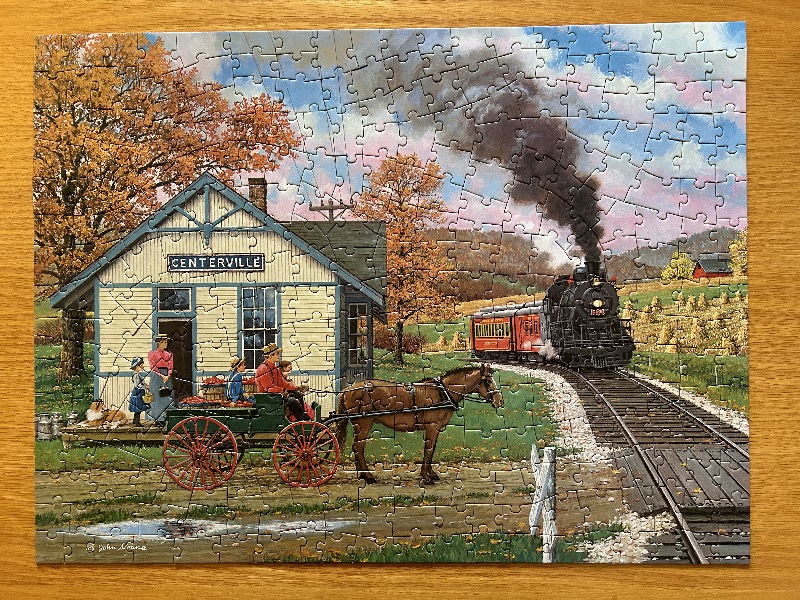
Another favourite puzzle around these parts. Nice and simple. One that you can do in a single sitting.
Another favourite puzzle around these parts. Nice and simple. One that you can do in a single sitting.

The crime:
For nearly thirty years Joaquín Archivaldo Guzmán Loera, commonly referred to by his nickname El Chapo (“shorty” or “stocky”), was one of the biggest drug traffickers in the world, being the leader of Mexico’s notorious Sinaloa cartel. After a long and colourful history of evading and escaping the law he was finally tracked down and apprehended by Mexican and American authorities in 2016, extradited to the U.S., and sentenced to life in prison.
 The book:
I didn’t like this one much. It’s very limited in scope, telling the story of the pursuit of El Chapo from the perspective of American FBI and DEA agents. So don’t expect to find out much about the operation of Guzmán’s empire, or what was happening in Mexico. Also, Alan Feuer’s reporting deals primarily with the various ways agents tried to locate and track the boss through his communications network, which is something that either wasn’t explained all that well or was just over my head since I couldn’t follow any of the details. At no time did I fully understand how the monitoring of Guzmán’s messaging system actually worked.
As for the gangster lifestyle, for all of his money, influence, celebrity, and power it doesn’t seem like Guzmán enjoyed himself much. He was, of course, always on the run, and lived a fair amount of the time in very primitive conditions, even in caves. Then there was the constant threat of violence from other gangs and having to respond to ever-changing market conditions, or the more mundane work of a CEO. It all sounds like a grind to me, not to mention dangerous.
But the Hollywood image of a drug lord – think of Pacino’s Scarface in his trashy Florida mansion – looms large in the popular imagination. And I guess there’s some truth to the tales of excess. Pablo Escobar had his hacienda, stocked with hippos and other exotic creatures. And El Chapo had a gold-plated AK-47 and lots of mistresses. But mostly the life just seems, like Guzmán himself, nasty, brutish, and short.
Even so, Guzmán seems to have been aware of the Hollywood mythology, and sought to promote it. One of the more interesting sub-plots here involves the fact that he kept a screenwriter on staff and was planning on making a movie about himself (with the rather unoriginal working title of El Padrino, Spanish for The Godfather). One of the raids to grab him was even thrown for a loop when it was discovered that Sean Penn had scheduled a visit at the same time. Penn was interested in interviewing Guzmán for Rolling Stone while Guzmán and his team were hoping the Hollywood actor would want to get involved in their film project.
This conflict between Guzmán’s notoriety, or celebrity status and his need to stay anonymous and hidden is one of the more interesting parts of his story. As Feuer puts it, “The ‘paradox of visibility’ was paradoxical only in the sense that Guzmán never wanted to be invisible; he wanted to be seen.” But I don’t think this is quite right. Guzmán did want to be invisible some of the time. He just also wanted to be famous. This is typical of most celebrities: they want to be in complete control of their brand, enjoying all the perks of fame without any of the downsides. But that’s not the way it works. At least not yet.
This isn’t a book about Guzmán though, so we don’t get any deeper into his psychology on this matter. Instead, the main reflection I was left with had to do with Guzmán as folk hero. Not so much for being a provincial big shot, the hometown boy who made good and gave a boost to the local economy while showing up the federal government as corrupt and incompetent fools, as for his fighting against the ineluctable web of digital surveillance. The story here is of an incredibly complex and long-running police investigation that was basically driven by tech people and all their wonderful toys and software. Guzmán was alert to the dangers, and seems to have done a good job protecting himself, but if you want to communicate in the digital age you’re going to be vulnerable to hackers. As terrible a person as Guzmán was, this does make you almost want to root for his escape. Because if he couldn’t free himself from the web, who can?
Noted in passing:
As Guzmán expanded his drug trade into Canada we’re told by Feuer that “It hadn’t gone unnoticed that a kilo of cocaine sold for almost ten thousand dollars more in Montreal and Toronto than it did in Chicago or Los Angeles.” This surprised me a bit. Cocaine costs that much more in Canada? So I did some Internet sleuthing and found that prices for cocaine (this is mostly from the Global Drug Surveys that can be accessed online) vary widely not just between countries but different regions within countries. Overall though, it seems that Canada, which consumes a lot of cocaine, enjoys (if that’s the right word) low cocaine prices. The main rule seems to be that the further the distance from the source (Colombia, say), the higher the price. So cocaine costs a lot in Australia and Dubai. I don’t think Canada is a very difficult country to smuggle drugs into, but I’m guessing most of the cocaine we get comes through the U.S. first so crossing two international borders drives up the price. Still, the amount of mark-up that Feuer cites sounds high.
“Whenever his safety and schedule permitted it,” Feuer writes, El Chapo “loved slipping off to havens like Los Cabos where he could eat well, drink among his friends and have his pick of the local professional talent.”
Is this use of “talent” widely understood? My own understanding is that what’s being referred to are escorts or prostitutes, but that’s mainly an inference from the word’s use in the porn industry, where “talent” refers to performers, with everybody else being business or tech support. I didn’t think “talent” meaning prostitutes was that common an expression, capable of being tossed off here in such a casual way. But I might just be out of the loop.
Takeaways:
Certain human beings have the power to hold a gaze. Without even asking for it, they command our attention, the most valuable commodity we have. . . . Guzmán had been right about one thing: the world had been watching him, much like it had always watched him, millions of people, across the planet, for nearly thirty years. The important questions – Why had it been watching? Did he deserve it? And what was the point of all that concentration? – never seemed to have occurred to him. Perhaps he took it for granted. Or perhaps he understood what we did not: that no matter what he did and no matter what he said – no matter what happened – all of us were going to look at him.
 The King in Yellow is a book by Robert W. Chambers first published in 1895 that is nearly as mysterious as the sinister work it takes its name from. It’s a collection of short stories, the first four of which are linked and have some connection to a fictional play, The King in Yellow, which has the effect of driving anyone who reads it crazy. In this graphic adaptation by I. N. J. Culbard it’s these first four stories – “The Repairer of Reputations,” “The Mask,” “The Yellow Sign,” and “In the Court of the Dragon” – that are represented.
I say it’s a mysterious book because despite being in the public domain and freely available on the Internet I don’t think it’s that widely read except by people interested in its influence on H. P. Lovecraft. But even Lovecraft had reservations about how good it was. As a side note of some interest, on the copyright page to this book we’re told that it’s an “Original story by H. P. Lovecraft / Adapted and Illustrated by I. N. J. Culbard.” That gives you some idea of how much cultural cachet Chambers has lost to his successor.
I don’t think much of Chambers’s book. To be honest, I never made it all the way through. So I was happy to come across this comic crib, which struck me as playing fair with the source material while having a vision of its own that nicely complements Chambers while making a fair job of stitching together the different stories. I liked the presentation of the pale, ghoulish figures who represent the King’s servants in our dimension, and could get behind the decision to switch from a first-person narrative. It’s a good comic, but at the end of it all I didn’t feel I had any greater understanding of what was going on and I still can’t say I think the original is a work of the first rank.

I’m not sure, but I think this came from a Joan Miró exhibition. Or maybe it just makes me think of Miró.
Book: Network of Lies: Fox News, Donald Trump, and the Battle for American Democracy by Brian Stelter

After posting a pic of a now forever incomplete world map puzzle, I thought I should balance things out with a puzzle of tourist highlights in Paris that at least has all its pieces.
The last of the three canonical Dupin tales is one where the great detective, or proto-detective, solves the case even before his “old acquaintance” Monsieur G – , Prefect of the Parisian police, can tell him about it. “Perhaps it is the very simplicity of the thing which puts you at fault,” he teases. “Perhaps the mystery is a little too plain . . . A little too self-evident.” Monsieur G – thinks this is all very funny, but Dupin has taken the measure of the man and knows exactly how a criminal will go about bamboozling him, and indeed fooling the entire Paris police department. The letter thief is, after all, a mathematician and a poet. Like the cunning schoolboy who wins all his classmates’ marbles, it will take someone gifted with both powers of observation and the ability to take “admeasurement of the astuteness of his opponent” to outfox Minister D –.
In my notes on “The Murders in the Rue Morgue” I listed a bunch of the now familiar detective-story tropes that Poe introduced. In “The Purloined Letter” he adds another in the face-off between the genius detective and the criminal mastermind. It seems Dupin and Minister D – have a history, and I like to think that if Poe had gone on to write more Dupin stories they would have become a bit like Holmes and Moriarty. But this was the end of the line. Poe’s favourite tale of ratiocination would go on to become popular with the reading public as well as a text for much trendy but worthless French criticism to puzzle over, but Dupin didn’t have the kind of franchise afterlife of Holmes or Poirot. What later writers picked up Dupin as they would those other detectives? None that I’m aware of. And that’s another mystery.
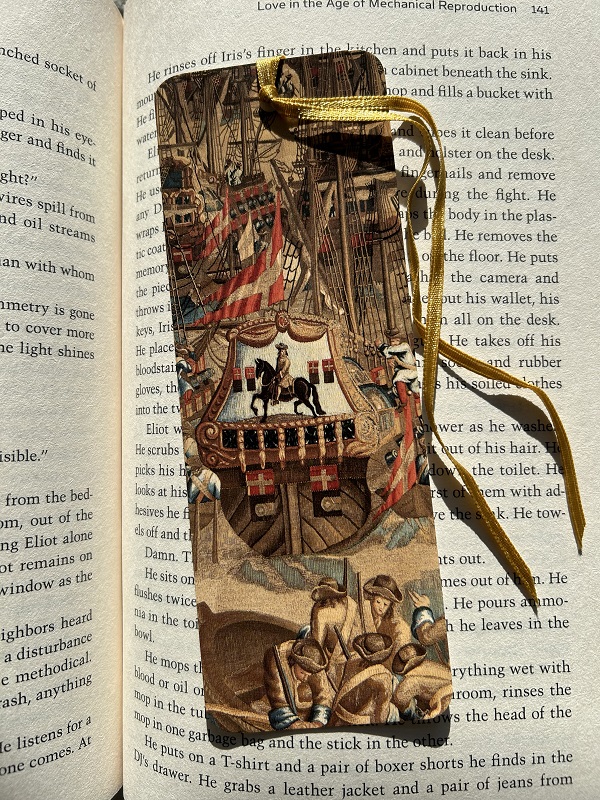
Another nice travel bookmark, albeit from another place I’ve never been. This is a picture of a tapestry from Copenhagen’s Rosenborg Castle.
Book: Love in the Age of Mechanical Reproduction by Judd Trichter
This weekend marked the 100th College Royal, billed as “the largest university open house event of its kind in North America.” I wanted to go just to see the dog show, in part because I knew a couple of this year’s contestants in the novice category. I don’t think they won, but they were both Very Good Dogs!

This guy was ALL about the snacks.

A Bernese-poodle cross.

Daisy gives a high five. Good dog!
The crime:
Scion of a long line of powerful South Carolina lawyers, Alex Murdaugh killed his wife and youngest son in June 2021, just as he was about to be exposed for having stolen millions of dollars from clients in order to pay for his drug habit.
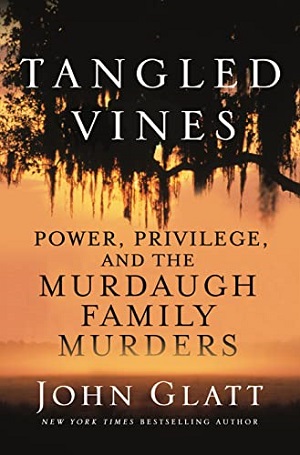 The book:
For reasons not worth getting into I had CNN on a lot in the background when this case exploded with wall-to-wall coverage. I didn’t pay much attention to it then, figuring a book was soon on its way, from which I would learn more. That book didn’t take long to arrive, though I can’t say I was keenly anticipating it. From what I could gather, it didn’t seem like a particularly remarkable crime. Why had it caught the public’s interest?
I think mainly because it fit a popular archetype: “a roller-coaster of murder plots, financial crimes, and drug addiction, straight out of a Southern Gothic novel.” The story of a powerful family’s decline into criminality, madness, and degeneracy may have had people thinking of Faulkner or even Poe, but I don’t think either of those authors is ever mentioned. Instead, Glatt goes further back and likens the fall of the house of Murdaugh to Greek tragedy. In fact, I think he makes that connection four times (and once, just for good measure, to Shakespeare). Is this a fair comparison?
The Murdaughs were big fish in the small pond of South Carolina’s Lowcountry, so I guess they qualify as being of tragic stature. Of Alex Murdaugh Glatt writes that “His greed and hubris were limitless,” which has an Aristotelian ring to it. But by the time of the main events recounted here the family was guttering out in a big way, to the point where it’s hard to see how Alex and his son Paul were functioning at all given the amounts of booze and drugs they were consuming. Alex was also more of a Shakespearean villain than a hero with a tragic flaw. In a final judgment that made me sit up and take notice Glatt concludes that “Whether or not Alex is a sociopath is not for me to say, but in all the true crime books I have written, I have never come across anyone as dark and totally devoid of conscience as he appears to be.”
That’s a bold claim – I believe this is Glatt’s twenty-fifth book – but it has some merit. The curious thing I found was that despite shooting his wife in the back with an AR-15 and then standing over her body and “firing again and again,” and then blasting a shotgun at his son’s head and chest at point-blank range, the murders seem not to have been crimes of passion. I didn’t even see where Murdaugh was particularly angry at either of them. They had just become inconveniences. That’s cold.
Was it the drugs Murdaugh was taking? There seems to have been little evidence that his mental or moral functioning was greatly impaired. To be sure he was an addict, but I don’t see where that changed his personality much. Where did all his rage come from? Or was it rage?
Nor was what was happening on the financial front easy to understand. This is usually a place where true crime books shine. My basic question was just why Murdaugh was in such financial distress, or, as described by Glatt, “drowning in debt.” He was presumably well remunerated as a partner in the large law firm his great-grandfather founded back in 1910. Then, by the nearest accounting we get here, he stole some $10 million from clients over a roughly ten-year period. Was it all going for drugs? I guess it’s possible. He claimed at the end to be spending up to $60,000 a week on pills, taking more than two thousand milligrams of oxycodone a day. That adds up, but I don’t think he could have been medicating that heavily for a decade. Glatt mentions how he was also involved in some kind of drug dealing operation, but if so it apparently wasn’t making him rich or else he was too busy getting high off his own supply.
While he and his wife liked to live large (as an exercise in family branding she posted pics of their opulent lifestyle on Facebook “to burnish the Murdaugh image”) it just seems to me that with that kind of money in such a relative backwater he should have had more to show for it. I mean, his home property was a whopping 1,772 acres, complete with hunting lodge and dog kennels, but was put up for sale after his arrest for only $3.9 million. I know neighbourhoods near where I live where a decent-size detached home on a suburban lot will put you back close to that. My point being that with a million bucks you could have been a very rich man in the Lowcountry, and Murdaugh had a lot more than a million.
Overall I thought this was just a decent, quick look at the case, thankfully without too many of the howler typos that often mar such timely productions. I guess the end of Chapter 39, which tells us that “Prosecutors and the defense are now busily preparing for Alex’s upcoming murder trial,” was originally conceived as being the end of the book, as we do get an account of the trial immediately after this. And while there weren’t many typos, I did get a smile out of Murdaugh’s lawyers arguing that he should be “afforded a release on his own reconnaissance.” That’s great.
An interesting aside: In one of Glatt’s previous books – Love Her to Death – an estranged wife looking for a divorce is killed when her husband talks her into meeting him in person, something that she wanted to avoid. That’s what happens here as well, as Maggie, who was also considering a divorce, didn’t want to go see Alex alone but felt obliged. There’s a warning for you, ladies! If you’re nervous about meeting your soon-to-be ex on your own, listen to your gut.
The bigger point that’s illustrated though is that of the corrupting effect of privilege. At bottom, privilege means a freedom from consequences, and a little of it can let you get away with a lot. The Murdaughs had a lot of it, and the suspicion shared by many is that they may have even got away with murder. The deaths of Stephen Smith, Murdaugh housekeeper Gloria Satterfield, and Mallory Beach have all been connected to the family, and Glatt provides enough background on each case for readers to make up their own mind as to what, if any, culpability they may have had.
There is, however, always a point where you can’t take things any further. In the case of privilege that point is a long, long way down, but just as the Peter principle has it that you rise to the level of your incompetence, so the privilege principle holds that the only thing that can really erase one’s privilege is the total destruction of oneself or others. Insulated by his wealth and social position, Murdaugh got to live in a bubble that atrophied any sense he had of personal responsibility or morality. Power just isn’t good for people: not for the people who don’t have it and suffer at its hands, and not for the people who do have it and who are debased by it. But still everybody wants some.
Noted in passing:
When he was in prison Murdaugh made a lot of calls, to family members mainly, talking about financial matters and encouraging his remaining son to return to law school. These calls were recorded, as I suppose is usual. What I did not think was usual was that the recordings of these calls were considered to be in the public domain. Indeed, I was quite surprised to find out that reporters filed a Freedom of Information request for the recordings of these calls and it was approved. They were subsequently released.
Murdaugh’s lawyers then “filed a federal lawsuit in US District Court in South Carolina to prevent any further calls going public, citing the federal wiretapping statute. It stated that although inmates were made aware that every call would be monitored and recorded, they were not told it would go public.”
This sounds like a valid complaint. While an inmate has no expectation of privacy when it comes to prison calls, I wouldn’t have thought the calls were public information. But after a pause allowing for a judicial ruling, a higher court agreed to release more calls. In his notes, Glatt refers to these “highly revealing jailhouse phone calls to his family” as providing “a real insight into his true character.” Which I’m sure they did, but I’m still not sure it’s right. Unless the material in the call has some bearing on the case, or can be interpreted as relating to the planning of some further crime, it seems to me that the press has no business publishing what are private conversations, no matter how psychologically revealing they may be.
Takeaways:
On the subject of family fortunes there’s an old saying that the first generation makes the money, the second conserves it, and the third loses it. “Shirtsleeves to shirtsleeves in three generations,” is the adage. And like many an old bit of folk wisdom, there seems to be some truth to it. According to a couple of reports I found online from the 2010s, some 70% of wealthy families lose their wealth by the second generation, and 90% by the third.
In other words, family decline is real. This is something borne out in the history of most dynasties, business and political. Even without their violent end the Murdaughs were locked on a familiar downward spiral, aided and abetted by Alex and Maggie’s staggering incompetence as parents. Paul’s death was tragic, but it’s hard from the evidence to see how he was going to turn things around.
The founder or patriarch of a family dynasty is usually at least a figure possessed of some qualities, though he may be an immoral scoundrel. The second generation are just inheritors. And by the time you get to the third generation – or, as in the case of the Murdaughs, the fourth and the fifth – you’re really scraping the bottom of the barrel with spoiled degenerates who were rotten with privilege, destructive of wealth, and not much good for anything.
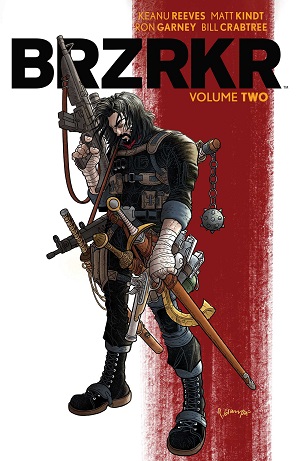 Wow, this was a big disappointment. I mentioned at the end of my notes on BRZRKR: Volume One that it set the hook well and left me wanting more, but I can’t even give the issues collected here credit for giving readers more of the same. It’s just less of the same, if that makes sense.
The main thing I was left wanting after the first volume was a supervillain who matched up against Unute’s awesome strength and unkillability. Well, that doesn’t happen. In fact, there is no villain at all in this part of the story, unless you count Caldwell, the shady (and very familiar) government scientist who is researching into the secret of Unute’s power so that he can clone an army of Berserkers. Or Brzrkrs. This is all what’s known as . . . wait for it . . . Project X.
That’s such a tired storyline, and there’s nothing interesting done with it here. Meanwhile, there’s nothing added to Unute’s backstory either aside from the suggestion that his powers didn’t come from a sky god but some alien intelligence. It’s all left pretty murky. Murkier even than it was in the first volume, which is part of what I mean when I say this is all less of the same.
There’s also less bloody action, and indeed the only action at all is in the first section. But it’s not as gory and over-the-top and the scene where Unute (or “B,” as he is more often referred to) is drawn and quartered, only to be inevitably reconstituted later, just struck me as silly. I don’t even want to go on. There’s no story here at all but only four issues of a comic spinning its wheels and getting nowhere – which is the usual middle stretch of any trilogy – with art that wasn’t selling me on the boring highlights. I guess you need a double-page spread for the explosion we’ve been counting down to from the opening frame, but . . . it’s just an explosion in the desert. We’re left with a “to be continued” but I don’t know if I’m in for any more as the whole thing seems to have run into a ditch.
 Alex Good