
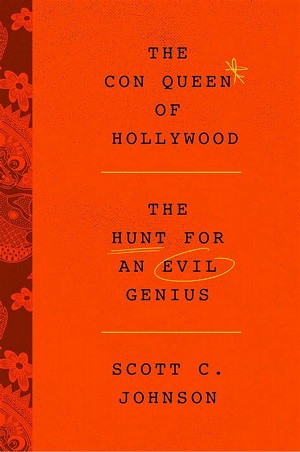
The Con Queen of Hollywood: The Hunt for an Evil Genius
By Scott C. Johnson
The crime:
Hargobind “Harvey” Tahilramani, an Indonesian of Indian descent who was partly educated in the U.S. and who for most of his working life resided in England, seems to have made a living (how, I’m not sure) out of impersonating various Hollywood power players. His main scam involved calling up individuals looking to get into the movie business and pretending to be a big-shot producer offering them a break. He would then send his marks running around Indonesia, racking up expense bills that he profited from in some way. After being tracked down by a private security firm and a reporter on the case he was arrested in Manchester.
 The book:
I had deeply divided feelings on this one.
On the plus side, I thought the story itself was fascinating, and the gradual uncovering of the scam by Scott C. Johnson played a bit like that of the journalists tracking down the mail-fraud operation in A Deal with the Devil, which was a book I loved.
On the other hand . . .
I didn’t think Johnson did a great job explaining the operation of Tahilramani’s scam. Perhaps, as the book was written before there’d been any trial (we leave with “Harvey” still awaiting extradition to the U.S.), little was known or could be said for sure. Johnson did try his best to follow up various leads, but I found myself scratching my head as to how money was being made off of the people Tahilramani was sending on various wild goose chases. Kickbacks on taxi fares? If most of the money spent went to what would have been legitimate expenses on any trip (travel, accommodations) how much of it went into Harvey’s pockets? The FBI estimates he might have made around $5,000 per person he sent to Indonesia, and maybe a million dollars over the years, but that strikes me as perhaps inflated and in any event no more than a guess. He was almost certainly lying when he told Johnson that there was another figure further up the chain of fraud who was making the real money, but it’s a lie that makes more sense than the truth.
The point is stressed by Johnson, however, that Tahilramani wasn’t in it for the money. Which then leads to an attempt at understanding exactly why he was doing it. Was it only for amusement? He confessed to that much. Did he have “a penchant for deception”? Given all of his pseudonyms (among others: Harvey Taheal, Gavin Ambani, Anand Sippy, Gobind Tahil) and the sheer amount of time he spent calling people (the better part of every day was spent on the phone) one feels that there was something like an addiction in play. Was pretending to be someone else empowering, or even an expression of gender dysphoria (he specialized in impersonating women, and when caught he claimed he would take his punishment “like a man, or a woman, it’s the same thing to me”)? Perhaps there was some of that too. Did he just like yanking people’s chains? Absolutely. Was he sadistic? This is a label Johnson applies a few times, though to me it doesn’t feel right. Sadists, at least in the classic understanding of the term, derive some sexual stimulation from inflicting pain on others, and Tahilramani seems to have been asexual. Indeed he claimed to be impotent and there’s no evidence here that he ever had intimate relations with anyone of either sex. Of course, it goes without saying that he had no friends.
But while Tahilramani is a hard character to figure out, it would be a mistake to extend him any sympathy or respect. In the case of the former, it’s part of every villain’s playbook, at least in the twenty-first century, to claim victim status. Tahilramani seems to have been gay, and may have been subjected to some form of gay conversion therapy while institutionalized in Indonesia, but that’s as far as his victim credentials extend. When being interviewed by Johnson he “hammered away at the victim narrative” of his life by blaming his sisters for the way he turned out, which seems to be far from the mark. What he understood, however, is the way being a victim gives one a pass for any amount of bad behaviour. We are even told that he held the view that Harvey Weinstein, the disgraced movie producer he admired, was “a tragic victim of the #MeToo movement,” which tells you something about the kind of lessons he took from that.
As for respect, that was even extended to Tahilramani by one of his marks. An aspiring screenwriter named Gregory Mandarano (who’d go on to write a script about the Con Queen) initially
expressed admiration and even awe at what his deceiver had been able to achieve. It had been a feat of spectacular creativity, a virtuoso display. As the years went on, his view began to change and, in the end, he felt disappointed – not so much by what he had suffered, but by what the scammer had failed to achieve. As a character in one of Gregory’s screenplays, Harvey could use his grifting talents to perform some truly ingenious, worthy crimes. If only the truth had been different, he might have created “something of value.”
By “ingenious, worthy crimes” I think something like the crimes of a Tom Ripley is meant. But then Harvey wouldn’t have been caught, and in the end nothing of value would have been created except I guess a life as a work of art.
Harvey was good at doing voices. I’ll give him credit for that. But the bottom line as I see it is that Tahilramani was just someone who held an intense hatred of the human race almost from birth. I don’t know where such bitterness comes from. He was born into a family of privilege and his parents both doted on him. His mother’s love in particular was an example of “rare codependency.” When you spoil people (young or old, makes no difference) it rarely turns out well. But this is a point I’ve remarked upon before.
The result was the kind of person an acquaintance of mine once described as “a black hole of shit.” One of his sisters, who perhaps knew him better than anyone, refused to refer to him by name, calling him only “the Monster.”
She saw him as a social predator devoid of empathy or remorse, a man without conscience who viewed other people as sources of personal gratification and gain. He was unable to love, a manipulative liar who had alienated his entire remaining family. He had no friends, no one to rely on. She described him as a “malignant tumor,” and said that even employing the terms brother or relative to describe their biological kinship was itself “cruel.” People who wished him harm, she said, were justified.
Even more succinct a condemnation is the assessment made by an “old acquaintance”: “He was, she believed, a dark malignancy in semi-humanoid form, glomming on to souls and retching on their dreams.”
Not, properly speaking, a human being at all then, but a form of life, like a “cancer” or “malignancy,” that feeds on humans. The final section of Johnson’s book is simply given the name “The Entity,” deriving from his sister’s description of her brother as “an evil entity.” Which I think is good, even if it does constitute a sort of throwing up of one’s hands.
What bothered me the most about The Con Queen of Hollywood though was the way Johnson kept trying to shoehorn in bits of his own family history, for no reason whatsoever that I could see. His father was a CIA agent and his mother had been sexually abused (I think) by his grandfather. None of this has any connection at all to Tahilramani’s story. Now I didn’t mind his account of tracking Harvey down to the apartment he was renting in Manchester, England. That was fine, and Johnson was aware of how it marked “the moment I stopped being merely an observer and became a character in his [Tahilramani’s] story.” But the family background was an unnecessary distraction and I felt like it led to the book losing focus on the portrait being drawn of the Con Queen, and indeed drawing us away from a better understanding of him.
Noted in passing:
Scammers have been around forever, and as with so many other unpleasant things we have today the Internet has only made the problem worse. What the story here underlines are the various ways this has happened. For one thing, there is no longer a barrier “that once separated the relative safety of ‘reality’ from the constant intrusions of online life.” Our virtual and real lives have merged. In addition, while the Internet has a global reach (Tahilramni had victims on six continents) it also fosters “the illusion of proximity”: “people who would otherwise be far removed and inaccessible are made to seem closer and more familiar.” And of course the cost of such scams is reduced to nearly zero, while at the same time making them exponentially more damaging.
How to defend yourself? Well, to be brutally honest there is no defence aside from staying off the Internet entirely. Even a group of Navy SEALs were taken in by Harvey, and indeed made to put on sexual performances for him (that they considered such behaviour to be at least somewhat normal is another sad fact of the digital age). But one bit of advice I remember from the early days of the Internet might help: your online presence should not be about you, but about what interests you. In the days of carefully curating a personal online presence (or brand) this is worth keeping in mind, especially if you’re really engaged with social media.
While some [of Harvey’s] victims were talented photographers, by and large their true dominion was social media. They had mastered the art of self-promotion, and were comfortable posting – advertising – the details of their lives. Masters of the selfie, they crossed back and forth between journalism and the more nebulous but profitable world of branding. . . . [Harvey’s] deep knowledge base could be scraped off the internet, an open vault where ambition and oversharing collided. Once in possession of a mark’s professional trajectory, along with the names of past collaborators or clients, [Harvey] could weave a tale to suit each one.
Again, I don’t think there’s any way to avoid risk completely. But you need to be aware of the risk and try to limit your exposure to it.
Takeaways:
I think one of the hardest things for any parent to do is to recognize that their child is, in fact, a completely worthless piece of shit and menace to society. Parents are, all too often, the enablers of last resort for such monsters. Which, in turn, leads into the point I made earlier about the disastrous effects of codependency.
All the more credit then to Tahilramani’s father Lal, who on his deathbed cut his son out of his will and “urged his daughters to distance themselves from him. He explained that they would face two great challenges in life: cancer [a family predisposition] and Harvey.” Again the link between the Monster and malignancy. Lal told his daughters he was sorry for what they’d gone through and that if there was any silver lining it was that they had already seen “the worst human in our midst.”
This is the correct response to have, but I’ve only personally known a couple of parents who have gone so far. The thing is, you owe your child a lot, but not a blank cheque supporting a lifetime of bad behaviour. So don’t bother with “tough love.” Just cut the damn cord and move on, even if it’s the last thing you do.
True Crime Files



 Alex Good