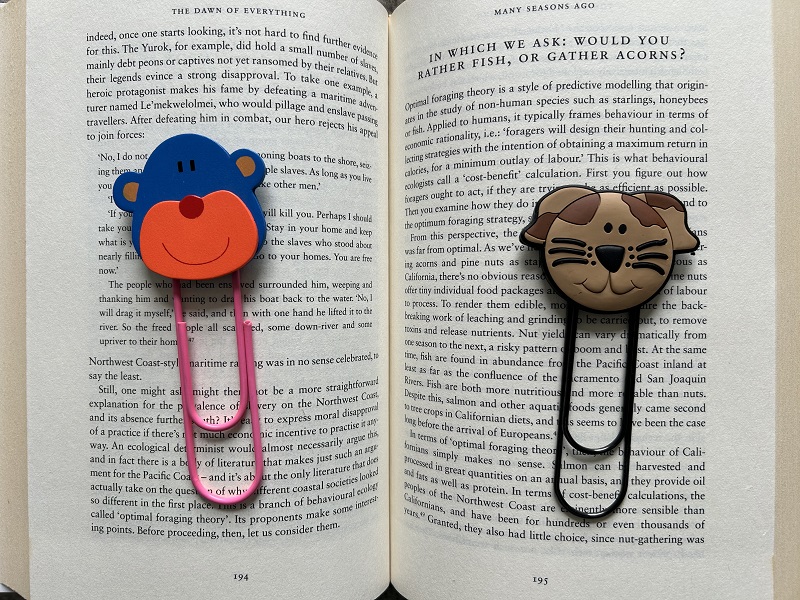
Bookmarked! #43: Bookstores No More IV: The Book Room

I’ve only visited Halifax once, around 2002 I believe, which is when I picked up my Citadel bookmark. I also visited The Book Room, which at the time was Canada’s oldest bookstore and (per Wikipedia) the largest non-chain bookstore in Eastern Canada. Some of its history is provided on the back of this bookmark. It closed in 2008 at the ripe old age of 169, a victim of people starting to buying books online and the practice of dual pricing (a recurring problem when currencies fluctuate and books become a lot more expensive in Canada than the U.S.).

With regard to people making their purchases online, the CBC story on the closing of The Book Room included this depressing little anecdote:

“The market reality is really changing,” said owner Charles Burchell, who described how a book was delivered to his store by mistake around Christmas time. The Book Room sits on the bottom of an apartment building; an online order was made by a tenant upstairs.

“The book was on our shelf, so they could have come down in two minutes and picked the book up, but they chose to order by computer and wait five [to] seven days for it to come in,” Burchell told CBC Radio.

That’s grim, and the sort of shift that a lot of retailers, not just of books, were having to deal with around the same time.

Book: The Kingdom, the Power, and the Glory: American Evangelicals in an Age of Extremism by Tim Alberta

Bookmarked Bookmarks

Telling my truth

Here’s a little something I said five years ago, on the occasion of a Liberal cabinet minister calling out the prime minister and being congratulated for telling “her truth”:

I’ve been vaguely aware of this expression for a while but I’m not sure where it got started. As near as I can tell, when someone says they appreciate you telling your truth what they’re saying is that they don’t believe what you are saying is true, but they accept that you believe it to be true. It’s very much a backhanded way of saying nothing much. It’s also a perfect political soundbite. In response to the recent accusation of inappropriate behaviour on the part of possible presidential candidate Joe Biden, other Democratic candidates again rushed to acknowledge the complainant coming forward with “her truth.” I guess this covers the bases pretty nicely, without committing anyone to saying what the truth in any particular situation is.

But isn’t this a problem? By just saying that someone has told their truth aren’t we making the claim that no objective truth can be arrived at or is recoverable? That everything is relative to one’s own subjective experience? How is this different from a world where nothing is true and everything is possible?

I found myself thinking about this again recently in response to a couple of news stories, and feel nudged toward saying a bit more. I’ll put it in the form of an appeal: Can we please stop referring to someone as speaking their truth?

The first story has to do with the claim made by Alice Munro’s daughter, Andrea Robin Skinner, that Munro took the side of Skinner’s stepfather after it came to light that he had sexually abused Skinner as a child. I found this revealing in many ways (apparently “everybody knew” about this, but in the approved manner of Canadian literary circles they didn’t talk about it in public), but it was the end of the story that caught my attention. This is from the CBC report:

Munro’s Books, a bookstore Alice Munro founded in Victoria with her first husband, James, posted a statement on its website supporting Skinner. The bookstore has been independently owned since 2014.

“Munro’s Books unequivocally supports Andrea Robin Skinner as she publicly shares her story of her sexual abuse as a child,” the store said. “Learning the details of Andrea’s experience has been heartbreaking.”

The bookstore also released a statement on its website from Andrea, her siblings Jenny and Sheila, and her step-brother Andrew.

“By acknowledging and honouring Andrea’s truth, and being very clear about their wish to end the legacy of silence, the current store owners have become part of our family’s healing,” they said. “We wholly support the owners and staff.”

Is this really unequivocal support? What does it mean to acknowledge and honour “Andrea’s truth”? Doesn’t such a statement imply that they’re not taking a side? Because after all, they’re not saying Skinner is telling the truth, only that she’s telling her truth.

The second story, also reported by the CBC, has it that Indigenous Services Canada is concerned about people who are not of indigenous ancestry claiming identity in that group anyway in order to take advantage of various professional benefits. Apparently this phenomenon is known as “race-shifting” (the people who do it are called “pretendians”) and there are concerns that it is spreading into Canada’s huge public service, which is, as one academic puts it, “fertile ground for race-shifting given the job security, lucrative salaries and its size.”

The solution, according to the Deputy Minister in charge of Indigenous Services? Well, “the key is to honestly tell your truth.” But isn’t that how this problem got started? I don’t want a bunch of frauds telling their truth, however honestly they may go about it.

Hasn’t this nonsense gone on long enough? What does it even mean to speak or tell “your truth”? I suppose the point is that if you believe something is true then it is true for you, and that’s all that matters. Or more poisonously, as George Costanza put it on Seinfeld, it can’t be a lie if you believe it.

In trying to be non-judgmental the term has become a dismissive and condescending insult. “Oh, I’m so glad that you’re telling your truth,” we say. It’s like smiling at someone in therapy. Because we’re quite deliberately not taking any kind of a stand on what the truth is. In fact, as I said five years ago, I think there’s a clear implication when we say someone is telling their truth that we don’t think they’re telling the truth at all.

And are we always so agnostic? Think of election denialism in the United States. Are the people who claim that the 2020 presidential election was stolen from Donald Trump to be graciously accepted as telling their truth, even if we know they’re not telling the truth? I don’t see that happening.

Yes, there are many different truths out there. And some things may be true for us and not true for others. But truth isn’t always so personal and subjective. To even say of matters that have been adjudicated that they only constitute some individual’s personal truth is to indulge in a relativism so absolute as to be nihilistic. Enough is enough.

Time Lapse: The Lotus Pond I

There’s a house near where I live that dug out a lotus pond in their front yard. At least I think these are water lotuses. And let me tell you, they are some giant flowers! I thought I’d post some pics of the pond as things go along so you can enjoy them  coming into bloom. (You can click on the pic to make it bigger.)

TCF: A Murder in Hollywood

A Murder in Hollywood: The Untold Story of Tinseltown’s Most Shocking Crime
By Casey Sherman

The crime:

On April 4, 1958 gangster and gigolo Johnny Stompanato was killed by a single stab wound to his belly in the bedroom of his then girlfriend Lana Turner. There had been a long history of Stompanato being a violent domestic abuser. At the coroner’s inquest it was found that Turner’s 14-year-old daughter, Cheryl Crane, had held the knife, but the jury found it a case of “justifiable homicide” so there was no criminal trial.

The book:

My previous attempt at a Casey Sherman book hadn’t gone well. His account of the serial killer Tony Costa’s rampage on Cape Cod, Hell Town, even made it into my DNF files. It was bad. But I still wanted to give this one a shot, mainly because it’s a case I’d often heard of but didn’t know much about.

As usual with true crime, the title oversells things. Was this really Hollywood’s “most shocking crime”? I’m not sure a woman (or a woman’s daughter or other family member) killing an abusive husband or boyfriend counts as very shocking. I mean, also on the cover there’s a blurb from Ben Mezrich calling it “one of Tinseltown’s darkest moments,” but even that seems like a stretch to me.

Even more questionable though is the subtitle’s assertion that this is an “untold story.” Really? The case was given saturation coverage by the media, for obvious reasons. And the fact is that Sherman’s sources consist mainly of the published memoirs of the main players in the drama, including Turner, Crane, and L.A. crime kingpin Mickey Cohen. Does Sherman add anything new to the mix? I don’t see where he has, and keep in mind that the most recent of these memoirs is over 25 years old. I also didn’t register a single point where he called into question the accounts of events described by Turner, Crane, and Cohen, despite the fact that autobiography is the least trustworthy genre of non-fiction writing there is.

As it is, we’re left with a number of scenes that we just have to take on faith. And not only faith in the memoirist making an honest report, but in their having an accurate recollection of events that may have happened thirty years before they set them down. When I reviewed Hell Town I called Sherman out for his description of events that I didn’t see how he could know so much detail about. Here he at least has a source for most of his stories, but if you don’t trust the source this doesn’t always help very much. Take the following two incidents, which I just flagged at random. The first describes Turner coming home to her husband Lex Barker after learning that he’d been molesting her daughter Cheryl:

While Cheryl remained at Mildred’s [Turner’s mother], Lana drove back to the house she shared with Barker. With rage building inside her, she walked quietly upstairs and into their bedroom. Lana had kept a pistol by her bedside after the foiled kidnap attempt of her daughter. Barker slept soundly while Lana reached for her gun. She stood over her husband with the weapon pointed directly at his head. One shot and he would be dead. Her finger rested on the trigger. She was ready to pull, but she stopped herself. If she murdered Lex Barker in cold blood while he was sleeping in their bed, she would undoubtedly get the gas chamber herself. And what good would she be to Cheryl then? Lana lowered the pistol and left the room. She stayed up for the rest of the night, smoking, crying, and contemplating her next move.

Of course the only possible source for this would be Turner, though the notes only refer to Crane’s memoirs. So I really don’t know how much to credit it. It makes for a very dramatic, even cinematic, moment (the book was immediately optioned for a film deal), but that just makes me more suspicious as to how much of it really happened.

A few pages later another dramatic scene plays out, this time with Frank Sinatra confronting Mickey Cohen. Stompanato had apparently been making a play on Sinatra’s then wife, Ava Gardner.

“Look, I want you to do me a favor,” Sinatra said, staring at Cohen with his famous blue eyes. “I want you to tell your guy Johnny Stompanato to stop seeing Ava Gardner.”

Cohen did not care how famous Sinatra was or what his deep connection to the underworld were. He damn sure wasn’t going to play Mr. Fixit for Sinatra’s love life. Cohen peered out his living room window and noticed the unmarked police car parked across the street.

“You mean to tell me you came all the way out here where they’re recording everybody’s name and number that comes near this house?” he asked rhetorically. “This is what you call important? I don’t get mixed up with no guys and their broads, Frank.”

Sinatra was not accustomed to getting dressed down in this manner. At that point, Cohen took out the proverbial dagger and stuck it in his back.

“Why don’t you go home to Nancy where you belong?” he asked spitefully in reference to Sinatra’s first and long-suffering wife, Nancy Sinatra.

Again, there is only one possible source for this story and that’s Cohen. Did he really “dress down” Sinatra in this fashion? Did he say these exact words? Or is he making himself the hero of his own story?

What makes the dependence on a few far-from-disinterested sources more troubling still is the fact that there is a real mystery at the heart of Stompanato’s murder. Is it true that Cheryl Crane killed him? She always claimed that she did, but many have their doubts, as do I. (If you’re wondering why the defence team would want to pin the rap on her, it’s because as a minor she wasn’t liable for the death penalty in California.) The narrative of what happened on the night in question is pretty shaky (per Sherman: “Lana went black for a moment. All the rage growing inside her had made her blind. Suddenly, there was a frenzy of motion in the bedroom . . .”), and the post-murder behaviour of Turner and her entourage was highly suspicious. In particular I’m talking about the staging of the crime scene. You don’t have to be as cynical as I am to raise an eyebrow skyward at what happened immediately upon the death of Stompanato. Did Turner call the police? No. Instead, she made “four frantic phone calls” to: her mother, a doctor, her ex-husband (Cheryl’s father), and her lawyer, Jerry Giesler. When Giesler arrived he then called “his clean-up man” Fred Otash.

Otash despised Stompanato and was happy to see his lifeless body sprawled out on the carpet of Lana’s pink bedroom. Otash looked around the bedroom and got to work. It took the private investigator two full hours to stage the crime scene to Giesler’s satisfaction. The attorney gathered Lana and Cheryl in the bedroom. . . .

Giesler huddled with Lana and her fourteen-year-old daughter and painstakingly walked them through his plan. Content with the narrative he was about to weave for police and the public, Giesler finally dialed the authorities.

When police officers were summoned to North Bedford Drive more than 120 minutes after Stompanato was stabbed to death, there was something peculiar about the setup in Lana’s bedroom. Investigators were surprised to see that there was little or no blood on the rug, and the bedroom walls were damp and appeared to have been recently scrubbed. Stompanato’s body looked like it had been moved from its original location. Also, the cover had been taken off Lana’s bed and was nowhere to be found. “It looked like a hog had been butchered on it,” Giesler reportedly told friends later on. The murder weapon, the kitchen knife, was located on the sink in the en suite bathroom. The fingerprints on the handle were wiped clean. It also looked like all the bathroom towels were missing from their racks, possibly used to soak up all the blood in the room. Were the bloody linens now stuffed in the trunk of Otash’s car to be burned later?

I don’t know about you, but this doesn’t inspire a lot of confidence in me that the “narrative” Giesler prepared had much relation to what really happened in Turner’s bedroom. It’s certainly something you’d think Sherman would want to look into a little more deeply, making some reference to later accounts of what Turner and others reportedly said about what went down the night of the murder. But he pretty much leaves the finding of the coroner’s inquiry alone, only tossing in suggestive tidbits like Lana dreaming of Johnny: “A long knife appeared in her subconscious, but who was wielding it? Was it her? Or was it Cheryl. It was all a blur to her now.” What are we to make of this? What is Sherman’s source? I couldn’t find any. In any event, for a book selling the “untold story” of Stompanato’s murder not having more to say about it than a sleepy “blur” is leaving a lot on the table.

“To me,” Sherman concludes in an Author’s Note, “Lana was a feminist hero and a pioneer.” Before the #MeToo movement, he writes, “we all must offer thanks to a female star from the golden age of Hollywood who broke a vicious cycle of violence and took her life back.” This is problematic on several counts. First of all, the #MeToo movement mainly had to do with “shitty” industry men preying on women who were trying to make it in the business. Harvey Weinstein was the totemic figure. But Turner sought out inappropriate men who the studio heads, most notably Louis B. Mayer, didn’t want her having anything to do with precisely because they would damage her career.

And in at least some cases she sought them out because they were bad boys. We want to tread lightly here because of the knee-jerk response to calling out a woman’s bad life decisions as victim-blaming. But the fact is that Turner, easily one of the most desirable women in the world at the time, was married 8 times to 7 different men (she re-married Stephen Crane, Cheryl’s father, when she found out she was pregnant). They were a line-up of drunks, losers, abusers, and one pedophile. And this isn’t including Stompanato, who she never married. Everybody is allowed one mulligan for making a bad choice of partner, but it’s only stating the obvious to say that Turner wasn’t just a poor judge of character in the men she dated but was setting herself up for serial disasters. After a while you have to own up to the fact that the problem is you.

Take her mésalliance with Stompanato, who endeared himself to her at one point by climbing a fire escape, breaking into her apartment, and attempting to rape her. “His consuming passion was strangely exciting,” she would later write. “Call it forbidden fruit, or whatever. But his attraction was very deep – maybe something sick within me – and my dangerous captivation [with him] went far beyond lovemaking.” That, at least, shows some self-awareness. But as a feminist “hero” I think Turner is compromised.

In sum, this is a pulpy read but not one that I thought added anything by way of new research or a fresh interpretation of the case. It’s basically just a recitation of what Turner, Cohen, and Crane had already said about it. And I’ll add another of my standard complaints about how the pictures are no good. They’re small, grainy, and mostly credited to Sherman himself, being pictures of locations as they appear now. Which isn’t always how they appeared back in the day. Why even include a recent picture of the famous Hollywood sign when (1) everybody already knows what it looks like, and (2) as the text makes clear, the sign at the time when Turner arrived in town read Hollywoodland (the “land” was only dropped in 1949). For a historical work of true crime like this there must have been a full archive of better pics to draw on. Could the publisher just not get the rights? There are even pics available online of the crime scene and the police looking at Stompanato’s body. You’d expect a photo section in a book like this to be stacked with pictures of Hollywood stars and the murder scene, but you get nothing like that. So in my opinion they would have been better off leaving pictures out entirely. If you’re not going to do it right then you might as well not bother.

Noted in passing:

“Cheryl had lost four pounds while being locked up at Juvenile Hall.” This statement was dropped in out of nowhere and I didn’t know how to take it. Was I supposed to think that losing four pounds in a week, or however long she’d been in for (it isn’t clear), was a lot? Because it isn’t. Even for a tall, skinny kid. I can easily lose four pounds in a couple of days by not eating as much, and I’m not obese. I suppose Cheryl didn’t care for the food in Juvie and wasn’t eating as much, so losing four pounds doesn’t strike me as either surprising or a big deal.

Takeaways:

Some women sure can pick them.

True Crime Files

The Immortal Hulk Volume 1: Or is He Both?

The Immortal Hulk Volume 1: Or is He Both?

I don’t know how much credit to give them for saddling this first volume of the Immortal Hulk series with such an obscure title. It’s a bold move that may appeal to die-hard fanboys, but when I was a kid I had a reprint edition of The Incredible Hulk #1 – the cover of which asks “Is He Man or Monster or . . . is He Both?” – and even I didn’t make the connection here.

So much for the “Or is He Both?” part. How about The Immortal Hulk? Well, as things kick off the world thinks Bruce Banner/The Hulk is dead. I’m not sure how or when this happened. There’s a bunch of excerpts from different comics at the end of this volume that are less than informative on the subject, and I didn’t feel like doing any further research (and you can certainly find answers to all these questions, and more, on the Internet).

In any event, as you will have guessed, the Hulk isn’t dead. In fact, he can’t be killed. He can even get a giant hole blown through his chest and it fills back in again. This leaves Bruce Banner to “walk the earth” in a hoodie, righting the odd wrong and filled with existential angst because when he looks in a mirror he sees the big green guy glaring back at him. And before long the cops, the media, and even an old friend are on to him.

I have to say I didn’t care very much for anything going on here. The art didn’t strike me as anything special, even with the way they tried to change things up in issue #3 (different styles for different narrative voices). And the stories weren’t all that good. Instead of being triggered by anger, Banner turns into the Hulk now at night. I don’t know why. In the first issue the Hulk avenges the accidental killing of a girl in a gas station hold-up. Then he encounters a guy who turned himself and his son into glowing green Hulk knock-offs. Then he fights Sasquatch, who is another Hulk-wannabe gone bad. This is a theme that’s played on throughout, as the reporter tracking the Hulk confesses at the end that she wants to be like him too. But of course they don’t understand.

There’s also something going on about Banner’s father, but I couldn’t figure out what that was. I think he abused Bruce when he was a boy. So on top of everything else the Hulk has daddy issues.

I’ll probably give this run some more time to get its feet, but in the first five issues I didn’t get the sense that it was going anywhere, and to be honest I don’t find the Hulk that interesting, so I might not stick with it for long.

Graphicalex

Bookmarked! #42: Going Big

I have some big bookmarks. So big that they’re actually hard to use. You can’t tell from the picture but this one is 14″ from top to bottom, so I had to find a really big book to put it in.

There’s a lot going on here. Some metal filigree. Textile. And a Turkish evil eye ornament at the bottom. So I’m guessing this came from Turkey, as I have a few bookmarks from there and I had an uncle who was Turkish. But I don’t remember now when I got it.

Book: Science Fiction of the 20th Century: An Illustrated History by Frank D. Robinson

Bookmarked Bookmarks

Marple: The Body in the Library

Again Miss Marple remains in the background. At least in the early going, this was a big part of her character and her method. Recall her quietly knitting through the stories of The Tuesday Night Club, or the fact that she isn’t the narrator of The Murder at the Vicarage and indeed isn’t a major presence in that book at all. In The Body in the Library she doesn’t even appear very often. She’s not the sort of detective to lead a very active investigation, looking for clues, or interviewing witnesses. Sure she does a bit of that, but mostly she just notices things. Luckily, the police are willing, if not always happy, to have her along for the ride.

Marple’s process of ratiocination goes from the local to the universal, the incidental to the supremely important. We’re told she “had attained fame by her ability to link up trivial village happenings with graver problems in such a way as to throw light upon the latter.” But to be honest I never see a lot of that happening. We just have to take it on faith, since any village happenings are only slightly alluded to. What seems more on tap here is a literary diversion. “Bodies are always being found in libraries in books. I’ve never known a case in real life,” says gruff Colonel Bantry, just before finding a body in his library. Christie herself introduced the book as having been written out of a desire to play a “Variation on a well-known Theme,” with the theme being the body in the library, recognized to be a cliché of the detective story. This made me wonder how many bodies had been found in libraries before this book (which was first published in 1942). I guess a lot.

Otherwise this seems much the usual puzzle for Jane to solve. The killers hatch an insanely complicated plot, which is made even more difficult to untangle because the innocent guy they attempt to frame behaves in a ridiculous manner. He’s the one who thinks it would be a neat idea to hide the body in the library of Colonel Bantry, just because he doesn’t like the Colonel very much. And I guess he was drunk. Throw in the absurd idea that only one person has to (mis)identify the dead body or else the whole scheme would instantly fall apart and you’ve got something so farfetched I don’t think it’s being fair to the reader. And then you get another of those clues that depends on a bit of specifically British knowledge, like the “banting” and “hundreds and thousands” that I pulled a blank on in “The Tuesday Night Club.” The clue here is a passing reference to Somerset House, which at the time was where the Registry of Births, Marriages and Deaths had its offices. But the Registry moved in 1970 and I don’t think that’s something anyone would be likely to get today. I didn’t understand what its mention meant even after I’d been alerted as to its significance.

Of course there are other Britishisms that I failed to grasp, like “beer and skittles,” but they weren’t as important and only gave the proceedings a bit of period charm.

And finally, since I’m on a roll here, the business with the fingernails is quite obscure.

To be honest, after having re-read the first Miss Marple stories and then the first two novels I’ve come away thinking they’re markedly inferior to Christie’s Poirot mysteries. And I’m not sure I liked them any better when I read them the first time forty or more years ago. As noted, the plots are bonkers, and not in a good way, as much as Miss Marple herself would want to object.

“An intricate plot,” said Colonel Melchett.

“Not more intricate than the steps of a dance,” said Miss Marple.

“I suppose not.”

Of course, the undoing of the intricacy is the point of the exercise, which is why the plot has to be so complex. There’s a nice moment here where it’s suggested that the “explanation of the whole case” may be criminal insanity, but this is immediately dismissed by the police superintendent as being “too easy.” “There are such cases,” he had earlier admitted, “but we’ve no knowledge of anyone of that kind operating in this neighbourhood.” “One does see so much evil in a village,” Miss Marple explains at another point. But not that kind of evil. As I’ve mentioned before, for Christie there are only three motives for crime: sex, greed, and lunacy. And she has no interest in lunacy because it can’t be explained in a clever way. We’re more used to psychopaths in our own time because they get so much media attention. Back in Miss Marple’s day they weren’t as interesting.

Marple index

Disney all-stars

This is a very old puzzle that I think we picked up at a flea market somewhere. You’ll be able to tell how old it is by the fact that the crowded cast of Disney characters doesn’t include anyone from The Lion King, Pocahontas. or any of their later hits. Instead you get the Disney pictures that I grew up with. Except for The Sword in the Stone. I never saw that one. Which means I had no idea who those characters were. Luckily there was an index on the back of the box that labeled everyone.

The thing that impressed me the most about this one though is that all the pieces were still there. For a puzzle this old, and one that has passed through several hands, that’s very rare. And I think this is especially remarkable for a puzzle where the pieces don’t fit together very well. They really just sit next to each other and if you nudge your work in progress, however slightly, they come apart.

Puzzled

The Object-Lesson

The Object-Lesson

I love the work of Edward Gorey but you have to take it in small doses. As I go along (if I keep going along) I’ll be revisiting his various Amphigorey collections, but until I get to them this little book will do as an entry point to his dark universe.

Dark because danger and death and loss and mutilation are always lurking around the corner. Some monster is no doubt waiting behind that thick network of wallpaper we’re faced with on the first page. A beast hiding in the mists on the moors. In the trees . . . “a bat, or possibly an umbrella.” You can’t even tell what it is when it flies away. “Something happened to the vicar,” and from the looks of it nothing good. Perhaps a bicycle accident.

The horizontal nature of the book leads you to believe there’s some sort of continuity at work in the way landscapes seem to run from page to page. Your eyes are moving at speed across a sweep of space. But is there a thread that holds it all together? Not an obvious one, but that just means we have to fill in the gaps and make the links ourselves. The text may suggests temporal relations. “Meanwhile, on the tower . . .” And we seem to be moving from morning through day to night. But are there also traps? When the people in the dinghy cry “Heavens, how dashing!” are they talking about the “erstwhile cousin” stepping backwards into the water? They seem to be looking at him, but is that just a coincidence? And is that water the same lake the lordship meets the Throbblefoot Spectre by? And are odd figures who are never identified recurring, or different people? Take the lady in mourning by the edge of the lake (she appears again from a distance, walking either away from or towards the tower), or the lady with the flowerpot.

Surrealism? Yes, or at least the absurd. It’s in the dreamlike symbolism of the landscape mostly. That tower in the middle of nowhere. The ornate gates to the asylum with no adjoining walls. The lonely kiosk. Detached structures that again might be understood as in the same neighbourhood, or be located on different continents and in different eras.

A haunted world, and by what? “The miseries of childhood.” That kid on the second page has seen too much that can never be forgotten. He (or she) will lose much that will never be found.

Graphicalex

Canada Day 2024

On those annual lists you’ve probably seen, lists that are calculated in all kinds of different ways, Canada usually rates as one of the best countries in the world, if not the best, to live in. Though I haven’t lived anywhere else, it’s a judgment I’m on board with. I can complain about the government (terrible and always getting worse) and unpleasant aspects of the national character (we’re passive-aggressive snobs), but being born and raised in Canada was one of the luckiest things that ever happened to me. To paraphrase Robert Frost’s “Birches”: Canada’s the right place for living. I don’t know where it’s likely to go better.