TCF: The Doomsday Mother

The Doomsday Mother: Lori Vallow, Chad Daybell, and the End of an American Family
By John Glatt

The crime:

Lori Vallow was living with her fourth husband, Charles Vallow, when she met Chad Daybell, a Mormon author of religious-themed end-time books who was married at the time to Tammy, with whom he had had five children. Vallow had a young daughter, Tylee, by a previous marriage and had adopted an autistic grandnephew of Charles named J.J.

As near as can be reconstructed, Lori talked her brother Alex into killing Charles. (Alex would not be prosecuted for killing Charles, arguing he had shot him in self-defence. Then Alex would die, apparently of natural causes, before the later trials involving Lori and Chad, though he was complicit in those murders as well.) Both Tylee and J.J. disappeared and were found to have been murdered and buried on Chad’s property at his home in Idaho. Chad is thought to have then killed Tammy. Chad and Lori, cashing in on the deaths, flew to Hawaii where they married. That is also where they were later arrested. At trial after being returned back to Idaho, Chad was found guilty of the first-degree murder of Tammy, Tylee, and J.J. and sentenced to death. Lori was found guilty of the murder of Tylee and J.J. and conspiracy to murder Tammy. She was sentenced to life imprisonment.

The book:

While the story of the Vallow-Daybell doomsday murders (as they came to be known in the media) is a singular and horrifying one, it also hits on a lot of themes that readers of the True Crime Files will be very familiar with. For example, in two previous books by John Glatt (Love Her to Death and Tangled Vines) I’ve noted how bad an idea it is for women to meet up with their exes, or soon-to-be-exes, on their own. In both those books the wives in question ended up being murdered. In this book it’s slightly different in that it was Lori wanting to meet with Charles. He had a bad feeling about this, and even mentioned to Lori’s (normal) brother Adam some misgivings. He ended up being shot to death by Alex.

Charles should have also paid more attention to what were clear red flags. Actually, calling them red flags at this point would be putting it mildly. When she met Charles, Lori had already been divorced three times, with two kids by two different fathers. All by the age of 32. That’s not a red flag, it’s a klaxon. By the time of the fatal visit Lori was clearly a madwoman, and Charles had even arranged to have her committed. After all, in the days just proceeding their fatal meet-up she’d (1) cleaned out his bank accounts and then changed the numbers on them so he couldn’t access them (because he ran a business this meant he couldn’t make payroll); (2) was clearly interested in another man; (3) changed the locks on their house; (4) stole his truck, and (5) accused him of being possessed by an evil demon.

But he still “loved her to death” (his death, as it turned out). Alas, as I’ve had occasion to remark several times in these case files, there’s just no talking to a guy who’s in love.

You’d think any man would have to be crazy to take up with Lori after all this, but then crazy came along. Chad not only knew all about Lori’s history before getting involved with her but took notes on her previous relationships and family connections. To be sure, Chad was messed up himself, but it’s also true that some women just have a poisonous “it.”

Another familiar story worth flagging (because, as I’ve long maintained, we’re supposed to be taking notes and learning something from all this) is the significance of life insurance policies. Just before his wife’s death Chad “made ‘significant increases’ on several life insurance policies he had taken out on Tammy, bringing them to the maximum legal payout allowed.” And yet this wasn’t any kind of tip-off to the underwriters or police when Tammy just suddenly died. Meanwhile, I did get a bit of a kick out of how upset Lori was that Charles had made his sister the beneficiary of his policy just before he was killed. If she wanted that money I guess she should have moved a little faster.

In ways like this, and I’m being selective, what we have here then is a fairly standard murder story: married man meets married woman and they have to get rid of spouses and children to enjoy their new lives together. There are two twists that give it special interest though. The first is the apocalyptic belief system and “prepper” culture that Chad and Lori were immersed in. In fact, Chad could be described as the leader of a mini-cult that separated people out in the usual way (the saved and the damned, the sons of light and the spawn of darkness) in anticipation of the Rapture. Like a lot of modern cults, there also seemed to be some heavy drawing from pop culture. This goes back at least as far as L. Ron Hubbard and the roots of Scientology in C-list science fiction stories. Here’s something I took note of in my review of Steven Singular’s book Killer Cults that I think is relevant:

What is the link between cults and the products of pop culture? Charles Manson thought the song “Helter Skelter” from The Beatles’ White Album contained a hidden message about a coming race war. Adolfo Constanzo based his brutal crime cult on a 1987 flick called The Believers starring Martin Sheen and Jimmy Smits that I have only the vaguest recollection of today. The Heaven’s Gate cult took its lead from Star Trek mythology, with its members thinking of themselves as parts of an “Away Team” as they killed themselves. Why do so many people put so much faith, or even find any meaning, in such crap? I know that’s a question every outsider asks of any belief system, but Star Trek? I guess fandom and cult membership have to be plotted on a spectrum.

Insofar as Chad was starting his own cult he seems to have borrowed from the same range of sources. We’re told he believed, for example, that the spells and curses in the Harry Potter books actually existed but required “great focused will to use.” Indeed, Chad even described himself to Lori as “a grown-up version of Harry Potter.” Meanwhile, one observer “felt like many of them [the cult’s beliefs] were ripped out of a Dungeons & Dragons manual. Between the stats, accounts of dark and light weapons . . . it sounded like someone had created a tabletop [Book of Mormon game] based on the Bible.”

It wasn’t clear to me from the evidence Glatt presents just how much of the stuff about light and dark spiritual possession and people turning into zombies Chad, as opposed to his followers, really believed. But this aspect of the case is gone into in more depth in Leah Sottile’s book When the Moon Turns to Blood so I won’t say more about it here.

The other thing that makes the story interesting is that we don’t really know that much about how Charles, Tylee, J.J., and Tammy were killed. By that I don’t just mean the actual causes of death, but how their murders might have been planned and arranged or who was directly involved. Clearly, however, Chad and Lori were responsible. This leads, however, to the deeper question of who was the dominant partner in their relationship.

As Glatt remarks in his postscript, despite all the coverage that the case received none of the accounts “have explained how the seemingly mild-mannered end-times author Chad Daybell managed to lead the glamorous grandmother into homicidal madness. But the real question is, what came first, the Lori chicken or the Chad egg?” Did Chad really lead Lori along, or was she leading him?

Let’s look at both sides.

The case for Lori being led by Chad was put by Special Prosecutor Rob Wood, who called what Chad did “spiritual abuse” and “spiritual manipulation”:

“I’m so torn. It’s such a conflicting feeling to know that this person’s been good her whole life, and then made this error in judgment and got sucked into this vortex of this man [Chad]. I feel for her. I just have so much compassion towards her because I know that’s not what she would have ever done on her own. And I hate her for that.”

Now Wood was talking to Lori’s sister at the time he said this, so not all of it may have been sincere. Lori had hardly been good “her whole life.” Not even close. But it does seem clear that she took a swerve for the worse when Chad entered in her life. Her marriage with Charles seemed to have been working, enough for him to have risked everything to save it. And even J.J.’s grandparents thought she’d been great with J.J. up until she met Chad. “You couldn’t ask for a better mother,” said J.J.’s grandfather. “She loved J.J. She loved Charles, and I don’t know what caused this conversion. You don’t go from being the mother of the year of a special needs [boy] to the person that won’t even tell you where they are. That just doesn’t happen.”

If you buy into the idea of Chad as cult leader you also find support for this notion of him leading Lori on. It’s telling in this regard that after their arrest Chad did talk her out of cooperating with the police and making a plea deal with prosecutors. One cult expert interviewed by Glatt says Chad was “still manipulating his new wife, even while she was behind bars” with his daily calls and scripture readings.  “He continued the marination of her mind.” Another expert interviewed by Sottile says Chad used “classic grooming techniques” on Lori. This strongly suggests someone very much in control.

On the other hand . . .

I don’t think Lori was ever normal. There seem to have been mental health issues running in her family.  Her father waged a quixotic life-long legal campaign against the government, claiming that he didn’t have to pay any taxes. Her brother Alex, who shot Charles, probably killed Tylee and J.J., and who attempted to kill the husband of Lori’s niece, may have had improper relations with Lori when they were both kids. Her sister Stacey went crazy starving herself to death, fearing that all food was poison. Stacey’s husband would liken the family to “a psychological hornet’s nest,” and that may have been selling it short. I don’t like the overuse of the excuse of mental illness when it comes to a lot of criminal cases, but it’s clear that Lori was sick.

As far as her personal relationships go, Lori also seems to have been a dominant personality. A friend named Melanie was described by someone who knew them both as “almost subservient to Lori . . . a passenger on Lori’s bus.” “Lori was definitely running the show,” was how the friendship was characterized. This seems to chime with the powerful hold Lori had over her brother Alex, and makes one wonder about her relationship with Chad. According to the minister who presided over their beach wedding in Hawaii: “Lori was definitely more forward than Chad . . . She really did all the pushing on this. She was definitely wearing the pants that day.” Also: “There were a couple of times when he really manned up, but most of the time she was the pilot.” For what it’s worth, this is the same impression I got seeing the video of them together when they were ambushed by a reporter in Hawaii. Lori seems far more in charge, with Chad sort of trailing beside her like he’s on a leash. As reported in When the Moon Turns to Blood, the police who first called on Chad and Lori when doing a wellness check on J.J. were singularly unimpressed with the man of the house:

Daybell was a jowly, potbellied man with an awkward, quiet demeanor, who gave off the air of a person who was deeply unsure of himself. He wore too-large clothes and walked with a forward-leaning slant, and when he spoke, he mumbled sleepily, like his words were smooth river rocks dropping from his lips.

That image of rocks dropping from his lips is an odd one, but the picture is pretty clear. In the language of the manosphere, Chad, despite his archetypal alpha name, was a confirmed beta. Whenever Chad’s father phoned him as the case became public he tried to speak to him alone, but Chad would always click the call on to speaker so Lori could listen in. Again, this sounds like Lori was in control.

Having set out the two arguments I’ll conclude by sharing the blame. What seems most likely to be the case is that Lori and Chad were an instance of folie à deux, or shared madness. My hunch is that Lori was a stronger personality, that she was (pick your metaphor) driving the bus or piloting the plane, but for things to go so spectacularly bad they had to come together.

Glatt was once again writing a timely book here, that’s his métier, and went to press before either Chad or Lori had gone to trial. That said, this is a readable account of a series of terrible crimes and one that helps set the complicated story straight. In his postscript Glatt tells us that “In my many years of writing true crime books I have never seen another case as terrifying as that of Lori Vallow Daybell. It simply defies logic, lying somewhere between cold-blooded murder and wild religious science fiction – the very embodiment of the truth being stranger than fiction.” But was it really so strange? Chad and Lori were just kindred spirits, not so much for their shared heretical beliefs (both were excommunicated from the LDS Church, eventually) as for having arrived at a point in their lives where they just didn’t care about anyone or anything very much anymore aside from having a good time. And that level of indifference to others can result in incredible cruelty.

Noted in passing:

Lori liked to live large and spend a lot of money, something perhaps related to her being raised in privilege but her family having come down in the world due to her father’s legal problems. But after her third divorce, at the age of around 30, she apparently owed $724,000 to creditors. At the time she was working as a self-employed hairstylist. How do you burn through that kind of money?

“In September 2001, Chad won a Cedar Fort Publisher’ House Award for his Emma Trilogy, despite the conflict of interest as they had published it and just hired him.” Ha-ha. Oh, literary awards. How does anyone take them seriously?

A week after killing Tylee and burying her burned remains in what amounted to a pet cemetery, Chad and Lori did a podcast entitled “Chad Daybell Sharing Jesus’ Love.” You can see why so many people today are cynical about religion.

Joe Ryan, Lori’s third husband, died alone, his body only discovered three weeks later in his apartment, with “an open jar of spaghetti and dirty dishes in the sink.” A jar of spaghetti? Or a jar of spaghetti sauce? The latter seems far more likely.

Takeaways:

Apocalyptic beliefs usually have something nasty about them, viewing most of humanity as either damned or worthless, which in turn justifies seeing all the zombies sent straight off to hell. But such beliefs are also dangerous, because if you think the end of the world is coming soon then you don’t have to care much about the long-term consequences of your actions. If you meet someone who’s convinced the Rapture is imminent (as opposed to thinking that the world is sliding into a more secular sort of catastrophe at its own leisurely pace) I’d keep a polite distance.

True Crime Files

Green Lantern Corps Volume 1: Fearsome

Green Lantern Corps Volume 1: Fearsome

I’ve mentioned somewhere before about how inflation is built into superhero comics. The good guys have to take on increasingly powerful bad guys, or more of them. Then the good guys have to multiply so that you get more of them too, either by being paired with regular sidekicks or assembled into teams of heroes.

For the Green Lantern this translated into series like the Green Lanterns (plural) for the DC Universe Rebirth (I made some notes on Rage Planet here), and the Green Lantern Corps for the New 52. I don’t follow these things closely enough, so I wasn’t sure which came first. On checking into it, the New 52 was launched in 2011 and Rebirth in 2016. So now I know.

In any event, the GL Corps weren’t new in 2011 since they’d been around since near the beginning (I even remembered them from when I was a kid), but having armies of “Lanterns” (as they’re called) in every issue felt to me like just part of the same “more is more” mentality. And what makes it worse in the case of the Lanterns multiplying is that they’re all basically the same. They’re different species united from all the far corners of the universe, but their super powers are all just whatever “constructs” they generate from their rings. So having two of them, or 7,000, just feels redundant if not overkill.

Well, on to this iteration of the Corps and its ceaseless battle against evil in all its forms.

Things kick off here on a very dark note indeed. Some evil force attacks a Lantern Corps “sector house” and quickly disposes of the two Lanterns stationed there, decapitating the one and slicing the other in two. This sets off an alarm back at Lantern HQ (on the planet Oa), and a team of Lanterns, headed by Earth representatives Guy Gardner and John Stewart (not of The Daily Show), is sent out to investigate. They soon discover another major crime against the universe: All the water has been sucked off of a planet inhabited by a race of friendly-looking beaver creatures, leaving behind a dry sea-bed of corpses. Then, just to send a further message, the resident Lantern guardians of the blue beaver planet have been left impaled on stakes.

To be honest, after reading the first couple of issues of this one I wasn’t sure I wanted to keep going. It just seemed grim. I’m no prude when it comes to splatter, but there was an incongruous cruelty to the proceedings here, with various scenes of torture thrown into the mix that I really didn’t care for. And nobody rises above it. I didn’t even like Guy and John very much, and thought the only way they were being made bearable was because of how bad the bad guys were.

As for those bad guys . . . they weren’t working for me at all. They go by the name of the Keepers because of the role they had watching over the Great Green Lantern Power Supply (a.k.a. the Central Power Battery), before the Lanterns decided to up sticks and move, leaving the Keepers to rot on their miserable home planet. So they had a legitimate grudge, but I didn’t really understand all the politics. As for the Keepers themselves, they’re just the usual army of mooks, made to look like zombies. They have incredible will power and an imperviousness to the constructs of the Lanterns, so they can just sort of overwhelm the Lanterns until the green guys power up with some old-school weaponry. Even so, they’re looking likely to take over until Guy hits upon the expedient of dropping a fear bomb on them that turns them into a bunch of crybabies who are then sentenced to dig graves for all their victims on the blue beaver planet.

I didn’t care for this at all. It’s dark but not very smart and even by the end I hadn’t managed to keep any of the Corps members’ names straight. But I picked up almost the whole series of these when the library got rid of them in an overstock shelf-clearing, so I’ll read a few more anyway and see if things get better.

Graphicalex

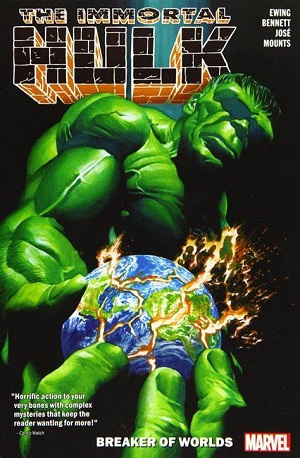
The Immortal Hulk Volume 3: Hulk in Hell

The Immortal Hulk Volume 3: Hulk in Hell

This series is yanking me up and pulling me down. I thought the first volume (issues #1-5) lacking, but the second (issues #6-10) very good. Expectations raised, I was ready to enjoy Hulk in Hell, which kicks off with skinny Hulk and various tag-alongs having passed through the sadly unerotic Green Door and winding up in some sub-dimension of evil. But I was in for a disappointment.

Writer Al Ewing feels like he’s channeling Alan Moore (bad Alan Moore) with a sporadically literary pastiche of psycho-mythology. Thus the explanation for what’s going on here: “Gamma radiation is science. It’s measurable, predictable, it has rules . . . until it doesn’t. Until it makes Hulks and Sasquatches and Leaders. Metaphor people. Until it’s magic. When the first gamma bomb went off, it unleashed forces beyond our control. Unified forces. It opened a door, deep down into the pit of reality. Into the lowest hell. And any high concentration of gamma – that’s a door too. Including gamma people.”

What does all this add up to? Just another example of the old trope of a portal to another dimension that our heroes have to close in order to save the world from an evil invasion. Except that the Hulk himself is a door. So “What will the Hulk be? The accuser or the adversary? Khamael or Satan? Is he of Geburah or of Galachab?” Etc. The Hulk’s abusive father again puts in an unwelcome appearance, which is an angle I care for less and less. And the way things are going it looks as though immortality is a side-effect of all the gamma energy flowing everywhere, as various characters – Crusher Creel (Absorbing Man), Thunderbolt Ross, Doc Samson, Betty Banner, Rick Jones – start climbing out of their graves. Throw in the usual shadowy government agencies who are up to no good, epigraphs drawn from the Bible, Shakespeare, Dostoyevsky, and Camus, and I thought it all a lot too much. There’s even a “Devil Hulk” which is the big green guy’s id, and a Moore-ish master plot about the Hulk (the basic model) wanting to destroy humanity in order to save it.

Still, I can’t help thinking there’s something here worth sticking with. So I’ll see what volume 4 has to offer anyway.

Graphicalex

In the gutter

This is a house near mine that was sold five or six years ago and is now rented out to students. I think five or six years ago was probably the last time the eavestroughs were cleaned. Click on the pic to make it bigger to see what I mean. I could have included this as one of my Gardening posts. Shocking!

But this week I also had to go clean out a neighbour’s eavestrough. This is what I found. Quite the blockage. You need to stay on top of these things. One of these days I’ll be too old to lug a ladder around. There is a service that cleans them out twice a year but that (clearly) isn’t enough. Plus they only clear the troughs and not the downspouts. Which is quite a scam, seeing as it’s the downspouts that get blocked. What a racket.

Apocalypse Nerd

Apocalypse Nerd

“Apocalypse” is a word that has undergone a bit of a transformation in the modern age. In terms of Biblical literature it refers to a genre of spiritual writing characterized by a revelation (what the word means in Greek) of the end times, typically accompanied with commentary provided by a celestial interpreter or guide. What the end times usually involve is a final battle between the forces of good and evil, but in the end evil is defeated and both sides receive cosmic justice.

In this regard the apocalypse is actually optimistic in tone, with the world being made new and the kingdom of heaven being realized. It’s prophetic literature, but like most prophecy (a word whose meaning has also changed) it’s not meant so much as a prediction of the future but as a description of what is happening in the world right now, and specifically the persecution of the godly at the hands of the wicked. Within the Bible as we have it the chief examples of apocalypse are the Books of Daniel and Revelation, but there were plenty of other apocalypses being written in the ancient world and they all fit the same general pattern.

Today, when we say “apocalypse” we mean something a lot simpler and darker. What the word refers to is a catastrophic end-of-the-world scenario. Earth being hit by an asteroid, for example. Or civilization collapsing due to climate change. Or an outbreak of plague. Or people turning into flesh-eating zombies. Apocalypse Now begins with The Doors singing about “The End,” meaning the end of “everything that stands” in a bath of napalm. In Marvel comic books Apocalypse is a big, bad guy who wants to kill off most of the human race. You get the picture. There’s no battle between good and evil but just a brutal struggle for survival. And there’s no vision of a New Jerusalem but only a charred wasteland where whoever’s left behind might be able to start over.

I get it. The world is too much with us. I think a lot of us feel the need to press some kind of a reset button on civilization. There are many issues facing us that now seem intractable, and some kind of shift of gears into reverse, if not outright collapse, seems inevitable. That doesn’t mean we’re all building bunkers in our backyards or pimping out our basements in survivalist décor, but it does go some way to explaining current interest in the genre.

I don’t know why I just wrote all that, but it seemed as good a way as any to introduce Peter Bagge’s Apocalypse Nerd. The apocalypse in the title here is actually a bit retro – not going all the way back to Biblical days, but to the fear of nuclear Armageddon that was big in the 1980s. Though things have changed a bit. What we get here isn’t global thermonuclear destruction but a nuke launched from North Korea taking out Seattle. A pair of buddies who live in Seattle are camping in the Cascades at the time and soon find out that they can’t go home. This leaves them not so much wandering in a wasteland as semi-roughing it in the bush. They survive by hunting deer, foraging for berries in the woods, and raiding cottages for preserves and packaged foods.

The story itself doesn’t amount to much. It’s episodic and doesn’t build to any kind of climax. Indeed, in the final panel we’re left with the suggestion that it’s all been a wild goose chase. But despite this I felt swept along by the sort of urgency that’s expressed in the sweating, buggy faces of Bagge’s rubber-limbed figures, who always seem on the edge, or over the edge, of a total breakdown. Though it’s not a short book, Apocalypse Nerd is a very fast read. It doesn’t have a message beyond human beings going back to nature reverting to being cavemen, but that was enough for me to enjoy it.

Graphicalex

1872

1872

Over the years there have been lots of entertainment columns written on the subject of promotional blurbs, to the point where you have to wonder what the point of them still is. In our time the pull quote of critical praise has become such debased coin that they’re widely recognized as not only worthless but laughable. Even a sticker announcing that a book has won some big literary prize is meaningless. Who cares what the last book was that won the National Book Award or Man Booker Prize? What does it matter that a book was named one of the New York Times’ Best Books of the Year? I guess it helps move a few copies, and as far as advertising is concerned it’s about all that publishers can do, but that’s it.

You can scrape the bottom of a deep barrel though in trawling for pull quotes. To the point where the blurbs I find on most new DVDs are usually from sources I’ve never heard of. The ratings from Rotten Tomatoes probably mean more, which isn’t saying much. I don’t even know if these are real people writing the “reviews” that quotes are drawn from now, as I think it’s something an AI could probably do more effectively, and better. A point that the team promoting Megalopolis apparently took to heart.

I say this because the cover of 1872 has “A rootin’ tootin’ good time” appearing on it, a bit of ad writing that comes courtesy of IGN.com, which as far as I can tell is just a blurb farm now. Then on the back cover we get “I’m not a fan of Westerns, but this comic book may have just changed my opinion of them,” which is attributed to ComicWow.com, a site that was offline when I went to find out if the blurb had actually come from a review and who might have written it.

Anyway, this is all beside the point. It’s just sort of a pet peeve of mind I thought I’d mention. I mean, there’s a really misleading bit of information scratched onto the Boot Hill tombstone on the cover too, but I won’t get after them for that.

I’m not even going to try to put 1872 into its context within the Marvel Secret Wars/Battleworld multiverse because that’s about as deep a rabbit hole as you can head down. Suffice it to say that we’re in the Old (and Wild) West, specifically the company town of Timely, which is populated by various Marvel superheroes and villains in period dress. Steve Rogers is the sheriff, Tony Stark is the town drunk, Bruce Banner is an apothecary, Natasha Romanov is the widow of former sheriff Bucky Barnes. Among the bad guys is Kingpin as the mayor and Wilson Fisk with his gang of hired guns: Bullseye, Grizzly, Electra, and Doctor Octopus.

The centre of the story though is Red Wolf, a Native American out to blow up the Roxxon Corporation’s dam. Red Wolf isn’t a very well-known Marvel hero, so also included in this collected edition of the 1872 series is his origin story from way back in Avengers #80 (1970, and not 1963 as is stated on the back cover), as well as a later appearance in Marvel Comics Presents #170.

I did like the story here. It’s straightforward while at the same time being clever in how it adapts characters we’re familiar with to their new surroundings. I loved Doc Ock’s multiple-gun contraption, and the appearance of Vision in one of those fortune-telling booths. The storyline follows a standard Western formula, but it’s punched up with extra violence that has a lot of the characters being killed. Steve Rogers is even thrown into a hog pen, where he gets eaten! That was a real shocker.

Not an epic Western maybe, but a great B-film that hits all its marks and has a genuinely fresh spin on the action by putting the old characters in some new costumes. Good stuff! And if anyone wants they can blurb that.

Graphicalex