
Murder of Innocence: True Crime Thrillers
By James Patterson
The crimes:
“Murder of Innocence”: Andrew Luster, the rich descendant of a cosmetics fortune, lived in California and spent his time surfing by day and drugging and raping women he picked up in bars at night. He also videotaped all of this. After jumping bail during his trial he was apprehended in Mexico and is now in prison.
“A Murderous Affair”: Mark Putnam, an FBI field agent in Kentucky, had an affair with an informant named Susan Smith. When Smith got pregnant Putnam strangled her. He pled guilty at trial and served 10 years of a 16-year sentence before being released for good behaviour in 2000.
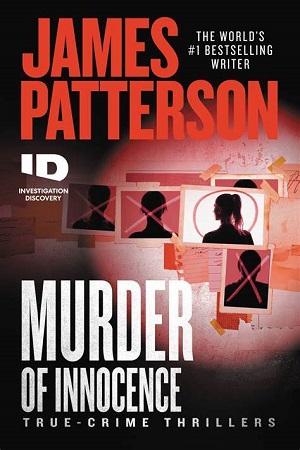 The book:
I want to start off addressing a lot of things about this book rather than the book itself.
In the first place we have the name “James Patterson” on the cover. It’s not in quotation marks but I put them in because Patterson is a brand now and his name goes on the cover of a number of books that he oversees the production of but that he doesn’t write all of himself. In fact, I don’t know how much of them he writes or what the extent of his involvement is. In any event, Patterson is also the only name on the title page, and it isn’t until you get to the individual stories that you find they were written “with” Max DiLallo and Andrew Bourelle, respectively.
The cover also declares Patterson to be “the world’s #1 bestselling writer,” and that at least is a claim that is inarguable. He’s sold well over 400 million books and is the highest-paid author on the planet. You know the page at the front of some books where it lists “Other books by this author”? You don’t get that here, just a note telling you that “For a complete list of books, visit JamesPatterson.com.” I did. I couldn’t count them all.
In the “About the Author” blurb at the back of this book Patterson is also called “the world’s bestselling author and most trusted storyteller.” The first part of that statement is, as I’ve said, inarguable. I don’t know what it means to be a trusted storyteller though. Trusted to deliver a generic reading experience? Or trusted in some other way? And how do you measure trustworthiness? What would make Patterson more trusted than anyone else?
Patterson is, of course, primarily a novelist and this book is an exercise in growing the brand outside of his various fiction franchises into the lucrative world of true crime. Can we trust the author(s) not to be making things up? A note on the copyright page tell us this:
The crimes in this book are 100% real. Certain elements of the stories, some scenes and dialogue, locations, names, and characters have been fictionalized, but these stories are about real people committing real crimes, with real, horrifying consequences.
Whoa, there. You often read true crime books where the names have been changed to protect the innocent. That comes with the territory. But how much of these stories has been “fictionalized”? The “certain elements” mentioned – scenes and dialogue, locations, names, and characters – would seem to cover pretty much everything. I mean names and characters? There are people described here who don’t exist?
How can we even tell what is true and what’s made up? There are no notes on sources so no way to check any of it out. Did Patterson or one of the other authors do interviews? Did they do any original research? I don’t know.
I don’t ask these questions just as a knee-jerk response to true crime being written by novelists (which is how both of Patterson’s co-authors are also described). It’s also something triggered by the style of writing, which is very . . . novelistic. Here’s how the book begins:
Carey flutters open her eyes, but she can’t see much of anything.
Hot water is running down her fact. Swirls of rising steam engulf her.
Her head is spinning, and her legs and arms feel wobbly, like the Jell-O shots she and her sorority sisters make for their house parties.
Carey had been drunk before. And stoned. More times than she can count.
But this feeling, what’s happening to her right now, is different.
Very different.
Carey gropes blindly for something to hold on to. Her fingertips make contact with a wall of wet tile. She claws at the slick surface, feeling dangerously shaky. Then she forces herself to take some slow, deep breaths. And think.
Well, there was a Carey and it was her complaint that led to Andrew Luster’s initial arrest. And from reading about Luster’s crimes in other sources I looked up it seems as though most of the story told here checks out, as does the story about Mark Putnam’s murder of Susan Smith. That said, a note like the one on the copyright page is disturbing. Time and again in both stories I found myself wondering how the action and character’s thoughts could be related so novelistically and still be credible. In the second story, which is written in a noticeably different style that leads one to suspect that the co-authors really were doing most of the work, we find a passage like this in the early going:
Mark and Whittaker step out of the car to wait. The wild grass in the clearing is two feet high, and grasshoppers jump from stalk to stalk. The air is loud with insects and birds. They hear the long, low honk of a semi in the distance, probably a coal truck leaving a mine. Mark closes his eyes and tries to enjoy the sound of the insects and the warmth of the sun on his face.
How does he (the author) know this? Did he measure the grass? Keep in mind that this is a 2020 book and the events being described occurred in 1987. There’s just no way. Perhaps something like this actually happened, but that would be the best anyone could say. And then the action gets hot and heavy with Putnam and Smith making out in his car:
Mark reaches up and gently guides her face down to his. Their lips meet, and they begin to kiss slowly. She tastes his tongue and the sweat on his lips. His stubble scratches against her chin.
I had a hard time finishing “A Murderous Affair” and this is the main reason why. I know I’ve given up on books for less. And remember: this is ostensibly a work of non-fiction. And we’re not talking about little things like the taste of a lover’s tongue either. As a reader you just have to toss up your hands at the account given here of the murder of Susan Smith, which goes on for several pages. I didn’t believe a word of the dialogue or any of the escalation to violence that’s described, and can only assume it’s based, somehow, on Putnam’s confession (as I’ve said, there is no note on sources). And this despite the fact that Putnam does deserve a lot of credit for coming forward to confess to the murder even when he likely would have gotten away with it and his lawyer was advising him not to say anything. But that doesn’t mean you have to buy all of his spin on what actually happened.
This particular book is a tie-in to a series of true crime documentaries that showed on the Investigation Discovery channel and it reads a bit like a novelization of one of those documentaries where actual events get dramatized by actors. Or, in the Putnam case, made into the feature film Above Suspicion (2019). I don’t like that style of documentary, and I didn’t like the way this book was written either. At some point when writing true crime, or any non-fiction, you have to draw a line as to how far you’re going to let creative license go. And Murder of Innocence crossed over any line I would have drawn.
Finally, while I’m still going over this preliminary stuff, I have to call out the lazy title. Sure, a lot of true crime books have generic titles that may or may not give you any indication as to what they’re about, but the title here seems particularly off base. It’s the title of the first story, which is about a rich guy who gives girls a date-rape drug and then films himself having sex with them. Nobody is killed and Luster isn’t a murderer. I guess you could say that it’s the innocence of the women he raped that was murdered, metaphorically, but that’s a stretch. The title is just a generic placeholder.
But I don’t want anyone to think I’m knocking Patterson, or “Patterson.” He’s a popular writer for a reason. He’s not a great writer, but he’s an easy one. Very easy. And that counts for something, at least for a lot of people. As I’ve said, I found the second story here hard to finish but I’ll chalk that up to my having higher standards. If you want, you can call me a snob. If you’re not a snob and don’t care how much the facts have been massaged in the interest of writing something more cinematic, than this is a book you might enjoy.
Having said all that, and I warned you it was going to be a lot, what about the crimes that were committed? One thing that unites them is the way they both highlight an attitude toward others grounded in a sense of privilege. They are, sadly, not exceptional in any other way. The use of date rape drugs is reported to be fairly common, and is a global phenomenon. What Luster did reminded me a lot of the case of Lucie Blackman as recounted in Richard Lloyd Parry’s People Who Eat Darkness. That book (which is excellent) involved a young man (Joji Obara) possessing a large inherited fortune who regularly drugged and raped women he picked up at bars in Japan. Like Luster he also videotaped the events.
Meanwhile, men cheating on their wives is nothing new, and sometimes these affairs do end in murder. I think it’s more common for men to get rid of their wives to be with the new woman though. What made the Putnam case different was that he was reported to be the first FBI agent convicted of homicide. Like the rich rapists he probably thought he was untouchable, above suspicion. But as a note from Patterson that appears on the flyleaf puts it, in these cases “The bad guy always gets caught.” That’s another thing that’s shared by popular true crime titles. You want to see justice being served, especially when it involves people who seem to be above the law.
Privilege has become a moral and political pejorative of some weight in today’s discourse, and not without reason (see a good recent true crime example of toxic privilege here). But is privilege always such a poison? I don’t think so, but I do think it breeds a certain attitude towards others. The less privileged come to be seen as inferior or, worse, only there to be exploited. At the same time, having privilege gives one a sense of immunity from the consequences of one’s actions. People with privilege feel free of responsibility for any of the damage they might cause or any fear that they might be caught. Combine these two effects and you’ve certainly opened the door for all kinds of bad behaviour. A door that weak people will almost unconsciously walk through.
Noted in passing:
In my notes on The Count and the Confession I asked why lie detectors were even still in use. One answer I suggested was that they’re a $2 billion-a-year industry. It’s hard to understand why Putnam would have agreed to take such a test, especially given that the results would have been inadmissible in court anyway. I can only chalk it up to his wanting to be caught at that point.
Takeaways:
“True crime” is a genre label. It doesn’t necessarily mean the book is all true.
True Crime Files
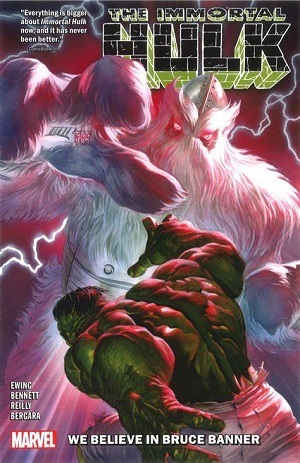 Quite a break from The Immortal Hulk: Breaker of Worlds volume. We left off that book with Cosmic Hulk smashing a planet and the sudden appearance of the Leader. There’s nothing like that going on here and the Leader doesn’t show up at all. Instead we have a political Hulk comic, with Bruce Banner (“an angry middle-class white guy talking about revolution”) on a crusade against corporate “crisis” capitalism. This means taking on the Roxxon Corporation and its CEO: a nine-foot-tall man-bull called (fittingly enough) the Minotaur.



 Alex Good