DNF files: End Times

End Times: Elites, Counter-Elites, and the Path of Political Disintegration

By Peter Turchin

Page I bailed on: 52

Verdict: Peter Turchin is a professor of historical social science whose baby is a field he calls cliodynamics. What this basically refers to is the mapping of historical processes by the use of mathematical models, in short a science-based grand theory of history of a kind that has long been popular both among historians and writers of fiction.

Normally I would have eaten a book like this up, as I’m quite fond of theories of historical cycles and evolution, from the Greek kyklos to today’s Big History. Turchin acknowledges this long tradition, but sees cliodynamics as something new mainly in its use of large data sets. It’s Big History meets Big Data, with the latter taking the form of something called Seshat or the Global History Databank.

I’d be on board with this approach if cliodynamics had come up with something really new, but I came away disappointed with its findings. All human societies “experience recurrent waves of political instability,” or alternating integrative and disintegrative phases that usually last around a hundred years. There are various factors that lead to a disintegrative phase or period of crisis and social collapse, including popular immiseration, weakened political legitimacy, high levels of social inequality, and exogenous shocks like climate change. The “most important driver of social and political instability” Turchin identifies though, and the one that has led to his making his mark in this field, is “elite overproduction.” Which means too many people holding an elite rank in society without enough positions of elite power to satisfy them. It’s like a game of musical chairs where the number of chairs stays the same but the number of people keeps growing.

This is a new idea, and one that has taken hold in the broader public discourse, but I think perhaps the main reason for this is that it reflects a contemporary concern. And specifically it feels like the concern of an academic, who no doubt sees a great deal of this sort of thing every day. That is, qualified Ph.D.’s who are unable to find good jobs. Then there’s the way the argument is geared toward explaining our current political climate and the Trump phenomenon in terms of a disintegrative phase. In a term historians like to use, this feels a lot like “presentism.”

I was both unconvinced and not very excited by any of the findings of cliodynamics. I don’t think integrative “golden ages” of internal order are typified by “cultural brilliance” while times of troubles experience “declining high culture.” As Harry Lime famously put it in The Third Man: “In Italy for 30 years under the Borgias they had warfare, terror, murder, and bloodshed, but they produced Michelangelo, Leonardo da Vinci, and the Renaissance. In Switzerland they had brotherly love – they had 500 years of democracy and peace, and what did that produce? The cuckoo clock.”

Lime’s speech is celebrated because it gets at a historical truth. To take another example, one of Turchin’s periods of extreme crisis is the lead-up to the American Civil War, but this was also America’s literary Renaissance. Countless other instances could be cited. Revolutionary times tend to be cultural volcanoes.

So cliodynamics paints with a broad brush. But in other ways a brush that isn’t broad enough. Just in the early chapters it seems like Turchin, in his list of factors contributing to social disintegration, was missing a more obvious and more foundational causal explanation: overpopulation. In the historical examples he gives of disintegrative phases the immiseration of the masses is mainly driven by the fact that the masses were growing at a pace that outstripped the economy’s ability to provide for them. And the overproduction of elites could be seen as a function of overpopulation as well. But once you focus on something as basic as this then cliodynamics itself doesn’t seem to be saying anything new.

Maybe in the rest of the book Turchin took all this in some truly groundbreaking directions, but by the time I quit I was pretty sure he was just filling out the old story of things falling apart with some new terminology and lots of numbers, while turning history into a database that wasn’t informed by any depth of understanding about what really happened in the past.

The DNF files

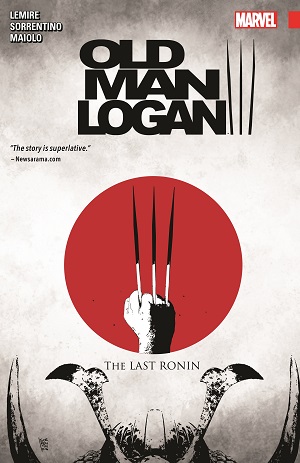
Old Man Logan 2: Bordertown

Old Man Logan 2: Bordertown

Let’s start off talking about place. I don’t like visiting the Marvel multiverse because I’m never sure what timeline or alternate Earth we’re in or on, but at least I was getting adjusted to the set-up in this series after the Berserker volume. In that book Wolvie was sent back from a dystopic (post-supervillain takeover) Wild West to what I guess is our current reality. But things kick off here at X-Haven: “Refuge for mutantkind and headquarters of the X-Men. Located in the Limbo Dimension.” Damn it, we’re in another dimension now? I had to look X-Haven up online and found out that it was created in 2015. Who can keep up with all this except the most determined fanboys and –girls?

Anyway, after a bit of talking between Wolverine and Storm at X-Haven, Logan is back (via teleportation) to the present day and driving his motorbike north. “Really north. Through Canada and beyond . . .” Wait, north of Canada? What does he mean? Russia? Because to get there he’d have to drive over the North Pole and technically be heading south. But then we’re told he arrives at Killhorn Falls in the Northwest Territory: “Nothing but a few rows of trailers and shacks along the Alaskan border. Whole community is built around a gravel quarry sitting on a small port in the Gulf of Alaska.”

Now wait just a minute. The Northwest Territories (it’s a plural) does not share a border with Alaska. That would be Yukon Territory. And the shoreline of the Gulf of Alaska is all part of Alaska (the panhandle), and notably not northern Alaska but the south-east part.

And this was all written by Jeff Lemire, who is Canadian. I don’t get it. Are we in another weird dimension or is Lemire just lost when it comes to geography?

Putting this to one side, I liked this instalment of the Old Man Logan series, but in terms of the larger story I felt like there wasn’t much there. Basically Logan heads off to this remote mining town when Lady Deathstrike and the Reavers show up, so he destroys them while defending a little girl who in one timeline he is going to eventually marry. At least I think I have that right, but don’t hold me to it.

The fighting is good and Sorrentino’s art is aces again in evoking the dark world of aging butchery that Wolverine inhabits. That double-page spread of skeleton Wolverine laughing with skulls dropping from his mouth is quite something. Then in issue #8 we get a vision of the depressing Gotterdammerung that was the supervillain uprising and it’s pretty bleak. But as Logan knows, getting old is itself pretty bleak. That’s just the kind of series this is. I was going to say that’s the kind of world this is, but since it’s many worlds I can’t.

The bonus comic is Uncanny X-Men #205 from 1981, a Chris Claremont story that has Wolverine fighting Lady Deathstrike and the Reavers again. Or not really again, but before. Or maybe not before because time is as loose a construct as geography in the multiverse. It’s a good comic though.

So lots of Wolverine’s claws coming out with a Snikt! sound and lots of limbs being detached. Plus Wolverine learning to accept his identity as agent of chaos, madness, and death, which is a familiar character arc for him. You do get the sense that he’s growing tired of all this though, and that now the game is playing him.

Graphicalex

Swamp Thing: The Bronze Age Volume 3

Swamp Thing: The Bronze Age Volume 3

After the initial run of Swamp Thing comics ended, along with Swampy’s brief sojourn with the Challengers of the Unknown (covered in The Bronze Age Volume 2), it looked as though the character was going to be left on the shelf for a while. Luckily, DC changed their mind and so we got a new series titled The Saga of the Swamp Thing, which was written by Martin Pasko. This omnibus edition presents #1-19 of that run, along with The Saga of the Swamp Thing Annual #1, which is a comic adaptation of Wes Craven’s 1982 movie and doesn’t really fit into the canon.

Because they were sort of starting over here we get a quick recap of the origin story. Which is understandable. What’s harder to get is why they keep coming back to retell this same bit (Alec Cross blowing up in his lab and then jumping into the swamp, where he’s transformed by his “biorestorative” formula). After a while, wouldn’t they think that regular readers knew how Swamp Thing came about? But perhaps there weren’t enough regular readers yet.

Immediately a depressing note is struck. Swampy is still mourning the loss of his beloved Linda, and wishing to God that he could join her in death. And as things proceed it seems as though that wish may be granted, not through mortal combat with the forces of evil but because we’re constantly being told that the mucky monster is “dying of some as-yet-unknown-ailment.” But why they keep making such a fuss over this is beyond me, for two reasons: (1) the ailment doesn’t seem to slow him down much, if at all; and (2) in the end it just turns out to be a bit of E. coli that’s quickly cured with a dip in his bio-restorative swamp. This seems to be the sort of thing that an editor should have been asking Pasko about. “Martin, where are we going with this disease angle?” And perhaps there was a point to it all in the beginning but things took a different direction. That happens.

The first 13 issues tell a single story, with a couple of minor digressions. This has Matt Cable and Abigail Arcane being replaced by Lizabeth Tremayne and Dennis Barclay as Swampy’s traveling companions. These three are opposed by the Sunderland Corporation, which is a generic bunch of baddies who basically run the U.S. military-industrial complex, and a “herald of the Antichrist” figure in the form of a fast-growing girl who is clearing a path for the coming of the Beast. She’s also tied in with Nazi occultism and such. Basically, she’s just everything bad. Her Van Helsing is a former concentration camp kapo named Dr. Helmut Kripptmann who soon joins the monster-hunting team.

It’s all wildly overwrought in a mythic kind of way (you can see what Alan Moore saw in the franchise), but I found it quite interesting and compelling on its own. My main problem with it is that Swamp Thing sort of became someone just along for the ride a lot of the time, especially since he was feeling poorly. And indeed I think this is a problem that all these early Swamp Thing titles had. They had good stories and well-drawn supporting casts, but Swampy himself keeps fading into the background. Maybe it’s because he has such trouble communicating, barely able to croak out a few words at a time. That’s quite a limitation for a leading man. Also, he’s obviously without any love interest (though one story here does play with the idea of him missing out on a woman who would understand him).

The digressions from the main storyline are also a lot of fun. The empaths who are used to absorb the injuries to Sunderland operatives were a neat idea, and the island of shipwreck survivors who reshape reality into classic old movies (King Kong, Casablanca) was a laugh. Things didn’t just fall apart after the initial 13-issue run either, as we then get a two-parter with Swampy facing off against a crystal man/living computer and then having to deal with the return of Arcane in a revolting insect form. There’s no keeping that guy down, even if he keeps coming back more damaged than ever.

A dark comic, what with the empaths, the town of vampires, and the child slayer storyline (dedicated, in 1982, to “the good people of Atlanta, that they may put the horror behind them . . . but not forget”). But it’s still full of the free-form imaginings that made Swamp Thing something just a bit different in the comic book canon. The outlier is the final comic, which, as mentioned already, is an adaptation of Wes Craven’s movie. It’s pretty standard stuff, and doesn’t connect well with the rest of the Swamp Thing mythology (Arcane, for starters, is a completely different sort of character), but fans will like having it in here anyway.

Graphicalex

Marple: Strange Jest

In my notes on A Murder is Announced I talked about how hard it was to think of it as being set in the 1950s. Christie’s own mental outlook on life crystallized in the 1930s and her cozy mysteries harken even further back. The buildings in the village of Chipping Cleghorn seem “done round about in Victorian times,” and Miss Marple (in “Miss Marple Tells a Story”) describes herself as “hopelessly Victorian.” Victorian is an adjective that’s used again to describe Miss Marple in this story, though in a slightly unexpected way (when she gets excited she’s said to respond with “Victorian gusto”). But “Strange Jest” came out in 1941 in the U.S. and ’44 in the UK, the delay presumably being due to the fact there was a war going on at the time.

There’s no mention of the war here, but only a mystery possibly involving an inheritance that takes the form of a buried treasure, like something out of Treasure Island (published 1883). And the main clues are drawn from the Victorian era as well, with letters seeming to have been mailed from the 1850s and a reference to “gammon and spinach.” This latter meant nothing at all to me (sort of like “hundreds and thousands”), but it is, or was, a slang expression for nonsense, its usage dating back to Dickens’s David Copperfield (published 1850). I think you might have to be a Victorian relic yourself to have picked up on that.

I thought of this story as a clever homage to Poe’s “The Purloined Letter,” with the amateur detectives tearing the property apart to find something (a letter, as it turns out) whose meaning is hiding in plain sight. “There’s really no need to make it all so difficult,” Miss Marple tells the treasure hunters. And once again we have an ending where the young lovers are set nicely on their way in the best comic style.

Marple index

Top of the world

Something about this guy perched on the roof made me smile. It seemed so incongruous. At least he didn’t brain himself flying into one of those mirrored windows. (You can click on the pic to make it bigger.)

The Last Days of American Crime

The Last Days of American Crime

The Last Days of American Crime is a fairly standard neo-noir heist story about a tough guy who works as a security guard who teams up with a pair of crazy-sexy punks to make a big score. A lust triangle ensues, and one of the guys has to be the odd man out.

If it had stayed on that level I think it would have worked reasonably well. But author Rick Remender wanted to add more than just a twist to the proceedings and I’m not sure if all he added to the mix was a plus.

Here’s what’s new. First of all, the U.S. is switching to an all-digital currency and the trio are looking to steal one of the machines that will control said currency. How? I really wasn’t sure about this, but chalked it up as just a MacGuffin. They could just as easily have been stealing gold or jewels from safety deposit boxes. Second: the heist is on a strict schedule because it has to be done before the government begins broadcasting a signal that will operate as a neuro-inhibitor, preventing people from committing any crimes or doing anything that they know is wrong. How? Well, I couldn’t explain the science to you, because there isn’t any, but even granting such a signal was possible I don’t see how it would work on a practical level. There are thousands of laws people break every day because they’re unaware of them. Do those get shut down as well? Or what happens when a psychopath who doesn’t know the difference between right and wrong decides he wants to keep killing people? This latter is a question that gets asked, and answered, in the finale here, and it underscores how little thought went into what’s called the American Peace Initiative.

Why add such a gimmicky pair of plot elements to such a basic heist story? Maybe just because the heist story was so basic Remender thought he needed something really “out there” to jazz it up. And I guess digital currencies and behavioral control are current issues, playing off fears of things like China’s social credit system. But meanwhile, the America we see before the signal is a hellscape of carnage: all domestic terrorism, gang violence, and bodies piling up in the streets. I guess something should be done about that. I mean, the bad guys are thinking of fleeing to either Mexico or Canada, and Mexico seems to be ahead of the country that’s full of “moose-fucking, commie-Mountie, hockey motherfuckers.”

In sum: it’s very violent, somewhat hard to follow, and unnecessarily futuristic, but I did find it a stylish riff on an old story that has some juice in it yet.

Graphicalex

TCF: Alice & Gerald

Alice & Gerald: A Homicidal Love Story
By Ron Franscell

The crime:

In 1976 Alice Prunty met Gerald Uden and they were married soon thereafter. It was the fourth marriage for both, and both had children from their earlier marriages. What Alice didn’t tell Gerald until after the wedding is that she’d killed her last husband, Ron Holtz, claiming abuse at his hands. Gerald was understanding. Later, Gerald became tired of making support payments to his ex-wife Virginia, who had custody of his two sons. So, perhaps egged on by Alice (who disliked his ex-wife intensely), he killed all three of them in 1980.

Authorities strongly suspected Alice of killing Holtz and Gerald of the triple homicide of Virginia and his two sons, but none of the bodies were found so after moving to Missouri the homicidal couple went on living the rest of their lives in peace as the case grew colder. But police never lost interest in it, and after much digging around (literally and metaphorically) they managed to find Holtz’s body where Alice had thrown it in an abandoned mine shaft. That was in 2013. Alice was charged and convicted of Holtz’s murder and would later die in prison. Gerald would confess to the murder of Virginia and the two boys and be sentenced to several life sentences. The bodies of his victims were never found.

The book:

By coincidence I came to Alice & Gerald after reading a series of books about criminal couples, each of which raised the same question about the apportioning of guilt. Here’s a recap:

The Art Thief by Michael Finkel: Stéphane Breitwieser and Anne-Catherine Kleinklaus lived together and had a side hustle stealing works of art from museums all around Europe. Anne-Catherine seems to have operated mostly as a lookout while Stéphane did all the work.

Guilty Creatures by Mikita Brottman: Brian Winchester killed Denise Williams’s husband Mike and then married her. After a few years together they split up and Brian copped a plea, implicating Denise in Mike’s murder. She was initially found guilty of first degree murder but then had the judgment overturned, though her conviction for being an accessory to murder remained.

American Fire by Monica Hesse: starting in November 2012 Charlie Smith and Tonya Bundick went on a months-long arson spree, burning abandoned homes on Virginia’s East Shore. At trial, Smith claimed he did it all for love and that torching houses was Tonya’s thing. Tonya didn’t have much to say.

In Alice & Gerald the issue of who was the dominant partner is again raised, and it seems as though most of the people close to the case agree that Alice was the one pulling the strings. That’s the sense I had as well, but it’s possible that the way Ron Franscell was telling the story led me to that conclusion. Plus, after reading some of the discussion in Guilty Creatures, I was on my guard against the “Eve factor”: “The way that when a man and a woman are part of a crime together it is generally the woman who is thought to be the mastermind, the Eve who tempts Adam.”

What makes it hard to say in the case of Alice and Gerald, especially given how cold a case it was, with the murders having taken place forty years before being brought to trial, is the fact that Alice played everything close to the chest. In this she was very much like the women in the other cases I just mentioned. Anne-Catherine Kleinklaus, Denise Williams, and Tonya Bundick all clammed up after their arrest, not talking to police or to reporters. If nothing else, this suggests they were at least smarter than their partners in crime. As I’ve said before, if you’ve been arrested, for pretty much anything, the best thing you can do is keep your mouth shut. Taking this principle a step further, I was particularly impressed by the fact that Alice refused to take a polygraph or lie-detector test as “a matter of principle.” When Gerald was later brought in for questioning he kept to the same line: “No polygraph. It’s not about my guilt or innocence. It’s just a matter of principle.” The detective questioning Gerald noted the similarity in response and assumed, probably correctly, that they’d been coaching each other. But, for them, this was absolutely the right move. In the first place, polygraphs are worthless (Alice later told investigators that she’d researched them and found they were “notoriously unreliable”), and in the second they didn’t want to answer questions or talk to the police anyway.

On the question of guilt, you could argue it either way. Taking Alice’s side, her murder of Ron Holtz could be seen as being what she said it was: a response to domestic abuse. Holtz was a violent head case who had spent a lot of time in mental hospitals (which is where he met Alice, where she worked as a nurse). On the other hand, Alice was a killer before she even met Gerald, and given her hatred of Virginia it’s hard to believe she wasn’t encouraging Gerald to do something to get rid of her. And it’s also pretty obvious that she knew what Gerald had done after the fact and didn’t just keep quiet about it but helped him to cover his tracks by writing phoney (and cruel) letters to Virginia’s mother.

In sum, while it’s hard to say who was the dominant partner I think the evidence shows that neither of them had much in the way of empathy, and thought nothing of murder as a way to dispose of people they found to be an inconvenience. Or an unnecessary expense. Gerald reckoned killing his boys would lead to savings in child support of $14,000: “He knew because he’d added it up: $150 for ninety-two more months.” As one of Alice’s children put it when describing his reaction to first meeting Gerald, “This guy is really weird. Not like a child molester weird or anything, just spooky weird . . . just spooky. . . . Like he has no feeling.” Not stupid then, but missing something.

I’ll confess that when I started in on Alice & Gerald it put my back up a bit. The Prologue felt overwritten in its evocation of place:

Wyoming [in the 1960s] was a place to land without baggage, where one could hide and never be found, a kingdom of dirt where giant hollows in the earth might swallow up a man (or woman) entirely, an ambiguous landscape of infertile dreams and pregnant hopes. The landscape was vast, desolate, and mysterious, festooned with hidey-holes that were forgotten or never known.

It was a spot on the edge of the Big Empty where your dog could bark forever or you could piss on the side of the road or shoot your gun at the moon or call yourself by another name. None of The World’s ordinary rules applied. Whatever your badlands fetish, you could practice it unmolested in this impossibly empty place.

I rolled my eyes at “infertile dreams and pregnant hopes,” but after a while Franscell’s voice grew on me. A native of Wyoming, he writes in a way that brings out the local colour. Here, for example, is his description of the spot where Virginia and the two boys will be murdered: “Virginia pulled off into the cheatgrass shoulder this side of the canal. The water ran sluggish and buckskin brown, full of sandrock dust, caliche, horseshit, and other high plains compost. There was so much dirt in the channel that you could damn near plow it.” In other places I had to look up the meaning of “butt-sprung” (old and worn out), and shook my head, smiling, at squalls that “can strike faster than a rattler on meth.” I entered into the spirit of this enough so that in a later ode to the “impossibly empty place” that is Wyoming I had no problems at all. And there was an important point being made connecting the murders to the desolate geography.

Wyoming poses a unique challenge for cops in all missing persons cases, cold nor not.

Anybody who’s driven through Wyoming’s boundless terrain has imagined how easy it would be to lose oneself in int.

And more than a few have fantasized about losing someone else out there.

The state’s average population density of six people per square mile (in contrast, New Jersey has 1,200 people per square mile) is an unfair mathematical measure. In fact, the state encompasses thousands of square miles where nobody lives, nobody goes, and nobody ever will.

In other words, Wyoming – the least populous and most incomprehensible of the lower forty-eight states – is the baddest of badlands. There are more places to hide dead people than live people will ever find.

Given this bad-ass landscape, all the more credit goes to the dogged police work that had to persevere through generations of different investigators to finally dig out the truth. They didn’t have much to go on, aside from their conviction that Alice and Gerald were guilty as hell. This was something that was obvious right from the first interviews they sat down for at the time of the murders, and it was reinforced in every subsequent interaction. But how to prove their guilt? For that the police would need a body, and even after identifying the probable location of Ron Holtz’s final resting spot, recovering his remains wasn’t easy, or cheap. It’s not often that I get a chance to compliment the police in these True Crime Files, so I’m happy to give them a shout out here.

In addition to the police work there was also the concern of Virginia’s mother, Claire, who did everything she could to keep the investigation going. “The universe loves a stubborn heart,” is Franscell’s tributary line. In a lot of the cases I’ve talked about you’ll find family members taking on this kind of a role. Mike Williams’s mother in Guilty Creatures and Kari Baker’s “angels” (her mother and sisters) who refused to accept the coroner’s verdict of suicide in her death (as recounted in Kathryn Casey’s Deadly Little Secrets). The sad irony is that Claire died shortly before Alice and Gerald were brought to justice, and the bodies of Virginia and the boys were never found. Instead, what undid the killers was the discovery of Holtz’s body, a man who nobody seemed to care about. Indeed, when the police tried to follow up on Holtz’s disappearance they found that his family were “so unconcerned about their son and brother, who’d been such an asshole all his life, that nobody even reported him missing.” The wheels of justice sometimes turn in mysterious ways.

Noted in passing:

The invocation of Shakespeare to lend weight to what are often just sleazy stories of domestic violence can be overdone. I mentioned this in my review of Guilty Creatures and it comes up again here. One of the three epigraphs comes from Macbeth: “The attempt and not the deed confounds us.” It’s a quote I’ve used myself on occasion, but what relevance does it have here? Alice and Gerald weren’t undone by their attempt to commit murder, but by the discovery of Holtz’s body. They weren’t convicted of attempting anything, but of committing murder. Then in his Acknowledgments Franscell refers to this as a “bizarre story of Shakespearean proportions.” How so? Bizarre yes, and tragic for the victims. But in what sense are the “proportions” Shakespearean? Does he mean heroic? Larger than life? Because I don’t see either.

The only point when I did feel Shakespeare’s presence was when Gerald confessed to shooting Virginia and his two sons in the head, with the unfortunate result that their bodies bled all over the inside of his car. “They didn’t suffer. But I had no idea the human body contained that much blood,” he tells the investigators. That does sound like an echo of Lady Macbeth’s “Who would have thought the old man to have had so much blood in him?”

When the police had Alice nailed for the murder of Ron Holtz there was renewed interest in the premature death of her previous husband, ascribed at the time to hypertension and kidney failure. The husband’s corpse was exhumed so that pathologists could test for the presence of ethylene glycol in the tissues.

Ethylene glycol is the primary compound in ordinary automobile coolants and antifreezes. In the past century, it has also been a favorite poison – especially for husband-killing wives, according to forensic data – because it’s in every garage, it’s colorless and odorless, it tastes very sweet, and its toxic effects can be misdiagnosed as something else.

I guess if the forensic data says this is the poison of choice for husband-killing wives then it must be true. It was a point that made me think of the story “Antifreeze and a Cold Heart” in the collection Murder, Madness and Mayhem by Mike Browne about a woman who killed two husbands this way. Husbands may want to keep the antifreeze locked up if they think their marriage is on the rocks.

Takeaways:

One violent person without a conscience is bad enough, but when they find a soulmate it’s double trouble.

True Crime Files

Titans Vol. 1: The Return of Wally West

Titans Vol. 1: The Return of Wally West

To set the scene, this series was part of the 2016 DC Rebirth program, which was a reboot of the DC Universe. So the Teen Titans are now all grown up (or at least in their 20s) and are now just called the Titans. They’re also in a different shard of the multiverse that Wally West, formerly Kid Flash and now just the Flash (because he’s “not a kid anymore,” get it?), comes blasting into as things kick off. He reunites with his Titan pals – Nightwing (Dick Grayson), Tempest (formerly Aqualad), Omen, Arsenal, and Donna Troy. They don’t recognize him at first but somehow he makes a synaptic connection with them and before long they’re a team again.

Unfortunately, Wally’s return also triggers the reawakening of Abra Kadabra, the techno-mage adversary of the Flash who had also lost his memory and been reduced to playing children’s birthday parties as Mister Hocus Pocus. Once he remembers who he is, and the power in his magic wand, he sets out to re-disappear Wally West, over the dead bodies of the other Titans and Wally’s normie girlfriend (as stock a character in superhero comics as you can get).

It’s a nicely structured story arc but the arc itself is the usual blather that ultimately gets lost in the mystic mumbo-jumbo of Wally having to access the “speed force.” Which means he has to run really, really, really fast. But he runs so fast he blasts himself clear out of this dimension. Luckily, the power of love and friendship provides an anchor capable of drawing him back, defeating Kadabra, and saving all his buddies. There’s even a full-page group hug.

This is cheesy stuff, and I’d be inclined to write this volume of the Rebirth off completely but for the character of Kadabra. He’s drawn by Brett Booth in the manner of Gris Grimly, and driven by a very contemporary obsession with fame. “It’s true,” he explains, “I do it all for fame and adoration. You must think that’s pathetic. You probably call it narcissism, or other derogatory psychological terms. You probably think I need therapy. But you should realize I come from a far future that is sterile and cold. Nothing there is wonderful at all. I came to your time craving fame or infamy. Either is fine.”

I don’t know why he’s bothering with the magic acts. He could be a successful politician or tech oligarch in the twenty-first century with that kind of an attitude. Other villains suffer from megalomania or have a need to dominate the world or the universe. Kadabra is just doing it for the likes and the clicks. He has almost godlike powers (until, of course, he doesn’t) but all he wants to do is play at being an edgelord. Maybe he really is from our future! Certainly in 2016 he was arriving just ahead of time.

Graphicalex

Bookmarked! #82: Bookstores No More XIII: Co-Op Bookstores (Stone Road Mall Location)

I remember the Co-Op Bookstore in the Stone Road Mall. But I think it closed in the 1980s. Making this a very old bookmark indeed. Back in the days when Canadian bookmarks, even the ones that are just slips of paper with some printing on them, had to be “Made in [the] U.S.A.”

I’m not sure if the Stone Road location was associated with the University of Guelph’s Co-Op Bookstore, which is still in operation on campus. I don’t know why they would have had a storefront in the mall, but it’s possible.

Book: Last Best Hope: America in Crisis and Renewal by George Packer

Bookmarked Bookmarks