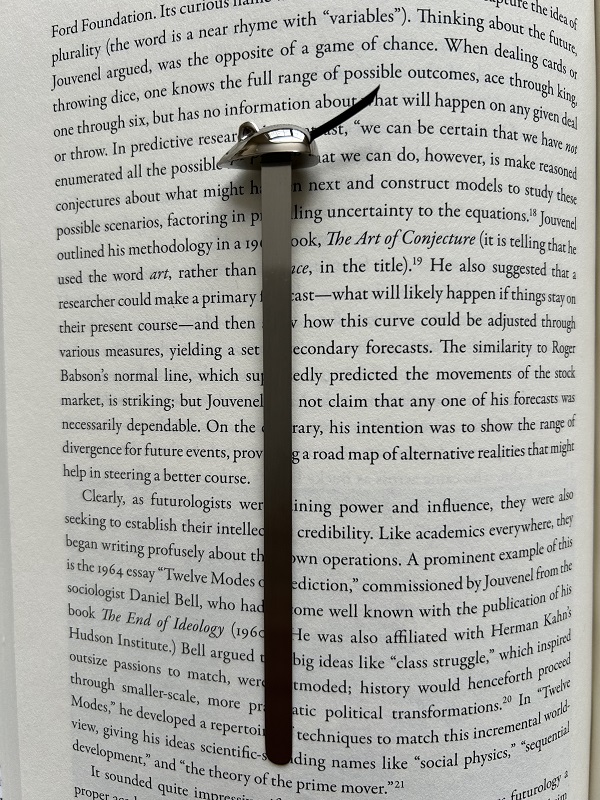
I’ve posted a lot of cat bookmarks over the years. Time to even things out a bit with this stylish silver piece from Gibraltar.
Book: A Century of Tomorrows: How Imagining the Future Shapes the Present by Glenn Adamson
I’ve posted a lot of cat bookmarks over the years. Time to even things out a bit with this stylish silver piece from Gibraltar.
Book: A Century of Tomorrows: How Imagining the Future Shapes the Present by Glenn Adamson

I ended up 2025 with a trip to the hospital for an MRI.
It was quite an odd experience. The hospital is usually a place that’s packed with people and crazy busy. But the combination of it being the holidays and 4:30 in the morning meant it was eerily quiet. That may also be why I managed to get an appointment for an MRI within a week. Usually you have to wait a lot longer than that.
No cars on the road for the drive to the hospital. I got to the main entrance and there was no one in sight. Only one person in the cavernous main lobby, and she was hidden in the information booth. I didn’t even see her at first. Went to the elevators. Nobody there. Rode them up to the third floor. Nobody. Nobody anywhere.
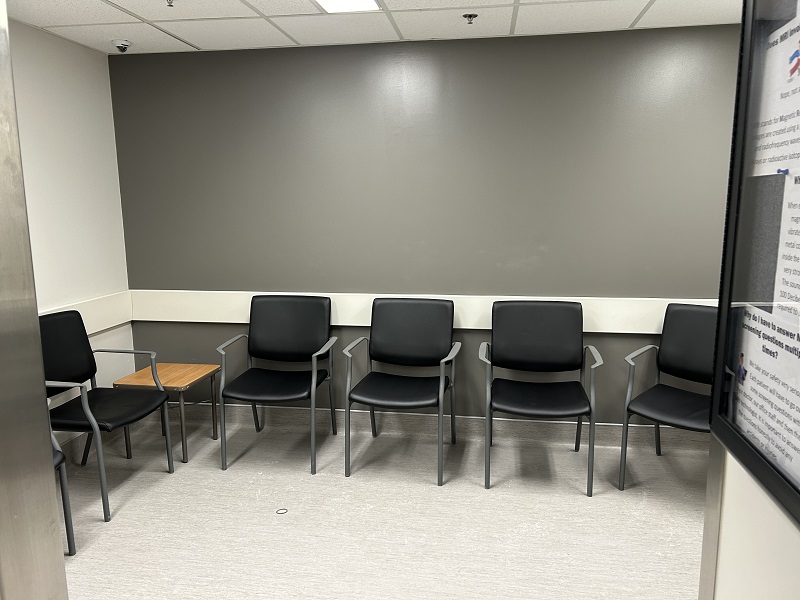
One person at the desk in the MRI room, who directed me to the waiting room. Empty. I just hung around until somebody came out and told me where to get changed and put my clothes. Then she left. So I got changed (messed up putting on the hospital gown because I don’t wear one of those every day, OK?), then went into the MRI room. Haven’t had one of those before but it turned out to be a pleasant experience. Really nice technicians. Then left. One person was just coming into the waiting room as I was heading out. Back on the main floor there was one janitor pushing a scrubber.
So inside and outside the hospital I saw a total of six people. Two at information desks. Two running the MRI machine. One patient and one janitor. All women. They say healthcare is a predominantly female occupation now but this still struck me as surprising. Though more surprising was just how empty the place was. I mean practically deserted. If I hadn’t been looking for people I wouldn’t have found any. And it’s a big hospital!
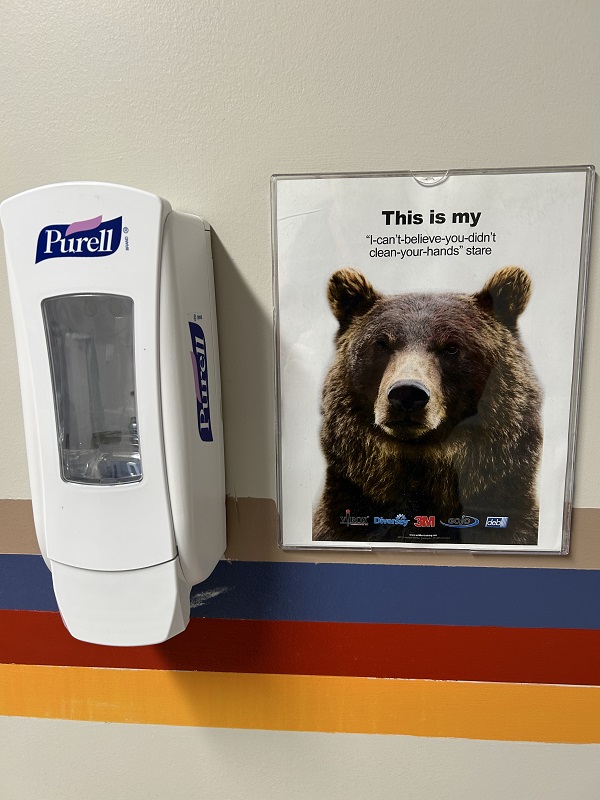
This was a great visit. Much nicer than the last time I was in a hospital! Best moment was this sign of a bear reminding me to wash my hands. I really loved this. And I did wash my hands!
Happy New Year! Take care of yourselves and stay out of the hospital if you can!
Over at Alex on Film you can read my annual awards for the movies of the year. Not much to choose from this year as November-December were really rough and I didn’t watch many movies. Oh well.
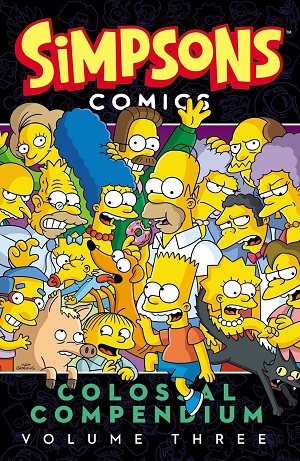 Not a bad collection. Some interesting longer stories, especially a huge three-parter about Krusty’s attempt to revive the flagging fortunes of the Radioactive Man comic. Radioactive Man seems to be a popular figure in these comics, perhaps for all the self-referential humour. They certainly do a number on the overuse of crossover plots here.
There’s also a lot of the usual surrealism, as when Professor Frink’s “Cool Juice” turns all the male inhabitants of Springfield into hipster Rat Packers, or when Milhouse’s dream life interacts with reality in chaotic ways. But there are also the jokes that land closer to home, like Homer telling Bart not to get angry at the news (“The TV can’t hear you, no matter how loud you yell, boy. Believe me, I’ve tried!”) and the way the Springfield Library is saved by becoming a homeless shelter. Also worth noting is the inking by Andrew Pepoy, which goes deep into heavy shadow effects. I liked the way it looked.
I thought the shorter stories were all duds, and to be honest I couldn’t see the point in several of them.
The papercraft Springfield building is the Kwik-E-Mart. It looks like it’s just a box with no add-ons, so not very interesting.
For the last couple of months I’ve been laid up with a bad back and so haven’t been watching many movies. I also haven’t been able to sit at a desk and do any writing. This means I’ll probably be taking a break from Alex on Film shortly. But I have been spending a lot more time reading — there’s always a silver lining! — so I’ll try to keep updating here and over at Good Reports, where I just posted a review of John Vaillant’s Fire Weather.
I decided to cancel my year-end Books of the Year post this year because I just didn’t read enough new books. Good Reports even spent most of 2025 on hiatus. But I’ve been adding a lot of book reviews here in my series on true crime, comics and graphic novels, and mystery and detective fiction. I’ve also been spending a lot more time with the classics, which I enjoy but isn’t something that leads to a lot of new content. In a mad world though, it’s helping keep me sane.
 This oversized volume is part of Marvel’s Black, White & Blood series, which is distinguished by its use of a mostly black-and-white format with coloured accents in red to show blood (with a bit of green mixed in for Xenomorph blood here). You may think of the sort of thing that was done with colour (and its absence) in Frank Miller’s Sin City comics, and I think that’s a good analogy for both the level of violence on display as well as the noir sensibility. Noir referring both to the heavy and dramatic shadow as well as a lack of traditional good guys in an amoral universe.
The Alien run consisted of four issues, each with a part of a long story, “Utopia,” as well as two short pieces. They all have different writers and artists, but the same letterer (Clayton Cowles), which actually provides a lot more of a sense of continuity than you’d expect. I would have even appreciated cover pages for each of the individual stories because it’s easy to miss where one ends and another is getting started.
The large format makes covers and full-page spreads into poster-size art that you just want to enjoy. I’ve commented before on the cheaper reprints in the Marvel Masterworks and DC compact comics lines and how hard they can be to read, and it’s a real treat to read a big book like this that looks so good throughout. I especially liked the chonky stylized turn that Claire Roe gives her story, with illustrations that look almost like woodcuts.
If you want one word to describe the general sensibility I’d say it’s bleak. And that’s saying something considering these are Alien comics. There are no happy endings, and most of the stories are very unhappy in brutal and ironic ways. Even “Utopia,” about a ship full of socialists looking to colonize a new planet as a worker’s paradise, took a dark turn I found surprising. Mankind is clearly something to be surpassed. The final line in the book is “Any chance to eradicate humanity’s ugliness is beautiful.” That gives you some idea of where you’re going.

Pewter presents from Pugwash, Nova Scotia. A Merry Christmas to all of you!
Book: The Celts: A Sceptical History by Simon Jenkins
If you’re fan of pastiche Holmes then you probably know the name of James Lovegrove for his Cthulhu Casebooks, a series of novels pitting Holmes against Lovecraftian monsters.
Sherlock Holmes and the Christmas Demon is something a little more mainstream. At first blush it might seem like we’re still in supernatural territory though. A damsel in distress named Eve Allerthorpe comes to London to see if Holmes can help her solve the mystery of an evil spirit of Yorkshire folklore known as the Black Thurrick (don’t bother looking the name up, it’s Lovegrove’s invention). This Black Thurrick creature has a reputation for stealing children at Christmas from families who don’t offer him the traditional offering of milk and cookies, leaving a bundle of birch twigs behind.
Intrigued, Holmes and Watson set out for the Allerthorpe family castle, a spooky place with the delightful name of Fellscar Keep that sits out in the middle of a lake. There they meet the extended Allerthorpe family as well as some of the household staff, and have some Scooby-Doo adventures involving possible ghosts and things that go bump or even scream in the night. Holmes isn’t buying the legend of the Black Thurrick for a minute though (he even dismisses Christmas itself as “fatuous and tawdry”), and is more interested in the fact that Eve is due to come into a significant inheritance on Christmas Day, but only if she is found to be of sound mind.
(As an aside, and still on the matter of sound minds, the novel is set in 1890 and at one point Eve refers to her deceased mother as having been “anxious and neurotic.” The term “neurotic” was popularized only in the 1940s, and according to what I could find online its first use in English, at least to describe an individual, was in 1896.)
As with a lot of contemporary Holmes pastiches the action and setting here are highly cinematic, as is the story’s structure. The mystery is also resolved in a manner that doesn’t play fair with the reader (Holmes, as he often does, disappears to do his own investigations when necessary), while the conclusion, with everyone gathered in the drawing room to hear Holmes’s explanation, includes a truly ridiculous character turn. That said, there’s fun to be had and we’re sent off with a Watson family Christmas vignette that indulges a bit of that holiday spirit. Holmes isn’t such a Grinch after all.
 Another part of the Druuna saga, a story cycle that runs in place, never really going anywhere because time and place have no meaning in the Druunaverse. We’re told that Druuna’s boyfriend Shastar has become pure energy and his mind integrated with the ship’s computer, within which he is joined with the ship’s captain, Lewis. But they can both still make themselves manifest either through dreams or virtual reality. Meanwhile the monsters are proliferating and creating “replicants” of the crew members: exact doubles who don’t even seem to know that they are replicants. Well, some of the time they do, but most of the time they don’t. So Druuna doesn’t even know if she’s a replicant. In her human form she’s something special, not quite a sub- or ur-human “prolet,” but also something different from the more civilized crew members. More civilized, I think, mainly because they wear more clothes. Druuna doesn’t like wearing clothes. Or maybe she does but just often finds herself without any.
There’s sex. And violence. And sexual violence. And various attempts, all futile, to explain what’s going on. I love how Shastar actually tries to draw a diagram to show Druuna what’s happening . . . and it’s of no use at all. As near as I can figure it, there are two dimensions, one good the other evil, and the ship has come up to the boundary between them and the monsters are spilling over from the evil dimension and contaminating our own. At the end the character of Doc figures out some way to go back in time and avoid all this. Or maybe he doesn’t and it’s a dream and they’re all replicants now. I couldn’t tell you.
You just have to learn to let go with Druuna. It’s not meant to make sense. Judged against the other books in the series I’d probably rate Carnivora near the bottom because there’s more talk and less coherence than usual. Even the minimal structure of the hero’s journey is dropped, as it’s not clear if Druuna is actually on her way anywhere or has any particular mission. I barked out a laugh when, after talking to Shastar (or his avatar) she says she has to return to the ship’s crew to pass on the message that they’re in danger. As if they hadn’t figured that out! Most of them have already been killed and eaten! But if you’re a fan then none of this really matters. Nor, I would argue, is the sex all that important. You’re just here for the crazy.
Postscript: My hardcover edition of this book is basically in mint condition. When I last checked there was only one for sale, used, on Amazon for $545. If I just hold on to mine for another thirty years I’ll be rich.

This is not a grawlix. It’s a grawlix emoji.
You probably can’t pronounce the title of this post, but you know what it means. What you may not know is that it has a name. It’s called a grawlix.
The word grawlix was coined by the late cartoonist Mort Walker, who created the comic strip Beetle Bailey. Walker invented a lot of terms relating to comics (like “briffit” for a cloud of dust to show a character’s sudden movement, or “plewds” for drops of sweat shed from someone who is stressing out), but I think grawlix is the only one that’s stuck.
The use of grawlixes long preceded Walker’s giving it a name though. It’s generally regarded that the first example came in the comic strip Lady Bountiful in 1901. It looked like this:
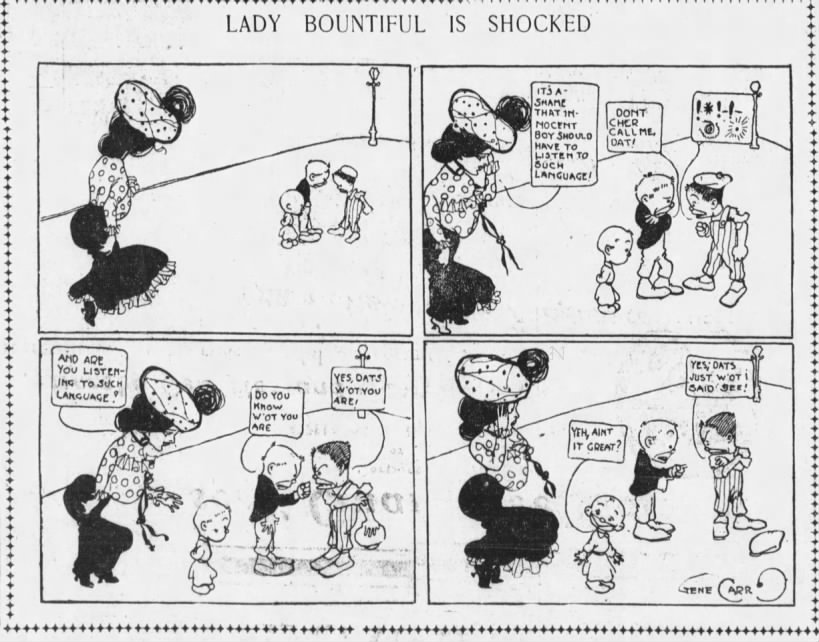
The definition of grawlix is the use of typographical symbols to replace profanity. Hence it is sometimes also referred to as an “obscenicon.” I got that definition from Wikipedia but I could have taken something similar from a dictionary since as of 2018 Merriam-Webster added grawlix to their lexicon and in 2022 it made it into The Official Scrabble Players Dictionary. Which must have pleased Scrabble players because it’s always nice to have another “X” word to play.

