Holmes: The Adventure of the Noble Bachelor

I think this is one of the slighter Holmes stories, and it’s one that Doyle himself ranked near “the bottom of the list.” A British aristo, the Lord Robert St. Simon, gets married but his bride pulls a runner as soon as they get home from the wedding. It turns out she was already married back in America to a man she thought was dead, but who had secretly appeared to her at the church. Since she still loved him, she ditched her new husband, who then went to Holmes, asking him to investigate and figure out what the heck just happened.

It’s not much of a challenge for Holmes, and what sticks in the mind is the moral judgment on display. Holmes doesn’t care for St. Simon from the get-go, treating him as a pompous ass in need of being taken down a peg or three. Indeed the intake interview basically just involves Holmes laughing and mocking him repeatedly, though it isn’t clear what’s so foolish about him, aside from his dress, which is only “careful to the verge of foppishness.” And what’s wrong with that?

The dislike clearly goes deeper than what’s registered by Holmes. Doyle seemed to have something in for the dregs of the British aristocracy, and made St. Simon into the standard-bearer for his class, being a poor fellow with a fancy title out to wed an American heiress. Which is true on the face of it, but again St. Simon doesn’t seem like he’s just a mercenary prig. And I’m honestly at a loss to explain the way he’s treated at the end. Does Holmes really think it likely that St Simon will join the newly reunited couple in a celebratory dinner? I don’t think that’s possible, which means the fancy meal was prepared as another form of mockery. But doesn’t St. Simon deserve to feel hard done by? I felt more than a little sympathy for him, as the typical ending of having lovers reunited is achieved very much at his expense and I don’t see where he’s done anything wrong.

The plot is again driven by a backstory set in a wild, foreign land, in this case the American West in the 1880s. And that link to America adds something to Doyle’s critique of England’s ruling class. As Holmes puts it at the end of the story: “It is always a joy to meet an American . . . for I am one of those who believe that the folly of a monarch and the blundering of a Minister in fargone years will not prevent our children from being some day citizens of the same world-wide country under a flag which shall be a quartering of the Union Jack with the Stars and Stripes.”

A nice thought, foreshadowing the mostly rhetorical “special relationship.” But wouldn’t the marriage of St. Simon to Hatty Doran have better dramatized the consummation devoutly to be wished? And if so, why was Doyle so against it?

Holmes index

Federal election 2025: After

Normally with one of my after-the-election posts I’d be looking back on what happened. But with the results of yesterday’s vote being so close it looks as though the story of the 2025 federal election is just getting started.

Some observations can be made. As expected, both the NDP and Green Party did very poorly, though the Liberal margin of victory as of this writing is tight enough that the NDP may still have some role to play. They’ll do so, however, without Jagmeet Singh, an articulate and intelligent fellow who never broke through and ended up outstaying his welcome. He lost in his own riding and his political career, I suspect, is over.

Also as expected the Liberals found Ontario, and specifically the Toronto area, to be a rock of support. Whenever that block begins to shift, and it will, that will be the end for their remarkable run.

In a first-past-the-post electoral system it’s always going to be hard for third or fourth parties to make an impact outside of specific regions. Despite slipping badly, the Bloc Québécois may have an outside influence in what happens now. Which leads me to confess that I don’t pay any attention during elections as to what their platform is as they don’t run candidates outside of Quebec. Essentially I see them as being a party of the right, though it’s an old right in a lot of ways and there were parts of their platform, when I started digging into it, that I found myself agreeing with. I’ll never give up on the dream of abolishing the Senate, for example.

It looks as though Pierre Poilievre wants to stay on as Tory leader (assuming he manages to win his own riding, which was still very much in doubt the morning after). I don’t know if this is a good idea, as he seems like one of those politicians with a hard ceiling due to his personality and campaigning style. On the other hand, Mark Carney doesn’t strike me as a skilled politician and he lacks any common touch, but he made an effective foil to Trump, which is all he needed to be in the present moment. He got a boost from being able to present himself as an outsider and a responsible steward of the economy due to his banking background, but I don’t think that’s going to last long. The default impression he gives is of an arrogant establishment technocrat. In any event, what mandate he’s been given will be to manage the economy through what I think is going to be the stormy weather. I wish him the best of luck, which I think he’ll need.

Update:

Poilieve did in fact lose his home riding, complicating his plans to stay on as Conservative leader.

Political punditry potpourri

Political punditry potpourri

Over the years I’ve done a number of posts on Canadian federal elections. This is an index to my penetrating reportage.

Just as a heads-up, I would describe my own political leanings as leftish. But I’m  what’s known today as the “old left,” which leaves me without a stable home in terms of a political party. In any event, I think most political systems in the West, if not broken, are in a bad state of disrepair and almost certainly not up to the challenges we face in the twenty-first century.

Federal election 2015: Before

“I sense a growing divide between public (unionized) and private sector workers both in Canada and the U.S. that could make for a coming split between a party of the state and a party of everyone else. If there is a future for the right it may be here.”

Federal election 2015: After

“It didn’t have to be this way. Canada is, in many ways, a conservative (small “c”) country. But the party’s leadership has been hijacked in the twenty-first century by angry freaks. Stephen Harper like Tim Hudak in Ontario, or even Rob Ford in Toronto could have been a more successful, effective political leader if he’d just been moderately reasonable. But being reasonable isn’t what any of these guys signed on for. They preferred to play ideologues and idiots (or actually were ideologues and idiots). Not one of them could be considered, and this is an important quality for a politician, normal. As I also indicated in my earlier post, the same thing can be said of the current Republican field in the United States. The right has spent years pandering to its base. That base now holds it hostage.”

Federal election 2019: Before

“We’re locked into a nineteenth-century political system, components of which were archaic in the nineteenth century. I don’t like it, but the system is never going to change itself, and indeed will do everything it can to resist any change happening.”

Federal election 2019: After

“One observation I’d make is that we are becoming a more regionally divided nation, which I see as being a sort of work-around of the archaic first-past-the-post electoral system.”

Federal election 2021: Before

“Heaven knows the environment should have been a strong issue to run on this year, but it hasn’t happened. I’m beginning to wonder if it ever will.”

Federal election 2021: After

“So there you have it. An election that nobody wanted ending with a result that will make nobody happy. Which will lead, I am sure, to more anger. A forecast of sunny days ahead.”

Federal election 2025: Before

“The way the election flipped on a dime (if that metaphor makes sense) represents one of the most dramatic turnarounds in Canadian political history. In fact, for its speed and for the size of the swing it probably is the most dramatic turnaround we’ve ever seen. ”

Federal election 2025: After

“But with the results of yesterday’s vote being so close it looks as though the story of the 2025 federal election is just getting started.”


Fighting MAD

Fighting MAD

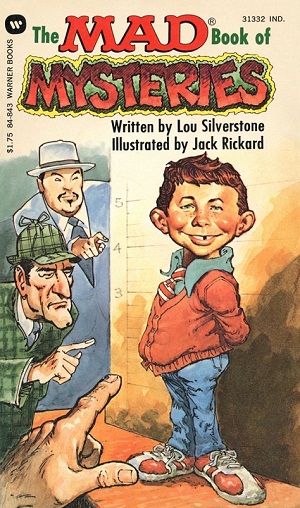
I grew up with MAD Magazine. And much to my delight, I actually held on to a lot of them, including a bunch of these paperbacks. So re-reading them now is a real stroll down memory lane.

This particular book was published in 1980 but the content is drawn from magazines published from the 1950s to the 1970s. What a different world that was! What struck me as particularly strange was the target demographic. MAD was a satirical magazine, including a lot of political satire that I would have thought over the head of most young people. And while there’s not much in the way of politics on tap here, there are passing references to Harvey Matusow and Dave Beck. Give yourself a pat on the back if you recognize either of those names. Or if you get the joke about a subliminal ad in a bookstore telling people to buy a copy of The Hidden Persuaders (1957).

Maybe young people as well as the culture at large were just more aware back then. I mean, I didn’t get (and still don’t get) the 1873 on the pugilist Alfred E. Neuman’s belt buckle. “The Great Dumb Hope” is a spin on the phrase “Great White Hope,” which only goes back to 1911. But what happened in 1873?

A joke like “Great Dumb Hope” wouldn’t fly today for obvious reasons, but this isn’t the most politically incorrect cover among the Mad pocketbooks I have so get ready. Indeed, you should be braced for some of the content here as well. Things kick off with a parody primer for teaching tots how to read that describes the adventures of a brother who helps his grandfather run a stolen car ring and a sister who tortures and kills the family cat. Brother and sister (looking to be seven or eight-years-old) meet up with their buddy Bobby (a juvenile Marlon Brando from The Wild One) for some extracurricular activities:

Bobby sells reefers to the other children at school.

Sometime we buy a stick from Bobby.

We light up behind the garage.

Crazy, man.

Then, in a later piece, there are these final words of wisdom for anyone quitting playing golf:

Giving it up is easier than you think. Many former golfers find that drinking takes their minds off the game. For others, gambling provides a new outlet for that competitive spirit. Sleeping late is also a good substitute. Or beating up your wife.

What did I think of this, reading it as a pre-teen? Did it register at all? If the violence was scary, you could find solace on their being an ad for the “wife-of-the-month” club that promises domestic bliss: “How would you like to come home from the office on the first Monday of every month, and find a new wife cooking supper for you?” When you hear manosphere types talking about trad wives, remember this is the stuff they may have been raised on.

The references to smoking reefers and lines like “Crazy, man” also date things a bit. As does the modernized or “up-to-date” Shakespeare that translates the balcony scene from Romeo and Juliet into hep cat patter. “My ears have yet not drunk a hundred words of thy tongue’s uttering, yet I know the sound” turns into “My lobes have not yet dug a hundred notes of your jive, but, like, I’m woke to your sound,” and becomes less comprehensible in the process. Or take this exchange: “By whose direction found’st thou out this place?” “By love, that first did prompt me to inquire” becomes “Who finked on how to find my shack?” “Love, baby, love first bugged me to plea.”

That all sounds kind of lame today, but I still got a smile out of reading it again. And several of the pieces included here hold up very well. The parody of a Mickey Spillane novel is great, and the nursery tales retold as newspaper stories were nicely done. But really I found all of it enjoyable, however much it had dated and had slipped into an irretrievable past.

Graphicalex

Holmes: The Adventure of the Engineer’s Thumb

Watson introduces this story in an interesting way. He tells us that the public will probably already be familiar with it since it has “been told more than once in the newspapers,” but that it’s worth telling again because of the way he’ll tell it. The effect such a story has “is much less striking when set forth en bloc in a single half-column of print than when the facts slowly evolve before your own eyes and the mystery clears gradually away as each new discovery furnishes a step which leads on the complete truth.”

I say this is interesting because it shows Watson’s self-awareness as a mystery writer, and not just someone who’s interested in presenting the facts. There’s an art to what he’s doing, a point that I think is glanced at in the story’s final paragraph, where Holmes laughingly tells the engineer that while he may have lost a thumb he has gained “experience.” He has “only to put it [his story] into words to gain the reputation of being excellent company for the remainder of your existence.” As we might say (and perhaps they were already saying at the time), he’ll be dining out on this adventure for years.

And it is quite an adventure. It has a gang of counterfeiters, and a hapless engineer who first gets stuck in a room that’s actually a giant press, with a hydraulic ceiling that threatens to crush him, and who then finds himself hanging from a window sill until the bad guy cuts his thumb off with a hatchet. It’s all he can do to find his way to Watson’s office so he can tell his story.

It’s not a bad little mystery either. Though Watson begins by apologizing that it “gave my friend fewer openings for those deductive methods of reasoning by which he achieved such remarkable results,” that just means there aren’t any of those silly “magic act” scenes where Holmes tells where someone went to university by knowing the size of his shoes. Instead there is just the one point where he cleverly outdoes everyone in locating where the counterfeiters’ house is. This is prepared for by a clue that he even draws attention to, asking the engineer to repeat a crucial point when telling his story. We’re given a nudge that this is important, and the challenge to the reader is to understand its relevance. In these early days of mystery fiction you could probably rely on it being an actual clue, whereas later you’d have to wonder if it was only being introduced as a red herring.

Holmes index

Federal election 2025: Before

We’re less than a week out from another federal election here in Canada, so it’s time for another of my super-perceptive and unerringly prophetic political posts.

The story of this election has been the crazy reversal of fortunes in the polling. Up until the beginning of January the Conservatives were predicted to be on their way to winning in a walk. Then . . . well, here’s the graph (you can click on it to make it easier to read):

That is crazy. The way the election flipped on a dime (if that metaphor makes sense) represents one of the most dramatic turnarounds in Canadian political history. In fact, for its speed and for the size of the swing it probably is the most dramatic turnaround we’ve ever seen. How did this happen?

I don’t think there’s any mystery to it at all. There were three drivers.

(1) On January 6 Justin Trudeau announced he would be resigning as prime minister. It was time. People were tired of him. I said in my notes on a previous election that he made me sick. The rap against him was that he was a pretty boy with great hair who looked good on TV but was a mental lightweight. I think that’s pretty accurate. What I could never understand is how poor a retail politician he was. As his critics never tired of pointing out, he’d been a drama teacher. Why was he such a lousy communicator?

Was he a bad prime minister? He didn’t have an easy time of it what with dealing with Trump and a pandemic. But even so it’s hard to think of his having much of a legacy. Not that this is always a bad thing.

Anyway, getting rid of him gave the Liberals a big bounce. Personally I think Mark Carney is a smart guy but also an arrogant establishment man of the type that the Liberal Party has always elevated to positions of power. I doubt he’ll wear well, but for the moment he’s been able to sell himself as a change candidate as he’s never been a politician. That he’s been the creature of politicians, running the central bank in Canada and then the U.K., seems not to have hurt him yet.

(2) Also on January 6 the American congress certified the election of Donald Trump, beginning his second term. This was probably the biggest factor in swinging the race, for two reasons. First of all, Trump has behaved in an unhinged manner right out of the gate, swinging wildly in terms of foreign policy while managing to insult and offend everyone. It’s hard to overstate how despised a figure he is outside of his base.

This has affected our election not so much because Trump has tainted the political right in Canada (Doug Ford successfully ran against Trump in winning Ontario’s provincial election) but because Pierre Poilievre, the federal Conservative leader, has made a career out of acting like a Trump Mini-Me. Every part of his campaign has been drawn from the Trump playbook, down to saying that Carney was somehow illegitimate for being chosen by a party congress. And the fact is, Canada’s Conservatives just aren’t as good at this stuff as the MAGA movement. Their commercials this cycle, for example, have been terrible. But the bottom line is that while Poilievre has tried to put some distance between himself and Trump, the stink is on him too deep, and it’s shown in the polls.

(3) In a polarized political environment, and with our stupid and outmoded first-past-the-post electoral system, third party support has collapsed. That yellow line on the graph marks the fading fortunes of the NDP. They look like they’re going to get crushed, and all those voters are going to the Liberals, in a strategic shift trying to block the Conservatives.

I don’t think this means the end of the NDP though. I mean, I’ve been predicting the death (even “annihilation”) of the Greens for the last three elections, and they’re still holding on (and good for them!). But I do think Jagmeet Singh is gone after this. Politicians have expiry dates and he’s reached his.

As for predictions, the race is tightening but I’m guessing the Liberals stay ahead and may even pick up a majority. Ontario in particular will be a rock for them, seeing as it just went Tory provincially and voters tend to split the difference. The polls are probably right and I don’t think things will change much between now and election day, in part because there isn’t much time but even more so because this past weekend saw record-breaking turnout for advance polls. My own polling station was just a five-minute walk from where I live so I dropped by on several occasions after I saw the line was too long to bother waiting. I finally voted Saturday night. So the election may already be decided.

Political punditry potpourri

Moonlight sonata

Sometimes when you get up in the middle of the night and there’s a nearly full moon beaming in your bedroom window, you get a nice effect. Of course by the time you’ve got your phone out and taken a picture you know you’ll never get back to sleep. But that’s the way it goes. Happy Easter!