Basement Library!

If you’ve been following along with the saga of my basement renovations, turning a totally unfinished space into a library, here are the results. Still not much furniture but otherwise it’s mostly done.

This is how it looked to start. You can click on all the pics to make them bigger.

And here we are today from the same point of view, which is looking north.

And here we are looking south.

Turn the corner to the right at the south end and it wraps around.

And just turning some more to the right. That far wall is DVDs.

That’s about it for now. The island chests of drawers are for displaying and holding my bookmark collection. I haven’t put the bookmarks in yet. And I haven’t got much art up. But I’m getting there.

Next step is doing the upstairs shelves. The basement is for history, politics, and other non-fiction mostly, with comics and SF/mystery at the south end. The more literary stuff is going to go on the main floor and the loft.

Kill or Be Killed: Volume One

Kill or Be Killed: Volume One

Something that I’ve found myself responding to a lot in these Graphicalex notes are comics that will have a great premise that fails in the execution. This happens fairly often and it’s not surprising. Between the idea and the reality falls a shadow.

When things are reversed then it’s all the more worth remarking. This is the case with Kill or Be Killed, another pulp/noir collaboration from the team of writer Ed Brubaker and artist Sean Phillips (with Elizabeth Breitweister as colorist). I thought the concept here was sub-grade, neither interesting nor credible. But somehow they managed to make a decent comic out of it.

So first here’s the pitch: Dylan is “just an average, depressed grad student” (this from the back cover) who tries to kill himself by jumping from the roof of his apartment building but is saved after getting hung up in some laundry lines on the way down. This leads to him being visited by a shadowy demon who tells him that his “second chance” comes with a price: Dylan will have to kill “bad people, people who deserve death . . . one each month” as “rent for the life you tried to throw away.” If he doesn’t, then he’ll be the one to die.

As an origin story I thought this just seemed lazy. How would Dylan know who was a bad person? How bad would they have to be to deserve death? Where had Dylan entered into any contract with the demon, and why should he even credit the existence of such a being, or his threats? In order to prove his reality the demon breaks Dylan’s arm, but I didn’t find that very convincing. I assumed the demon was some sort of psychological projection, but born of what? The whole idea just seemed a brainless way of explaining the lame premise, which is a young man adopting a double life by going on a vigilante murder spree.

Having said that, the actual story was effective once it got going. Dylan is in a moral no-man’s land, both in selecting the bad people for execution and for getting involved in a relationship with his roommate’s girlfriend. Suspense arises from wondering which of these poor life choices will blow up on him first. Phillips’s art is suitably grotty and Brubaker does his best to make Dylan at least a semi-relatable narrator-protagonist. I didn’t like all the foreshadowing, something that even Dylan admits is too much, but I could live with it. And I felt hooked enough to stick with things for another volume at least. Now that they had the rough part out of the way I felt like there were some interesting directions they might go in. So we’ll see.

Graphicalex

Marple: The Unravelling

I’ve complained in some of my reviews of these modern Miss Marple stories (see, for example, here and here) about how they don’t provide any clues to even base a guess on as to whodunit. I didn’t think this one did either, but I still didn’t have any trouble figuring out what was going on. This was because of a couple of external clues.

The first is that in her pocket bio at the back of the book (which I read first), Natalie Haynes is described as a writer and broadcaster who “tours the world speaking on the modern relevance of the classical world” and who has written two books that were “retellings of Greek myth.” This alerts you to the relevance of the epiphany Miss Marple experiences when she has to unravel her work knitting a baby blanket. And throwing in a reference to a high school production of Aeschylus’s Agamemnon (“wives murdering husbands”) was another waving red flag. Because I don’t think many high schools were putting that play on, even back in the day.

The bigger clue for me though came from the fact that I’d read The Return of Martin Guerre, which was the far more obvious literary allusion being made. Add the fact that the suspects were all members of the same family and things seemed pretty obvious, and the question of whoever pulled the trigger (or loosed the arrow) was just by the way.

A decent read that has some fun with a bizarre murder in a cozy village setting. Not a great mystery, but few of Christie’s Marple stories were either.

Marple index

Alien: Thaw

Alien: Thaw

OK, if you’ve read my notes on titles like Aliens: The Original Years, Bloodlines, Revival, and Icarus then you know how high I rate the storytelling chops on display in the Alien series. Whenever I read these comics I can’t help imagining how they would play as movies, and the answer is invariably “Much better than the actual films in the franchise played out, after Aliens.” I’ve loved reading all of them, despite not being blown away by the art (which I’d usually rate as only competent). In fact, digging into a new Alien comic is something I look forward to more than any other title or character out there.

Alien: Thaw doesn’t disappoint in this regard. And that’s remarkable given that there’s nothing all that special about the story. Talbot Engineering has a trio of employees working on the ice moon LV-695, harvesting the ice to satisfy a universal demand for water. And you’ll never guess what they find frozen in the ice! First just a normal facehugger, but then a whole bunch of adult Xenomorphs. Of course, as soon as they make this discovery the evil Weyland-Yutani corporation shows up, having immediately bought out Talbot Engineering. Things look bad for our plucky ice miners, but then the ice starts to melt and everyone’s in even deeper shit because this means the party is on. When you get a full page of an army of Xenomorphs on the march you have to laughingly start quoting Bill Paxton: “It’s game over, man. Game over!

The story moves quickly. Very quickly. From the start of the franchise there have been questions raised about how the Xenomorph grew to such a massive size so quickly on board the Nostromo. But in this comic there’s one Xenomorph that goes from facehugger to chestburster to full-grown adult in something like an hour. How did that work? Well, because things are moving so fast there’s no time to ask questions like that. Or at least to answer them.

All the franchise touchstones are here. The facehugger glomming on to someone. A chestburster scene. A corporate heel (one of the seemingly endless descendants of Paul Reiser’s Carter Burke). Heavily armed space marines getting their asses handed to them by the Xenomorphs. A last girl. There’s even an android reveal that came as a surprise, which was something I have to give them full credit for because I knew it was coming. On the one hand, it’s pure formula by this point. But this is what an Alien story should be, without the weight of all the later mythology. And I enjoyed every page of it.

A final point: I wonder how much thought writers put into onomatopoeic sound effects in comics. Some of them have become iconic, like the SNIKT! of Wolverine’s claws, or the PAF! of Asterix launching a Roman centurion with a single punch. Of course sometimes you have to go with the classics. Like an explosion being some variation on KABOOM! But now ask yourself: how would you render the sound of a Xenomorph’s tail swishing through the air and decapitating someone? It’s not obvious, is it? But it should be something dramatic. I’ll let you think about it, and provide the answer in the comment thread below.

Graphicalex

Dry storm

Not all of the words I feature here are ones I come across when reading. This one struck me when I was at the gym, watching the Weather Channel. Which is actually one of the more interesting shows on cable these days.

A virga (plural virgae), also known as a “dry storm,” is a streak or shaft of rain that evaporates before it hits the ground. As I read up a bit about virgae I found it necessary to understand the concept of a “precipitation shaft”: a highly localized precipitation event. It’s not a whole front of rain then but a sort of column, which ties into the Latin root of virga: a rod, staff, sprig, or twig.

This is not a word I can imagine myself using, ever. I don’t think I’ve ever seen a virga, so I’d have to employ the word as a metaphor. Looking it up online, however, I did come across this amazing picture of a virga in the sunset over the Russian city of Saratov. That in itself seemed worth a post. (You can click on the pic to make it bigger.)

Words, words, words

Old Man Logan 4: Old Monsters

Old Man Logan 4: Old Monsters

The previous Old Man Logan volume was set in Japan because Logan went there to find Lady Deathstrike. In this one, or at least the first part of it, he’s off to Romania to hunt for Jubilee, who has fallen under the spell of Dracula.

I liked how things kicked off. The art by Filipe Andrade has a suitably gothic flavour to it, with blood flying like mad calligraphy or musical scores turned on their head, and the vampire-hunting Howling Commandos were a lot of fun. I also enjoyed the way they disposed of Dracula at the end. But as I said in my notes on The Last Ronin, if this series is just Logan or “Old Wolverine” (as he hates being called) putting in frequent flyer miles as he jaunts about saving people then it’s not really working for me.

But then in the second part of this volume (back being drawn by Andrea Sorrentino) Logan goes even further afield, finding himself (somehow) in space, visiting an orbiting station that has been taken over by the Brood. “What madness is this?” the back cover asks. I’m not sure. Because Jean Grey is on the space station too and she’s messing with Logan’s mind. In addition, it seems like Logan is caught in some kind of spatial-temporal flux, “stuck between two places”: the station and the wastelands, where he’s confronting Hulk’s grandson, who has grown up (way up) into a green Lord Humungus.

This was all kind of weird, and the sight of Wolverine roaring away in a space suit was, perhaps unintentionally, hilarious. Nevertheless I thought both parts of the story went down well, even if the Dracula adventure was very much a standalone. And the thing is, after The Last Ronin I was pretty much ready to give up on the series but after this I wanted to read a bit more, mainly to see if Jeff Lemire was going to be able to pull all this together.

Graphicalex

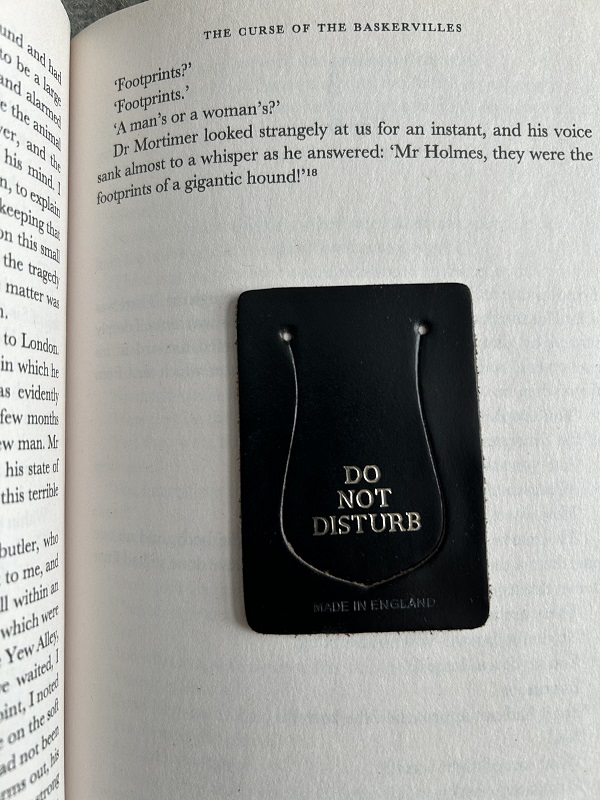
Bookmarked! #99: Alnwick Castle

My one and only trip to the UK occurred in 1976. We visited a lot of castles, which is something you do a lot over there if you’re a tourist. That and go for walks in the countryside. Anything to escape the cities. I don’t know what things are like now, but back then urban Britain was almost unimaginably bleak.

But I digress. I was just starting to collect bookmarks back then and in most of the castles we visited you could get these leather bookmarks with pictures on them. I doubt they still sell them in the gift shops. I’m told that most places don’t sell bookmarks anymore, but that’s a story for another post.

Anyway, on that trip I picked up a lot of bookmarks like this that I’ll be showcasing here. This one is from Alnwick Castle in Northumberland. It’s one of the nicer (and more intact) castles and they film a lot of movies there. Fifty years later I honestly can’t remember much about it, but I still have the bookmark.

Book: King John and the Road to Magna Carta by Stephen Church

Bookmarked Bookmarks

DNF files: Introducing Postmodernism

Introducing Postmodernism: A Graphic Guide

By Richard Appignanesi and Chris Garratt with Ziauddin Sardar and Patrick Curry

Page I bailed on: 80

Verdict: There’s nothing wrong with short introductions to complex, or even not-so-complex subjects. I’ve never gone the For Dummies or Complete Idiot’s Guide route but I’ve enjoyed most of the volumes I’ve read in Oxford’s Very Short Introduction series. Out of the twenty or so of those I’ve been through I think there have only been a couple of clunkers that were of no help at all in adding to my understanding of the topic being covered.

One of the good ones was Christopher Butler’s book on postmodernism. I learned quite a bit from that. But I learned nothing from this Introduction, which takes the form of a “graphic guide.” I take it all the pictures were to make it more engaging and/or accessible, but they added nothing to the text and didn’t help explain or make clear any of the concepts in play.

Granted, I’m not, and never have been, a fan of critical or literary theory. Especially after it got bogged down in the philosophy of language in the twentieth century. Maybe I’m just a die-hard pragmatist, but I keep wondering what the use value is of postmodern speculations. If Derrida (probably not a good example, as he was so slippery about saying anything) was right (or “right”) then so what? Why does it matter? I still don’t know, and it’s hard to summon the mental energy to tackle such an obscure body of work when I feel there’s nothing at stake.

The DNF files

The Vault

The Vault

A mix of standard SF-horror tropes. Underwater treasure hunters find a sarcophagus containing the remains of a demon that has been sealed away for centuries, or maybe millennia. They open it up and remove the occult seal from the demon’s corpse, thus reviving it. Carnage follows as the awakened beast goes on a bloody rampage, all while a hurricane strikes.

It’s basically Carpenter’s The Thing (the alien thawing out of the block of ice) meets Alien (the demon is a close cousin to the Xenomorphs). If you want something new, it’s that the action takes place in Nova Scotia (the author, Sam Sarkar, was born in Halifax), with the divers exploring the famed Oak Island “Money Pit.” I appreciated that part, but it doesn’t really add much. I’ve never visited Oak Island, or seen the TV show they made about its treasure-seekers, but I still felt I’d been here before.

It might have worked. I really liked Plunge, another recent horror comic that riffed on 1980s deep-water monster movies. But the plot moves awkwardly, with some abrupt breaks that left me momentarily confused, and the art doesn’t sell the action or suspense. In particular, the different characters are posed like plastic action figures, unmoving over several different panels, and their faces are totally expressionless, even when they’re supposed to be freaking out, delivering lines punctuated with triple exclamation marks!!!

Normally I’d only recommend this to hardcore fans of the genre, but I think they may be the most disappointed by it. It didn’t do anything for me.

Graphicalex