Sherlock Holmes: The Final Problem

Sherlock Holmes: The Final Problem

Most graphic adaptations of classic literature are massive disappointments. They tend to either go with a generic comic-book look or adapt the work in some way that makes a mess of the source material, often without even being interesting.

Swiss artist Hannes Binder’s illustrated version of Conan Doyle’s “last” Sherlock Holmes story, “The Final Problem,” is a wonderful exception. I put last in quotation marks because this is the story where Holmes was supposed to be killed off, falling from the Reichenbach Falls, only Doyle had to bring the great detective back due to popular demand. Even though it’s not really much of a story, it’s always been a favourite among illustrators because of the iconic scene where Holmes and Moriarty grapple at the top of the falls before plunging to their supposed deaths. That’s a moment you get here as well, though I think it’s worth pointing out that it’s not an event that is ever described in the story itself because in fact it never happens.

Binder’s black-and-white scratchboard technique is well suited for evoking mists and smoke and spider-webs, as well as hinting in a way I can’t really explain at a sort of aural quality. I think this latter is something Binder is conscious of too, as the full-page drawings of a screaming mouth and then an ear point toward the same thing. The mouth and ear are also suggestive of vortices that, like Moriarty’s sinister web, draw us in to our doom. Then the illustrations of a falling brick or a utensil shattering a dessert explode in ways that don’t require any textual effects. We can hear them well enough.

The text is abridged and adapted quite a bit, but in a way that I thought was remarkably efficient. And I liked the way Moriarty, a figure almost entirely absent, at least as a physical presence, from the story, shows up as a glowering atmospheric presence, a demonic eye of God. Binder isn’t just doing his own thing here but is making something distinctively in his own style while respecting the source. Holmes has been illustrated by a lot of different artists, right from the first published versions of his stories, but Binder doesn’t take a back seat to any of them.

Graphicalex

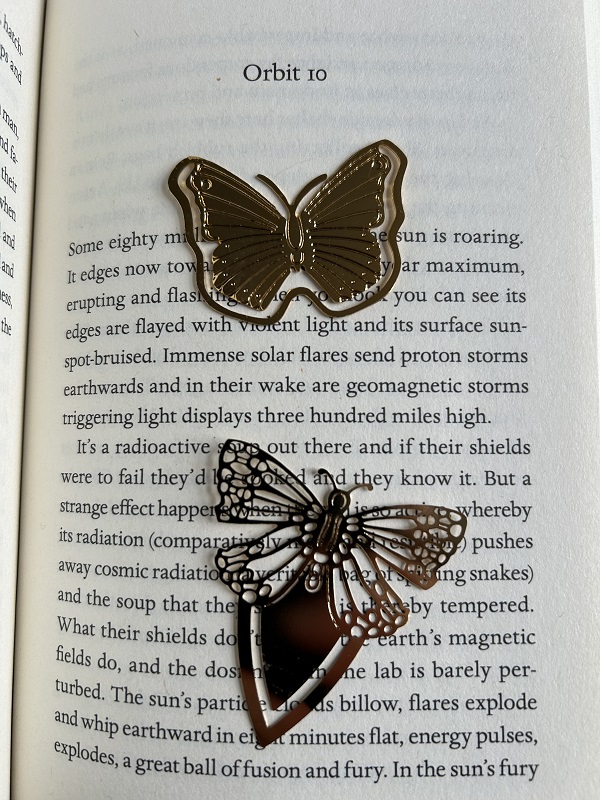
Bookmarked! #129: Book Pile

A very special bookmark this week from the fabulous Fraggle! It’s a handpainted comic scene with a feline taking a catnap on top of a pile of books (which I’ve reviewed). Not a very comfortable perch for that kitty, but they always seem to make do.

Book: American Mirage: How Reality TV Upholds the Myth of Meritocracy by Eunji Kim

Bookmarked Bookmarks

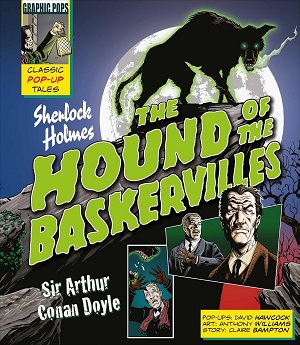
Holmes: The Final Problem

In “The Greek Interpreter” Doyle shook things up a bit by introducing Sherlock’s brother Mycroft. In “The Final Problem” (published only a few month later) Mycroft has a cameo as a cab driver but of more importance is the introduction of Professor James Moriarty.

These two characters would go on to have a huge importance in later Holmes mythology, but I find it interesting that Doyle himself didn’t make much out of either. They are only referred to in a handful of stories in the canon, and usually don’t have any significant role to play.

In “The Final Problem,” however, Moriarty does have a critical function, which was to kill off Holmes and thus free Doyle to write what he thought were more important literary works. As we know, that didn’t take, but it does show a real spirit of idealism given how much money writing Holmes stories was bringing in.

It’s a different sort of Holmes story in that there’s no mystery to be solved but just a game of cat and mouse between Holmes and Moriarty that ends with the two of them plunging, presumably to their deaths, from the Reichenbach Falls.

That dramatic plunge is one of the iconic moments in all of fiction, so much so that I think all of us can picture it in our memories. We might also be thinking of any of the many illustrations of the scene, beginning with different versions in both the original British and American publications. Re-reading the story for the first time in a long while I was actually surprised to find that Watson didn’t witness the event at all. He’s been sidelined and only returns to the Falls after the fact to find some footprints in the blackish soil and an awkward note from Holmes explaining what was about to happen. After that, we’re told that an “examination by experts leaves little doubt that a personal contest between the two men ended, as it could hardly fail to end in such a situation, in their reeling over, locked in each other’s arms.”

That must have been quite an expert examination! What did they base their conclusions on, especially given that neither of the bodies was ever recovered? The only evidence for what occurred were the footprints and the note, which don’t paint a very full picture.

So as it turns out, one of the most iconic moments in all of fiction is one that’s wholly imagined. Unless you’re reading an illustrated version there’s nothing of it on the page. And Doyle could have easily arranged things so Watson sees the fatal plunge from a distance. Was he leaving himself an out? Or just playing a game? Even though this isn’t one of my favourite Holmes stories it remains one of the most intriguing.

Holmes index

Mountain melt

Once the plows have built up these piles of snow in parking lots I always wonder how long they’ll last. We’ve had a fair bit of snow this winter, with more on the way, so I suspect these will hang around a while. I walk past the top one every day so I’ll try and report back. I suspect some of it will still be there well into April.

Archer: Find a Victim

Lew Archer is a bit out of his usual L.A. stomping grounds here. While on his way to Sacramento he stops for “the ghastliest hitchhiker who ever thumbed me.” This turns out to be a young man who has been shot and left for dead in a ditch by the road. And just like that Archer is involved in a complicated web of murder and corruption in the sleepy town of Las Cruces.

Two things stood out to me. First of all there’s the speed with which the plot unfolds. It got to the point where I started to write down Archer’s full Las Cruces itinerary. He picks up the dying man just as the sun is setting “and the valley was filling with twilight.” From there he takes the man to Kerrigan’s Court – Deluxe Motor Hotel (it is later described as a “motor court”; the word “motel” was first used in 1925 but seems not to be known by anyone here). From the motel he goes to the hospital, where the hitchhiker dies without regaining consciousness and being able to say what had happened to him. Then Archer goes back to the motel, or motor court. Then he goes to a Chinese restaurant and eavesdrops on a conversation between Kerrigan (the motel’s owner) and a sexy young chanteuse. Then he visits the trucking company the dead man drove for. Then he goes out to the house where the owner of the trucking company lives and gets hired by him to find out what happened to the load of booze the dead man had been driving. Then he goes to the sheriff’s house and meets the sheriff’s sexy wife. Then he goes to the apartment of the daughter of the owner of the trucking company. She has gone missing. Then he goes to a sleazy bar and interrogates one of the prostitutes about the missing girl. Then he goes to the singer’s apartment. Then he goes to the motel owner’s house, remaking that by this time “it was getting late.” Then he goes to a drive-in burger joint where he witnesses what looks like a handoff of some money. Then he goes to an abandoned air base just outside of town. At around 1 o’clock in the morning he’s back at the motor court, where he gets knocked out (or at least knocked on his ass) for the third time. Then he goes back to the motel owner’s house. We’re told it’s now 2 o’clock. The motel owner’s wife sends him off to check out a cabin on a lake two hours’ drive away. On the way there exhaustion (finally!) catches up to him and “something broke like a capsule behind my eyes. It leaked darkness through my brain and numbness through my body.” He keeps driving until he comes to a tourist camp where he rents a cottage and spends the rest of the night (or early morning) “wrestling nightmares on a lumpy bed.”

This is a busy guy! And even given Las Cruces isn’t that big a place I still found it hard to believe he was going so many places and meeting so many people in the space of at most eight hours. But that’s the nature of stories like this.

The scenes are set with some quick brushstrokes. Macdonald is particularly fond of personifying buildings, so one will have yellow rust streaks running “down from the balconies like iron tears” while another sports “a peeling yellow face with blinded windows, surrounded by a wild green hair of eucalyptus trees.” I also loved this description of the owner of the trucking business’s man cave:

His living-room was the kind of room you find in backcountry ranch-houses where old men hold the last frontier against women and civilization and hygiene. The carpets and furniture were glazed with dirt. Months of wood ashes clogged the fireplace and sifted onto the floor. The double-barreled shotgun over the mantel was the only clean and cared-for object in the room.

We’re even told that the place smells like a bear cage, which I can believe.

Information in these wonderfully degenerate settings will be conveyed in clipped dialogue with lots of snappy comebacks, and may end in fisticuffs. And then it’s time to hop in the car and go to the next stop.

The second thing that struck me was the evocation of a now long-vanished time. In part this has to do with the language, so I’ll include some notes here for fellow word nerds. “Wasn’t he drunk on Sunday?” Archer asks the singer of the motel owner. “He was pixilated all right,” she replies. This does not mean that the motel owner has the appearance of being an enlarged, low-resolution digital image where the individual pixels stand out, giving it a blocky texture. The word for that is pixelated, though apparently pixilated is now accepted as a variant spelling of the same thing. Anyway, pixilated is a much older word referring to someone behaving in a strange, eccentric or mentally disordered way, as though being led by pixies. Obviously the singer has in mind this older meaning, but even so it seems a bit inappropriate to describe someone who is actually an angry and dangerous drunk.

At another point Archer is driving over a rough road whose “surface was pitted with chuckholes.” I had to look this up and found that it refers to any hole or rut in a road or track. So a pothole. I’ve never seen or heard the word chuckhole before and I don’t think it’s in wide use.

I was far less successful tracking down the term “sluff.” At one point Archer interrogates a drugged out girl who asks him “Are you sluff?” From the context I think she’s asking if he’s with the police. Later, her boyfriend will beat Archer up and say “God damn you, sluff.” So again, I think he’s saying that he thinks Archer is a cop. But I looked around for any information on this one and found nothing except dictionaries giving it as a variant spelling of “slough,” which is clearly not what was meant.

Aside from the language, there are also some other parts of the book that give its date away. In The Way Some People Die Macdonald had indulged his dislike for the drug business by giving us a heroin junkie going through withdrawal. There’s another druggie in this book but she’s hooked on marijuana and she really needs a reefer bad. I think in our own time we’d be put off by such a depiction of “reefer madness” (the film of that title had come out in 1936), as while marijuana can be addictive in most cases it isn’t, and certainly not to the extent depicted here. The scene plays today as silly, but luckily Archer has some reefers in his car (hey, it’s evidence) and he’s able to use it to get her to open up. Which is kind of low, but worse will happen to her later.

There are the usual Archer elements here, especially his fascination with breasts. The sheriff’s wife is stacked, “heavy-breasted and very female, almost too female for comfort.” Later, while he is holding onto her, these same breasts will move “against me like wild things in a net,” and later still she will grip them “cruelly” herself. I don’t know what’s going on with all this. Boobs just have a way of grabbing Macdonald’s attention.

And finally there’s Archer’s sense of mission. Told that he’s brave at one point, he replies “Not brave. Merely stubborn. I don’t like to see the jerks and hustlers get away with too much. Or they might take over entirely.” The jerks and the hustlers, however, aren’t the real problem here. They rarely are. Instead the rot runs deeper, into perverted family dynamics and degenerate psychologies. Archer can afford to be understanding, but is no doubt relieved to finally get out of this town.

Archer index

Saga of the Swamp Thing Book Five

Saga of the Swamp Thing Volume Five

I liked the introduction to this volume by artist Stephen Bissette where he talks about how Alan Moore’s interest in the grand cosmic battle between the forces of good and evil that ended the previous storyline had been waning and that a change in direction was necessary. As I’ve said before, I think Moore is at his best when he keeps his feet on the ground, and I didn’t like where the “American Gothic” story ended up.

So things start off on a slightly better foot here. But only slightly better because the new storyline is all about the romance between Abby Cable and Swamp Thing, which for some reason fascinated Moore but which I don’t care for at all. I don’t think of Saga of the Swamp Thing as a romance comic. The plot is also predicated on the absurd legal problems Abby gets into when it’s made public that she’s been getting physical with Swampy. It’s a real stretch to see why she’d be prosecuted for this to the degree she is, but you just have to take it as a given so that Swamp Thing can rocket through the Green to her rescue by turning Gotham into a botanical garden full of hippies. This is “the greening of Gotham,” which I take it is a nod to Charles Reich. But there’s a dark side to this too, suggested by the title of one issue as “The Garden of Earthly Delights.” Bosch’s carnivals have an ambiguous colour to them.

Anyway, with Swamp Thing becoming “very nearly a god” there are a bunch of people who want to take him down. Batman tries using a Super Soaker filled with defoliant but that gets him nowhere. Then Lex Luthor figures out, somehow, that Swampy’s ability to zip away into the Green and regenerate himself whenever he’s in danger can be blocked by an electronic jammer. So after being tagged with one of those he then gets napalmed, which sends his spirit to a blue planet while a despairing Abby heads back to the bayou. They both dream of each other, in their different ways.

The “blue heaven” Swampy is exiled to looks interesting, with Rick Veitch giving us a different take on the sort of psychedelic otherworldliness you get in the Doctor Strange comics. But I also thought Moore’s writing went over-the-top again, with the shades of blue likened to “the color of saxophones at dusk . . . of orbiting police lights smeared across tenement windows . . . of a flame’s intestines . . . of the faint tracery of veins visible beneath the ghost-flesh of her forearm’s underside . . . of loneliness . . . of melancholy. The blues.” But this is the complete Moore, and you have to take him all together. I really wonder what the average comic reader thought of it though. In any event, Moore’s run with Swamp Thing was nearing the end. In fact, he was writing Watchmen at the same time as he was working on the stories collected here, which is both a sign of being in a particularly hot creative phase as well as an indication that his attention was starting to wander.

Graphicalex

Bookmarked! #128: Celeb Sex Shenanigans

I’ve talked before about these promotional bookmarks that used to be quite common and that you don’t see as much of anymore. This is a good example, and it’s from the early days of my collection. I don’t know when I picked it up, but the first edition of The Intimate Sex Lives of Famous People came out in 1976. The keyhole shape was a sly idea.

Book: The Film Encylopedia by Ephraim Katz

Bookmarked Bookmarks

Holmes: The Naval Treaty

In that often-cited list that Doyle made of his favourite Holmes stories he ranked “The Naval Treaty” nineteenth out of nineteen. Which, given that the original list he composed was of twelve stories and he later added seven more, and that the canon contains 56 stories total, sounds almost as though he didn’t like it much at all, or that he considered it at best mid.

I’d rate it much higher. It’s actually one of my favourites.

In part this is because Holmes displays an attractive side not often witnessed. He takes time to smell the roses, literally. The scent of a moss rose through an open window moves him to poetic reflections that reveal “a new phase of his character” to Watson, “who has never before seen him show any keen interest in natural objects.”

“Our highest assurance of the goodness of Providence seems to me to rest in flowers. All other things, our powers, our desires, our food, are really necessary for our existence in the first instance. But this rose is an extra. Its smell and its colour are an embellishment of life, not a condition of it. It is only goodness which gives extras, and so I say again that we have much to hope from the flowers.”

It’s a nice sentiment, but of course totally unscientific. As commentators point out, the smell and colour of a rose are not superfluous extras. Nor does it make much sense to me for Watson to say that Holmes had never shown a keen interest in natural objects. He made a study of many. What I like most about this passage though is the reaction of the couple who have hired Holmes. They are struck “with surprise and a good deal of disappointment.” They want him to find the stolen naval treaty, not talk about flowers!

A similar moment comes on the train journey back to London where Holmes sees the newly established Board schools through a window. “Lighthouses, my boy!” he says to Watson. “Beacons of the future! Capsules, with hundreds of bright little seeds in each, out of which will spring the wiser, better England of the future.”

This paean to education is even more of a digression than his thoughts on the rose, but also reveals more of his true character. Holmes is arrogant, but he’s not a snob.

“The Naval Treaty” is a long story, the longest in the canon, and was originally published in two parts. It’s also one that has attracted a more than the usual amount of critical nit-picking, beginning with the reference to “The Adventure of the Second Stain” in the opening paragraph and ending with speculation over who Joseph Harrison may have been working for. As usual, none of this meant anything to me. I guess it’s a fun game for Holmesians, but I don’t care for it.

What I liked most of all here was the fact that it’s a great little mystery story. For starters, a surprising amount of time is put into casting suspicion on the commissionaire and his wife. “The principal difficulty” in the case, Holmes explain at the end (“in his didactic fashion”), “lay in the fact of there being too much evidence. What was vital was overlaid and hidden by what was irrelevant.” Of course misdirection through giving the reader too much information to pay full attention to is now a staple of mystery of fiction, but it’s not something the Holmes stories went in for as much. As it is, we’re given enough clues to at least arrive in the general location of Holmes’s solution, which ends up feeling quite reasonable given what we have to go on. Indeed, Holmes points the way to where he’s going, even though it’s not easy to see what conclusions he’s drawing. Given the high stakes we’re led to believe that something larger is going on, so the fact that the theft was merely opportunistic comes as a surprise, but a satisfying one given that it makes sense of the evidence.

I did have to roll my eyes though at poor Percy Phelps. He doesn’t come off well. Using family connections to get a cushy desk job and then being struck with “brain fever” when the treaty he’s been copying is stolen. Brain fever was a nineteenth-century euphemism for a nervous breakdown, and Percy was really selling it, becoming “practically a raving maniac” before needing nine weeks of convalescence where he is alternately unconscious and raving mad before he is even capable of reaching out to Holmes. If he wants to keep working for the British foreign office he’ll have to work a bit on stiffening that upper lip.

Holmes index

Number jumble

I was trying to locate a house a few months ago and ran into this bizarre numbering system. It’s a condo townhouse development and I got lost in the little roads that circled around and came out in odd places. But what really got me were the house numbers. How does this work?

Swamp Thing: Volume One

Swamp Thing: Volume One

It’s called Swamp Thing but that character (the transformed Alec Holland) only briefly appears a couple of times, once in a flashback. Instead this is the Daughter of Swamp Thing, a teenage girl named Tefé, who has come about through – here I take a deep breath – Swampy temporarily possessing the body of John Constantine and having sex with his (Swampy’s) wife Abby and impregnating her with an elemental spirit known as the Sprout. After she’s born, Tefé inhabits the body of a girl named Mary Conway, who was terminally ill. Tefé loses her memory of being the Sprout when she becomes Mary, but it all comes back to her when she gets angry, leading to her shedding the body of Mary and being reborn as the platinum-haired Tefé Holland. With her hair she’s supposed to look like her mom Abby but I kept being reminded of Sabrina the Teenage Witch. She even operates a bit like a witch, as her super powers involve casting what amount to plant-based spells that kill or incapacitate people. In any event, now conscious of her powers she starts crisscrossing the U.S. having various adventures while different people (federal agents, a samurai-style killer from the Green) try to hunt her down.

There’s real talent on board here – from headline author Brian K. Vaughan, the distinctive art of Roger Peterson, and John Costanza’s lettering – but something about it wasn’t working for me. I didn’t mind changing the focus from Swamp Thing to his daughter, but she’s pretty much just a drifter here. At one point she has a mission to find the Tree of Knowledge (not the one from the Bible, at least I don’t think) but she doesn’t know where it is or what it does and by the end of this run she’s basically given up on it. Along the way she picks up a couple of (male) drifter friends: an ex-Marine named Pilate and an ex-smokejumper named Barnabas who’s had half his face burned off. Together they steal vehicles and crash in abandoned apartments or other temporary accommodations as they just . . . drift.

Basically, Tefé wanders into one bad situation after another and punishes evildoers. She’s on a lobster-trawling ship where one of the crew goes crazy, so she kills him. A girl gets raped by a band she’s a fan of, so Tefé fixes them (I think literally). A hobo tries to rape her so she skins his arms. A guy selling flowers at a roadside stand upsets her so she chokes him with pollen. A guy who killed the man in the apartment next to him is immobilized and handed in to the police.

You’ll note that none of the bad guys she punishes are supervillains or have any special powers at all. Either of her drifter friends could easily kick their asses, if she’d asked them. Her victims are certainly no match for Tefé, and she usually disposes of them in a couple of panels through her ability to manipulate the tissue of flora and fauna. After a while this started to not be very interesting. Meanwhile, the big story playing in the background isn’t moved along very quickly and we don’t really find out much more than the fact that certain people, some of them likeable and others not, are after Tefé.

So on the one hand I appreciate Vaughan and his team trying to go in a new direction, and I like the meatiness of the writing, which is very character-driven. I’m sure Vaughan must have been thinking of Alan Moore’s run with Saga of the Swamp Thing and what he did to basically re-invent the title and make it his own. But there is no larger compelling story being told here and no conflict either. Perhaps that was still to come in the series, but I have to say that after this first volume of the series I wasn’t enthusiastic about reading more.

Graphicalex