
This was a tough one! As you can see, it took me down to the wire. But I got lucky and landed it on the final guess.
This was a tough one! As you can see, it took me down to the wire. But I got lucky and landed it on the final guess.
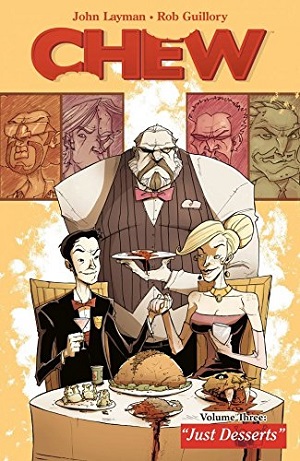 Alright, we’re rolling again with my go-to comic for a good time. This volume contains issues #11-15, with #15 marking the quarter mark for the team of author John Layman and artist Rob Guillory as they had originally planned a 60-comic run.
I think this gives some idea of the forethought that went into the series and explains the way hints keep getting dropped as we go along to characters and events that didn’t seem all that important at the time, or that we might have thought we were finished with. To be sure, I knew that Gardner-Kvashennaya, the arctic observatory that hosted a vampire bloodbath, was going to play a big part in what was to come. Ditto the “Frog Man” Montero (so-called because he breeds frog-chicken hybrids). But I wasn’t expecting the return of the killer rooster Poyo, or the introduction of new characters like a mysterious food taster, Tony’s sister, and all the rest of his family, including his daughter(!) and one very weird ex.
The other thing about planning so far ahead is that it allows Layman and Guillory to play with the arrangement of the narrative blocks. This happens in almost every issue, as we begin with a scene (often the aftermath of some act of violence) that only gets explained later. They know what they’re doing here, as they even make fun of it in issue #12, which begins with the editorial note “The pages got shuffled out of sequence. This is actually page 18.”
Given all this preparation I feel confident that I’m not going to be disappointed in how things turn out. In the meantime, I’ve enjoyed everything so far, down to all of the little background gags you really have to be on your toes to catch (and a few of which I’ve missed). On to the next course!
There were 3,866 investment fraud victims reported in 2024, who collectively suffered a financial loss of $310.6 million, according to the Canadian Anti-Fraud Centre (CAFC). These numbers include all types of investment fraud, not just online scams.
So far in 2025, Maude Blanchette, chair of the Canadian Securities Administrators (CSA) Investment Fraud Task Force, estimated that there have already been about 3,000 cases reported. The official tally will be released by the CAFC in 2026.
Blanchette said the number of reported cases has levelled off since 2022, but added that scams tend to be severely underreported to begin with. According to the CAFC, just five to 10 per cent of fraud incidents are reported.
“It’s very scary because it means that it is only the tip of the iceberg,” Blanchette said.
I found this news report upsetting for a number of reasons. Assuming only 10 per cent of fraud incidents are being reported, the total annual losses would be over $3 billion. And perhaps double that if 10 per cent is too high. That’s a lot of money, and victims, for one country without a large population.
The thing is, as much as we can shake our heads at the foolishness of people who fall for some of the more obvious scams, I think we are all vulnerable. I even got scammed by one online retailer about fifteen years ago, but it was only for $10 so I didn’t feel too bad. And while most frauds are pretty transparent, I’ve known a couple of people who were fooled by operations that were really quite sophisticated. And with AI these scams are apparently getting even better. The bottom line is: even if you think you’re much too smart to fall for an online fraud, you probably aren’t. You just haven’t been caught yet.
What also bothers me is the inability, or unwillingness, of law enforcement to do much of anything about the problem (I won’t even mention the platforms who are basically accomplices in all this). It’s just too much work for authorities, or too difficult. I knew a lawyer who worked in the field twenty years ago and back then he told me that the police wouldn’t even investigate a complaint that was under $75,000.
I think we should take this kind of thing a lot more seriously, and while there may be jurisdictional issues I don’t see why it should be so hard to crack down on these people. As it is, they all know they can get away with it so it’s a problem that keeps getting worse. And as the numbers indicate, it’s a big problem now.
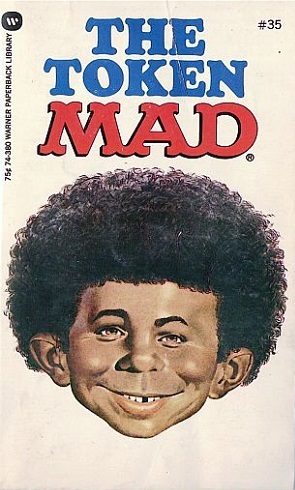 Nope, I don’t think you’d get away with that cover today. But in 1973 (this is a first edition!) you could. It’s meant as a send-up of tokenism (think wokeness, but fifty years ago). The back cover declares: “Is MAD guilty of tokenism? You bet we are! We’ve always offered our readers token humor, token satire, token good taste! And this book is no different . . . just another token attempt at courageous publishing! So even though the price is only a token of what a good book would cost, you’ll be taken . . . with . . . The Token MAD.”
That token price, by the way, was $1.50. Wouldn’t see that on many covers today either.
This is another grab-bag MAD collection, full of bits and pieces mostly from the 1960s. The movie and TV satires, both illustrated by the great Mort Drucker, are for The Professionals (1966) and I Spy (1965-1968) respectively. For years I didn’t know anything about either of these shows, and by the time I finally saw them it was through the lens of the Mad versions that I knew practically by heart. Alongside recurring features like David Berg’s Lighter Side of . . ., the Don Martin Dept., and Spy vs. Spy (they each win one) there are some great one-offs like “Vanishing Human Types and Their Modern Replacements” (do you remember “the inexpensive handyman”? or are you more familiar with “the specialized service technician”?), “Historical Events as Covered by Modern News Feature Writers” (the Battle of Bunker Hill written up by the sports editor) and “Obituaries for Comic Strip Characters.” I got a real laugh out of this last one, and the obit for “noted man about town Donald Duck,” who was killed in a hunting accident after being mistaken for a wild canvasback. I loved this paragraph especially: “A spirited eccentric, Duck was known for his clever wit, all of which was unintelligible. He countered this, however, with savage bursts of temper which accomplished nothing.” That’s our Donald! And that was MAD!

Princess Leia reads books. Darth Vader reads books. Yoda reads books. Maybe not on screen (at least I don’t remember ever seeing any of them with a book), but they do in this set of magnetic bookmarks.
Book: The Great Movies by Roger Ebert
Or: “Holmes’s First Case.” Which is its single claim to fame. Though young Sherlock wasn’t a detective yet but a student on holidays when a school chum invited him to spend some time at his family estate. While there he stumbles into the usual mess of a blackmail plot involving a shady old acquaintance from the colonies.
I didn’t find any of it very interesting, and Holmes’s great skills at detection aren’t put to much of a test. For example, he picks up on the fact that his chum’s father had known someone with the initials J.A. who he had subsequently tried to forget based on the fact that he had had “J.A.” tattooed on his arm and then tried to erase the tattoo. Clever. And then he solves the easiest code ever by figuring out that he just has to read every third word in an otherwise baffling note. (Experts, by the way, point out that this means the note is in fact written in cipher, not code. There is a difference, albeit not one I’m keen on explaining.)
Basically this is just Holmes narrating the events to Watson and reading a long letter from the father explaining all that was happening in the blackmail scheme, which is something Holmes didn’t figure out on his own. It may have been his first case but it’s also among his most forgettable and well worth skipping.

I was out for a walk a couple of weeks ago when I saw this well-dressed fellow giving me some side-eye. But I don’t think he minded having his picture taken.
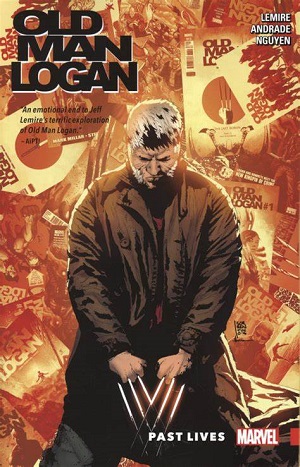 This was the final issue of the Old Man Logan series to be written by Jeff Lemire and it has even more of a retrospective feel to it than usual. As things get started Logan has decided he wants to go back in time and to the specific part of the multiverse where the saga began so that he can save Baby Hulk, and maybe his family too. Unfortunately, none of his friends and enemies want to help (he appeals to the Marvel science-and-sorcery brain trusts, from Doctor Strange and Scarlet Witch to Black Panther and Doctor Doom), so as a last resort he springs a devil-worshipper named Asmodeus from supervillain prison. Asmodeus says he’ll send Logan back into his past, but –surprise! – he’s actually going to double-cross Logan. I don’t know why Logan would have expected anything less. That struck me as silly.
Anyway, instead of going straight back to the Wasteland, where it all got started, Logan ends up being unstuck in time, forced to “re-enact [his] greatest hits.” His fight with Hulk. The climax of the Phoenix story. As Patch in the streets of Madripoor. He even gets to re-use his famous tag-line about bad guys taking their best shot but now it’s his turn. But eventually he does get back home, only to have to say good-bye to his wife and kids, knowing that he can’t save them.
(An aside: I was a bit put off by Lemire not knowing the difference between a combine and a tractor. When Logan gets back to his farm he’s shown working on what is referred to as “the combine” but which is really just a tractor. A combine is a combination harvester. From the looks of it, I don’t think they’d have any use for a combine in the Wasteland, which is a Western desert landscape like that of the homestead in The Searchers. And I never could figure out what kind of farming the family was doing in that movie. On further reflection though, I thought this made for a fitting vision of our dystopic future, caring for and repairing old machinery that nobody has any use for now anyway.)
As a way of wrapping Lemire’s part of the series up this sort of thing is fine, but it doesn’t stand out as being a great or essential comic on its own. It has the feel of the last episode of some long-running TV show, like Seinfeld, where you just bring everybody back for a cameo before shutting things down. I like the art by Filipe Andrade (the first couple of issues here) and then Eric Nguyen, the latter feeling influenced by Sorrentino’s earlier modeling of the character while also doing its own thing. And the mechanism for the time-skips, a magic amulet, is at least easy to follow, even if there’s no discernible rhyme or reason to how it works. Of course this wasn’t to be the end of the line, as the series would continue. But there’s still a well-deserved sense of an ending.

Dig in!
For those who don’t know, poutine is a French-Canadian dish consisting of french fries covered in cheese curds and gravy. This past weekend the World Poutine Eating Championship was held in Toronto, an event sanctioned by Major League Eating (yeah, I’d never heard of it either) and sponsored by Smoke’s Poutine at their annual Smoke-a-Palooza festival.
Two years ago the contest was won by a guy who ate 20.4 pounds of poutine in 10 minutes. That number was crushed the next year though by competitive-eating legend Joey Chestnut, who swallowed 28 pounds of the stuff in the same time. This year Mr. Chestnut won again but only ate 26.5 pounds. Maybe he pulled up seeing how far ahead he was.
Needless to say, I couldn’t imagine eating 28 (or 26, or 20) pounds of anything in ten minutes. I will say that Mr. Chestnut is very good at what he does, and he trains hard for these events (yes, training is involved). This is a guy who can (and has) eaten 76 hot dogs in twelve minutes. But this kind of thing, in addition to looking gross, isn’t healthy. Most deaths from these stunts occur due to choking, but even assuming you get everything down it seems to me like you’re ravaging your body. I think you could get clogged arteries just from watching this amount of poutine being consumed.
Still . . . 28 pounds. Disgusting, sure. But you have to be impressed, just a little.
In a post last month I mentioned how I’d been reading Geoffrey Chaucer’s The Book of the Duchess, and how it kicks off with a description of insomnia that felt on target for me 600 years later. But back in the fourteenth century people probably had a lot of the same problems with sleep as we do. Or maybe they had it worse. In any case, Chaucer was describing the sort of experience that everyone, even today, can relate to.
This month I was reading The House of Fame and several things about it struck me as very contemporary, albeit in a less direct way. It’s a dream vision, which means it’s set in a fantasy landscape that is meant to be read allegorically, and what’s surprising is that a lot of the allegory still works. The House of Fame itself, for example, is like a giant surveillance/data hub that gathers in everything that is said by anyone all over the world. The narrator is amazed when this system and how it operates is described to him. “I can’t believe it’s possible to hear all that,” he says, “even if Fame had all the informers in a country, and all the spies.” Fame isn’t just a passive recipient in his imagining, but something like a giant AI monitoring all of our social media traffic, and indeed all information on the move everywhere. It seems we’ve always been capable of imagining such a thing, only now it’s not only possible but we can measure and monetize the data that’s harvested on a granular level.
Then there’s the pursuit of fame itself. Today I think we see “fame” and “celebrity” as pretty much being synonyms, and I actually don’t think that’s too far off where things were in Chaucer’s day (the word “celebrity,” in slightly different spelling, may have even first appeared in English in Chaucer’s translation of Boethius). As The House of Fame makes clear, fame is a fickle goddess and you have no idea what’s going to give rise to it, how accurately it will reflect anything real, or how long it will last. Fame could be merit-based, but just as easily be mere rumour or gossip. But people of all types still clamour for it, and in the poem Fame is appealed to by various suitors. One of these struck me as representing the modern notion that any kind of news coverage is good for you. Don’t worry about what’s being said, just count the column inches.
Or at least that used to be the way it was put. Now I don’t think “column inches” means much to anyone. Still, in our attention economy the basic point remains the same: it doesn’t matter what you’re doing to be famous, or go viral, for. The only thing that matters is being famous. Getting attention.
Umberto Eco addressed the subject in Chronicles of a Liquid Society (2016), which came out just before the advent of the influencer:
. . . in an age of great and ceaseless movement, when people leave their villages and lose their sense of home, and the Other is someone with whom they communicate via the Internet, it will seem natural for human beings to seek recognition in other ways, and the village square is replaced by the global audience of the television broadcast, or whatever comes next.
But perhaps not even schoolteachers, or those who take their place, will recall that in that bygone time there was a rigid distinction between being famous and being talked about. Everyone wanted to become famous as the best archer or the finest dancer, but no one wanted to be talked about as the most cuckolded man in the village, for being impotent, or for being a whore. If anything, the whore would claim to be a dancer and the impotent man would make up stories about his gargantuan sexual exploits. In the world of the future, if it is anything like what is going on now, this distinction will be lost. People will do anything to be “seen” and “talked about.” There will be no difference between the fame of the great immunologist and that of the young man who killed his mother with a hatchet, between the great lover and the man who has won the world competition for the shortest penis, between the person who has established a leper colony in central Africa and the man who has most successfully avoided paying his tax. Every little bit will help, just to be seen and recognized the next day by the grocer or the banker.
…
Once this all-seeing Witness [God] has gone, has been taken away, what remains? All that’s left is the eye of society , the eye of the Other, before whom you must reveal yourself so as not to disappear into the black hole of anonymity, into the vortex of oblivion, even at the cost of choosing the role of village idiot who strips down to his underpants and dances on the pub table. Appearance on the television screen is the only substitute for transcendence, and all in all it’s a satisfying substitute. People see themselves, and are seen, in a hereafter, but in return, everyone in that hereafter sees us here, and meanwhile we too are here. Think about it: to be able to enjoy all the advantages of immortality, albeit swift and ephemeral, and at the same time to have a chance of being celebrated in our own homes here, on earth, for our assumption into the Empyrean.
…
At one time the threat to privacy came from gossip. The fear of gossip, or the washing of dirty linen in public, came from the impact it had on our public reputation. But perhaps in the so-called liquid society, where people suffer from lack of identity and values, and have no points of reference, the only means for obtaining social recognition is through “being seen” at all costs.
Anyway, here is the passage from The House of Fame that set off these musings. I think it shows that what Eco had to say about their being an earlier time, specifically the Middle Ages, when fame was something with more exclusively positive connotations, is not entirely accurate. Someone has come to Fame to request being made famous for his villainy. He’s requesting that the horn of slander rather than praise be sounded for him. The Middle English is a little tough in this passage so I’ve followed it up with a shonky translation of my own.
“Lady, lefe and dere
We ben swich folk as ye mowe here.
To tellen al the tale aright,
We ben shrewes, every wight,
And han delyt in wikkednes,
As gode folk han in goodnes;
And Ioye to be knowen shrewes,
And fulle of vyce and wikked thewes;
Wherfor we prayen yow, a-rowe,
That our fame swich be knowe
In alle thing right as hit is.”“I graunte hit yow,’ quod she, ‘y-wis.
But what art thou that seyst this tale,
That werest on thy hose a pale,
And on thy tipet swiche a belle!”“Madame,” quod he, “sooth to telle,
I am that ilke shrewe, y-wis,
That brende the temple of Isidis
In Athenes, lo, that citee.”“And wherfor didest thou so?” quod she.
“By my thrift,” quod he, “madame,
I wolde fayn han had a fame,
As other folk hadde in the toun,
Al-thogh they were of greet renoun
For hir vertu and for hir thewes;
Thoughte I, as greet a fame han shrewes,
Thogh hit be but for shrewednesse,
As gode folk han for goodnesse;
And sith I may not have that oon,
That other nil I noght for-goon.
And for to gette of Fames hyre,
The temple sette I al a-fyre.
Now do our loos be blowen swythe,
As wisly be thou ever blythe.”‘Gladly,’ quod she; ‘thou Eolus,
Herestow not what they prayen us?’
‘Madame, yis, ful wel,’ quod he,
And I wil trumpen hit, parde!’
And tok his blakke trumpe faste,
And gan to puffen and to blaste,
Til hit was at the worldes ende.
Translation:
“Dear Lady,
We’re the kind of guys you may have heard of.
To tell the truth,
We’re scoundrels, every one of us,
And we take delight in wickedness,
Just as good people do in goodness.
And we like being notorious,
Known for being full of vice and for our wicked deeds.
Which is why we’ve come to ask you
To broadcast our bad reputations,
And show us just as we are.”“I’ll grant your wish,” she said,
“But who are you to talk like this,
And why are you dressed like a clown?”“Madame,” he said, “truth to tell,
I’m the same desperado
Who burned the temple of Isis
In the city of Athens.”“And why’d you do that?” she asked.
“I swear,” he said,
“I did it for the attention,
Just like the others get in that town,
Even though they’re well known
For their virtue and good qualities.
I figured rogues should be as well known
For being wicked
As good people are for being good.
And since I can’t have a good reputation,
Because I won’t stop being bad,
In order to get famous
I set the temple on fire.
Now let everybody know!”
 Alex Good