Kill or Be Killed: Volume Three

Kill or Be Killed: Volume Three

There’s not much new to report in this review. We begin with our anti-hero Dylan shooting up the brothel run by the Russian mob, which is exactly how Volume One kicked off. And again our narrator is aware of how roundabout he’s been in his duties, leading us to think that “this entire story has been the longest flashback in history.” Some readers, he says, may have “been thinking about that the whole time.” Guilty as charged!

Even so, it’s going to take us nearly another hundred pages before we come back to the brothel and are finally “caught up.” “I know, I know,” he’ll say then, “I’m the worst narrator in history for actually getting to the point” (in history again!) But “it can’t all be action . . . right?” Sometimes there’s a need to fill us in with “some stuff you have to know before the action gets going again.”

So when I say there’s not much new to report here, that’s really a comment on the fact that this story has been spending most of its time running in place and not going anywhere. Which means the things I like are all the things I’ve liked so far, and the things I don’t like are the same as well.

Unfortunately, I wish things had been all action, or at least more action, because Brubaker and Phillips do that well. I really love those star-shaped gun blasts and the way the outbreaks of violence are set up and choreographed. The filler is either dull (Dylan’s love life with Kira) or confusing (the business with the demon).

Still, with only one volume left to go some resolution beckons. Dylan has, singlehandedly, taken out the boss of the Russian mob, an improbability that’s credited to his belief in some wisdom he picked up from the movie The Edge: “What one man can do, another man can do.” Which is absolute bullshit and made me think that getting rid of the demon was actually making the rest of the story even more unlikely. But we shall see how things wrap up before delivering a final judgment.

Graphicalex

Re-reading Shakespeare: Twelfth Night

(1) It’s a cliché to say of the opening speech that it reveals Duke Orsino to be a man “in love with being in love.” Nevertheless, like most clichés, it’s true. What’s less noticed, but I think more significant, is how self-aware he is about it. He analyzes his condition and even rationalizes it. He is fickle, to the point where the Clown later thinks his doublet should be made of “changeable taffeta” as his “mind is a very opal.” He calls for more music and then seven lines later says “Enough, no more!”

This changeableness is of a piece with the “spirit of love” itself, which is “quick and fresh.” Later in the play he will say the lover is “unstaid and skittish in all motions” save the image of the beloved, and then a few lines later he adapts this to say that even those fancies (of love) remain “giddy and unfirm.” Nothing can satisfy the spirit of love, even for a minute, except the work of the imagination. Indeed it is the fancy that is constantly undercutting love. It alone is high fantastical, which is to say it’s even better than the real thing. And so the Duke prefers to live in a world of imagination, especially if it involves lying in a bed canopied with flowers. Perhaps reading romance novels, or watching porn. OK, that modern reference may jar, but you tell me that what the Duke is describing here isn’t the Renaissance version of edging.

The Duke’s mooning over Olivia is often compared to Romeo’s love for Rosalind before he sees Juliet. And I think we all get the feeling by the end of the scene that these two posers deserve each other. But again the difference is that the Duke is aware of the fact that he’s just playing a game, as (or so he supposes) is Olivia, and that the chase is more fun than actually getting what he wants, which will only lead to his loss of appetite. He’d rather be pursued by his fell desires than have them catch up to him. And this is something he’s thought about.

Shakespeare’s great theme is the world as a stage and our lives all performances. This is most obvious in his political plays (kings are always conscious of playing to an audience), but it’s just as important in the romances and comedies. It’s certainly the structuring principle in Twelfth Night, and for the skill with which it’s introduced here I think this the best opening speech in the canon.

(2) Does Orsino’s self-awareness make him cynical? I think the shoe fits. Illyria is a profoundly cynical place. It’s not one of Shakespeare’s magical, topsy-turvy forest worlds of freedom and liberty, where “Nothing that is so is so.” That only happens when everything gets disrupted by the new arrivals. Normally, it’s a world where everything has its place and its price. I think Feste has more coins tossed at him than any other fool of Shakespeare’s. Olivia, when targeting Cesario, calculates what she’ll need to “bestow of him”: “For youth more oft is bought than begged or borrowed.” You have to pay for the young stuff! Toy boys don’t come cheap, even in Illyria. Viola, meanwhile, is offended at the notion of receiving pay for her services (“I am no fee’d post.”). She’s from out of town, and I’m left feeling that neither she nor her brother are going to be happy long in this place.

The final scene goes further in underlining the underlying nastiness. Sir Toby isn’t a jolly Falstaff (to which he’s often compared) but an angry drunk. Which is to say, the worst kind. His line “I would we were well rid of this knavery” after the abuse of the imprisoned Malvolio is often seen as his expressing a moment of conscience. In fact, as the immediate follow-up makes clear, he is only concerned about offending his niece and putting his longer game at risk. In his final lines he explodes on Sir Andrew in an uncalled for way, revealing the hate that fuels his cruel pranks. Orsino threatens Viola with some unspeakable torment (“My thoughts are ripe in mischief”) just to spite Olivia. It’s all about getting back, getting revenge: “I’ll sacrifice the lamb that I do love. To spite a raven’s heart within a dove.” Not nice! But not to be outdone in this orgy of nastiness, Feste turns out to have been a bitter grievance collector all this time, waiting for the “whirligig of time” to bring him his revenges on Malvolio. You’d think a professional fool would have a tougher skin. And finally Malvolio stalks off threatening his own revenge on everyone, and not without cause.

What was Malvolio’s crime? “He hath been most notoriously abused,” but why? Because he’s a Puritan spoilsport? I don’t think so. I think a more likely reason lies in the way cynical people naturally tear each other apart. Malvolio may be a responsible steward (and in that household someone has to do the job), but he’s also a climber who gives himself airs. Imagine him having a chance with Olivia! As the Reverend Elton explains to Emma, “Everybody has their level.” And he (the Reverend) should know, as he was trying to be a climber too. Sir Andrew is, unconsciously, also aware of this: delighting in playing the same trick on Malvolio that is already being played on him. That’s psychologically apt and a very nice touch.

What I mean by cynics tearing each other apart is that when you’re just using people to get ahead the thing that really makes you mad is seeing other people using people to get ahead. Malvolio at least has a job; Sir Toby and Maria are only mean-spirited parasites, feeding off Olivia or Sir Andrew’s three thousand ducats a year. And being parasites they see everyone else as having the same jealous motivations. Malvolio is a threat not because he’s a killjoy but because he’s competition. The same sort of attitude can be seen in Valentine’s suspicion, noted by Viola, of how quickly Cesario has risen in Duke Orsino’s affections. This is just the kind of place Illyria is. Cynical. Nasty.

(3) What with all of the present day’s obsessions over gender fluidity and gender obsessions, Twelfth Night is as current now as it’s ever been. Is the play’s interest in these matters superficial though? Is there anything more to it than just cross-dressing and a change of pronouns?

Instances of true homosexual attraction are rare in Shakespeare. Seeing any of that going on involves a fair bit of reading between the lines, and building up cases of same-sex affection that may have been only literary conventions in 1600. These same conventions may have been strategies to work around the fact that Shakespeare couldn’t very well have presented a loving homosexual couple on stage at the time. Antonio in this play (much like Antonio in The Merchant of Venice) is one example of a same-sex bond that today we’re likely to look at as representing sublimated sexual feelings. It just seems as though there must be something more going on in this place than friendship can account for.

That said, Duke Orsino wins my vote as the most openly gay character in Shakespeare. Of course here we’re reading between the lines here too, but many critics have pointed to the significance of the way Viola never puts on her “woman’s weeds” at the end of the play, and that Orsino takes her hand calling her “boy.” As Tony Tanner puts it: “It is possible that Orsino actually prefers her as Cesario – the adoring, beautiful boy servant.” Which is much like the role Olivia has in mind for him.

But then, Viola seems to like being Orsino’s boy. There’s no particular reason why she adopts male dress in the first place. What should she do in Illyria? Why, play dress-up. Sebastian, in comparison, just wants to wander about and play the tourist: “let us satisfy our eyes / With the memorials and the things of fame / That do renown the city.” Then he’ll hit the pub. But Viola jumps right away at the chance to play a eunuch and then a young man. I wonder if she heard something more about Orsino from her father, and she chooses to put on drag to conquer. All of which makes me ask what Sebastian means when he says that “nature in her bias drew” Olivia to Cesario. Is it a bias in Orsino’s nature that drew him to the same boy?

Druuna: Morbus Gravis II

Druuna: Morbus Gravis II

In my review of Morbus Gravis I I noted parenthetically how Heavy Metal magazine had just recently ceased print publication. This is a real shame, as it was a terrific mag with high standards for art and storytelling throughout most of its history. What it also means though is that these Druuna books have become collector’s items. For a cover image I actually had to take a snap of my own copy of Morbus Gravis II as I couldn’t find one online (sorry for the glare!). On Amazon a copy in the same condition as mine would set you back at least $250.

So everybody’s favourite (well, at least my favourite) post-apocalyptic babe is back, with her boobs out and her red thong only being replaced, as occasion demands, by some vintage lingerie, or nothing at all. Things begin with romantic sex on the beach, followed by some post-coital posing (“I want to admire your body for one last time . . .”), before our hero wakes up and it’s revealed she’s been having some kind of mind-sex with Lewis, the guy who was running the ship before Delta (the computer system) took over. Now he’s just a head floating in a tank, sharing a telepathic link with Druuna, falling in love with her but also dreaming of finally being allowed to die. The story, such as it is, has Lewis sending Druuna on a mission to destroy the “tower of power” that keeps Delta running.

There’s nothing remotely politically correct about any of this. Not only is Druuna raped, but she likes it. Ditto for the bald-and-busty friend she picks up. Which may be meant as empowering but I doubt it. Not when a dominatrix in a leather skirt, wielding a riding crop, shows up and we’re told her name is Seka (the screen name of an actress known in the 1980s as the Platinum Princess of Porn). We know where Serpieri is coming from, and where he’s going to.

But it’s not just sex and violence that are near allied but love and death, Eros and Thanatos still going at it. I do think this is a comic with something to say. And Druuna isn’t just suffering the misfortunes of virtue in this world. She’s a true goddess. “In these times of hunger and death,” one brutal lover says, “the fact that you exist defies reality.” Only in a comic book I guess.

Graphicalex

Bookmarked! #101: Hello, Frank Lloyd Wright

I don’t know if I’ve ever been in a Frank Lloyd Wright building. The only possibility is the Guggenheim Museum in New York. I know I walked past that one, but I can’t remember if I went inside.

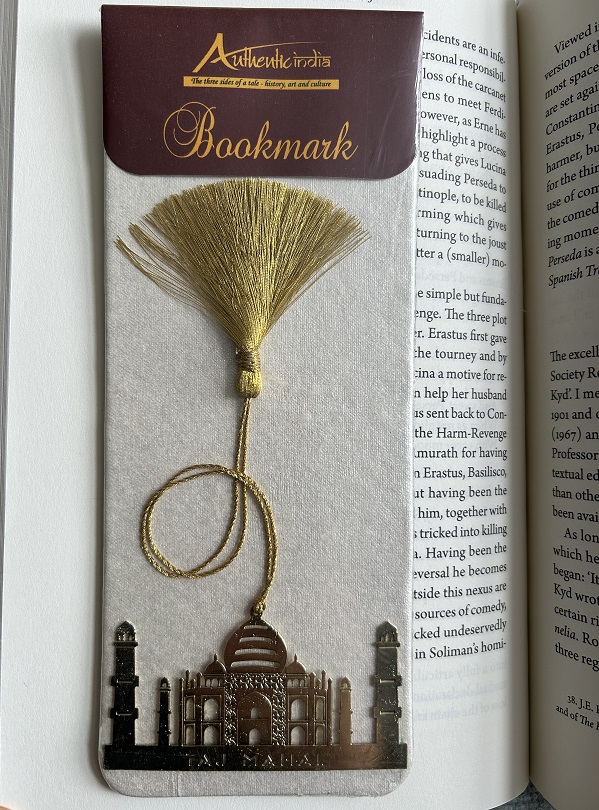
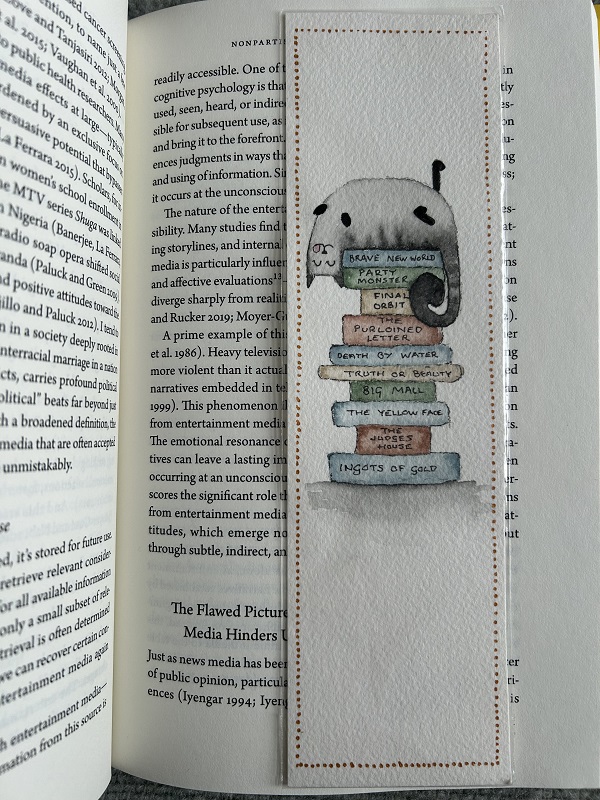
Anyway, this is the Frank Lloyd Wright Home and Studio building in Oak Park, Illinois. I have a friend who’s an architect who visited it and he picked me up a bookmark. Which, as you know, is the next best thing to being there.

Book: Modern Architecture by Alan Colquhoun

Bookmarked Bookmarks

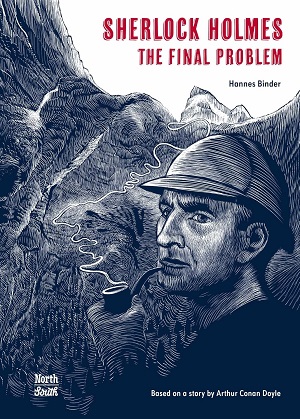
Holmes: The Yellow Face

A story best known today for its progressive views on race. And it still feels progressive well over a hundred years later.

A man named Grant Munro comes to Holmes concerned about the strange behaviour of his wife, Effie. She’d been previously married to a man living in Atlanta, Georgia who she’d had a child with. Both this husband and child had reportedly died in a fire. Munro claims to have seen the death certificate. Or more specifically, he says he’s seen the husband’s death certificate. This is actually a clever bit of clue-dropping. Of course, when we hear that he’s seen the death certificate (actually not in use in Georgia for another twenty years) we immediately think it must be bogus. Because why else mention it? But what we might not register is that he only says he’s seen the husband’s death certificate.

As it turns out the child is alive. Holmes speculates that the wife is being blackmailed by her still-living first husband, who has moved into a nearby cottage. Meanwhile, what’s really happened is that a truculent Scottish governess is living there with Effie’s daughter, who has been seen looking out the second-floor window while wearing a yellow mask.

There are two twists. First, Effie isn’t being blackmailed by her first husband. Second: her daughter is “a little coal-black negress.” Effie had, you see, “cut herself off from my race to wed” a Black man. After overcoming a bit of shock, however, Grant scoops the child up and agrees to adopt her, claiming to be a better man than his wife has credited him with being.

I call the husband’s views progressive, but Wikipedia goes further in finding them “extraordinarily liberal for the 1890s.” Though interracial marriage wasn’t illegal in Britain at the time, I think the reveal here would still have been quite something. For comparison, Thomas Hardy’s Tess of the d’Urbervilles had just come out in 1891. This story was published in 1893. So they’re almost exactly contemporary. In Tess, Angel is so appalled when he finds out Tess had been effectively raped as a sixteen-year-old and had a child who died, that he abandons her and flees to Brazil. Diff’rent strokes indeed.

Watson introduces the story as one of Holmes’s rare failures, even though everything turned out well in the end. He tries to excuse Holmes’s shortcomings by saying that it was “when he was at his wits’ ends that his energy and his versatility were most admirable,” but the fact is that his guess as to the inhabitant of the cottage was nothing but the wildest speculation. Which, in turn, quite undercuts all his boasting about not indulging in a lot of guesswork in the absence of facts. But as regular readers should have known by now, Holmes is actually quite a fantasist, and while most of his solutions turn out to be accurate they are just as often as not lucky shots.

A little point that caught my attention is that when Effie gets up in the middle of the night to visit the cottage, Munro checks the time by taking his watch “from under the pillow.” This triggered very old memories of sleeping with my watch under my pillow. Memories so old now I can’t be sure if this is something I actually ever did. But at least it wasn’t unheard of, back in the day.

Holmes index

Kill or Be Killed: Volume Two

Kill or Be Killed: Volume Two

A mixed bag.

I like how the story is getting thicker, even as I hate all the stuff having to do with Dylan’s improbable love life and I couldn’t understand the way things kept jumping around. Ed Brubaker has to work hard to justify the different points of view while explaining how Dylan, our narrator, knows everything he’s talking about. Dylan’s also still doing that thing where he jumps ahead and then spends the rest of an issue telling us how we got there. And sometimes he’s more than just an issue ahead. At the end of this volume we still aren’t caught up to the gunfight in the brothel where the series began.

Now to be sure a lot of writers do this, and one thing to be said for it is that it shows how much planning went into things. The Chew comics do a lot of this too, for example, and they go even further with the breaking of the fourth wall, albeit with comic intent. But Dylan’s “artistic license” with the storytelling here just confused me. There were more hints dropped in this volume about the demon being Dylan’s imaginary frenemy, his appearance perhaps the result of Dylan going off his meds. But then the demon also seems to know things Dylan can’t, which may be its own version of artistic license.

Otherwise things are escalating nicely, with Dylan’s vigilantism having predictably messy side effects as he keeps skating out onto thinner ice. He’s been lucky so far but the cops and the Russian mafia are closing in, as is the demon. And to be honest, I hope things get worse for him, as I can’t say I like the character at all.

Graphicalex

What does that even mean? Part IV

In the midst of a recent heat wave I went to pick up some drinks for the fridge just in case I wanted something a little stronger than my usual water. They had Gatorade on sale so I picked up a 6-pack of this stuff. Why this particular flavour/colour? Because it was all they had left. For good reason, as I later discovered.

In the store I didn’t even look at the label. I just figured it was blue and so probably had some kind of berry flavour. My bad. I thought it tasted like antifreeze. But then I don’t know what antifreeze tastes like because I don’t have a wife who’s trying to poison me. I had to be really thirsty just to get through one bottle.

But what was it supposed to taste like? Orange energy drinks are orange flavoured. Purple ones are grape. The red ones may be cherry but are more likely fruit punch. And this is what they’re called on the label.

This is called . . . Glacier Freeze? What does that mean? That it tastes like run-off from the Greenland ice shelf? For what it’s worth, I went online and found this AI slop:

Glacier Freeze Gatorade is widely understood and marketed as a blend of refreshing, subtly sweet citrus and berry flavors with a dominant crisp, cool taste. The exact composition remains a closely guarded secret, but the prevalent consensus points towards notes of lemon-lime combined with a hint of raspberry, creating its signature icy profile.

Unlike some Gatorade flavors that are explicitly tied to a single fruit, Glacier Freeze offers a more complex and abstract flavor experience. This ambiguity is part of its appeal, allowing consumers to project their own interpretation onto the taste. The marketing has also played a key role in shaping perceptions. The “glacier” imagery evokes a sense of icy coolness and cleanness, reinforcing the refreshing quality of the drink. The pale blue color further contributes to this association.

It’s essential to note that taste perception is subjective. Factors like individual taste buds, cultural background, and even the temperature of the drink can influence how someone perceives the flavor of Glacier Freeze. While the majority may identify lemon-lime and raspberry, others might detect subtle nuances of other berries or citrus fruits. Ultimately, the ‘true’ flavor is a personal experience, shaped by individual interpretation.

Yeah. Whatever. I guess it tastes like whatever you think it tastes like then.

Since all labels have to be printed in both English and French in this fair land, I spun the bottle around and found this.

All of which only told me (something I didn’t know) that the French word for “iceberg” is “iceberg.”

Index

Basement Library!

If you’ve been following along with the saga of my basement renovations, turning a totally unfinished space into a library, here are the results. Still not much furniture but otherwise it’s mostly done.

This is how it looked to start. You can click on all the pics to make them bigger.

And here we are today from the same point of view, which is looking north.

And here we are looking south.

Turn the corner to the right at the south end and it wraps around.

And just turning some more to the right. That far wall is DVDs.

That’s about it for now. The island chests of drawers are for displaying and holding my bookmark collection. I haven’t put the bookmarks in yet. And I haven’t got much art up. But I’m getting there.

Next step is doing the upstairs shelves. The basement is for history, politics, and other non-fiction mostly, with comics and SF/mystery at the south end. The more literary stuff is going to go on the main floor and the loft.

Kill or Be Killed: Volume One

Kill or Be Killed: Volume One

Something that I’ve found myself responding to a lot in these Graphicalex notes are comics that will have a great premise that fails in the execution. This happens fairly often and it’s not surprising. Between the idea and the reality falls a shadow.

When things are reversed then it’s all the more worth remarking. This is the case with Kill or Be Killed, another pulp/noir collaboration from the team of writer Ed Brubaker and artist Sean Phillips (with Elizabeth Breitweister as colorist). I thought the concept here was sub-grade, neither interesting nor credible. But somehow they managed to make a decent comic out of it.

So first here’s the pitch: Dylan is “just an average, depressed grad student” (this from the back cover) who tries to kill himself by jumping from the roof of his apartment building but is saved after getting hung up in some laundry lines on the way down. This leads to him being visited by a shadowy demon who tells him that his “second chance” comes with a price: Dylan will have to kill “bad people, people who deserve death . . . one each month” as “rent for the life you tried to throw away.” If he doesn’t, then he’ll be the one to die.

As an origin story I thought this just seemed lazy. How would Dylan know who was a bad person? How bad would they have to be to deserve death? Where had Dylan entered into any contract with the demon, and why should he even credit the existence of such a being, or his threats? In order to prove his reality the demon breaks Dylan’s arm, but I didn’t find that very convincing. I assumed the demon was some sort of psychological projection, but born of what? The whole idea just seemed a brainless way of explaining the lame premise, which is a young man adopting a double life by going on a vigilante murder spree.

Having said that, the actual story was effective once it got going. Dylan is in a moral no-man’s land, both in selecting the bad people for execution and for getting involved in a relationship with his roommate’s girlfriend. Suspense arises from wondering which of these poor life choices will blow up on him first. Phillips’s art is suitably grotty and Brubaker does his best to make Dylan at least a semi-relatable narrator-protagonist. I didn’t like all the foreshadowing, something that even Dylan admits is too much, but I could live with it. And I felt hooked enough to stick with things for another volume at least. Now that they had the rough part out of the way I felt like there were some interesting directions they might go in. So we’ll see.

Graphicalex