Thomas Crown’s affairs

Free at last.

Over at Alex on Film I’ve posted my notes on the two film versions of The Thomas Crown Affair: 1968 and 1999. Both are slick, but thin on substance, which I think is their point. They offer impressions of the good life, which is all about expensive toys and being free. And this isn’t just the freedom to jet off to wherever you want, and do whatever you want, whenever you want to do it, but freedom to be a total scofflaw.  Thomas is, after all, a criminal who gets away with it. In fact, he probably gets away with more than just the heists he likes to pull on the side. I can’t imagine Crown’s business, whatever it is it does, being squeaky clean.

In the 1968 version Thomas was a rebel, and thirty years later a libertarian. Is there some hypocrisy in the political right criticizing the Woodstock generation for its “freedom, baby!” attitude while presenting itself as the upholder of law and order? I think so. From Steve McQueen to Bill Clinton to Pierce Brosnan to Donald Trump: hasn’t Thomas Crown just got older, without changing party?

Sleuths

Game, set, and . . .

Over at Alex on Film I’ve been watching some film versions of Anthony Shaffer’s play Sleuth. Or at least the 1972 Laurence Olivier-Michael Caine Sleuth and the 2007 Michael Caine-Jude Law Sleuth, with 1982’s Deathtrap (Michael Caine and Christopher Reeve) sandwiched in-between. Deathtrap is actually based on Ira Levin’s play, but it also clearly derives from Sleuth, and may even be closer to Shaffer’s play than the 2007 movie, which was written by Harold Pinter.

Everyday rudeness #5: Not removing winter shoes and boots indoors

At the gym I go to the locker rooms (remember them?) are on the main floor, with a rather grand staircase leading up to the equipment and program rooms. During the winter months there’s a sign placed at the bottom of these stairs asking members to not go past that point wearing winter boots or outside shoes. You can’t miss the sign. You have to walk around it to go up the stairs.

Even if you didn’t read the sign, the effects of people not taking off their boots is evident. The stairs are often dirty and wet, and they have to put up signs warning how slippery the steps are. Upstairs, the carpeting is being ruined with all the salt brought in. The janitorial staff also have to mop the steps down several times every day because they are such a mess.

I spoke to one of the janitors on this detail the other day and mentioned how surprised I was that people didn’t take off their outdoor shoes before coming upstairs. He said that “Sadly (yes! he said ‘sadly’!) most people don’t read the sign.”

I don’t think that’s true. I think everyone knows the sign is there and what it says. And like I say, it’s obvious the mess they’re making. They just ignore it. In this they are following what I’ve described before as the essence of rude behaviour: a sense of privilege and entitlement that tells them that rules don’t apply to them. Such people are, in the favourite diagnosis of our age, narcissists. Or assholes. What this leads to is, as usual, a mess for someone else to clean up.

Happy 1,000th

Party time.

Over at Alex on Film I just put up my 1,000th post: some comments on Guy Maddin’s The Forbidden Room.

I wasn’t sure when I started my movie blog that I’d get to 1,000 posts. Then for a while I imagined I might try to do a special film to mark the occasion. Citizen Kane. Casablanca. Vertigo. Something like that.

One thing I’ve found as I’ve gone on, however, is that doing commentaries on those movies is nearly impossible. This is, in part, because so much (really, everything) has already been said about them. Just in jotting down some personal impressions and reflections, which is all I do at Alex on Film, would require too much work. I do listen to commentaries when available. I do try to read up on some of the basic background and criticism that’s out there. But the field has become so overgrown in many cases that the volume of it is self-defeating.

Who can hope to read everything that’s been written on Psycho? Who would want to tackle Blade Runner? These movies have millions of words dissecting their every frame in print, with millions more online. Nobody can read all of it. And what do you do when the DVDs for not-quite-great films like Fight Club or Hostel come with four full-length audio commentaries each?

I think this is the reason you find so many movie blogs talking about really obscure titles that almost nobody has seen. Critics want to feel like they have some elbow room, or aren’t just reinventing the wheel. What’s interesting is that the same attitude doesn’t seem to apply to fiction. A book that doesn’t find an audience, critical or otherwise, is just ignored. Nobody wants to go near it. Even if it’s a great book that somehow got overlooked. But even the dreariest exploitation flick from the 1960s seems to be able to find an audience today online. I’m not sure why that is.

Beowulf on the big screen

Mr. Ray Winstone. No, not really.

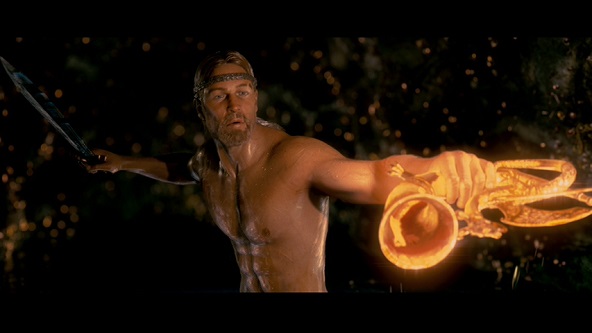
Over at Alex on Film I’ve been watching some movies loosely (very loosely) based on the Old English poem Beowulf. I’m not sure what the attraction for filmmakers is, since despite having lots of classic fantasy elements (a powerful hero, a witch, a monster), the story is kind of bare bones. As a result, these movies indulge in a lot of freestyle reinterpretation. Some of it works, some doesn’t.

Despite its reputation as a box office bomb, which may not be wholly deserved, The 13th Warrior (1999) is actually pretty good. Beowulf & Grendel (2005) only has a few moments set amidst some nice scenery. Robert Zemeckis’s Beowulf (2007) has dated so badly in only ten years that it’s unwatchable.

Books of the Year 2018

Whenever I see an end-of-year list of best books (or movies, or songs, or whatever) I always think about how small a sample size any individual list-maker can hope to draw on. I read a fair number of new releases every year, but even so my own list of the best has to be drawn from a pretty narrow number of choices. That said, here are my favourite books of 2018 in three categories.

Best fiction: This is where I really fell down this year. I didn’t read that many new novels and short story collections in 2018. But of those I read I liked Iain Reid’s Foe the best. It’s a page-turner that forces you to reflect on what makes us what we are.


Best non-fiction: Looking over all of the non-fiction books I read this past year it’s amazing how dominated the list was by Trump. So just to be different, I’ll say Adam Zamoyski’s Napoleon. It’s a good read and does an admirable job of summing up a complex man’s incredible life in a single volume.


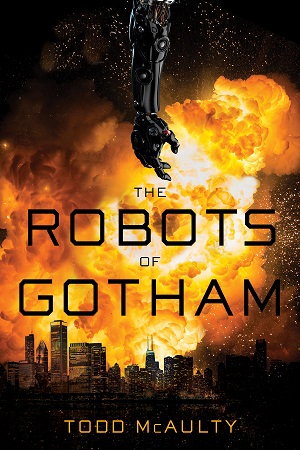
Best SF: There were a lot of choices here – even leaving out Foe, which was an SF novel too. On my short list I’d have The Body Library by Jeff Noon (not really SF, but weird), 84K by Claire North, and The Razor by J. Barton Mitchell. But I think I’ll vote for The Robots of Gotham by Todd McAulty. It’s an epic SF robot opera set in a remarkable new world where humans and independent machines are fighting to get along. Great stuff.

A star is born

Some people — percentage-wise not very many, but some — make money off of their YouTube channels. A very few become rich. According to Forbes magazine the highest earner is 7-year-old Ryan, the star or “host” of Ryan ToysReview. In the past year he generated over $20 million in income, which was up 100% from last year (the site has only been existence since 2015).

This is yet another of those things that make me feel horribly out of touch. I get that if, by whatever strange alchemy, you become a YouTube star or celebrity you can make a lot of money through ad revenue and selling merchandise. I understand that this mainly happens through the channels of people who play video games. I don’t play video games, but I know that many people do. I also accept that some people — if I can say it without sounding judgmental, mainly lonely people — will sit and watch someone else play a video game and just talk for hours.

I get all that. I don’t get the success of Ryan’s channel. I watched as much as I could of one episode and saw that it was mainly being presented by Ryan’s parents, with Ryan appearing to be little more than a prop being played with like one of the toys (upon reading about this phenomenon some more I discovered that Ryan has, in fact, been turned into an action figure being sold at Walmart for $9 each). His mother does most of the talking on the videos and her voice is excruciating. The production and presentation are crude. They really are awful in every way. But even if it had been well done, or if I was missing something, I still don’t understand how something like this can appeal to so many people or influence sales so much. Who watches it? Kids? Parents? Just people who want to enjoy the thrill of rampant consumerism (“unboxing”) daily? Apparently the “reviews” eschew any kind of evaluation or analysis of the toys in question but just offer up moments of sheer enjoyment.

Is this the end of the world as know it? Probably not. It’s not really that different from the story of any child star in years gone by. And I guess there is a universal appeal to voyeuristically and vicariously experiencing a child’s joy, however artificially stage managed it may be. Not to mention the fact that with daily updates, even given the simplicity of the videos the family is obviously putting a lot of time and effort into this project. There’s something about this story though, and more broadly about the Internet economy, that strikes me as both profoundly weird and probably unhealthy. If nothing else, such success stories guarantee an endless stream of imitators, just as Ryan’s channel was cloned from other unboxing sites. I wonder how much of this is just a fad, like viral fame itself, and how much of it is a real glimpse of things to come.

Who ya gonna call?

I always wondered how she’d manage with a flat screen.

Over at Alex on Film I’ve been watching a bunch of horror movies that fit into what I call the Ghostbusters paradigm, where a team of specialists equipped with all the latest toys investigate weird goings-on. I believe the genre started with the BBC film The Stone Tape, and it’s had a long and varied history. Of course, this being the movie business science is always shown to be inadequate when it comes to combating the forces of evil. Just as religion also usually fails. Anyway, here’s the line-up of movies I looked at.

The Stone Tape (1972)
The Entity (1982)
Poltergeist (1982)
Ghostbusters (1984)
Prince of Darkness (1987)
1408 (2007)
The Conjuring (2013)
Ghostbusters (2016)
The Conjuring 2 (2016)
Rings (2017)