Culture docs

Kenneth Clark, explaining how it all went down.

Looking back on it, one could see the 1970s as being a kind of golden age for documentary series on television. The father of them all was Kenneth Clark’s Civilisation (1969), which became something of a surprise hit. People just couldn’t get enough of this tweedy, donnish fellow talking about art from the medieval period to our own day. It was followed by several landmark series produced in a similar vein, but on different, if still general, cultural subjects. Programs like Jacob Bronowski’s The Ascent of Man (1973), John Kenneth Galbraith’s The Age of Uncertainty (1977) (to which Milton Friedman’s Free to Choose (1980) was a libertarian response), and Robert Hughes’ The Shock of the New (1980).

Each of these series followed the path charted by Clark, featuring a single narrator taking us on a guided tour through broad topics like the rise of science, the history of economics, or the story of modern art. They were aimed at a general audience, but I think remain informative and educational even for those who have studied a fair bit in these areas. They were also accompanied by companion books that, while well illustrated, were far more than coffee-table ornaments. Indeed, as good as the programs were I think I prefer the books (particularly in the case of The Age of Uncertainty, which didn’t work that well on TV).

I was looking through one of these books the other day and wondering what happened to this great spurt of achievement. Yes, there have been sequels. Carl Sagan’s Cosmos: A Personal Voyage (1980), another hit show accompanied by a bestselling book, was followed-up in 2014 by Cosmos: A Spacetime Odyssey,  narrated by Neil deGrasse Tyson, but that was a development that had to be expected. As good as Sagan was in his day, science had moved on. But who are the other inheritors? I can think only of Simon Schama, host and author of A History of Britain (2000-2002) and Power of Art (2006). And much as I like Schama, and I think he might be the best at this kind of thing we have, I don’t know if he’s quite at the same level.

Civilisation itself had a sequel in Civilisations (2018), which had three presenters (Schama, Mary Beard, and David Olusoga). It didn’t have anything like the same impact. Why was this? Has the age of the cultural documentary series on TV passed? If so, why?

I can think of at least three possible explanations.

(1) We no longer have people like Clark, Bronowski, Galbraith, Hughes, and Sagan: deeply learned and capable of speaking in an assured and accessible way to a general audience. I like Mary Beard and deGrasse Tyson, and various other people I’ve found on the Internet doing good work, but I don’t get the same feeling of authority from them, or of a personality being molded with scholarship into a personal vision. There’s some significance in Clark’s choice of subtitle for Civilisation: A Personal View, and the shift from A Personal Voyage to A Spacetime Odyssey. I’m also tempted to think that this falling off has something to do with universities (where we usually have to go to find these people) becoming more compartmentalized and less concerned with teaching. Still, I do think there’s talent out there, and people capable of doing the job.

(2) Public broadcasters no longer have the budgets to produce quality documentary series. Most of the series from the golden age were made by the BBC or PBS, and those outlets are feeling the pinch. But when you see what the BBC have been able to do with their Planet Earth programs, and what some dedicated individuals are producing and posting on YouTube with virtually no money at all, there’s no reason culture docs can’t be made up to the same standards. I mean, I don’t care for the historical re-enactments anyway, and those are the only parts of most of these shows that look like they would cost very much.

(3) The audience is no longer there. We may think here of the sad decline of the History Channel, which has transitioned to reality-TV shows or investigations into ancient aliens or the likely whereabouts of Hitler. But as much as purists may complain, I’m assuming the people in charge know what they’re doing. Meaning that they understand that quality documentary series just don’t draw enough eyeballs to make them worthwhile. Put another way, even if programs as good as Civilisation or The Shock of the New could be made today, I doubt very many people would watch them. I’m sure they wouldn’t have anything like the sort of impact such shows had forty or fifty years ago. And for this I think we have to mainly blame ourselves.

Maigret: A Man’s Head

I saw the title for this one and thought it was going to involve Maigret finding a loose noggin floating in the Seine. But the loss of a man’s head is only prospective, as it’s still attached to a man on death row for a crime that Maigret is convinced he is innocent of. So convinced that he arranges to have the man “escape” from prison in the hope that this will somehow lead him to the real killer. The tabloid press finds such an operation “probably unique in the annals of crime.”

Yes, but not in the annals of Hollywood crime movies, which is very much what this novel plays like. There’s a lot of action and chasing people around. The plot is a stretch, even without the escape from prison, but in the character of the bitter Czech Radek we get one of the best villains of the series. Twenty years earlier, Maigret speculates, he might have been a militant bomb-thrower, but that has gone out of fashion. Which means what? That there are no more causes, political or philosophical, worth throwing bombs for. Radek doesn’t even rise to the level of a Raskolnikov. Jealous of love, and of life, all he has left is his hate. Does Maigret understand him? I don’t think he’s able to relate.

Maigret index

Adaptive addiction

From The Uninhabitable Earth: Life After Warming (2019) by David Wallace-Wells:

Presumably, you can already feel this transformation underfoot, in your own life – scrolling through photos of your baby when your actual baby is right in front of you, reading trivial Twitter threads while your spouse is speaking. In Silicon Valley, even tech critics tend to see the problem as a form of addiction; but, like all addictions, it expresses a value judgment, if one that makes the unaddicted uncomfortable – in this case, that we find the world of our screens more rewarding, or safer, in ways so hard to justify and explain that there really isn’t a word for it other than “preferable.” This preference is much more likely to grow than shrink, which may seem like cultural devolution, perhaps especially to temperamental declinists. It could conceivably also be a psychologically useful coping mechanism for living, still within the consumptive bourgeois tradition, in a dramatically degraded natural world. A generation from now, god help us, tech addictions may even look “adaptive.”

Maigret: A Crime in Holland

On the canals again, only this time in northern Holland. Why Maigret has been sent to Holland isn’t clear to me. A French national is being held as a suspect in a murder, but what of it? It seems a merely local matter that even the locals aren’t interested in figuring out. Meanwhile, Maigret doesn’t speak the language and doesn’t much like Holland or the Dutch. In fact you could go even further: he seems to despise the place and the people that he meets. Immediately upon wrapping things up he clearly can’t get out of there fast enough (“And that’s all . . . What time is the next train for France?”).

I wonder what his problem is. He finds the citizens pinched and repressed? Hypocrites? The small port town of Delfzijl is repeatedly described as being like a toy town full of doll houses. It is a façade, or whited sepulchre: “one could see the smug residences of the local bourgeoisie, freshly painted, with their sparkling panes, immaculate net curtains and pot plants in every window. Beyond those windows, impenetrable shadows.”

Well, we could say much the same for most English country villages in the golden age of crime writing. Into this world of stolid middle-class respectability the disruptive force of a homegrown pair of luscious eighteen-year-old breasts has blossomed. Which is “reducing events,” as Maigret does, “to their crudest common denominator.” In only a couple of years the owner of these breasts will have “put on weight” (Simenon need say no more) and be scarcely recognizable, but when you’re 18 having such spectacular frontage can cause all kinds of trouble.

I don’t think it’s much of a mystery. Maigret just doesn’t like the look of some people, and they all crack pretty easily under pressure. Even under the ridiculous expedient of a group re-enactment of the crime, which seemed entirely superfluous to me. All of which left me as happy to leave Holland as he was.

Maigret index

The craft so long to learn

In a review of Blake Bailey’s new biography of Philip Roth  Christian Lorentzen concludes with some advice for aspiring authors that may not get covered in many Creative Writing programs:

An exquisitely managed career, right down to this totemic and compulsively readable biography, which young writers are well advised to consult as a blueprint for enduring literary stardom. Its lessons include: never marry; have no children; lawyer up early; keep tight control of your cover designs; listen to the critics while scorning them publicly; when it comes to publishers, follow the money; never give a minute to a hostile interviewer; avoid unflattering photographers; figure out what you’re good at and keep doing it, book after book, with just enough variation to keep them guessing; sell out your friends, sell out your family, sell out your lovers, and sell out yourself; keep going until every younger writer can be called your imitator; don’t stop until all your enemies are dead.

They’re here!

Your invasion may be colourized.

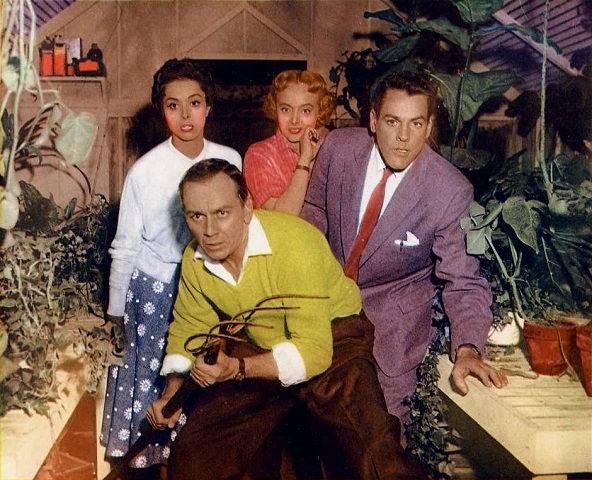
Over at Alex on Film I’ve been watching various body-snatcher movies. The basic idea may have come from Robert A. Heinlein’s novel The Puppet Masters (1951), which had a real political edge to it. Jack Finney’s The Body Snatchers (1955), later made into the movie Invasion of the Body Snatchers, which the novel subsequently adopted as its title, was less political, but that hasn’t stopped people from interpreting it (and all of its successors) that way. Let’s face it, it was the Cold War and body-snatching aliens were all part of the Red Scare. Anyway, here’s the line-up:

Invaders from Mars (1953)
Invasion of the Body Snatchers (1956)
The Brain Eaters (1958)
Invasion of the Body Snatchers (1978)
Invaders from Mars (1986)
Body Snatchers (1993)
The Puppet Masters (1994)
The Faculty (1998)
The Invasion (2007)

Maigret: Night at the Crossroads

The table is nicely set with the location and cast, especially the pair of Danish weirdos. But the resolution disappoints. Intentionally? It seems as though Simenon was, already, wanting to poke some fun at the mystery genre. When we first meet “Else” she “was wreathed in what American movies portray as sex appeal.” Ah, the femme fatale. But why only the sex appeal of American sirens? Maigret is just as entranced by her loose peignoir as any audience in the heartland would be.

I think Simenon is having a go at conventions. Take the way Maigret drags all the suspects (it’s a full house) in for the big reveal in the Poirot manner. He’s even described as being like a conductor leading a “motley orchestra.” And then there’s the fight in the well that is described as clownish, a farce, and buffoonery, followed by revelations that come as though “just like a novel.”

It’s not surprising this one has been filmed several times (thus completing Else’s circle). Those police inspectors gripping revolvers in both fists as they jump out of their car are straight from Warner Brothers’ back lot. All a lot of fun, but it left me wondering where things could go from here.

Maigret index

Revolutions reviewed (again!)

I’m really impressed with another review of my book Revolutions appearing online, this one by the novelist and critic Jeff Bursey. It appears in Galleon, a literary journal based in Atlantic Canada. Very in-depth and well worth reading, as Bursey makes a number of points expanding on and challenging those I made.

For other reviews see here.

Maigret: The Yellow Dog

Maigret is one of those detectives who care less about doing their professional duty than serving some more general idea of justice. This is something the mayor of Concarneau, among others, can’t get his head around, but it’s especially obvious with the bit of subterfuge Maigret pulls at the end of The Yellow Dog. We often miss this in discussions of mystery fiction. The point isn’t so much to re-establish a sense of order that existed before the crime, but to right any deeper wrongs, to pick winners and losers through the exercise of moral judgment.

Enter the trio of immoral losers (including one nicely captured momma’s boy) who find themselves being hunted in The Yellow Dog. It’s hard to feel any sympathy for them. And once again Maigret is cast in the role of class avenger. It all makes for a satisfying read, even if it does come off a bit rushed at the end. Then again, these books all move at a pretty crazy pace. Simenon really seemed to believe in the Elmore Leonard axiom of leaving out all of the boring parts. To the point where a lot of connective tissue also goes missing even in the basic mechanics of his prose. I keep coming to places where it isn’t even clear who is speaking, or to whom.

One interesting note: When Concarneau first goes under siege a newspaper article describes the “deathly still” atmosphere as “reminiscent of towns in northern France during the war when the air-raid sirens sounded.” I was surprised to learn by this that air-raid sirens were such a ubiquitous feature of life in France during the First World War that their use could be so easily invoked. I didn’t think towns had such alarm systems widely in place. The bombing of Guernica is usually cited as the first sustained aerial bombing of a civilian target, and there was an air-raid siren that sounded in that attack, but that was in 1937, twenty years later.

Maigret index

Update, June 26 2021:

I’ve read that in 1917 there was an air-raid siren system planned to give citizens of London a five-minute warning before an attack, but I’m not sure if it was put into use, or if it was ever adopted in France at the time.

Critter round-up

Leonardo DiCaprio, looking even prettier than his costar in his film debut.

Over at Alex on Film I’ve been watching the five (thus far) movies in the Critters franchise. Widely seen as a Gremlins rip-off, these omnivorous furballs apparently were independently conceived, and the first two movies aren’t all bad. The others are garbage, though Critters 4 does deserve some credit for being, I think, the first horror franchise to expand from Earth into space (later, Hellraiser, Friday the 13th, and the Leprechaun franchises would all make a similar migration).

Critters (1986)
Critters 2: The Main Course (1988)
Critters 3 (1991)
Critters 4 (1992)
Critters Attack! (2019)