Maigret: The Cellars of the Majestic

Upstairs-downstairs at the swank Hotel Majestic, and you know what side Maigret – “plebeian to the bone, to the marrow” – is on. Meanwhile, the rich guy (American, so you know he’s really rich) is an asshole even if he is innocent.

The class divide played a bigger role in some of the earlier books, like The Hanged Man of Saint-Pholien, but you definitely feel its presence resurfacing here. Still, the social order is never fixed: a dancer can marry a millionaire. This upward mobility is seen in several stories, where we find a character with  proletarian/plebeian/peasant roots who has risen in the world. And, as Balzac put it, the secret behind many a great fortune is a crime that was never found out.

It seems Simenon was hitting his stride around this time. The characters are all interesting and the plot is relatively tight. I’m not sure what to think of Maigret’s outburst of violence at the end, but maybe that’s his peasant blood reasserting itself. Plus he’d earlier shown that he could take a punch himself and shrug it off. If you’re going to dish it out you have to be able to take it.

Maigret index

Maigret: Cécile is Dead

I guess Maigret didn’t retire, as he’s back as Paris’s celebrity police investigator here. Even to the point where a young man has come all the way from Philadelphia just to learn about his “method.” Good luck with that. “How can I explain it to you?” Maigret asks. “I feel it.” But then how can you explain anything to a man who won’t wear a hat, even in the rain? Americans!

Though one of the longer Maigret mysteries I still felt shortchanged. I thought there was so much more to say about what was going on in that Neapolitan ice cream apartment building. As it stands, it’s pretty clear who the good guys and the bad guys are, though the focus on a smaller cast of characters and a single setting gives you more to sink your teeth into. The idea of love changing to avarice, “one passion chases out another,” made me think of Trina in Frank Norris’s McTeague. I love these pocket case studies in abnormal psychology.

As I say, I would have been happy with a few hundred pages going deeper into all this. But Simenon seems to have had a kind of attention-deficit problem when it came to these books. He’ll set the hook with a delightful opening, as he does here with an evocation of the foggy Paris streets to kick things off, or again at the beginning of Chapter 8:

It was still raining in the morning, a soft, dismal rain with the resignation of widowhood. You didn’t see it falling; you didn’t feel it, yet it covered everything with a cold film, and the surface of the Seine was pitted with thousands of little circles. At nine, you still felt as if you were off to catch an early train, for day was reluctant to dawn, and the gas lamps were still lit.

But he never continues in this vein for more than a paragraph or two. He’s impatient to get on with the story. Why the rush?

Maigret index

The high price of living (somewhere)

In recent years there’s been a lot of discussion about the affordability of homes in Canada, and whether we are experiencing a real estate bubble. A lot depends on location, as always when talking about buying a house. But the numbers on the ground where I live are concerning.

In March 2020 the average resale price of a home where I live was $590,176. A year later, March 2021, the price had risen to $744,775. A 26.2% increase in one year, which is a record-setting pace. The average house was appreciating in value over $10,000 a month. That makes for a very fluid marketplace. I was recently informed by a real estate agent that one local home had sold for more than $300,000 over asking. I do not live in Toronto or Vancouver, by the way.

I don’t know if this is a bubble, but it is a run-up that has to stop at some point. I don’t see how such inflation is sustainable. But will there be a collapse, or just a freeze or gentle deflating? And who is buying all these million-dollar homes anyway?

Maigret: Maigret

Yes, it’s just Maigret. I wonder if Simenon was starting to have doubts about the project at this point, tossing off a title like that.

Well, the big guy is enjoying a cozy retirement with Madame Maigret when his nephew, a newly minted detective on the Paris police force, badly bungles a stake-out. So badly, indeed, that he’s charged with murder. So Maigret is dragged back into action to clear the poor idiot out.

A bit of a change from the usual fare, as we basically know whodunit from the start. It’s more along the lines of a crime story than it is a mystery. Amadieu, Maigret’s replacement, even explains how Maigret’s “usual method” doesn’t apply here: “Usually, you get involved in people’s lives; you try to understand their thinking and you take as much interest in things that happened to them twenty years earlier as you do in concrete clues. Here, we’re faced with a bunch about whom we know pretty much everything.”

Instead of using his powers of empathy and reasoning Maigret has to resort to some old-school trickery involving the use of a piece of broom handle and a telephone. Even then, he’s really flying by the seat of his pants. But does this mean he’s back?

Maigret index

Maigret: Lock No. 1

The curtain rises, by way of a nice analogy to the movement of fish, on a working-class riverside neighbourhood that has the appearance of “a stage set or rather a self-contained world heavy with reality.” That attention to setting doesn’t mean much in terms of plot, but it does suggest a kind of fish-bowl like focus on the Charenton neighbourhood Maigret has been called to, a focus complemented by the fact that there are only a couple of characters we spend any time with. This is a minimalist Maigret and it plays well alongside the usual jerkiness of the prose. At least we don’t feel like we’re being jerked around such great distances.

Émile Ducrau isn’t one of Simenon’s more interesting or complex creations, in my opinion, and what’s odd is how we’re supposed to read Maigret’s response to him. Even before their first meeting, on discovering evidence of Ducrau’s boorishness, Maigret is beaming with pleasure. Later, as audience to further displays of just how obnoxious Ducrau is, our hero is described as “reveling in the company of someone who was really worth knowing.” In what regard? In what ways, aside from the physical (which is always important in these books), is he a match for Maigret? Why the build up to so many of their “man to man” conversations, turning them into epic competitions? One can understand Ducrau’s respect for Maigret, but is it reciprocated? By the end Maigret will see in the blasted Ducrau something “tragic but also rather ridiculous and contemptible.” But has this been a tragic fall? Ducrau had been a pig right from the start. A rich pig, but still a pig. So what does Maigret see in him that’s so fascinating or enjoyable? In Maigret at Picratt’s there will be an even more extreme example of this odd sort of connection being made, with Maigret finding a sleazy strip-club operator to be disturbingly simpatico. I’m not sure how we’re supposed to take this.

And what’s this about Maigret retiring? How old is he anyway? I’m sure that’s not going to last. There’s still a rather long shelve of books to get through.

Maigret index

Iconography

I’m a card-carrying Luddite, and by “card” I don’t mean the kind of digital ID you put in a virtual wallet or display on a cell phone. My Luddite status can be established simply by the fact that I watch a lot of DVDs, which remain my preferred way of enjoying movies.

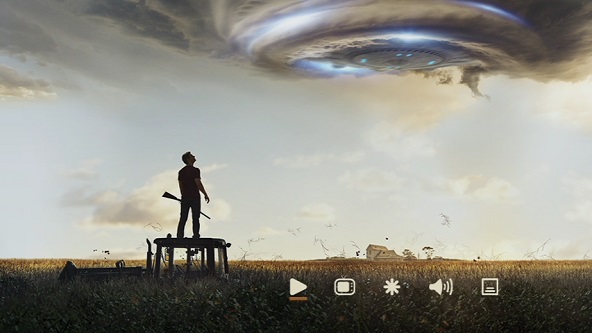
I do hope that DVDs will be with us for years to come, though I’ll admit to having doubts about this. I’ve heard rumours recently that some studios are thinking of abandoning the format entirely. It seems like everything is moving to streaming. But recently I’ve found even my love of DVDs is starting to be undercut by my inability to understand the language of icons. Evidence is here supplied by the “menu” to the DVD I recently watched of the three-part series they made out of Arthur C. Clarke’s Childhood’s End.

What do these symbols mean? OK, the first you pressed to play the movie. I got that. The second? I don’t know. And I still didn’t know after I clicked on it. It took me to another page that I couldn’t understand the purpose of. I thought it might be scene selection, but I don’t think that was available anywhere. At least I couldn’t find it. The third button was for accessing the DVD’s special features. But how would you get that from an asterisk? The fourth looks like it’s meant to control sound settings, but actually it’s for languages. Which turned out to be superfluous since there was only one audio track and it was English. The fifth was for subtitles, though the only subtitles available were in English. Still, it did allow you to toggle whether you wanted them on or off (if you couldn’t do that from your remote).

Years ago, or really decades ago now, I remember the despair in some circles that arose when it was revealed that more and more automated services were being designed for people who couldn’t read even the simplest instructions. Meaning that menus were entirely controlled by buttons marked with icons. It now seems that, at least in some cases, we’ve lost written instructions completely, to be replaced by visual prompts and cues that are both unnecessary for overcoming language barriers (this particular DVD has no language options other than English) and confusing.

It’s a brave new world, and I’ve been left behind. Childhood’s end, indeed!

Maigret: The Misty Harbour

I think this is the longest of these Maigret books I’ve read thus far. Which doesn’t mean it’s very long. Simenon’s style is almost telegraphic in its abruptness, to the point where I feel like I can hear the typewriter keys hitting the paper as he banged them out. In The Misty Harbour he’s off again to a provincial town hiding a bunch of dirty secrets. So many that it takes the extra pages just to sort them all out.

As I proceed through the canon I’m finding a basic, recurring disjunction. The crimes and criminals are usually very interesting, with motivations grounded in strange yet familiar psychological conditions. But the plots are a stretch, feeling hasty and indifferently slapped-together. I think it’s what Eliot might have called a failure to find a successful objective correlative, in this case a plausible narrative, for representing extreme emotional states.

Another commonality is the way justice, at least in its formal, administrative sense, is rarely done. This is a point I made in my notes on The Yellow Dog. Culprits don’t get handcuffed and taken away by the police, but instead either destroy themselves or are let go by Maigret. I’m not sure what Simenon is saying in all this about the proper role of the police. He’s dogged in finding out what happened, but upon achieving that goal he basically loses interest and hops on a train back to Paris. Let God sort it out!

Maigret index

The end of anger

Angry, and not alone.

I’ve read and reviewed a lot of books on (mostly American) politics over the past few years, and one point that keeps coming up is anger. To be sure, anger has long been a key component in politics. It was in 1976 that Howard Beale (in the movie Network) gave his live rant about how people should scream from the windows that they were mad as hell and not going to take it anymore. This famous line would be adopted by Dominic Sandbrook for the title of his political history Mad as Hell: The Crisis of the 1970s and the Rise of the Populist Right. So the 1970s seem like as good a place as any to locate when temperatures started to rise.

Gerald F. Seib picks up the story a little later on, tracking the genealogy of anger “from Reagan to Trump” in We Should Have Seen It Coming. He sources the main fount of anger, however, to the Tea Party movement, which launched in 2009 (kicking off with another live rant on television, this time not fictional). The Tea Party, in Seib’s account, “was the first political movement born on social media, and the first to show that anger was the special rocket fuel that could propel such a movement. It would not be the last.”

Before the Tea Party, however, Gavin Esler had described the 1990s as the seedbed of today’s angry politics in his survey of The United State of Anger. A very prescient take on what was coming down the pipe, and one with a precise and correct diagnosis of what was driving it. Remember the Angry White Males? They were much talked about at the time, and never went away.

In books about the Trump phenomenon there has been a lot of talk about anger. Obviously Trump himself is a very angry person, which made him the perfect vehicle for what a large segment of the population was feeling. Alexander Zaitchik’s The Gilded Rage being a good on-the-ground account of what Trump was tapping into.

I find the historical analysis fascinating because it reflects what I’ve been witnessing happening first-hand. There is a lot of anger out there. I can’t recall a time when there’s been so much of it. I sit across from it at restaurants, see it when I go out shopping, and even encounter it when walking in the park. I have sat and been a sounding board far too many times in the past few years for someone venting about their family, their job, or just the world in general. We are living, as Pankaj Mishra puts it, in The Age of Anger (a must-read for these times).

A couple of observations that I’ve made before but that I’ll repeat here.

(1) The anger is not exclusive to white males without a college education, or those “left behind” by the new economy. Far from it. Many of the angriest people I know are wealthy, successful professionals or businesspeople. Not all of them are young. Many are older, and enjoying comfortable retirements. Many are women. Anger also possesses both the political left and right. It is, in short, not limited to any one demographic. In Twilight of Democracy Anne Applebaum makes the same point when describing former friends who have embraced populist politics. They are not losers but an elite. This has not, however, made them immune to anger. Is anger then part of, or connected in some way to the so-called “narcissism epidemic,” a condition where the whole world is not enough to feed our egos? The example of Trump suggests there may be something to this.

(2) The main factors that are pushing our individual and collective needles into the red are, in my opinion, growing economic inequality and social media. With regard to the former, I’ve written before about how the COVID-19 pandemic is only going to make things worse (and people angrier). With regard to the latter, Seib ends his book by interviewing Eric Cantor, a former House Majority Leader who lost his seat to a populist uprising. When Seib asks Cantor what has fed and spread the anger that eventually took him down he answers by pulling out his smartphone. Enough said.

Broader factors contributing to a politics of anger would include the fact that people find politicians and parties increasingly unrepresentative and unresponsive, as well as a more general sense of the world being outside their control and indifferent to their feelings. In any event, if I’m right about the role being played by inequality and technology it’s hard to come up with an optimistic prognosis. Economic inequality is going to get worse, perhaps much worse. Social media is not going to bring us together because it makes money out of triggering rage. Anger will grow, tempting more politicians to ride the tiger. Who can believe this will end well?

Update, July 5 2021:

Tom Nichols, writing on Twitter, is another commentator who sees anger as the drug of choice not of the down-and-out but of those who are better off: “If you wonder why super-privileged kids or retirees in nice condos are so angry, it’s because it feels *great* to be angry. Otherwise, life becomes about getting a job (if you’re young) or just accepting the twilight of age. Easy heroism is crack to Americans raised on cable.”
Hillbillies

You don’t know the half of it.

Over at Alex on Film I’ve been watching the Hills Have Eyes movies. This is a weird franchise. The original 1977 film written and directed by Wes Craven has gone on to become a cult favourite, though I don’t think it’s anything special, or very good. It was followed up eight years later by The Hills Have Eyes Part II, a movie that I don’t think Craven wanted anything to do with and which appears to have been cobbled together out of whatever he’d shot after the success of A Nightmare on Elm Street. It’s terrible.

Then, nearly thirty years after the original, Alexandre Aja was picked to direct a remake which I think is the best of the horror-franchise remakes that were thick on the ground in the early 2000s. I love what Aja did, and the mutant hill people are a great twist.

There was a sequel to Aja’s movie the next year with The Hills Have Eyes 2. Though not as good, it’s still a decent attempt at doing something different, this time having a squad of National Guardsmen being hunted by the cannibal clan of hillbillies. Anyway, the upshot is that the remakes are actually more entertaining than the first two movies, which is rarely the case. Obviously, though, they aren’t for everyone.