A few more words from our sponsors

Fascinating.

Here’s something I wrote three years ago:

Wow, the Super Bowl ads really sucked.

They’ve probably been bad for a while now, but to be honest I haven’t been paying any attention. This year I managed to check a bunch of them out. And they were . . . terrible.

I’m honestly surprised they were this bad. No intelligence or creativity at all. They just seemed like they were throwing around lots of money, big stars, and brand IP, and then hoping for the best.

Well, guess what? In 2025 the Super Bowl ads were even worse!

I didn’t make notes on all of them, but what I saw was just a lot of expensive junk with random celebrities and lame jokes. Eugene Levy’s distinctive shaggy eyebrows take off and fly away, scaring people before settling back where they belong. This is funny because flying eyebrows are funny? They spent millions of dollars on this. Levy is a veteran comedian as well as a very funny and very smart guy. I can’t imagine what he thought when he saw the script.

Shane Gillis and Post Malone showed up as a pair of bros who know how to party like it’s a beer commercial. Because it’s a beer commercial. Some girl in a bikini ate a really unappetizing looking hamburger. Chris Hemsworth and Chris Pratt combined their star power to deliver a weak punchline about eating that $6 million banana duct-taped to the wall. I didn’t even know what it was a commercial for, which is the same I could say about most of these ads. The singer Seal is transformed into a seal, which was horrifying. I think that ad was for some kind of beer. Häagen-Daz did a Fast & Furious commercial that just left me thinking “Why?”

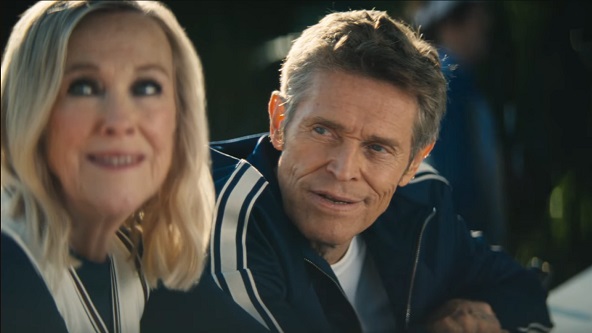
No laughs. Not even a smile. The one, single, good line I culled from all of these ads was Willem Dafoe saying “Fascinating.” That was fantastic. I’m sure it’s already a hit meme. The rest of the commercial was crap though. It was for some kind of beer.

Moving away from the humour, the Clydesdale horses were sentimental favourites again, as they have been for years (decades?) now. Nothing new. And Nike had that angry “girl boss” message going again. Just spinning the classics for us, barely even trying.

These ads cost a lot of money to make. They cost a lot of money to run during the Super Bowl. A lot of work goes into them. And every year now they are almost complete crap. They don’t sell a product and they aren’t in any way memorable or funny or entertaining on their own. What is going on in the world that even our advertisers can’t do their job properly? That they aren’t even competent at creating effective 30-second spots? How can they be this bad?
Mapping the north

Map not drawn to scale. Or reality.

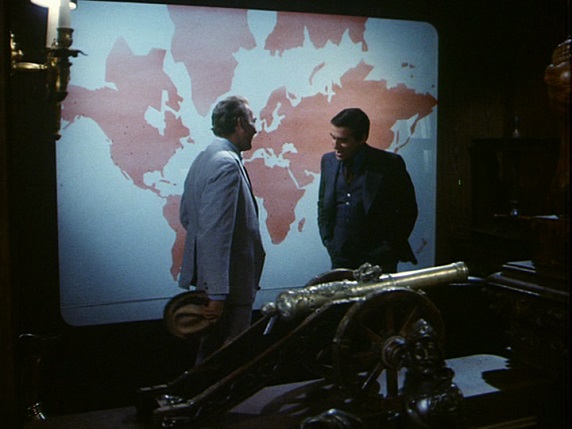
I’ve recently been watching Kolchak: The Night Stalker, a fun precursor to The X-Files that only ran for a single season in 1974-75. In the episode “Primal Scream” a team of scientists in the Arctic who are working for an oil company bring a cell sample back to Chicago that then thaws out in their lab and turns into a murderous pre-human. At one point Kolchak goes to the office of the vice-president of the oil company, who explains some of their drilling operations by pointing to a giant wall map showing the Arctic region.

Or at least one person in the art department’s rather fanciful notion of what the Arctic region looks like. I don’t know where to begin, so maybe I’ll just let the map speak for itself.

Stupid aliens

Nope.

I’ve been watching a number of videos online recently that have addressed the popularity of the Netflix series Ancient Apocalypse, written and hosted by Graham Hancock. These online “debunking” videos, produced with little or no budget, criticize Hancock’s show for advancing highly speculative theories on the basis of little or no evidence.

Hancock has been at this for a while, following in the footsteps of Erich von Däniken’s smash bestseller Chariots of the Gods (Hancock even gave his books titles like Fingerprints of the Gods and Magicians of the Gods). I wanted to get some more insight into the attractiveness of this kind of fantasy history so I checked out a DVD from the library called The Best of Ancient Aliens: Greatest Mysteries. This was a two-disc collection of eight episodes from the popular television series Ancient Aliens. I’d heard of this show, and was of course familiar with the face of Giorgio A. Tsoukalos and his famous meme, but I’d never actually watched any of it. So I stuck it in the machine.

I don’t think I’ve ever given up on a show faster. I made it maybe 15 or 20 minutes in to “Aliens and the Third Reich.” The intro kicks off with some talking head telling us that “a lot of the information we’ve been told about the Second World War is wrong.” Well, no doubt. Especially if you include shows like this. Then we cut straight to the lede: “Did, as some believe, Adolf Hitler base his plans for world domination on secret extraterrestrial knowledge?”

No. No he did not. Nor do I think Nazi rocket technology came from reverse engineering a downed flying saucer.

I then tried to watch a bit of “Alien Tech,” which had to do with the alien influence on the building of ancient megastructures. I think. It just seemed like more bullshit to me. None of the claims being made had much if any evidence to back them up but it was all put across with slick production skills and in documentary style, including interviews with experts whose credentials I didn’t think amounted to much.

Two thoughts came to mind.

First of all, why is this bullshit so popular? It’s been big since at least the ’70s so it’s not a recent phenomenon, but it’s still tempting to tie it in to our contemporary rage against experts and elites who seem to know it all and our appetite for the craziest conspiracy theories imaginable. If you believe that Democrats are shape-shifting lizard people I suppose none of this seems that far-fetched. This brought me back to the well-known passage from Hannah Arendt’s The Origins of Totalitarianism:

In an ever-changing, incomprehensible world the masses had reached the point where they would, at the same time, believe everything and nothing, think that everything was possible and that nothing was true. . . . Mass propaganda discovered that its audience was ready at all times to believe the worst, no matter how absurd, and did not particularly object to being deceived because it held every statement to be a lie anyhow. The totalitarian mass leaders based their propaganda on the correct psychological assumption that, under such conditions, one could make people believe the most fantastic statements one day, and trust that if the next day they were given irrefutable proof of their falsehood, they would take refuge in cynicism; instead of deserting the leaders who had lied to them, they would protest that they had known all along that the statement was a lie and would admire the leaders for their superior tactical cleverness.

Whenever I come across this sort of “reject authority” babble I find myself agreeing, at least somewhat, with the skeptics and doubters in their questioning of the evidence, but being baffled as to their own alternative theories. Put another way, I can sort of understand why they don’t believe what they don’t believe, but I can’t figure out why they believe what they do. Cynicism shouldn’t have its end in such blank credulity. But Arendt’s observation only brings home what Chesterton said: “When men choose not to believe in God, they do not thereafter believe in nothing, they then become capable of believing in anything.”

The second, and more depressing if of less immediate concern, point is the fact that television used to be good at putting together quality documentary series that were entertaining and educational. I wrote about this a couple of years ago and tried then to think of some reasons for how and why we’d lost our way. I was only concerned then with what we’d lost, not with what had taken its place.

Of course what drives all this is ratings, and stories about lost civilizations and ancient aliens do attract eyeballs. But it does make you wonder just how much stupider we will get if we continue on this course. I’m heartened by the popularity of some of the debunking videos, but they’re still coming nowhere near the cultural reach of the (underline this!) mainstream media messaging of pseudoarchaeology. It’s almost like there really is a conspiracy afoot to keep us from the truth . .

And now some words from our sponsors

Just go away already.

Wow, the Super Bowl ads really sucked.

They’ve probably been bad for a while now, but to be honest I haven’t been paying any attention. This year I managed to check a bunch of them out. And they were . . . terrible.

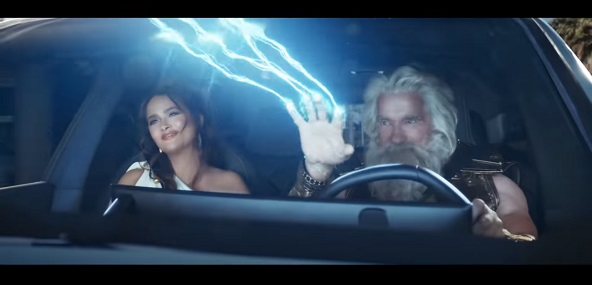
I’m honestly surprised they were this bad. No intelligence or creativity at all. They just seemed like they were throwing around lots of money, big stars, and brand IP,  and then hoping for the best. What was funny about Arnold Schwarzenegger and Selma Hayek playing retired Olympians (Zeus and Hera) who get an electric car? Do you think they might have written them actual jokes? What was funny about Mike Myers reprising his role as Dr. Evil to hawk an SUV (in an ad The Athletic rated the pick of this year’s crop)? What was funny about Ryan Reynolds recycling an old Mint ad upside-down? What was funny about Lindsay Lohan reinventing herself by going to the gym, along with a bunch of weird celeb cameos (Dennis Rodman, Danny Trejo, William Shatner)? There was nothing clever, noteworthy, or memorable about any of this. It was all trash.

Is ad culture now as exhausted for new ideas as Hollywood has long been? Because that’s what these ads felt like. Blockbuster commercials with A-list talent and no brains. Were these the ads we were supposed to be talking about the next day around the water cooler? Or is that itself an antiquated notion now?

Or perhaps I’m just being a curmudgeon. Writing in Slate, Justin Peters declared this year’s Super Bowl ads to be “by and large, pretty good.” So I watched all of the ads he ranked as the best. I was even more disappointed. The Chevy Silverado ad just mined The Sopranos for . . . what? That’s the ad? Meadow and AJ hugging after she drives through the opening credit sequence? It was only a minute long and I honestly had to skim through it to make it to the end. And I loved The Sopranos!

Next Peter had an ad for something called ClickUp, with the joke being that the signers of the Declaration of Independence were using a tablet and cloud computing. No laughs, not even a smile, and the whole idea is played out by now.

Then there was an Expedia ad which was sort of meta, poking fun at previous Super Bowl ads and ad culture in general. Another yawn.

A Lay’s Potato Chips ad which had Sexiest-Man-in-the-World Paul Rudd teamed up with Seth Rogen, as they reminisced over movies they’d been in together while sharing some Lay’s. Peters found this “very funny.” Huh?

Nissan “Thrill Driver.” Eugene Levy is funny in just about anything, but this is more of the blockbuster syndrome I was talking about. Big effects, big star cameos, and nothing else.

I sort of gave up at this point. Among the rest, Jim Carrey was back as the Cable Guy. I actually thought this was a little better than Mike Myers returning as Dr. Evil, though not much. Apparently there were a lot of not-good commercials trying to sell us on crypto. One of these just had a QR code bouncing around the screen. Larry David shilled for another, but his ad was way too long, dragging out a single joke to the point where it lost its edge before the hook at the end. LeBron James also pitched crypto, with the same FOMO message. As Matt Schimkowitz writing for Yahoo put it, “The [crypto] ads, disturbing and boring in their own ways, were met with derision online for basically the same reason: They suck because the thing they’re advertising sucks.” Yep.

Anyway, the only ad I sort of enjoyed was the Uber Eats one, which was weirdly riffing on “can you believe how stupid the people are who order Uber Eats?” You could say it fell into the category of so-dumb-it-was-kind-of-good, and Gwyneth Paltrow’s cameo was definitely off-putting. In a field of disposable formula and conspicuous waste, it’s the only moment that stood out.