TCF: Dead in the Water

Dead in the Water: A True Story of Hijacking, Murder, and a Global Maritime Conspiracy
By Matthew Campbell and Kit Chellel

The crime:

In July 2011 the oil tanker Brillante Virtuoso was apparently hijacked by a gang of pirates in the Gulf of Aden. The pirates didn’t hold the ship or the crew for ransom but only set it on fire. It later turned out at trial that the owner had staged the pirate attack and scuttled the ship in order to claim the insurance. Along the way, a British investigator living in Aden was killed by a car bomb, which was probably a hit related to his early questioning of the ship owner’s shady business practices.

The book:

This is the sort of true crime book I really enjoy because in addition to telling an interesting story it also provides a lot of background that’s new to me. In their introduction, the authors set the scene by talking about how marine trade has gradually become more invisible:

as ever-larger vessels required ever-larger quays, and robotic cranes replaced longshoremen’s brawn, the ports moved away to obscure locales like Felixstowe and Port Elizabeth [today Gqeberha]. Eventually the sailors also receded from view – some made obsolete by automation, the rest pushed out by cheaper, less demanding workers from developing countries. Even more than power lines or sewer pipes, ships slipped into the background of modern life, not so much taken for granted as barely noticed at all. As consumers, we’ve never before had access to such a bounty of goods, and we’ve never had to think so little about how they come into our possession.

Assisting this slip into the unnoticed background of daily life has been another peculiarity of the shipping trade: the use of layers of shell companies concealing the ownership of individual vessels and the “flags of convenience” that allow vessels to avoid pesky labour, safety, and environmental regulations. As a result, if a ship sinks or the cargo and crew are lost it can be a Herculean task just sorting out who is responsible or liable. From its beginning

the entire modern shipping industry had been structured to interpose layer upon corporate layer between the men who profited from owning ships and those who labored on them. When something went wrong, if there was a fatal accident or the crew ran out of food, it was easy for shipowners to claim ignorance and diffuse responsibility.

As a result, cases of maritime insurance fraud are fascinating mixtures of high-seas skullduggery and white-collar shenanigans. The attack on the Brillante Virtuoso was just a crude and stupid affair, albeit quite grim for the poor Philippine crew. The insurance plot, on the other hand, was more sophisticated: designed to take advantage of the fact that the law doesn’t do a great job dealing with such problems. In fact, as with most white-collar crime the law is designed precisely to avoid having to deal with these matters. And the insurance industry in particular would rather just pay to make problems go away since losses can just get passed on to consumers anyway. That’s how insurance works. The house never loses. In fact, white-collar criminals don’t lose either. “The lesson: maritime fraud is profitable, and even if you are unlucky enough to get caught, you’re unlikely to be prosecuted.”

The bitter sting in the tail of this story is that the owner of the Brillante actually came out ahead by about $10 million. The “moral flexibility” of the insurance market would even see him still being able to buy insurance from Lloyd’s after the legal findings against him. It’s all just business. As for moral hazard, I guess if the sums are large enough that doesn’t matter anymore. This led me to a deeper reflection on not just morality but the whole question of corporate culture having its incentives not just a bit but entirely wrong. This is what led to the subprime mortgage crisis back in 2008, and I’m afraid it’s pervasive in all sectors of the economy now. We’re all in the money and enjoying cheap goods until the music stops and we’re left wondering “Who did this?’

The book itself is not quite a page-turner, but it’s pretty darn good. The focus is on the efforts of two investigators, Richard Veale and Michael Conner, and their battles not only against the Greek ship owner and his allies but the insurance company that hired them. Talk about a snake pit.

Noted in passing:

There’s a great interaction described between some of the insurers and Veale where the insurers are pushing back against the strength of the case.

Everything they’d learned so far was “circumstantial,” one of the attendees said. Incensed, Veale interrupted him.

“Throughout this I’ve heard you all talk about circumstantial evidence,” Veale said. “Do you actually know what that means?”

“That there’s no smoking gun,” the man replied.

“A smoking gun is the best example of circumstantial evidence,” Veale said, his voice rising with frustration. It could only be otherwise if someone had witnessed the weapon being fired. “Circumstantial evidence isn’t weaker evidence,” he continued. “DNA and fingerprints are circumstantial evidence.” None were proof, on their own, that a crime had been committed or by whom. They were building blocks, to be combined into the foundation of a persuasive case, one that Veale was confident would succeed if the insurers were willing to make it.

The exchange addresses the very common misconception that circumstantial is somehow less reliable and weaker than direct evidence. In fact, circumstantial evidence is often far stronger than direct evidence, as eyewitnesses can be very unreliable while physical evidence (such as DNA and fingerprints) is something you can take to the bank.

Takeaways:

“The shipping industry has the unique attribute of being utterly integrated with the world economy while existing apart from it, benefiting from its infrastructure while ignoring many of its rules. It’s sometimes said that the seas are lawless, and that’s true: far from shore, on a decrepit trawler or a juddering ore carrier, there are certainly no police, and often no consequences. But the most audacious crimes can occur where the maritime world intersects with the more orderly terrestrial one – enabled by the complexities of twenty-first-century finance and, perhaps most of all, the collective indifference of a global populace that wants what it wants, wants it now, and doesn’t want to know the human cost.”

True Crime Files

TCF: Slenderman

Slenderman: Online Obsession, Mental Illness, and the Violent Crime of Two Midwestern Girls
By Kathleen Hale

The crime:

Three Waukesha, Wisconsin girls — Morgan Geyser, Anissa Weier, and Payton Leutner – went into the woods on May 31, 2014. Geyser and Weier had planned beforehand to kill Leutner as a sacrifice to the Internet bogeyman Slenderman (or Slender Man). Geyser stabbed Leutner 19 times and then ran off with Weier. Leutner fortunately survived the attack. Geyser and Weier, who were both 12 years old at the time, were quickly apprehended and found not guilty by reason of insanity at trial.

The book:

This is a story that became a media sensation at the time, which rarely does anyone any good. A lot of the reporting was misleading. For example, Kathleen Hale mentions the false impression received by many (and I can raise my own hand here) that Leutner had been killed in the woods. Also, the focus of a lot of the coverage was on the idea that the girls had been corrupted in some way by the Internet. But there were shocking crimes like this long before the Internet, or even television, and as Hale convincingly argues Geyser in particular was already in a bad way before she ever met up with Weier and started visiting the Creepypasta site, source of the Slenderman mythos.

I doubt this will be a crime that has the staying power in the popular imagination as more celebrated cases involving children, like the Parker-Hulme murder (which the film Heavenly Creatures was based on), Mary Bell strangling two even smaller children in Newcastle, Robert Coombes killing his mother (the subject matter of Kate Summerscales’ The Wicked Boy), and the murder of James Bulger by Robert Thompson and Jon Venables. For purposes of comparison, Hulme and Parker were 15 and 16 respectively, Bell just turned 11, Coombes was 13, and Thompson and Venables were both 10. Now that they’ve played out, is there a lesson we can learn from those earlier crimes?

If you believe that the primary purpose of the justice system is rehabilitation, then crimes involving young people provide the most instructive test cases. Let’s face it, by the time you’re 30 or 40, you are what you are. I’d even say you’re mostly set well before that. But children can change, unless they’re truly bad by nature. So what does the evidence of those previous cases tell us? Julie Hulme went on to become the famous mystery writer Anne Perry and Pauline Parker started running a children’s riding school. Mary Bell, her identity still concealed, has apparently gone on to live an incident-free life. Robert Coombes moved to Australia and would serve with distinction in the First World War as a stretcher-bearer at Gallipoli before settling down to operate a market garden. Robert Thompson, considered by authorities to have been the dominant partner in the Bulger slaying, hasn’t re-offended since being released from a young offender’s institution in 2001. Only Jon Venables has turned out to be incorrigible, continuing to have several serious run-ins with the law relating to the possession of child pornography and disorderly conduct.

In other words, even the most violent and dangerous kids can get better. Slenderman foregrounds the question of what to do with two young offenders, one of whom (Geyser) was clearly suffering from some form of mental illness (Anissa Weier’s defence of folie à deux, on the other hand, didn’t fully convince me). To what extent are such individuals a risk to themselves and others if they get early release? How can they best be treated? There’s a lot of disagreement even among experts when it comes to matters like these, but the bottom line is that any way of dealing with the problem is going to take a lot of time and money, and the general public can’t be expected to feel particularly generous toward such types.

Hale, who has written a couple of YA novels, is a responsible reporter of the events, extending sympathy to everyone caught up in the tragic whirlpool of events. It’s heartbreaking to read her account of the assault and the events leading up to it. She doesn’t have to do anything to work up the pathos, and aside from a few minor and forgivable touches (like the victim’s blood staining the words “love,” “hope,” and “justice” on her t-shirt in a fading red) I didn’t think she was trying to tell the story slant. But what I found most interesting in her account was the shadow cast not by Slenderman but of what has become an American nightmare.

What I mean is the pervasive sense Hale gives of a nation not just in decline but almost in ruins. There’s the collapsing justice system that has seen underfunded mental health institutions and the prison-industrial complex being crudely bolted together in a merger made in hell. There’s Leutner’s parents struggling to pay her astronomical hospital bills and Geyser’s parents (and grandparents) cashing out their savings and going into debt to pay for her legal defence. And then there’s the book’s strange final vignette, which has the lead defence lawyer going for a jog by a river declared officially toxic due to poisonous water runoff from local paper mills and seeing a group of three men making a video of themselves having public sex. The lawyer has a hunch the three are opium addicts hooked on drugs dispensed by predatory pain clinics.

We are told, in passing, that Waukesha is “one of the most conservative counties in what was becoming an increasingly conservative state – one that by around twenty thousand votes would swing the 2016 election in Donald Trump’s favor.” So American carnage then, all the way.

Noted in passing:

The book spells Slenderman as all one word. Wikipedia designates him as Slender Man with Slenderman as an alternative spelling. Apparently he was described as “The Slender Man” in his first appearance online. It’s testimony to how completely the Internet has taken over our sense of orthography that I figured Slenderman must be right. We smush all our words together now as a matter of course. I wonder where this will eventually lead. Perhaps we’ll go back to the style of ancient times with whole pages of text unbroken by any spaces between words. Then, in some future renaissance, we’ll rediscover Carolingian minuscule . . .

The cover shows what seems to be a very upscale suburban street, with pretty houses and a big flag flying from a front porch. Is this Waukesha? In any event, Geyser and Weier were both condo kids, and not fancy condos either. I guess the publisher was trying to sell the idea that these were all-American girls, and that beneath the pristine surface of American life all sorts of evil is bubbling away, but I found it misleading.

In my notes on Obsessed by William Phelps I made some remarks on the decline of cursive handwriting. Whatever else one thinks of its loss, being able to write cursive can be a useful skill, especially when having to write quickly because you don’t have to lift your pen up from the paper as often. I think it would have helped the detective here who took down Anissa Weier’s confession in all-uppercase handwriting. I can’t imagine how awkward that must have been.

There’s one moment of black humour that I loved. At one point the budding psycho Anissa is described as taking “a field trip with her FLIGHT class to talk to her third grade ‘buddy’ about the difference between right and wrong.” And it gets better:

In FLIGHT (facilitating learning through integration, guidance, high expectations, and technology), she [Anissa] was studying PBI (positive behavior intervention), helping younger students at the nearby elementary school make good decisions and stay out of trouble. Earlier that year, Anissa had confided in another girl in FLIGHT that she had found a way to become a proxy [a murderous disciple] of Slenderman, saying, “You have to kill one of your friends.” The other girl, identified in court by her initials, K. N., would later testify, “And when I looked at her like ‘What are you talking about?’ She was like, ‘Don’t worry, it’s not you – and I was kind of like, confused? But I didn’t think she actually was like, gonna do it because she didn’t seem like that kind of person.”

I could add this to the list of background evidence of a nation in decline. Oh, the horror of what grade school has become. The horror.

Takeaways:

Hale makes a strong case for the importance of understanding and being sympathetic toward mental health issues. My own advice, however, is this: Unless you’re a professional you should stay away from these people. Interaction with them should be limited to steering them toward someone who can help.

True Crime Files

TCF: Lost and Found

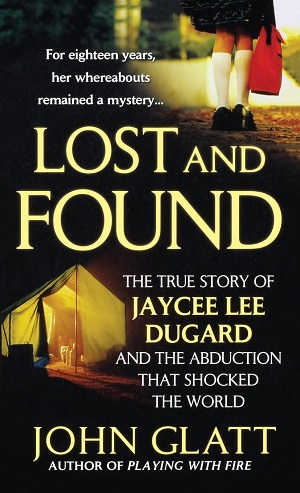
Lost and Found
By John Glatt

The crime:

In 1991 11-year-old Jaycee Lee Dugard was grabbed off the street by convicted kidnapper and sex offender Phillip Gorrido and Gorrido’s wife Nancy. Dugard would be kept by Gorrido as a prisoner in a backyard compound he had specially prepared for the next 18 years, during which time she was repeatedly raped and bore two daughters (the first at the age of 14). In 2009 Gorrido, who had become increasingly erratic in his behaviour, was apprehended and Dugard and her two daughters freed.

The book:

I’ve talked before about how a lot of true crime writing takes the form of timely reporting, with instant books trying to cash in on the notoriety of a particular case that has been in the headlines. That was certainly the case here, as the book ends abruptly just before Gorrido’s trial was set to begin (they would both plead guilty, with Phillip receiving a sentence of 431 years to life and Nancy 39 years to life). This is unfortunate, because while John Glatt does a respectable job covering the case, including taking a very full look at Gorrido’s first conviction for kidnapping and rape and interviewing a number of people who knew him during the years he was keeping Dugard a prisoner, you don’t feel like you’re getting the full story, even if what’s missing is what turned into a lot of confusing legal maneuvering. I think it’s still a book worth reading, but you’d be advised to supplement it with further research on the Internet.

You’ll find a lot of information online. This case was huge at the time, though as per usual I think it’s been mostly forgotten today. It was one of three “captivity” cases that made headlines within a few years of each other, the other two being a pair of sensational stories out of Austria: the abduction and imprisonment of Natascha Kampusch (subject of the book Girl in the Cellar), and Josef Fritzl’s house of horrors (subject of another book, also written by Glatt, called Secrets in the Cellar). For her 18 years of hell Dugard received a modicum of fame, a book deal, and a $20 million payout from the State of California (they had been slack in following up on Gorrido’s parole). But I think it’s probably been a blessing to her that the spotlight moved on, as it always does.

Anyway, even for someone steeped in crime writing I find these stories particularly disturbing, and the offenders representative of a particularly unconscionable expression of evil. There’s more to it than just the violence. It’s the demonic inversion of family values, and most notably the abuse and betrayal of a position of authority and trust. But there’s something more to it as well. Serial killers are driven by uncontrollable urges that explode into sexual violence and then go into remission for a while. They are like werewolves: temporarily possessed but the rest of the time able to at least pass as normal. Fiends like Wolfgang Priklopil, Josef Fritzl, and Phillip Gorrido made their evil into a lifestyle. I think that may be why they tend to be such terrible people in all regards. I’ve followed up my hot take on Priklopil with a couple of posts (see here and here) on the foul psychology of the booby or man-baby, enabled by submissive women. There’s a reason these people don’t have any friends. I also noted in my review of Secrets in the Cellar how Fritzl’s wickedness didn’t end with what he did to his daughter:

Not only was he selfish and cruel, he was also cheap: not tipping at the bordellos he frequented, trying to nickel-and-dime the tenants in his apartment building, and even fostering his own children instead of adopting them because it got him a bigger government cheque. Despite this streak of vicious mean-spiritedness he was a lousy businessman and was deep in debt at the time of his arrest. Of course being a miser was far from his worst personal failing, but it just goes to show how some people are bad all the way through.

I was reminded of this as I read Lost and Found. Gorrido was also a mama’s boy, living at home with his aged mother all the time he had Dugard penned in the backyard (like Priklopil, he would first let his captive out only so she could clean the house). Meanwhile, his wife Nancy became a mindless domestic servant who “worshipped” Gorrido and took care of his mom. In short, he was doubly enabled. And like Fritzl his meanness was of a piece. In addition to satisfying himself sexually on Dugard he also used her as slave labour in a print company he started up, and befriended an elderly neighbour who he swindled for thousands of dollars. Gorrido was one of those people you just can’t find any good in, and who the wickedness runs right through.

From being the crazed head of a captive “family,” where does one go? Naturally, to creating one’s own religion and becoming a cult leader. When Gorrido came up with an idea for a black box that would allow the user to listen to angels as well as cure schizophrenia and sex addiction (it was just an amplifier that you could plug headphones into), it’s hard not to think of L. Ron Hubbard’s E-meter machine. But of course the stronger connection to Scientology was that it was just a cynical way of turning religion into cash. Gorrido quickly incorporated his God’s Desire Church and boasted to his brother that it was going to make him rich. And of course there would be the payoff that’s at the core of most cults, something that burns even hotter than the desire to get rich: a fanatic obsession with sex as a weapon of domination and procreation. As Stephen Singular put it in his book on Killer Cults: “a common thread in almost all [cults] is an attempt to control sexual behavior.” What most cult leaders seem to want more than anything is possession of an exclusive harem and the ability to make lots of babies.

Noted in passing:

There’s a reason sex offenders have to be in a registry that’s accessible to the public. That sort of behaviour is in the blood and there’s not much you can do to change it except by the most drastic measures. And while I don’t think it’s right to persecute or stigmatize such people, a red flag is still a red flag. Unfortunately, Gorrido’s home near Antioch, California, affectionately dubbed a “shithole” here by one resident, was a magnet for people with such flags since laws prohibited sex offenders from living near schools, churches, and parks, and his immediate neighbourhood had none of these. As a result there were apparently some 1,700 registered sex offenders living in the county. Gorrido fit right in.

That being the case, I’m actually not as critical of the parole officers in this case as many were. To be sure they could have done a more strict follow-up at various times, but you could probably say that about most of the parolees they were managing. Was Gorrido behaving in a manner that was especially suspicious? In many ways he must have seemed like a successful case of rehabilitation: married, living with his mother, and running a successful small business. I mentioned in my post on Anne E. Schwartz’s Monster that Jeffrey Dahmer’s parole officer didn’t even go to visit him at his apartment because Dahmer lived in a bad part of town. I raised an eyebrow at that, but I wouldn’t be surprised if that was more the norm than an exception.

Takeaways:

Priklopil and Fritzl kept their captives in basement dungeons, expertly concealed. I don’t believe in being a nosey neighbour, and it’s true that Gorrido’s was a bad neighbourhood to begin with, but at some point you have to be suspicious as to why the guy next door is doing putting up eight-foot fences around the back half of his backyard.

True Crime Files

TCF: Pizza Bomber

Pizza Bomber: The Untold Story of America’s Most Shocking Bank Robbery
By Jerry Clark and Ed Palattella

The crime:

On August 28, 2003 a pizza delivery man named Brian Wells robbed a bank in Erie, Pennsylvania with a bomb locked to a collar around his neck. He was almost immediately apprehended by the police and the bomb detonated while he was in custody, killing him instantly. After years of investigation a rough outline of the robbery plot was pieced together, principally involving a mentally ill woman named Marjorie Diehl-Armstrong, a superficially genial but disturbed handyman named Bill Rothstein, and a couple of junky lowlifes named Barnes and Stockton. Diehl-Armstrong was the only one who would go to trial for the crime, as Rothstein died of cancer before he could be charged with anything, Barnes pled guilty for a reduced sentence, and Stockton was granted immunity for testifying against Diehl-Armstrong. Barnes and Diehl-Armstrong both died in prison.

The book:

I’d forgotten all about the Pizza Bomber case. At the time it was headline news, receiving national (and some international) coverage and having seven episodes devoted to it on America’s Most Wanted. But the churn of new and shocking crimes is endless and it took reading this book, which was published in 2012, to bring the story back to me. I then went and watched the four-part Netflix documentary Evil Genius that came out in 2018, which brought the story up to date. But more on that in just a bit.

Both authors were involved in the case – Jerry Clark being the lead FBI agent in charge of the investigation and Ed Palattella covering the story for the Erie Times-News – and there’s a bit of a joke near the end of the book where the lawyer for one of the conspirators tells Clark that his client is looking for a book or movie deal. “Get in line,” Clark tells him. “Everyone who’s touched this wants that.”

Indeed, and it was a “line” that Clark himself was near the front of.

The reason there was such a line is that the story is true crime gold. All of the essential elements are here: a cast of eccentric characters, a strange and sensational crime, and a mystery remaining at the end as to what exactly was going on. As the judge at Diehl-Armstrong’s trial put it, “This case represents the unfortunate combination of the incredibly bizarre and the sadly tragic.”

The biggest question has to do with how much Brian Wells knew about the plot in advance. Was he a total innocent, grabbed nearly at random, or was he a semi-willing co-conspirator in the bank robbery? Did he know the bomb around his neck was real? Law enforcement at the time felt that he was involved in the plot to some degree, and they had grounds for thinking so. One witness put him together with Rothstein the day before the robbery, and his behaviour leading up to his death was very strange. On the other hand, in the Evil Genius documentary a prostitute Wells associated with confesses that she basically set him up as the stooge (this is, by the way, perhaps the bit of information that Clark thought she was holding back at the end of the book). Is she a credible witness? No. Is she more credible than the other participants in the scheme? Yes.

It seems unlikely we’ll ever know what was going on now. But the question of Wells’ involvement underlines a bigger mystery relating to the case: Just how smart were these guys?

Clark and Palattella go out of their way to make the argument that Diehl-Armstrong, Rothstein, and even Wells were smarter than average. Perhaps. Wells, however, was a middle-aged man delivering pizzas and using prostitutes. Diehl-Armstrong and Rothstein both came from privileged backgrounds and were recognized as intelligent, but they had both bottomed out: living in hovels, with no jobs and not only associating with criminals but being engaged in various criminal activities themselves. That they considered themselves to be intellectuals and the smartest people in whatever room they happened to be in is pretty strong evidence of the contrary. Being smart is not something that really smart people brag about.

They might have been “fractured intellectuals,” to use the term Rothstein adopted for one of his clubs. Diehl-Armstrong in particular was mentally ill. But it’s probably as accurate, and more to the point, to just describe them as bitter losers, experiencing the full measure of downward mobility with the next stop being homelessness and a potter’s field. As Clark and Palattella observe, “their avarice fit with their obsession to hang on to the past, to the prosperity their families once enjoyed.” The robbery they planned made no sense whatsoever except as a way of lashing out at forces they felt had conspired against them.

So, intelligent? I guess it depends on how you define intelligence. Clark and Palattella mention IQs on occasion, but I don’t think that means much. Criminal masterminds? Hardly. In my notes on Julie K. Brown’s Perversion of Justice I brought up the subject of criminal intelligence, but I don’t think even by those loose standards anyone here qualifies. “For people who were supposed to be brilliant,” the authors write, “Diehl-Armstrong and Rothstein did a lot of stupid things.” Perhaps the best assessment came from Diehl-Armstrong herself, describing Rothstein: “as very stupid but very, very intelligent and dangerous.” A good example is the collar bomb itself, considered by one of the agents as “the most sophisticated improvised explosive device (IED) he had ever seen.” Despite all its cleverness though, it was also a Rube Goldberg doohickey that only half worked as it was supposed to. Or was it supposed to work at all?

I do have to credit the gang with one very notable accomplishment though. The hardest part in any conspiracy is getting everyone involved to keep a secret. This never works out. So how did this gang of broken and burned-out cases manage to maintain so much solidarity in silence? Even Brian Wells, wearing the collar, played his part until the end, making up some story about being shanghaied by a bunch of Black guys.

I guess fear was the main motivator. In the documentary, Diehl-Armstrong says all the co-conspirators were afraid of the death penalty and so watched each other’s backs. They may also have been afraid of each other, and Diehl-Armstrong in particular. She’d already killed a couple of partners. In Evil Geniuses it’s suggested that Rothstein was still carrying a torch for Diehl-Armstrong, but since he’d already dropped the dime on her for Roden’s murder I have trouble squaring that.

Still, it’s impressive that there was so much solidarity. Even after copping pleas, Barnes and Stockton clearly didn’t want to rat their partners-in-crime out.

So there you have it: violence, weirdos, and mystery. True crime in its purest form.

Noted in passing:

There are often moments when you’re reading the description of some action in a book that you have to stop and wonder just what’s happening because it’s so hard to visualize. For example, in the authors’ brief recounting of the stormy relationship between Diehl-Armstrong and then-boyfriend Jim Roden (she ended up killing him and stuffing his body in Rothstein’s freezer) this little nugget is served up: “Violence plagued their relationship for a decade. He cut her thigh by pushing her into a broken glass panel of a stove door in July 1994.”

Now just how did this work? Stove doors are usually pretty low to the ground and Diehl-Armstrong was a very tall woman. How would he push her thigh into a stove door? Or was the glass panel completely detached from the stove door and located somewhere else?

Takeaways:

Dead men tell no tales. But dying men can be liars even on their death bed. Clark and Palattella talk about the admissibility of “dying declarations” as evidence (they are considered an exception to the rule against hearsay) because the circumstances under which they are made support their credibility. But Bill Rothstein repeatedly lied that he’d had no involvement in Wells’ killing, even just hours before his death. Does it make sense to believe that someone’s character is going to change in their final days, or even minutes? Thinking like that seems to belong in a time when there was widespread belief in deathbed conversions and sneaking into heaven by a whisker. I don’t think it applies very much today.

True Crime Files

TCF: Murder, Madness and Mayhem

Murder, Madness and Mayhem: Twenty-Five Tales of True Crime and Dark History
By Mike Browne

The crimes:

“Girl Gone”: a man kills the parents of a 13-year-old girl and kidnaps her, but he is later apprehended and she is rescued.

“Spell Murder for Me”: a pair of lesbian lovers working at a nursing home decide to kill some of their patients.

“The Boozing Barber”: an alcoholic barber poisons a series of women with overdoses of ethanol.

“The Elementary School Murderer”: the Mary Bell case. Bell strangled a couple of pre-schoolers when she was only 10 years old herself.

“Bad Apples”: the murder of Sylvia Likens.

“Sing a Song of Murder”: an American serviceman stationed in Australia in the Second World War strangles three women.

“Antifreeze and a Cold Heart”: a woman poisons her husband with antifreeze and it’s discovered that she killed her previous husband the same way.

“The Oak Island Mystery”: people keep digging for gold or other buried pirate treasure they think is hidden on Nova Scotia’s Oak Island.

“Who Was the Persian Princess?”: a mummy turns out to be a deceased woman of more recent vintage.

“The Love Me Tender Murders”: a pair of young Elvis fans are killed in Chicago.

“Dark Water”: the body of Elisa Lam is found in the rooftop water tank of a hotel in L.A.

“The Unknown Man”: an unidentified man is found dead on a beach and nobody can figure out who he is.

“The Dyatlov Pass Incident”: a group of explorers are killed while hiking in the Ural Mountains.

“Northern Rampage”: a pair of teens kill some people they met on the road and then drive part way across Canada before killing themselves in the bush.

“The UFO Cult”: the Heaven’s Gate mass suicide story.

“Colonia Dignidad”: a bunch of Nazis set up their own little torture village in Chile after the Second World War and the government finds them useful.

“The Ripper Crew”: a foursome of Satanists butcher women.

“Lost Narcosatánicos”: a Mexican drug gang gets into voodoo and human sacrifice.

“Children of Thunder”: a man styling himself a prophet attempts to set up his own church, using murder to get a bit of seed money.

“The Great Influenza Pandemic of 1918”: millions die worldwide from the flu.

“The Eruption of Mount St. Helens”: a volcano in Washington State goes off, killing more than fifty people.

“The Space Shuttle Challenger Explosion”: a space shuttle blows up soon after launch.

“The Grenfell Tower Fire”: a high-rise apartment building in London burns up because of cheap siding.

“The Boxing Day Tsunami”: a massive earthquake (the third largest ever recorded) beneath the Indian Ocean spawns giant waves that destroy many coastal areas, especially in Indonesia.

“The Chilean Mining Accident”: a group of miners are rescued after spending more than two months underground.

The book:

Not what I was expecting.

Mike Browne, a native of Nova Scotia, is host of a podcast called Dark Poutine, which is primarily about Canadian true crime stories and “dark history” (a rather vague term I hadn’t encountered before). Given this, and the picture on the cover of a loon floating in a northern lake and the bibliographic information categorizing the book as “Canadiana,” I figured the line-up was going to consist mainly if not exclusively of Canadian crime stories.

That’s not what this is. Instead, many of the stories fall outside the category of what I’d call true crime, and only a few have a Canadian setting.

The twenty-five tales are divided into four categories: murders, unsolved mysteries, partners in crime, and “notable disasters.” Unfortunately, the labels aren’t very helpful. Category one is called “murder with a twist,” but the murders didn’t strike me as exceptional or linked to each other in any way. Category three is called “the madness of crowds,” but some of the cases are just a couple of people killing together while others deal with cults, criminal gangs, and even political movements. “Notable disasters” range from natural to man-made catastrophes, and I couldn’t figure out what the 1918 influenza pandemic, the space shuttle Challenger explosion, the Grenfell Tower fire, the Boxing Day tsunami in 2004, and the rescue of 33 Chilean miners in 2010 had in common.

Even some of the titles left me scratching my head. Why was the horrific Sylvia Likens case called “Bad Apples”? I feel like I was missing something. I assume “Dark Water” was a reference to the movie of the same name, but that’s a link that’s never explained so there could be something I wasn’t getting there too.

The overall effect was a bit like flipping through a Reader’s Digest in a doctor’s office. Browne is a fluid writer, but the sections are all pretty brief, around ten pages each, and there’s little if anything that’s new in terms of information or interpretation. And in the final section especially some of the disasters are just too broad and technical, not to mention already well known, to deal with in so short a space. Throw in the fact that there aren’t any pictures or maps and I came away a bit disappointed. The only case that was new to me was that of the Brownout Strangler, a figure who I then looked up on Wikipedia to find out more about. Isn’t that moving in the wrong direction?

Noted in passing:

At the Grenfell Tower fire: “Firefighters told bystanders to back away for their safety, but many stood their ground, shooting photos and videos on their cellphones to share on social media.”

During the Boxing Day tsunami: “Thai tour guides and resort employees began yelling for people to leave the beach and get to higher ground. As locals ran past them, some tourists, not realizing the danger they faced, walked toward the incoming wave, taking photos and shooting video.”

It’s easy to see behaviour like this as being a sign of the times, but if they’d had phones that took pictures and shot video in the nineteenth century people would have probably done the same thing.

Takeaways:

There is no gold, or treasure of any kind, on Oak Island.

True Crime Files

TCF: Blood & Ink

Blood & Ink: The Scandalous Jazz Age Double Murder that Hooked America on True Crime
By Joe Pompeo

The crime:

Edward Wheeler Hall, a priest, and Eleanor Mills, a choir singer, were found dead on the morning of September 16, 1922, their bodies arranged together under a crabapple tree. Both Hall and Mills were married, but not to each other. The prime suspects were Hall’s wife Frances and her siblings, but after  years of investigation and the circus of a huge trial they were found not guilty and the case remains unsolved.

The book:

The title tips you off that Joe Pompeo is going to come at the story from the angle of its media coverage, which I think is justified given how big a deal the Hall-Mills case was at the time. I don’t think it’s as well known today, though among true-crime connoisseurs it remains a favourite: a fun case to dig into, both for being unsolved and for the colorful cast of characters.

It’s a bit misleading though to say the case hooked America on true crime, and in his conclusion Pompeo admits that the press coverage only “arguably laid the groundwork for the genre as we know it.” I don’t think he’s as interested in the genre of true crime anyway as he is in the rise of tabloid journalism. The two were connected, though not the same thing. Joe Patterson, one of the first tabloid impresarios, had it down to a formula: the subjects that most interested readers were “(1) Love or Sex, (2) Money, (3) Murder.” He also believed that readers were “especially interested in any situation which involved all three.” The Hall-Mills case hit the trifecta. As one reporter covering the trial put it, “It has a combination of every element that makes a murder case great.”

So the story of the case and how it was covered go together, especially when the tabloids themselves, mainly in the person of New York Daily Mirror editor Phil Payne, became the driving force in the investigation. And like the best cultural history it reflects a critical light back on our own media ecosystem. When the Daily Mirror launched it promised readers “90 percent entertainment, 10 percent information.” Clearly the days of infotainment were upon us. As William Randolph Hearst (publisher of the Mirror) understood, “People will buy any paper which seems to express their feelings in addition to printing the facts.” So the foundations for today’s media silos were being poured as well.

Other points of reference are even more intriguing. The Evening Graphic made use of an innovation called the “composograph” that apparently worked by superimposing the faces of story subjects on body doubles, thus creating deep fakes a century ahead of schedule. And the publisher of the Evening Graphic was also a health and fitness nut who wanted to use the paper to “crusade for health! For physical fitness! And against medical ignorance!” What this meant, among other things, was a competition to find ideal human specimens (“Apollos and Dianas”) who would be “perfect mates for a new human race, free of inhibitions, and free of the contamination of the smallpox vaccine!” A eugenicist and anti-vaxxer then.

This is all interesting stuff, but in the drive to get to the totemic 280 pages there’s still a fair bit of filler. I was uninterested in the details of Payne’s life and death, or the story of cub woman reporter Julia Harpman, as inspiring a figure as she may have been. Payne in particular seems to have been more than a bit of a jerk, and it’s hard to tell if he really believed any of the trash news he was trying so hard to manufacture out of nothing, or if he cared about any of the people he might have been hurting along the way.

As for the crime itself, it’s continued to cast its spell over armchair sleuths for generations. There’s the sex not only at the heart of the story but also creeping around the edges. The bodies were discovered just off the local lover’s lane by Ray Schneider and Pearl Bahmer, a pair who authorities discovered were up to no good. This grand jury confrontation between the lead detective on the case and the young man involved must have been shocking stuff:

“Did you go up there,” Mott demanded, “knowing that [Pearl] was having her period, for the express purpose of lying down on your back, as you did, and [having] her do the vile thing she did to you? Wasn’t that why you were there?”

“No, sir,” Ray lied. “It was not.”

In addition to the sex (I’m still going off Patterson’s trinity here) there was the money. Or class. Hall represented money, even if only by marrying into it. Mills came from a less privileged background. But the split was also there in the arrest of a young man named Clifford Hayes, who was soon cleared of any involvement. Harpman drew the storyline in clear terms:

The law says certain things about equality of rich and poor. But the law speaks with its tongue in its cheek. The law says the rich Mrs. Frances Stevens Hall . . . deserves no more consideration than Clifford Hayes, the young man who was thrown into prison on the unsupported accusation of an irresponsible character. But the eyes of reality see an impassable gulf – a chasm cleft by the sinews of wealth – between the preacher’s widow and the swarthy young sandwich cook, who worked, when he did work, in a side-street lunch cart.

Later, when Frances herself was arrested, the conflict was drawn between “the masses and the classes.” Which was a divide that everyone in 1920s American could relate to. It’s interesting that in our own time, where the level of inequality has managed to regress to the level of those years, the language of class has mostly been retired. As cited by Paul Fussell in his excellent book on the subject, class is America’s “forbidden subject.” We’re still drawn to stories of rich people behaving badly, but there’s no sense of an “us against them” anymore.

Finally there’s the murder, and “the million dollar question” that remains of Whodunnit?

My own take is close to that of Bill James, as laid out in his book Popular Crime (in which there was also a lot I did not agree with). Given the nature of the crime – basically the execution of an adulterous pair who were not robbed – I think it very likely that the killer(s) knew the victims very well. Indeed, that they knew where and when they were meeting the night they were killed. That basically leaves two groups of suspects: Frances and her brothers, or James Mills (Eleanor’s husband). Pompeo sees Frances as “the most obvious” solution to the mystery, reasoning that “there was too much smoke around Frances and her brothers for there not to have been any fire.” Unfortunately, a lot of the smoke was proven to be just that. Meanwhile, I agree with James in seeing the disproportionate violence directed at Eleanor as significant. Edward Hall was shot once while Eleanor was shot three times in the head and had her throat slit. This suggest a special order of anger. It’s possible that Frances or one of her brothers might have felt this same level of rage, but it seems to me that James Mills was more likely to have gone over the edge.

Noted in passing:

There’s a wonderful moment in the trial for all lovers of language and anyone interested in how the meaning and usage of words changes. The prosecutor Simpson is questioning Frances:

“When you got up,” Simpson said, referring to the morning after Edward’s disappearance, “you telephoned police headquarters?”

“I did.”

“You were looking for information about your husband?”

“Yes.”

“You thought you would get it from the police?”

“I thought I would hear of any accidents.”

“Accident was in your mind?”

“Yes.”

“But you said to the police, ‘Have there been any casualties?’”

“Doesn’t that mean accident?”

“Weren’t you looking to see if the dead bodies had been found?” Simpson pressed. “If you used the word ‘casualties,’ and you had accidents in your mind, why did you use the word ‘casualties’?”

“It means accidents,” Frances replied. “It is the same thing.”

“It also means death, doesn’t it?”

“I do not know that it does.”

“So, with your understanding of the meaning of the word, you telephoned police headquarters, you did not give your name, and you asked for casualties? You thought, you say, maybe there had been an accident, maybe your husband had been hurt in an automobile accident?”

“Yes.”

Today I think most of us take “casualties” as referring to lives lost either in battle or in natural disasters (though non-fatal injuries in both cases are still considered casualties). But Frances is correct, in an upper-class sort of way, that it could refer to any loss through accident or misfortune, to life or property and possessions. In the insurance industry it still has this broader meaning, though it too has evolved and mainly refers today to liability insurance. I love how Frances and the prosecutor can’t understand the words they’re using, even when they are the same words.

Takeaways:

Pompeo uses the term “trial of the century” as a chapter heading, and it may be that in 1926 Hall-Mills deserved that appellation. However, I don’t recall any of the journalists covering it using those words. In any event, in 1935 the Lindbergh kidnapping trial effectively supplanted it and would go on to hold that title at least for another seventy years. The only challenger I can think of would be the O. J. Simpson trial in 1995. But as F. Lee Bailey said in the aftermath of the Simpson circus, “trial of the century” is just “a kind of hype. . . . It’s a way of saying, ‘This is really fabulous. It’s really sensational.’ But it doesn’t really mean anything.”

True Crime Files

TCF: Hell’s Half-Acre

Hell’s Half-Acre: The Untold Story of the Benders, a Serial Killer Family on the American Frontier
By Susan Jonusas

The crime:

The Bender family – consisting of Ma and Pa Bender, daughter Kate and son (or son-in-law) John – ran a trailside inn during the early 1870s in Kansas. Some who checked in never left. After being brained with a hammer and having their throats cut they were robbed of whatever cash and valuables they had and their bodies buried in a nearby orchard. As suspicions mounted over the number of disappearing travelers in the area the Benders fled to parts unknown. They were never apprehended and their ultimate fate remains a mystery.

The book:

The Bloody Benders, as they were later designated, are famous frontier figures, but what Hell’s Half-Acre brought home to me was how little about them is actually known. In large part this is because they were never captured and made to stand trial, with a full public hearing of the evidence against them. As it is, we don’t know where they came from or where they went, if John and Kate were siblings or married, or if John was a half-wit or just someone who behaved in an odd manner and giggled a lot. Susan Jonusas doesn’t definitively answer any of these questions in this full account, but I think that’s because they’re probably unanswerable now.

This is not for a lack of contemporary reporting. The Benders were big news back in their day. But newspapers had more flexible standards then, as Jonusas notes in her Introduction:

. . . nineteenth-century newspapers can be unreliable, as proven by the wild variations in the number of victims attributed to the Benders, with some claiming the number as high as 150. Along with embellished figures come misspelled names, seemingly random locations, and widely varied physical descriptions of the Benders themselves.

So we are left with these same basic questions. How many people did the Benders kill? Can we just go off the number of bodies dug up in the orchard? No, because they disposed of at least one other victim in a nearby river. What did they look like? Even among those who knew them descriptions varied quite a bit and there was no “paper of record.”

Like the frontier rumor mill, regional newspapers were a mixture of fact, hearsay, and complete fiction. Out-of-state newspapers that could not afford or be bothered to send reporters to Labette County pooled information from local articles, selected the narrative they liked best, and reprinted it as fact.

Meanwhile, I don’t know what to think of when Jonusas says that the Benders regularly appear in top 10 lists “where they routinely secure the top spot above other murderous families.” What other murderous families have there been? I couldn’t think of any. I did a quick search for some of the lists Jonusas might have had in mind (none are mentioned in the notes) and found several, but they mainly consisted of couples or other pairings, which I categorize as folie à deux and not families. The only other “family” I saw mentioned was the Sawney Bean clan, who were figures out of Scottish folklore (that is, not real). Would you include the Manson “family” in such a list? Or mafia crime families as serial killers?

This may seem like a minor point, but it gets at the historical uniqueness of the Benders. There’s nothing else quite like them in the annals of true crime, at least that I’m aware of. The serial killer family is more likely to be encountered in crime and horror films like Bloody Mama, Texas Chain Saw Massacre, and The Hills Have Eyes, along with all of their descendants (House of 1000 Corpses, et al.).

And Jonusas does give Hell’s Half-Acre a good squirt of horror-movie juice. The Bender cabin is evoked as the kind of place that did in fact creep a lot of guests out (including a few who only narrowly escaped). I did think, however, that in several places she crosses over a line in trying to make the proceedings more novelistic. There are scenes she describes where the only people present are members of the Bender family and I don’t see how she has any idea what they were doing, saying to each other, or thinking. I appreciate this being a good read, but there are still rules when it comes to writing non-fiction.

Otherwise, I’d fully recommend this as being a decent look at the case. Some of the historical material, like the fad for spiritualism, are worked into the mix well, though I felt the final chapters wandered off a bit into the trial of a pair of women who were falsely accused of being Ma and Kate Bender.

Noted in passing:

The question of how smart criminals are is one that gets a lot of attention from true crime writers. I think a lot of this is driven by media representations. Here’s something from my review of The A-Z Encyclopedia of Serial Killers by Harold Schechter and David Everitt that I think is on point:

What undercuts the expertise of the profilers even more is the fact, amply demonstrated (it seems to me) by the case histories in these volumes, that most serial killers aren’t very bright. Contra the FBI’s profiling program, that found the mean IQ for serial killers to be “bright normal,” and Schechter and Everitt’s conclusion that “serial killers tend to be smart,” the best that can be said for the best of them is that they were able to live functional double lives. Smart people don’t think they can get rid of bodies by cutting them up and flushing the pieces down the toilet. And yet this is how both Dennis Nilsen and Joachim Kroll were caught. Again we can blame Hollywood for the entirely fictional figure of the serial killer as cunning genius and criminal mastermind – someone like Hannibal Lecter who can lecture on Dante and play the Goldberg Variations from memory. In the real world some of the most successful serial killers, like the cretin Ottis Toole or the degenerate Wests, were borderline retarded.

But underestimating the intelligence of criminals can also be a trap. Think of Eliot Spitzer’s remark about how most crooks are stupid, just before his own fall. Or how, as described in The Suspicions of Mr. Whicher by Kate Summerscale, Constance Kent, who everyone seemed to think was just a stupid girl, initially got away with murdering her step-brother, even fooling the great detective Mr. Whicher himself.

A similar dynamic was at work with the Benders. When Alexander York, who hadn’t followed up on suspicions of the Benders earlier, digs up his brother’s grave he sees “only his own obstinate refusal to believe that the Bender family was clever enough to commit such an atrocious crime.” And years later, when newspapers speculated on the fate of the family, it was thought by some that they must be dead because “They were simply too stupid to have evaded the authorities for so long.”

Attitudes like this confuse me. I’m never sure what people mean when they describe someone as being either smart or stupid. Intelligence takes many different forms – from book learning to social skills and mechanical proficiency. And it can be put to infinite uses. Were the Benders stupid or cunning in their criminal careers? Were they clever and resourceful or mostly just lucky in evading the law? Surely it’s a mix of all of the above. My sense is that Kate was not only the scheme’s honey trap but its directing intelligence. How clever she was is impossible to say now, but I wouldn’t underestimate her.

Takeaways:

In strange settings, always sit with your back to a wall. That way no one can sneak up behind you.

True Crime Files

TCF: Monster

Monster: The True Story of the Jeffrey Dahmer Murders
By Anne E. Schwartz

The crime:

Jeffrey Dahmer killed (at least) sixteen men and boys mainly in the late 1980s and early ‘90s, working out of a small apartment in Milwaukee. A necrophiliac and cannibal as well as a serial killer, his case is one of the most notorious in the annals of American crime.

The book:

Some preliminary matters are worth talking about.

In the first place, Monster is described on the copyright page as having been “originally published as The Man Who Could Not Kill Enough” in 1991 and again in 2011. Such a quick publication date (Dahmer killed eight of his victims in 1991, when he was really spinning out of control) is something you often see with timely books, and the original title really was in need of a do-over, but the information still didn’t make sense to me as I don’t think The Man Who Could Not Kill Enough was published until June 1992. Which would make sense as Dahmer’s trial was only in January 1992. As far as I can tell, this is the same book as “originally published” in 1991 (or 1992) and 2011 (a second edition), with the addition of an Afterword bringing the story up to 2021, the publication date for Monster.

I bring up this chronology because it’s a bit misleading thinking of this as a 2021 book. It’s still basically the book that Schwartz, a reporter at the time who broke the story for the Milwaukee Journal, wrote thirty-plus years ago. Which means it’s not a full account of the case and there were a number of places where it seemed like some clarification might have been in order. Were all of Dahmer’s victims gay, for example, or were some only gay-for-pay? Did he have sex with his first victim, Steven Hicks, or was he rebuffed? Did he drill holes in the skulls of his victims before killing them in order to turn them into zombies, or did he do this only after they were dead? We’re told that one court-appointed psychiatrist thought it unlikely he did it while his victims were still alive, but wouldn’t this be easily ascertained? For what it may be worth, I believe Dahmer himself admitted to doing this to his victims while they were drugged. In any event, I don’t bring this up out of any ghoulishness, but it makes some difference if Konerak Sinthasomphone had been so lobotomized when he was returned to Dahmer by the police. Was a hole in the skull something the paramedics didn’t identify? Also, Zombie, the Dahmer-inspired novel by Joyce Carol Oates, took the drilling business as a major plot point, so I was curious.

The new (sub)title says this is going to be a book about the “Jeffrey Dahmer murders” but it’s not really focused on the murders. In each case these are presented in a perfunctory manner, obscuring matters like those I just mentioned. Again, this isn’t an appeal to go into excessive detail, but some points in the story needed to be nailed down better as there are different versions out there. This was what I meant by bringing up the matter of when the book was written. After thirty years, an authoritative book on Dahmer should be possible, but I don’t feel like this is it.

Instead of digging deeper into Dahmer’s biography, psychology, and criminal career, Schwartz turns more in the direction of a reporter’s memoir, something that would later become a marked trend in true crime.

In Schwartz’s case some of this is actually quite interesting. It’s jaw-dropping that on the very night of Dahmer’s arrest she just breezed into his apartment (“for a single man’s dwelling, it was tidy”), and got to look around. Being on the police beat and knowing some cops apparently has its advantages. Indeed, it was a source within the police who first tipped her to something big going down, which turned into what literally became the scoop of a lifetime. That Schwartz was also there on the ground in Milwaukee also allowed her to report knowledgeably about the way the case played out in terms of city politics, given the fact that so many of Dahmer’s victims were gay and Black. On the specific matter of police culpability in the tragic case of Sinthasomphone’s near escape she provides a full defence of the officers involved, which I thought had some value but really failed in the end to present an objective account. Personally, I don’t think the police were criminally negligent, but there’s no doubt they screwed up.

This isn’t a bad book, but to return to my main point: after thirty years you’d expect a fuller treatment of the case then you get here. The attempt to go “Inside a Murderer’s Mind” is only cursory. Dennis Nilsen is a good starting point, but there’s little follow-up. Some notice might also have been taken of Dahmer as a cultural phenomenon that has seemingly only grown, looking at texts like the aforementioned Zombie, the Netflix series Monster: The Jeffrey Dahmer Story (admittedly this came out a year later), and Derf Backderf’s comic My Friend Dahmer and the subsequent film they made of it. Backderf’s personal account of Dahmer’s high school years is a particularly valuable source that needs to be taken into account.

Put another way, Schwartz should be recognized as having had the first word on Dahmer, and she did a good job covering the story. But even as late as the 2020s the last word on this monster has yet to be written.

Noted in passing:

Dahmer’s parole officer rarely had any meetings with him, electing to just contact him by phone. This was due in large part to the fact that Dahmer lived in a rough part of town and the officer didn’t feel safe visiting him in person. I thought this a bit slack. Don’t a lot of people on parole live in rough parts of town? Isn’t visiting them part of the job?

As a single gay male on the prowl, Dahmer frequented a number of Milwaukee gay bars. I was surprised to hear so many different ones mentioned by name, but according to one source Schwartz talks to there were 8 in the city in the early ‘90s. This struck me as a lot. By coincidence, I read Kathleen Hale’s Slenderman a couple of weeks after this book, where she says that Milwaukee had a “tiny gay district” when Dahmer was active. If you have 8 bars that sounds like a fair size village, not a tiny district. But then Schwartz mentions that Chicago, which Dahmer visited on at least one occasion, had 76 gay bars at the time. I would have never guessed that even a city as big as Chicago would have so many.

Takeaways:

“‘Oh, my God. How horrible! How awful! Tell me more.’ Those comments conveyed the mood of the city in the first couple of weeks.”

True Crime Files

TCF: Without Pity

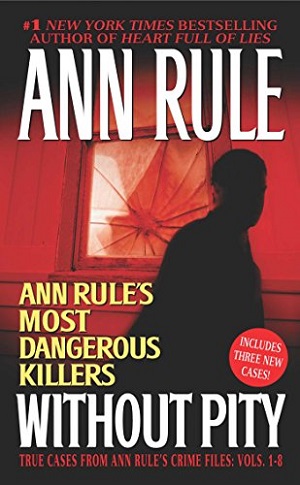
Without Pity: Ann Rule’s Most Dangerous Killers
By Ann Rule

The crimes:

“The Tumbledown Shack”: the still unsolved case of two young women found murdered in a remote shack in 1975. A man confessed, but he was mentally unstable and the police were never sure if he was telling the truth.

“Dead and on Tape”: a paranoid petty criminal records his own murder at the hands of a dirty cop.

“Fatal Obsession”: a bank manager (well, vice president of personnel) has a breakdown and kills his wife and son.

“Campbell’s Revenge”: a giant brute goes to prison for raping a woman. He gets early work release and returns to kill her and her child along with a neighbour.

“One Trick Pony”: a man decides to kill his wife rather than bother with a costly divorce. He tries to make it look like one of her horses kicked her in the head, a story that the police buy but that her sister doesn’t.

“The Last Letter”: an Alaskan businessman falls in love with a younger woman, who he eventually divorces his wife to marry. He becomes an alcoholic, loses all his money, and kills her, but not before mailing out a dozen or more copies of a long letter he’d written blaming her for everything that happened.

“I’ll Love You Forever”: A con man marries a wealthy widow, takes out an expensive life insurance policy on her, then throws her off a cliff.

“Murder and the Proper Housewife”: a woman hires the grown-up version of a kid she used to know to kill her friend’s estranged husband. Because that’s what friends are for, I guess. “To this day, I’m not sure why they did what they did,” Rule says in her introduction.

“The Most Dangerous Game”: a pair of naïve Seattle teens run away from home to rough it in the Cascades. In winter. The cold turns out to be the least of their worries though when they meet up with a weirdo who tries to kill them.

“The Killer Who Never Forgot . . . or Forgave”: race car-driver husband kills his wife and baby after taking out a double indemnity policy on their lives. Just a stupid and sad story.

“The Lost Lady”: Marcia Moore, a wealthy New Age/spiritualist, disappears while experimenting heavily with ketamine. Her remains are later discovered but there are no messages sent back from the other side and it’s never determined what actually happened to her.

“The Stockholm Syndrome”: a young couple go camping in the woods and a psycho drifter kills the husband and gets the wife to go along with his story of it being an accident. Later, she recants.

The book:

This is a collection of stories previously published in volumes 1-8 of Ann Rule’s Case Files. Things kick off with three new cases, and there are brief introductions and even briefer updates to a few of the reprints to basically just let us know if the perps have died in the meantime. In other words, the book itself feels very much like a cash grab, with the publisher banking on Rule’s name to repackage some old material.

There doesn’t even seem to be any thematic cohesion. Look over the case summaries and see if you can find any connecting threads. In a very brief introductory Author’s Note Rule tells us that “Some [of the perpetrators] are wealthy and some are drifters, but they all have a special gift with words, a rather negative talent that lets them hide what they really think from friends, enemies, victims, and even detectives – for a while.” Was that the case with Charles Rodman Campbell? Or the bank manager in “Fatal Obsession”?

Nor does the title help much. I doubt very much if these were Ann Rule’s “most dangerous killers.” Some of them weren’t even killers, but just attempted murder. Then there are the comic pair in “Murder and the Proper Housewife.” They were nearly as big a danger to themselves. And why Without Pity? I suppose anyone who plans murder is missing some degree of empathy, but even here it feels like this was generic verbiage and just part of the packaging, in no way a reflection of the book’s contents.

You’ll have guessed I wasn’t thrilled by this one. Even the photo section is terrible, with pictures so blurry I honestly had no idea what some of them were supposed to be of, despite being labeled. But sticking with the text, if these were the greatest hits from Ann Rule’s Case Files I don’t feel inspired to go back and read any more (though I probably will). I also trust Rule’s judgment in determining which cases were worth full book-length treatment and which weren’t. None of these did (though her one novel, Possession, was based on the case related in “The Stockholm Syndrome”). I think part of what turned her away from exploring these particular cases in more depth is that there just wasn’t enough in the way of character and motive to go on. I found myself particularly mystified by the events of “Dead and on Tape.” What was going on there? Did anyone ever find out?

If there’s no common thread there are at least some recurring themes. The most interesting of these I found to be the American urbanite’s nightmare vision of the backwoods, the lost traveler landing up in Deliverance or Texas Chain Saw Massacre country. The girls who went to orchard country at harvest time and ended up dead in “The Tumbledown Shack.” The even younger girls who went roughing it in the bush in “The Most Dangerous Game.” The young couple who were ambushed when led off the beaten path in “The Stockholm Syndrome.” If true crime caters to our curiosity with horror it’s no surprise that there’s a strain of it that’s shared with one of the most popular tropes in horror films: the sinister cabin in the woods, the wrong turn off the highway, nature not as a source of spiritual renewal but as destroyer.

Noted in passing:

In the first story, “The Tumbledown Shack,” Washington’s Lake Chelan is called “the second largest inland lake in America.” When I read that I didn’t understand what it meant. I’d never heard of Lake Chelan and when I went to look for it in a compact atlas I keep handy I couldn’t even see it marked.

It’s a long, thin body of water but is nowhere near the second largest lake in the U.S. In fact, when I went to check on Wikipedia it ranked 97th in size. Even if you discount binational lakes, like four of the five Great Lakes and Lakes Champlain and St. Clair, it’s still way down the list. This made me wonder where Rule was getting her information. Does “inland lake” have a special meaning? Aren’t all lakes inland by definition? I did find one website that said that the designation “inland lake” excludes the Great Lakes, but I wasn’t sure why. Because they have an outlet to the ocean? Even if that is part of the definition I still don’t think Lake Chelan ranks so high.

Takeaways:

When a wife or husband is murdered, the surviving spouse is usually the prime suspect, and for good reason. That being the case, taking out an insurance policy on one’s wife only a month or so before killing her is being a little too obvious.

True Crime Files

TCF: A Convenient Death

A Convenient Death: The Mysterious Demise of Jeffrey Epstein
By Alana Goodman and Daniel Halper

The crime:

While awaiting trial at Manhattan’s Metropolitan Correctional Center, the notorious sex-trafficker Jeffrey Epstein was found dead in his cell on the morning of August 10, 2019. The official story is that he hanged himself, but questions have since been raised.

The book:

With any unsolved crime you’ll be able to find plenty of armchair sleuths willing to tell you that they know whodunit. They know the real identity of Jack the Ripper. They know that Lee Harvey Oswald was a patsy. They know who killed JonBenét Ramsey. And they know that Jeffrey Epstein didn’t kill himself.

All we can do is assign probabilities to the various theories in each of these cases. My own feeling is that Epstein really did kill himself, but that’s only on a balance of probabilities. It’s not something I’d say has been established beyond a reasonable doubt. As has been endlessly pointed out, his demise was surrounded by a web of suspicious circumstances: what the authors describe as “a confluence of egregious mistakes” and what then Attorney General William Barr called “a perfect storm of screw-ups.” Most notably, the guards who were supposed to be checking in on Epstein every 30 minutes left him alone for 8 hours while they slept or were online shopping, all while the video camera monitoring his cell wasn’t working.

A general rule I’ve invoked before is that we shouldn’t ascribe to malice what is more easily explained by incompetence and laziness. That may be all that was happening here – and I loved how the prison guards’ union tried to defend its members here by complaining about how “severely overworked” they were, a condition that made such an event as Epstein’s death “inevitable.” That said, I can understand seeing darker forces at work.

I’ve already given some of my thoughts on the Epstein case in my review of Julie K. Brown’s Perversion of Justice. Goodman and Halper are more gossipy, though not conspiratorial, but they also delve into some of the other points about Epstein’s case (that is, other than his “convenient death”) that remain most mystifying. In particular, his sexuality and how he made his money.

When considering Epstein’s sex life I found myself thinking of Alfred Hitchcock. There has been a lot of in-depth biographical research into Hitchcock but the matter of his sexuality has never been clarified. Indeed, it’s been reported as being all over the map. Some say he was impotent and asexual (he described himself as “Hitch . . . without the cock”), others say he was a sexual predator, and still others offer up that he was gay.

The same range of interpretations have been placed on Epstein. He apparently received “massages” three to four times a day, and one woman who knew him says that he explained to her that he needed to have three orgasms a day. “It was biological, like eating.” One of the masseuses, however, also said “he can never get fully hard, ever. . . . I don’t know if that’s some sort of thing that’s wrong with him, but it definitely was not normal.” Was there some connection between this and his plan to use his New Mexico ranch as a base where women would be inseminated with his sperm and give birth to his babies? Why insemination? Was he, as several people who were close to him and knew him well insisted, gay? And was he so ashamed or closeted that he adopted a macho persona to compensate? That was the theory of one associate, who immediately adds that it’s only speculation.

The second point has to do with how Epstein made his money, and more broadly what exactly it was he was good at and whether he was all that smart.

Julie K. Brown writes that “One thing that most people agree on was that Jeffrey Epstein was brilliant.” Really? What exactly did they mean by that? Epstein wasn’t some autodidact genius. It’s not even clear he was above-average smart. He was good at math and could play the piano. To be sure, intelligence can be measured in many different ways and take many different forms, but while smart people are often associated with being good at math and music I still think they’re very different things.

Nor was he particularly book smart. He’d dropped out of college, and while surrounding himself with prominent intellectuals for exclusive get-togethers this was all for show. As his “best pal” Stuart Pivar, himself a scientist, put it: “He brought together scientists for the sake of trying to inculcate some kind of higher level of scientific thought, even though he himself didn’t know shit from Shinola about science. . . . He never knew nothing about anything.” Large donations got him designated as a Visiting Fellow at Harvard, but it was just a title meant to impress people.

Did any of that matter? Not if he was good at making money, or making rich people richer. But was he? As the authors here insist, his business “most assuredly was not – and never was – money management.” Like everything else about him, his financial acumen seems to have been in large part a fraud and a con. What did people pay him for then? It’s questions like these that lead to deeper speculation, some of it related to his sexuality. Rumour was apparently rampant, for example, that he was his chief benefactor’s secret lover, and that he was blackmailing other rich and famous personages with secret surveillance tapes he’d made.

It’s a short book and a quick read, with an obsessively right-wing political bias. The chapter on Bill Clinton’s links to Epstein is the longest in the book, with contempt dripping from nearly every paragraph. It’s even suggested that without Trump’s election in 2016 Epstein would have gone free, since “the whole reason . . . or at least one of the rationales” for the Miami Herald running their “Perversion of Justice” series was to take down Alex Acosta, Trump’s labor secretary.

Even on a more personal level the Clinton-bashing is egregious, with the hunt for dark connecting threads between the two “friends” (they actually didn’t like each other) taken down to the level of insisting on their shared personality traits. Yes, in a facile and not very significant way. Personally, I thought something more might have been made about how both Epstein and Trump used charities and foundations as piggy-banks (the Clinton Foundation, in comparison, was a model of probity). I think it’s also likely that Epstein and Trump shared similar attitudes toward women: not liking them very much, paying them (as little as possible) for sex, and otherwise just using them as trophies. Clinton certainly had issues relating to women as well, but they seem to have been of a different order.

Finally, I did get a guilty kick (the book has a number of guilty kicks) out of the depiction of some of the most distinguished intellectuals and academics in the world being such shameless money-grubbers.

Noted in passing:

Epstein didn’t care about his legacy. This is a subject that interests me, and that I’ve written about with relation to American politicians in the Trump years. I feel like it’s related to the old question of how we can be good without God. If we’re just here to make as much money and live as large as possible, wouldn’t we all behave really badly? It’s similar to the question of fame. Is it an absolute good, so that it doesn’t matter what you get to be famous for as long as it gets you attention that you can monetize? In any event, here’s Epstein’s deep thoughts on the matter: “I don’t care about my legacy. The minute I’m dead, I’m dead. It’s over. . . . I don’t care what people think of me. I only care about what’s happening to me while I’m alive.”

Takeaways:

I still lean toward suicide, but it’s easy to suspect the worse of the worst people in the world. By which I mean not Epstein himself but his enablers. As the authors conclude:

It’s only fair to say . . . that we will probably never know the true story in full. The reason for this is simple. Consider this question: Who would you believe to tell you what happened? The elite, the press, our political leaders, or law enforcement? These are the institutions every American has been told since childhood that can and should be trusted, because they have the best interests of all people at heart. But these are the very same institutions that shielded Jeffrey Epstein for years.

The Epstein case didn’t break public faith in these institutions, but it revealed a hole in the social compact that had been growing for years.

True Crime Files