TCF: Homegrown

Homegrown: Timothy McVeigh and the Rise of Right-Wing Extremism
By Jeffrey Toobin

The crime:

On April 19, 1995 (the second anniversary of the end of the Waco siege) Timothy McVeigh detonated a truck bomb in front of the Alfred P. Murrah Federal Building in Oklahoma City. There were 168 dead, including 19 children. McVeigh was quickly apprehended and after being found guilty executed by lethal injection. His associate Terry Nichols, who helped him build the bomb, is serving a life sentence.

The book:

Homegrown is the opposite of a timely book, coming out nearly thirty years after the events it describes and the extensive media coverage it attracted. Ten years ago I reviewed a book on the subject – Oklahoma City: What the Investigation Missed – and Why It Still Matters by Andrew Gumbel and Roger G. Charles – that took a very critical look at the investigation and the question of whether McVeigh and Nichols were working alone. Jeffrey Toobin doesn’t mention Oklahoma City and I don’t know if he even read it, but he takes the opposing side, praising the efforts of law enforcement and arguing that there were no shadowy connections between McVeigh and various right-wing militia movements.

Which is not to say he doesn’t see McVeigh as part of the same tide of extremism that was swelling in America at the time and that later crested in the Capitol riots of January 6, 2021. The connection to the Capitol riots, and “the rise of right-wing extremism” more generally in the wake of the Oklahoma City bombing is the main point Toobin wants to drive home. This he does repeatedly. Flipping to the index I found January 6 referenced over 30 times. It usually sounds like this:

The right-wing extremists of the 1990s employed the same kind of violent imagery that their successors would use more than twenty-five years later. Before Oklahoma City, [Rush] Limbaugh spoke of how close the nation was to “the second violent American revolution,” just as Donald Trump told his armed supporters on the Ellipse on January 6 to march to the Capitol and “fight like hell.” On both occasions, actual violence followed broadcast incitement. Clinton believed that this kind of language had real-life consequences, but that wasn’t the kind of conclusion that could be tested in a court of law. In contrast [Merrick] Garland and others in the Justice Department refused to tie the bombing case to contemporary politics, believing that such analyses could only confuse a straightforward criminal trial. Thanks to the reticence of Garland and his colleagues, as well as the tunnel vision of the journalists covering the case, the impression lingered that McVeigh was an aberration, a lone and lonely figure who represented only himself and his sad-sack co-defendant. This notion, as history would show, was mistaken.

Or:

The events of January 6, 2021 saw the full flowering of McVeigh’s legacy in contemporary politics. McVeigh was obsessed with gun rights; he saw the bombing as akin to the revolutionary struggle of the Founding Fathes; and he believed that violence was justified to achieve his goals. So did the rioters on January 6.

And so on. From their embrace of violence, performative rage (“the fight – was the end in itself”), fetishization of the Second Amendment, invocation of the spirit of ’76, and inspiration drawn from The Turner Diaries (elevated into a kind of sacred text), a clear line runs from McVeigh to today’s right-wing militias. What has mainly changed is the way the Internet and social media now allow for greater mobilization of the “army” that McVeigh could only dream of. McVeigh read books and listened to the radio and shortwave. He wrote letters to the editors of local newspapers and to his representatives in congress. He met up with kindred spirits in the flesh at gun shows. What he “lacked was something that hadn’t been invented.” “The digital radicalization of McVeigh’s descendants,” Toobin notes, “was much faster and more efficient.” “More than any other reason, the internet accounts for the difference between McVeigh’s lonely crusade and the thousands who stormed the Capitol on January 6, 2021.”

I’m in broad agreement with this point of view, as it’s part of a larger question that historians and pundits have been discussing ever since the rise of Trump: to what extent did Trump and his MAGA movement mark a significant break with traditional Republican values, and to what extent was he the culmination of the American right’s long slide into violent insanity? Toobin clearly comes down on the side of continuity, and I think he makes a strong case. There were some places, however, where I thought he pressed too hard. At one point, for example, he tries to rope McVeigh in with “incel” culture:

McVeigh came of age before the term “incel” – involuntary celibate – came into wide use. Like the incels of a later day, McVeigh was unable to attract the sexual interest of women and responded with rage toward them.

This appears to be mistaken just on the basis of Toobin’s own reporting. For starters, I wasn’t sure what rage he was referring to, aside from McVeigh’s anger at his mother. But more to the point, McVeigh himself claimed to his lawyers that he’d had eight sexual partners, “three of them the wives of friends” (including the wife of Terry Nichols). A serial cuckolder isn’t an incel, and I wouldn’t have thought having eight partners by one’s early 30s was considered batting at such a low average as to be described as “unable to attract the sexual interest of women.”

Even without knowing anything of McVeigh’s sexual history, my own knee-jerk reaction against calling him an incel had to do with his height. Are there many tall incels? According to dating data, height is a primary (if not the primary) sexual selector, and McVeigh at 6’3” would be considered pretty much ideal in this regard. In comparison, famous killer incels Elliot Rodger and Alex Minassian were both 5’9,” which isn’t short but didn’t make them irresistible.

I’ve noted this dangerous predilection women have for tall men before in these notes, and the point here is that just by being 6’3” McVeigh seems to have had no problem attracting at least some women, despite having no job, living out of his car, and only possessing average looks combined with a rebarbative personality. But he also seems to not have been that interested in women anyway, or bothered seeking them out, which sort of kills your chances. In any event, it’s interesting that he took exception to a New York Times story that considered him to be “asexual” because he did his own dishes – a judgment that shows how facile such analyses can be.

Calling McVeigh an incel though isn’t just another way to tie his case in with more recent cultural trends but is part of the usual pattern, at least among not very good writers, of painting a villain as black as possible every chance you get. McVeigh was an evil man, but having said that, what purpose is served by calling him an incel, or a coward? Here is Toobin trying to explain “the real reason” why McVeigh didn’t shoot Charlie Hanger, the officer who arrested him:

In Iraq, McVeigh could fire a projectile from a Bradley and still strike a target far off in the distance. In Oklahoma City, he could put in his earplugs and set off a bomb that targeted faceless federal employees he would never see. But McVeigh never had the guts to kill a man face-to-face.

This struck me as a really cheap shot, and stupid. Because why does it take guts to kill someone face-to-face? I would have thought that this was just the mark of a psychopath. Would killing Hanger have made McVeigh more of a man?

I guess this is a minor point though, when placed in context. Overall I thought Toobin did a good job here retelling the story, though I was surprised given the amount of material he had to mine (courtesy of McVeigh’s lawyer rather dubiously donating all of his material on the case to a library in Texas) how little here is actually new. But did we not know all about McVeigh before this? What was there to find out? Toobin seems mainly intent on putting to rest ideas that McVeigh had help from anyone other than Nichols and Michael Fortier. This seems pretty convincing, though I wouldn’t be surprised if some of the “clutter” that the prosecution didn’t want to bring into their case might have also included other individuals or even groups who were to some degree in the know.

I also wasn’t as impressed as Toobin by the efforts of law enforcement and the prosecutors. They did their job. But the fact is this was as open-and-shut a case as you could imagine. Toobin frankly calls McVeigh’s defence to be “hopeless.” It’s also true that McVeigh was apprehended by accident, after being pulled over for failing to attach a licence plate to his car (much the same way Peter Sutcliffe, the Yorkshire Ripper, would be caught). Nichols, for his part, would basically turn himself in. Then, after McVeigh was in custody he pretty much gave himself up and wanted to sound a call to arms/become a martyr to his cause. The fantastic sums his lawyers were provided to defend him seems mostly to have been wasted on what were basically just expensive vacations.

The most disturbing thing in the book though is the conclusion Toobin draws: that what was once extreme has become mainstream. The so-called Overton window has shifted. To take just one example:

The McVeigh prosecutors put the “civil war” issue in front of the jury to show how extreme and exotic the defendant’s views were. But a quarter century later, McVeigh’s view was close to the conservative movement norm. This view – about the possibility of civil war – became mainstream as the passions underlying the January 6 insurrection roiled conservatives during the Biden presidency. According to an Economist/YouGov poll in the summer of 2022, 43 percent of Americans believe it’s at least somewhat “likely” that “there will be a U.S. civil war within the next decade.” More than half of Republicans feel that way, and 21 percent of “strong Republicans” believe a civil war is “very likely.” McVeigh’s extremism had spread to much of the contemporary Republican Party.

First you imagine these things happening. Then you calculate their possibility. Then you start talking about them as inevitable. And then they happen.

Noted in passing:

There’s long been a theory about how the American West has traditionally acted as a kind of safety valve for the discontents of “civilized” modern life. I don’t know if McVeigh was aware of this, but on some level he clearly was tapping into it in his understanding of the kind of American past he wanted to return to: “I want a country that operates like it did 150 years ago – no income taxes, no property taxes, no oppressive police, free land in the West.” The frontier thesis of Frederick Jackson Turner is still in play, at least in some minds.

I’ve written before about the strange way that some cases strike the fancy of the public and stick in the public consciousness more than others. At around the same time as the Oklahoma City bombing trial was going on (in Denver) there were the O. J. Simpson civil trial and the JonBenét Ramsey murder, and it’s hard to say if the bombing will last longer in memory than either of those. That may sound callous and even cruel, but as Toobin points out at one point it may have been technically inaccurate to say, as many media figures and even the FBI did at the time, that the bombing was “the deadliest act of homegrown terrorism in U.S. history.”

It was not; indeed, the bombing was not even the deadliest terror attack in Oklahoma history. In June 1921, a white mob in Tulsa conducted a pogrom and killed about three hundred Black residents of the city’s Greenwood neighborhood. In the aftermath of the Oklahoma City bombing, the Tulsa race massacre was scarcely mentioned.

Actually, before there was a spate of interest thrown up by a book and documentary recently, I think the Tulsa race riots had been almost completely forgotten. Similarly, the Bath, Michigan school bombing of 1929, which killed 44 people (38 of them students) is an event that very few people know anything about today. Or take this list that Toobin provides in talking about the 1994 bill before Congress to ban assault weapons:

Assault weapons – that is, short-stock semiautomatics, with magazines for multiple rounds – had figured in several recent mass murders at the time. In 1989, a teacher and thirty-four children were shot by an intruder in an elementary school in Stockton, California, in 1991, a gunman killed twenty-three people at a Luby’s restaurant in Killeen, Texas; eight people were killed in a San Francisco law firm in July 1993. (Notably, as the roll call of mass shootings continued in subsequent decades, these horrors have been largely forgotten.)

Guilty as charged. I pulled a blank on all of these, though the Luby’s shooting did ring a distant bell.

It really is impossible to say what historical events, or cultural artefacts, are going to stay with us. Here, for example, is a bit Toobin takes from the summation of McVeigh’s lawyer, Stephen Jones:

Forty years ago this very month, there was a major literary event in this country. James Gould Cozzens’ great novel, By Love Possessed, was published. And for people of my generation and my mother and father’s generation, and I’m sure some but not all of you, that novel remains with us today, though its author has long since been forgotten. The book was an instantaneous best seller. It stayed at the top of the New York Times best seller list for over a year. It was a Reader’s Digest condensed book. It won for the author not only the Howell prize but a cover story on Time magazine. And eventually as you might expect, it was made into a movie and then translated into some 14 or 15 languages throughout the world.”

Again, and perhaps with even greater embarrassment, I have to plead guilty. I couldn’t remember ever having heard of By Love Possessed, book or movie, before this, or for that matter of the Howell Prize (technically the William Dean Howells Medal, which Toobin also must not have known anything about). I know I must have at least read Dwight Macdonald’s review, but there’s no memory of any of it now. The author, I can testify, has indeed “long since been forgotten.” This is just the way cultural memory works. Or doesn’t work.

Takeaways:

There’s nothing new about violent right-wing extremism in America. What has changed is how mainstream it has become. A lot of that is probably due to the Internet and social media, as people bring the poison into their homes and their phones, but it’s also due to the rot now spreading down from the top. All of which makes me think that it’s probably impossible now to root out.

True Crime Files

Torso

Torso

Torso is a six-part series based on the Cleveland Torso Murderer investigation. Though the killer was never apprehended, it’s assumed that he killed and then dismembered some 12 victims in the 1930s, leaving their body parts scattered around Cleveland (for fuller accounts of what happened, see here and here). So we’re definitely in true-crime noir territory here, as if you couldn’t tell from the stark black-and-white art inking every face half in shadow.

There’s also a documentary feel to the proceedings, underscored by cityscapes backlit with vintage photos. And for the most part, at least in the early going, creators Brian Michael Bendis and Marc Andreyko stick fairly close to the record, even including a gallery of newspaper archive clippings and pictures with this edition (though there’s no bibliography or suggested further reading; even 300 had suggestions for further reading!). On the other hand, some names have changed and made-up characters have been introduced. The drama is heightened and compressed. And at the end a climactic shootout in a burning human abattoir that is very Hollywood is wholly invented. But overall it’s not bad on that front. Just remember that it is a fictionalization, a historical graphic novel.

The presentation plays off different tensions. The separate chapters begin by taking us in and out of focus and commercial stippling. As with the shadow – and there is a lot of shadow in this book! – it seems the harder we look the less we see. Another tension is between static and dynamic. Stencil-like figures are repeated identically throughout the book, sometimes throughout entire scenes of dialogue and sometimes reappearing in different scenes in different chapters. But this stationary feeling is given a spin by a layout that zigs and zags around the page, or that requires you to turn the book on its side to read. One scene, Eliot Ness’s interview with the killer “Gaylord Sundheim,” even forces you to turn it all the way around as it’s written in a spiral.

That spiral page (or double-page spread) will annoy some people, but I thought it had a thematic point and worked well playing off the circling movement with the way figures are repeated over and over. Plus, it’s a one-off.

This is a stylish but not artificially artsy book that I rated very highly, though I’ll concede that it’s probably not for everyone. Don’t get hung up on it being an accurate account of the Cleveland torso murders and just enjoy it for the dark entertainment that it is.

Graphicalex

TCF: American Demon

American Demon: Eliot Ness and the Hunt for America’s Jack the Ripper
By Daniel Stashower

The crime:

Between 1935 and 1938 at least twelve people are believed to have been the victims of an unidentified serial killer in Cleveland, Ohio. The bodies were found in a dismembered state, mostly in the area of a shantytown known as Kingsbury Run. Eliot Ness, Cleveland’s Public Safety Director at the time, was in charge of the investigation.

The book:

I’m surprised that the case of the Cleveland Torso Killer, or Mad Butcher of Kingsbury Run, isn’t better known. But it’s an interesting question – one I’ve addressed before and will again – as to why some crimes grab hold of the public imagination and have more staying power in the culture than others. As an unsolved series of murders with the highest possible gore quotient – “those two qualities guaranteed to compel enduring fascination,” in the words of James Jessen Badal – you’d think it would have attracted greater attention than it has. As it is, American Demon takes its place on my shelf alongside Badal’s In the Wake of the Butcher: Cleveland’s Torso Murders and the comic adaptation Torso by Brian Michael Bendis and Marc Andreyko, but that’s all I have and I don’t think there’s a whole lot else out there.

Maybe, in part, it’s the absence of good information. As Badal reports (and his book remains the authoritative account), the original case files have vanished and it’s not clear they’d add much anyway. The victims mostly were, and to this day remain, unknown, and the couple we can name we can’t say very much about. Nor is the killer easily pigeonholed. He (assuming it was a he, which seems to me a pretty safe bet) killed men and women, making the sexual nature of the crimes, if there was one, hard to figure. Usually unsolved crimes give us a little more to go on. Here, even the leading suspect – a disturbed ex-doctor named Francis (Frank) Sweeney – seems only the most likely candidate in a thin field.

That said, there was a lot of forensic evidence, from the actual body parts to their distinctive wrappings. I don’t think it’s just the so-called “CSI effect” that makes me think such murders would be easy to solve today. The police at the time were hard working, but before the invention of the term “serial killer” no one seemed sure how to proceed, or what they were looking for. “Is there someone in Cuyahoga county a madman whose god is the guillotine?” a Cleveland newspaper asked. “What fantastic chemistry of the civilized mind converted him into a human butcher?” As Stashower points out, “This was a question that the Cleveland police of 1936 were ill-equipped to answer.” You can tell just from the way the questions were put, the sort of language used (“fantastic chemistry” of the mind), that they had a problem. And when Ness’s external help came in the form of “the first policeman in America with a PhD,” who also happened to be one of the people credited with inventing the pseudoscientific “lie detector” machine, then you get some idea of the lack of professional expertise available.

Still, you would have expected the police to come up with something more. As it is, they couldn’t even identify the “tattooed man” – whose tattoos were far from generic. Nor was forensics up to the job. One coroner mistook a classroom skeleton for a victim of the Butcher, while a couple of others might have missed the fact that the body of one of the later victims had been embalmed. These were not little mistakes.

This general lack of fitness for duty went right to the top. Ness himself had no experience in chasing after killers, and what’s more didn’t see it as his job. “The director of public safety [Ness’s actual title] wasn’t expected to hunt murderers any more than he was expected to put out house fires or rescue cats stranded in trees.” Instead, he saw his mission as busting vice networks and cleaning up police corruption while modernizing the force. And in that he had some success. He apparently wanted nothing to do with the murder investigation and only finally got involved when the job was thrust upon him. That’s not a likely recipe for success.

Did his failure to apprehend the killer contribute to his subsequent breakdown? Or was the golden boy of Untouchables fame just another example of celebrity burnout? Given that this book is as much about him as it is about the Butcher’s killing spree you get enough information to make up your own mind. Whether you actually want this much Ness material mixed in is another question, as I felt it didn’t add much to the story. Ness had an interesting life story, but as this isn’t a biography a lot of it feels out of place and doesn’t add much.

As a final note I have to call out the supporting apparatus. There are no maps provided (and they would have been useful), and only a poor selection of photographs. There actually are a lot of good photos relating to the torso killings available, many of them reproduced in Badal’s book. They aren’t included here, and instead what we get are mainly pictures of Ness, some of them looking like publicity shots. Plus photos of all of Ness’s wives. These were unnecessary, and the way the photo section is tucked away at the back is another thing I didn’t care for.

It’s a good read, but I wouldn’t call it either the best book out there on the Cleveland killings, or the best book available on Ness. As an introduction to these subjects though it doesn’t hurt.

Noted in passing:

Soon after the killings stopped and Ness’s life started to circle the drain he was involved in a car accident in which he was intoxicated. He left the scene and might have got away (he hadn’t identified himself to the other driver) but for the fact that someone had taken note of his distinctive license plate: EN-3.

I think it was about thirty years ago that a thoroughly disreputable person (not a friend) told me to never get vanity license plates. When another person I was with asked him why not he simply replied “Too easy to identify.” So I guess he had a point.

Takeaways:

In the 1930s having six small tattoos about your body was enough to make you a “tattooed man,” and most likely a sailor or ex-con. Today it just means you’re a guy with some ink.

True Crime Files

Plants vs. Zombies: Zomnibus Volume 1

Plants vs. Zombies: Zomnibus Volume 1

Sometime around about the year 2000 it became clear that videogames were taking over the movie business. You could say comic books were too, and in many ways it comes to the same thing. Lots of CGI and narratives structures built around the idea of progressing through various levels before facing off against a main bad guy at the end, then resetting or rebooting and doing the whole thing over again on an endless loop.

Plants vs. Zombies is a popular and very simple videogame that basically has the player using various weaponized plants to beat back an outbreak of zombies. Somehow they figured there was a comic book in there. And not just one book, but a whole series!

It’s all very bright and colourful, but as you could probably guess it’s spread pretty thin. A pair of eleven-year-old chums, Nate Timely and Patrice Blazing, team up with Patrice’s inventor-uncle Crazy Dave to stop the zombie army of Dr. Edgar Zomboss (he’s a doctor of thanatology) from taking over the town of Neighborville. Seeing as this is for kids there’s no real violence aside from the odd zombie limb falling off, and the day is always saved.

This “zomnibus” edition collects three story arcs, Lawnmageddon (an introduction to the basic storyline), Timepocalypse (using a time machine to collect various pieces of one of Dr. Zomboss’s evil inventions) and Bully for You (the best of the bunch, with a gang of college zombies getting revenge on Dr. Zomboss for having bullied them years earlier).

A comic for kids who would rather be playing a videogame doesn’t offer much for the rest of us. The standard zombie refrain of “brains” quickly gets tired, but not quite as quickly as Crazy Dave’s gibberish, which has to be translated throughout by Patrice. Meanwhile, the story just sort of jerks around with little in the way of connecting tissue between the various episodes, to the point where several times I had to check to see if any pages were missing. I guess it was worth sticking my head in the door, but it’s not a series I’ll be bothering with anymore.

Graphicalex

TCF: Sacco and Vanzetti

Sacco and Vanzetti: The Men, the Murders, and the Judgment of Mankind
By Bruce Watson

The crime:

Nicola Sacco and Bartolomeo Vanzetti were a pair of Italian immigrants accused of killing two men in the commission of an armed robbery in Braintree, Massachusetts. Despite a weak case against them they were convicted at trial, in part because of prejudice due to their being immigrants and anarchists but also because of poor representation by a grandstanding defence lawyer at trial. They were sentenced to death in 1921, and after years of appeals (but no retrial) and a global outcry were finally sent to the electric chair in 1927.

The book:

The trial of Sacco and Vanzetti actually wasn’t that big a deal initially, and nowhere near “trial of the century” billing. But it became an enormous cause célèbre, attracting media attention around the world. As I understand it this book is the fullest treatment of a case that had enormous political significance at the time and that has become something of a legend in the annals of criminal justice.

It was also a very complicated case, and I don’t think Bruce Watson explains it all that well. To be sure, this is a fair-minded and exhaustive account, but I got confused trying to follow things like the ballistics evidence and the varying eyewitness reports. Though in fairness they seemed to confuse the jury too. The witnesses in particular were all over the map with their testimony, not just because eyewitnesses are notoriously unreliable but because some people will do anything for attention, to feel important, or just to be listened to. It has always been thus.

Watson doesn’t argue a side but I think he lines up with what is the general consensus, which is that Sacco and Vanzetti were railroaded. So how did things go so wrong?

Albert Einstein remarked, with specific respect to this case, that “even the most perfectly planned democratic institutions are no better than the people whose instruments they are.” As we’ve seen in our own time, the guardrails can’t be expected to hold if there’s something rotten in the culture. And it seems there’s always something rotten in the culture. Watson speculates on the social and political psychology of the jazz era in ways that really strike home today.

In Watson’s analysis the 1920s were a time of “culture war,” driven by cults of celebrity, newness, and consumerism. “But of all the decade’s casualties,” Watson writes, “the least lamented was the death of compassion.” In such a time the defence lawyers “would never rally the American masses to their cause.”

An amusement park is a poor place to gather marchers. Radicals had been shouting for decades – about the McNamaras, Tom Mooney, the “capitalist” war, and now Sacco and Vanzetti – and what good had their carping done? Labor unions were shrinking, the war had whipped patriotism to an all-time high, and the flu’s staggering toll suggested how unforgiving this world could be. In the midst of frivolity, the idea of risking one’s reputation for two down-and-out anarchists seemed quaint. . . . Had they been condemned during a sober decade, they might have tapped a collective sense of justice. Yet Sacco and Vanzetti were men of their times, and their times were too hurried to care about immigrants, radicals, or so-called frame-ups. Besides, hadn’t the papers said they were guilty?

Reading this I had to wonder what decade in America’s history Watson would count as “sober.” Certainly in the years since compassion hasn’t had much of a rebound, and I don’t think there’s any evidence of a growing “collective sense of justice” in our own time. Perhaps among the so-called “greatest generation,” those who survived the Depression and the Second World War, there might have been the requisite sobriety for the guardrails to have held. But I can’t think of any other time I would have bet on it.

Noted in passing:

Watson mentions the discomfort of the (all-male) jury, who had to swelter sequestered through a miserably hot trial and who had not been able to bathe in more than two weeks before being taken to the basement of a local jail to wash up. I’m sure they were in need of a good bath, but it’s also true that it’s only in our present day and age, with the convenience of modern baths and showers, that daily bathing has come to be seen as a requirement. It was typical of working men just a generation older than me to only properly bathe once a week. This was usually on a Sunday. They did, however, wash their hands and face more frequently than people do today.

Takeaways:

One of the worst things that can happen to anyone is to become the target of a police investigation. The dreaded “tunnel vision” locks in and the whole point of the investigation becomes to prove, even frame, your guilt, to the exclusion of any other function. Even worse is when the judicial process has run its course and found you guilty. From that point on the establishment (police, judiciary, media), backed by all the resources of the state, will go to any length to defend itself, doing anything to “protect the verdict” and their own reputations. Even if you can overturn the verdict and gain your freedom, it’s unlikely you’ll get any admission from the authorities that they did anything wrong or made any mistake, since apologies only lead to liability. The case of Ron Williamson, as described in John Grisham’s The Innocent Man: Murder and Injustice in a Small Town, is a good true-crime example. That of Tom Mooney and Warren Billings, mentioned here as precursors to the Sacco and Vanzetti hysteria, is another. Of course the classic historical instance was the Dreyfus case, which also illustrated how public opinion can join establishment forces and ally itself against the innocent.

This was the terrible situation Sacco and Vanzetti found themselves in. While there was a groundswell of sympathy and support for them nationwide and globally, this only made local media dig in more strongly against them.

To “Cold Roast Boston,” Sacco and Vanzetti were more than symbols; they were the line between the venerated Victorian age and the chaotic twentieth century. If a Massachusetts judge and jury could be overruled by a worldwide radical uprising for “these two murderers,” then the old Commonwealth and all its institutions would be fair game for modern mayhem. “No two lives,” one lawyer told a civic club, “are of greater import than the stability of our courts.” In the prideful state there were few dissenters, very few. . . . Touring New England, the populist editor William Allen White sensed only “bitterness and hate” toward the demonized men. Before visiting Massachusetts, White wrote [Massachusetts Governor] Fuller, “I had no idea that one could let their passions so completely sweep their judgment into fears and hatreds, so deeply confuse their sanity. I now know why the witches were persecuted and hanged by upright and godly people.”

This is a takeaway that I’ve expanded on because of its importance. Even proving your innocence, a near impossible task, won’t always be enough. The “stability” of the system will always take precedence, even at the cost of innocent lives. There is no worse trap to be snared in than the law.

True Crime Files

300

300

The first thing that strikes you about 300 (the collection of a five-part series that was originally published in separate volumes) is its physical appearance. There’s the shape of it: a stretched out format that allows each page to be a double-page spread that emphasizes strong horizontals in the art and an overall sense of epic, CinemaScope visuals. But at the same time it’s actually quite a slender book, under 100 pages, which underscores how efficient the text is. It is, after all, an action comic without a lot of interest in historical accuracy, and the hero (the Spartan king Leonidas) is suitably laconic in his words. The text is all very bombastic in a hokey way – as we’re back with the defence of Western Civilization against the evil Eastern empire – but at least there isn’t much of it to roll your eyes at. And besides, this is a comic book.

You could read it as vaguely homophobic and as foreshadowing the later trouble Frank Miller would get into with the anti-Islamic comments he’d go on to make. But in Miller’s defence, while the knock on those boy-loving Athenians makes no sense, as there was even more of this in Sparta, where it was even more deeply embedded in the culture, it’s also true that being on the receiving end of homosexual sex was still seen in Classical times as something shameful, and could be cast as a military metaphor. See, for example, the Eurymedon vase and compare it to what is said here about the Persians showing the Greeks their backsides at Marathon. And as far as the cultural angle goes, the view of Persians (or are they orcs?) as being pleasure-loving and decadent (politically as well as morally) goes back at least as far as Herodotus, and insofar as Miller addresses the subject of religion here, in the form of the Spartan ephors, it’s clear he has no time for any of it.

Acclaimed when it first came out in 1998, it’s a work that’s only grown in stature after the release in 2006 of Zack Snyder’s mostly-faithful film adaptation (which Miller served as a consultant and executive producer on). I think it misses a chance to be something more than just a rousing, boo-yah adventure story, but as an action comic I think it’s exceptional, with the art in particular balancing motion with stasis (those galloping horses suspended in air) and visions of chaos with discipline and order. There are also surprising perspective shifts (mixing in lots of overhead “shots”), and the motif or visual punctuation of forests of bristling spears and arrows that thrust us forward, stand at attention like exclamation points, or lie scattered and broken in the chaos of a battle’s aftermath. So while it’s a story that doesn’t occupy me very much it’s still a book I can return to fairly regularly just to admire the unique style of its presentation.

Graphicalex

Bible reading

I was recently reading a volume in Oxford’s Very Short Introduction series on the New Testament by Bible scholar Luke Timothy Johnson. In Johnson’s discussion of the Gospel of Mark he mentions the scene where Jesus is arrested and how “Among those following [Jesus] was a young man with nothing on but a linen cloth. They [the Roman soldiers] tried to seize him; but he slipped out of the linen cloth and ran away naked.”

I must have read this before but it’s not a detail I remembered. According to a footnote in the Oxford Study Edition of the New English Bible (the one I keep on hand for consulting on such matters) “The young man appears only in Mk. and his identity is unknown.” Turning to the Internet I found a wealth of further commentary on the passage. Over the years the young man has been identified as (and this is not a complete list): Lazarus (the young man’s “linen cloth” or sindon is the same as that used for the burial of the dead), the owner of the garden of Gethsemane (only rich people had linen cloth), and even Mark himself (according to the Cambridge Bible for Schools and Colleges: “The minuteness of the details given points to him [Mark]. Only one well acquainted with the scene from personal knowledge, probably as an eyewitness, would have introduced into his account of it so slight and seemingly so trivial an incident as this.”)

What I didn’t find except in one other source was the spin Johnson puts on it, identifying the young man with the figure (he’s not said to be an angel in Mark) who the women later find at the empty tomb of Jesus:

Careful readers recognize the messenger at the tomb. He is described by Mark as “a young man sitting at the right side, clothed in a white robe” (16:5). Mark wants readers to understand that the young man who fled naked (14:51) is already restored, as the first human witness to the resurrection.

I don’t think Johnson means that the young man sitting in the empty tomb is literally the same young man who fled naked from Jesus’s arrest. Though maybe he does. The same Greek word for a young man, neaniskos, is used to describe them, but that seems a generic label to me. In any event, I think you’d have to be a careful reader indeed to recognize the association. If this is what Mark wanted readers to understand from the incident I think he might have tried harder, as it doesn’t seem as though many readers over the years have made the connection. I raised the matter to a pair of retired ministers I know and they’d never heard of it, though they were familiar of the identification of the naked man with Mark.

Well, the Bible is a big house with many mansions and I don’t think there’s any end to the various interpretations and meanings that have been put on it. And I’m not saying I disagree with Johnson’s reading. I only flagged it because it struck me as odd, and because Johnson presents it so matter-of-factly. Also, having gone through the effort of looking into it, it’s probably going to be stuck in my head forever now.

Shower time

In my notes on The Empty Man I made reference to a page in the comic where a woman pulls back a shower curtain to reveal her infected husband seeming to decompose or be transformed before her eyes. But as I said in my notes, I couldn’t be sure what was actually happening because of the way it was drawn. Curious minds in the comments wanted to be able to judge for themselves, so I give you the page in question and allow you to draw your own grisly conclusions. I still think my own guess of explosive diarrhea is probably closest to the mark.

What do you think is going on?

TCF: Under the Bridge

Under the Bridge: The True Story of the Murder of Reena Virk
By Rebecca Godfrey

The crime:

On the night of November 14, 1996 14-year-old Reena Virk was attacked by a group of six teenage girls and one boy under the Craigflower Bridge in the town of View Royal on Victoria Island. Virk managed to walk away from the initial beating but was followed across the bridge by two of the gang – 15-year-old Kelly Ellard and 16-year-old Warren Glowatski – who then proceeded to further assault and then drown her.

The book:

Rebecca Godfrey came to this book with solid credentials for the job, being raised in Victoria and having previously published a novel called The Torn Skirt about teenage girls in Vancouver who are involved in drugs, gangs, and prostitution. Under the Bridge isn’t what I’d call “novelistic” though, and its main literary flourishes are relatively subtle ones like the use of repetition for rhythmic effect. It’s a good read, and as a work of true crime it also indulges a more subjective point of view than you’d expect from say a journalist. But at the end of the day I wasn’t sure if this was a plus, or even if Godfrey really understood these kids all that well.

Moral judgment comes with the territory when writing true crime. One expects condemnation of the wicked and sympathy for their victims. And in what I have to say here I don’t want to be mistaken as saying that the wicked here weren’t truly wicked, and Virk not a tragic victim. But I felt that Godfrey was telling the story slant or leaving things out. Virk herself, for example, was a very troubled kid, but Godfrey doesn’t go into any of her history at all.

Obviously Godfrey despises the two main “bad girls”: Ellard and Nicole Cook (whose name is changed to “Josephine Bell” for legal reasons here). But Cook’s explanation of her initial motive for attacking Virk wasn’t “embarrassing and petty.” Apparently Virk had stolen an address book that belong to Cook and was phoning up Cook’s friends and spreading rumours about her, including that she had AIDS. “Her anger at Reena’s transgression,” Godfrey writes, “seemed to Josephine a perfectly normal response.” I think it was. Obviously things went much too far, but I can’t find fault with Cook being very angry at Virk. These things don’t just matter to high-school girls.

Then, much later, a big deal is made out of the low-cut red top Ellard wore to court the day she was granted a new trial. Most of the shock and outrage over this comes from the report of a journalist who attended the court that day, but Godfrey quotes it approvingly. And I wasn’t sure why. I see girls wearing more revealing outfits at the mall or walking around downtown all the time. Isn’t this just slut-shaming?

Godfrey’s loathing of Ellard and Cook is justifiable, though in examples like these I found her oddly out of touch with the lives of the people she was writing about. But what makes her telling of the story even more slant is that her attitude toward the girls is in marked contrast with the way she treats Warren Glowatski. She seems charmed by Glowatski, which is in keeping with the effect he is said to have had on many women, both girls his own age as well as teachers and parents. Was Godfrey another of his conquests? I can’t see why he gets off so easy here otherwise, as he seems to have been just as culpable as Ellard in Virk’s death. The main difference is that he appeared to be remorseful after the fact, but one can question how big a difference that should make or how sincere it was. Certainly Ellard didn’t do herself any favours with her long denial of any responsibility, but what are we to make of this description of Glowatski leaving the courtroom after the announcement of the verdict against him: “When he looked at the little boy [Virk’s brother], it was then that Warren knew, as if for the first time, what it was that he had really done.” How does Godfrey know this? Is it something Glowatski told her? It seems a sneaky way to enlist our sympathy and I wasn’t buying it.

That said, Godfrey does an exemplary job getting us through the many trials of Ellard quickly and efficiently, though the various police interviews come across as just pages of transcripts and the description of the high-school milieu and the personalities involved in the case struck me as missing something. Or a couple of things in particular . . .

Noted in passing:

Among the things Godfrey doesn’t talk about, I found it very odd that she didn’t explore the issues of race and sex more. Indeed, they’re both avoided entirely. I didn’t have any prurient interest, and wasn’t looking for salacious details, but I was wondering how sexually active these kids were. The suggestion is certainly made that boyfriends and girlfriends were having sex, but it’s just left at that.

Then the race of the various actors is also left largely unmentioned. The police would later declare that Virk’s murder wasn’t racially motivated (she was of Indian ethnicity), but this was later called into question. Meanwhile, the various high school gangs modeled a lot of their behaviour after American “gangsta” or rap culture, with one group even calling themselves the Crips. This all seems ridiculous now but probably really did mean something at the time to the kids in question. But what? Were these mostly white high schools? Was the girl (Godfrey names her “Dusty”) who wrote “Niggers rule” on the group-home wall in strawberry jam even Black? Or was this just the kind of thing white suburban kids said in the 1990s?

I don’t think Godfrey needed to go into these matters very deeply, but leaving race and sex totally out of the book seemed like quite an omission. I’m sure they both played a part in what happened.

A more minor point I flagged came when the school guidance counselor asked Glowatski if he’d come in with his girlfriend and talk to some of her other students about “being a couple. A nonviolent couple.” She wanted them to present as role models that “worked out their problems non-violently.”

Really? They were 15 years old. It reminded me of Anissa Weier, one of the girls involved in the Slenderman assault, being part of a program in her high school “helping younger students . . . make good decisions and stay out of trouble.” Would Glowatski be a better role model than her? But I guess the guidance counselor adored Warren, so thought it would be a good idea.

In any event, I understand kids listen to their peers more than they listen to adults, but this still struck me as weird. Were there that many “violent couples” among these adolescents that this was an issue needing to be addressed? Again I have to think that Godfrey might have gone into more detail about the nature of these relationships in order to provide some context.

Takeaways:

It’s easy for adults to forget, or just not appreciate, how truly hellish an experience high school is for many kids.

True Crime Files

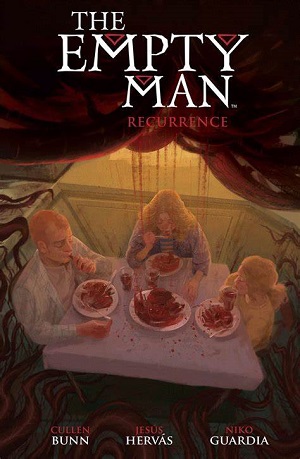
The Empty Man

The Empty Man

This one left me with mixed feelings.

The main problem I had with it is that it’s murky. What I mean by that is two things. In the first place, Cullen Bunn’s story is so vague (not to mention unresolved at the end) that I honestly had no idea what was going on. There’s an outbreak of suicidal dementia that gets dubbed the Empty Man virus because that’s something the victims are heard to mention. There’s a preacher who thinks this might be a sign from or manifestation of God. Or it might be aliens. Or it might be some actual psychic virus, one that began with a possessed patient zero who the Empty Man cult is keeping alive. I don’t know. I’m not sure anyone in the comic understands either. A pair of FBI agents are investigating, and so is the CDC. They have visions and receive messages, but are these just hallucinations? Again, I don’t know. And we’re never told.

(I should add as an aside here that they made a movie “based on” this comic that was released in 2020. From what I’ve heard, it only has the loosest connection to the comic.)

Then there’s the art by Vanesa R. Del Rey. It’s very sketchy and rough. Which you could say makes it a perfect complement to Bunn’s story: you can’t understand what’s going on and you can’t see what’s going on either. What the hell is happening to the woman’s husband in the first issue? Explosive diarrhea? There’s no amount of looking at that picture that makes it clear to me. In other places the drawing is so crude and the colouring so dark I literally couldn’t locate faces, much less read them. No question Del Rey has her own style, but it wasn’t my thing even if it did give the book a really distinctive feel.

These caveats entered, I still found myself enjoying it, or at least committed to reading along. Bunn and Del Rey do, somehow, conjure up an effectively grimy vision of madness, and if it’s all a mess, well, that could just be the way things fall apart in the end times. But don’t ask me to explain any of it.

Graphicalex