Holmes: The Five Orange Pips

Does anyone use the word “pip” for “seed” anymore? Perhaps it’s still current in the UK, but I’ve never heard the seed of a fruit referred to as a pip in my life. Outside of this story, I don’t recall encountering it in a book either, though probably at some point I have.

Anyway, the five orange pips in question are death threats from the “KKK,” which Sherlock Holmes (having recourse to the American Encyclopedia) identifies as the Ku Klux Klan. I guess that wasn’t so obvious in 1890s London. Once again the plot revolves around a crime in a foreign country being avenged back in England, resulting in a series of murders. That was also what happened in both A Study in Scarlet and The Sign of the Four. The difference here, perhaps due to space constraints, is that it’s a mystery that’s not fully resolved, not to mention one that Holmes flubs.

The introduction tells us up front that Holmes did have cases that “baffled his analytical skill, and would be, as narratives, beginnings without an ending, while others have been but partially cleared up, and have their explanations founded rather upon conjecture and surmise than on that absolute logical proof which was so dear to him.” Watson puts “The Five Orange Pips” into the latter category, and Holmes admits at the end that that the murder of the young man who initially had sought his help offends his pride. But even during that initial intake interview he had cautioned that he had only ever been “generally successful” at solving crimes. Even a proud man can possess genuine humility.

Doyle considered this one of his favourite stories, and it has found a lot of popular favour, but to me it feels rushed. The deductions that lead to Holmes discovering the identity of the killer are pedestrian, and it may be that the reason it ends the way it does is because Doyle couldn’t think of any other way for justice to be done. What was sending five orange pips to Captain Calhoun supposed to do? Holmes says he’s cabled the police in Savannah, but what evidence does he have against the killers?

That said, I didn’t mind being left with no explanation for the killings. That goes with Holmes’s earlier musings about “the ideal reasoner”: someone possessed of perfect knowledge who would, “when he had once been shown a single fact in all its bearings, deduce from it not only all the chain of events which led up to it but also all the results which would follow from it.” This is a vision of a mechanical, deterministic universe, one where if one could but know all the forces at play one would be able to predict every outcome. I don’t know if Holmes (or Doyle) actually subscribed to this point of view, but it’s nicely undercut by the outcome here, which checks the hubris of such a philosophy. Today I think we’re even further from it, accepting that the best that even the most godlike knowledge can aspire to is a calculation of the probability of different results.

Holmes index

Batman: Justice Buster Vol. 3

Batman: Justice Buster Vol. 3

Since Volume 2 of this series ended with Batman facing off against his rogue AI-controlled battlesuit (named the Justice Buster) you’d be forgiven for thinking that we’d be kicking things off here with a no-holds-barred showdown.

Not so. Instead Batman just wakes up after being knocked out with some sleeping gas to find that the Justice Buster has disappeared (which is kind of remarkable, even the police admit, given how large a unit it is). And that’s it for the Justice Buster in this volume! It isn’t mentioned again in the rest of the book, and indeed I think it’s only seen later brooding over the city on a couple of pages that are just filler.

So instead of that, what do we get? More on the unlikely partnership between Batman and Joker (who is Jason Todd, and a good guy, in this Batman universe). More on Dick Grayson and his relationship with Joe Chill, or Uncle Sam, or whoever this guy is. It seems he’s been hypnotizing young Dick and been orchestrating scenes of violence around Gotham while wearing a bucket on his head.

Interesting stuff, with a dark “death in the family” ending that still leaves a lot of loose ends. I’m still impressed with this series as it goes places I haven’t been expecting and these swerves are usually pretty interesting. So on we go!

Graphicalex

TCF: Guilty Creatures

Guilty Creatures: Sex, God, and Murder in Tallahassee, Florida
By Mikita Brottman

The crime:

Mike and Denise Williams were a Florida couple who were good friends with Brian and Kathy Winchester. Mike went missing while duck hunting one day in December 2000 and was thought to have fallen out of his boat and been eaten by alligators. It later turned out that Brian Winchester had been carrying on an affair with Denise. He had killed Mike and, five years later, after divorcing Kathy, married her. He and Denise had a messy falling out, leading to their divorce and Brian being charged with kidnapping her. Brian then confessed to the murder of Mike Williams in a plea deal that gave him immunity. In 2018 Denise was tried, convicted of first degree murder and sentenced to life for killing Mike, but a later appeal overturned this because there was no evidence she’d actually been involved in the murder. Her conviction for accessory to murder remained, however, for which she was given a 30-year sentence.

The book:

It’s interesting how the title emphasizes guilt. That’s not something you hear a lot about in true crime stories. We’ve become so used to the psychopath: someone unable to feel empathy who just kills and goes on with his or her life without feeling any pangs of conscience. Conscience is more of a literary trope, belonging in classic works like Crime and Punishment. It’s not something you encounter as much in real life. At least I don’t see much of it. People don’t even say they’re sorry anymore. An apology means taking responsibility, which might lead to being sued.

Introducing the notion of guilt – not guilt in a legal sense but as a moral reckoning – helps foreground the question that lies at the heart of Mikita Brottman’s telling of this tawdry tale. Were Brian and Denise tortured souls, either before or after the murder, or were they just thoughtless, sleazy people? Was Brian’s confession a genuine come-to-Jesus moment, a way of expiating a sense of guilt that had weighed on him for years? Or was it just a way of getting back at Denise? Did Denise not want to divorce Mike because it went against the Bible’s teachings? Or because she didn’t want to take the financial hit? (“Better to be a rich widow than a poor divorcée,” as Brian put it.) And how did Denise feel about marrying the man who killed her husband? Guilty? Complicit? Or did she think about it at all?

These are the questions that Brottman worries away at, and in doing so I think she takes the more literary route I mentioned, giving the protagonists a moral or spiritual depth relating to their faith that I thought they didn’t fully deserve. But I’ll admit to not being sure about that, as I never want to judge people, even murderers, so harshly that I don’t give them the benefit of a doubt.

In order to explore this question of guilt Brottman has to imagine what might have been going on in their heads. Here’s how that goes. First, Denise’s adultery:

They’d both been taught that abstaining from sex before marriage would lead to spiritual, physical, and emotional satisfaction. All their lives, they’d struggled to follow the Bible, and when the time came for them to reap their reward, it wasn’t there. They felt cheated.

Now a door had opened. Forbidden sex, it turned out, was a lot more exciting than anything that happened at home. At the same time, they couldn’t set aside what they’d learned in church – that adultery was a terrible sin. They could go to hell for what they were doing – which made it even hotter.

On the one hand, this is plausible. Forbidden fruit and all that. And a lot of people who go down this road don’t know in advance that they’re going to end up feeling cheated either way: following the rules or breaking them. We’re talking about sex here, and that’s all just hormones. I don’t think we need to invoke “the complications and paradoxes of desire.”

Then, after Brian kills Mike, he achieves a kind of post-coital clarity:

There was no feeling of exhilaration, no relief, no sense of achievement in pulling off the plan, no excitement about the prospect of finally having Denise all to himself. None of it was how he’d imagined it would be. All he could think about was the shock and horror of what he’d done. He regretted the murder right away. It weighed on him every day of his life.

Did it? And how much?

Their own way of making sense of or even justifying what they were up to led, of course, to rationalizations. Only here those rationalizations were tinged, I think in a way many would consider heretical, with faith: that God wanted them to be led astray as part of some mysterious plan he had for their salvation. That if the murder was arranged as an accident it would be a kind of “test” that God had prepared, both for Mike and for the two of them. Then, after the murder, they recommitted to doing more church work:

In terms of profit and loss, their biblical credit balance was in negative figures; they had to build it back up through religious devotion, as well as monetary tithes. Their recommitment to the church was also a symbolic attempt at moral cleanliness, a desire to sanitize themselves, to rewrite their story. It was a kind of hand washing or exorcism, a cleaning of the self after encountering a contagious force of evil. Never mind that the force was their own.

How much of this should we credit? “To the faithful, transgression has a special force and valency that’s absent from secular life.” Does it? I don’t think so. I don’t think you need to have any kind of faith to have a moral compass. And this leaves aside the question of how faithful Brian and Denise ever were.

I just don’t like this kind of thinking, where being a person of faith somehow puts you above the common run of sinners, the people who don’t even know that they’re sinning. You find this in writers like T. S. Eliot and Graham Greene and it puts my back up. Perhaps it isn’t always humbug, but in this case it sure feels like it. For Brian, Brottman tells us, “Guilt, the invader, pushed apart the cracked barriers of his conscience.” He was “not as well defended as his wife [Denise]. His armor was thinner, his capacity for repression less profound.” Really? Or was he just practicing a sort of strategic blame-shifting after it was clear that the “mutually assured destruction” of the guilty secret he shared with Denise was a token in play after their divorce? “Their pledge [to each other] was unbreakable because there was no way out. Their prenup was a murder.” But unbreakable pledges can be broken, and you can always argue over a prenup in court.

I think Brottman pitches the spiritual drama too high. She often has chapter epigraphs drawn from the Bible or Shakespeare, and even at one point describes Mike’s mother entering the courtroom at Denise’s trial “like Cleopatra sailing by on her barge,” an allusion to Anthony and Cleopatra which I thought ridiculous in context. What the story more closely resembled, and it’s a connection Brottman also makes, is the world of film noir and movies like Double Indemnity (yes, there was a big life insurance policy involved here too). In this view Denise became the femme fatale or Black Widow, which is the lens the media took to seeing her through. I found this perspective on the story reminiscent of American Fire, another tale of a criminal couple who shared a “kind of love that is vaguely crazy and then completely crazy and then collapses in on itself.” The only “essential truth” being that when they (Charlie and Tonya, Brian and Denise) started off they were in love and “by the time they finished, they weren’t.”

Sticking with American Fire, we might also note how in both cases it was the man who pled guilty and his partner (both in life and in crime) who maintained her innocence and subsequently attracted the lion’s share of media opprobrium. Denise’s attorney describes this as the “Eve Factor”: the way that when a man and a woman are part of a crime together it is generally the woman who is thought to be the mastermind, the Eve who tempts Adam. There’s the Bible again, but it’s also the standard noir plot:

When lovers plot to kill the wife’s husband, or the husband’s wife, although the woman might help plan the murder, it’s almost always the man who carries it out. But the woman is punished equally, if not more so, and unlike her co-conspirator, she’s publicly sex shamed. She’s scorned, ridiculed, and condemned, described as a Black Widow, a Jezebel, or a Delilah. Examples are easy to find.

Then, dialing things down even lower, we get to a final layer: the public (now mostly online) finding Brian and Denise to be “trashy and ugly; their story . . . lurid and tawdry, a cheap tabloid scandal.” But, naturally, a “guilty pleasure.”

Noted in passing:

I mentioned how police originally suspected that they couldn’t find Mike Williams’s body because it had been eaten by alligators. But he had disappeared on a particularly chilly day in December and it turns out that alligators do not generally feed during the winter months due to the colder temperatures. Specifically:

Most herpetologists agree that between November and late February, alligators, even in Florida, go into a state called brumation – a kind of semi-hibernation in which their metabolism slows down to conserve body temperature, and they no longer need to eat.

Search parties did encounter active alligators at the time in question so the police felt this was still at least a possible explanation for not being able to find a body, but apparently it is very unlikely alligators would be active at all in the existing conditions. They only look to maintain their body temperature and aren’t interested in food.

In 2008, with the investigation into Mike’s disappearance ongoing, authorities contacted a forensic psychologist with a Ph.D. “who used her intuitive powers to envisage what might have happened to Mike.” She said he had been shot in a bedroom by a woman with a revolver. In fact he was shot out on a lake by a man with a shotgun.

If you read enough true crime you’ll find this happens a lot. When the police are at a dead end they’ll talk to psychics. But it always surprises me. This is the twenty-first century. Why do this?

Takeaways:

I’ll throw out a couple of quotes here, both relating to the theme of “us and them” we experience when reading true crime:

It’s easy to assume that familiarity robs a story of its intrinsic interest, but the contrary is true – events are uniquely engrossing when they’re closer to home. The more alike we are, the more hypersensitive we become to tiny differences. . . . We don’t want to accept how similar we are to someone who’s done something reprehensible, so we exaggerate minor distinctions to separate ourselves from them. We try to find an otherness to disguise our sameness.

And:

People are murdered because they are loved, because they were once loved, or because they stand in the way of love. When a person kills another out of the blue, if they’re not mentally ill, we assume they must be in the grip of some great passion: rage, desire, jealousy, greed, or lust for revenge.

Most of us don’t commit murder, even though we might sometimes want to, because our fear of the consequences outweighs the impulse or the desire of the moment. It seems impossible to believe that two otherwise rational, God-fearing people would decide to kill someone rather than contemplate divorce. But it happens all the time. People aren’t reasonable. God-fearing people sometimes least of all.

True Crime Files

Old Man Logan

Old Man Logan

I’ve dumped on the Marvel multiverse concept quite a lot over the years, so I think it’s only right to give them credit when it works. And if you wanted perhaps the best example of that you need look no further than this storyline by writer Mark Millar and artist Steve McNiven.

The world-building here is exceptional. The world in question is (checks notes) Earth-807128, which is about as rotten a hellscape as you could imagine. There’s been a battle between superheroes and villains and the bad guys won. America has been divided up among various boss-level villains and Old Man Logan, no longer Wolverine because of a tragic incident in his past that we only find out about later, is living as a rancher with his wife and kids in a burnt-out version of Sacramento. It looks like the Wild West.

This part of the U.S. is run by the Hulk Gang: the original Hulk/Bruce Banner, who has gone insane, and his degenerate and bullying green descendants. They even beat Logan up. Anyway, in need of money, Logan agrees to accompany a blinded Clint Barton/Hawkeye on a cross-country trip to deliver some secret contraband to D.C.

This is where the hellscape and world-building I mentioned really kicks in. As the two former superheroes pass through parts of the U.S. run by Kingpin, Doctor Doom, and finally the Red Skull (now the president of the United States) they are witness to scenes of incredible violence and desolation. They see the Punisher and Daredevil fed to a pair of dinosaurs in an arena. They meet up with Barton’s daughter, but she’s gone full Spider-Bitch and tries to kill him after overthrowing Kingpin. They’re chased by a T-Rex that has bonded with the Venom symbiote. They meet up with a sort-of resistance underground headed by the White Queen. And finally they get to D.C. where Barton gets killed and Logan is captured by the Red Skull. He escapes after decapitating the Skull with Captain America’s shield and returns to Hulkland only to find that the Hulk Gang has killed his family. He takes a spectacularly bloody revenge before riding off into the sunset with Baby Hulk, on their way to more adventures.

This is all hard, hard, hardcore stuff, especially with all the heroes and villains being cruelly tortured and destroyed. Logan himself takes several severe beatings, but of course he’s immortal so no matter how badly he gets disassembled or destroyed he’s always going to come back. But with that warning for the faint of heart, I came away impressed with what Millar and McNiven managed to accomplish. This is a fast-paced, wild ride that keeps upping the ante with every turn in the road (a road that I was grateful to follow with the map provided of Logan’s and Barton’s route across the no longer United States).

The road trip framework isn’t open-ended but makes this a self-contained story, with a beginning, middle and end, or departure, journey, and return. I’ve read few series with such a satisfying sense of completion, even if Marvel (as always) decided to keep the Old Man Logan storyline going. The way it all works is mainly through a kind of narrative edging: we keep waiting for Logan to snap and “pop his claws,” and Millar keeps denying us, even finding ingenious workarounds for Logan’s fight with the Red Skull. But when he gets back to Sacramento and finds what’s happened we finally get it, an orgasmic double-page spread of SNIKT! and then, claws finally extended “The name isn’t Logan, Bub . . . It’s Wolverine.”

Old Man Logan isn’t a deconstruction of the superhero mythos any more than the spaghetti western blew up the traditional Hollywood oater (and that’s a connection that’s very much in play here). But, like the spaghetti western, it’s a more violent and dirtier rendering of that mythology. So not for everyone, but in its own way a contemporary classic.

Graphicalex

Holmes: Dr. Jekyll and Mr. Holmes

Sherlock Holmes fandom has always had a thing – lovable or annoying – for treating Holmes and Watson as real historical figures and not fictional characters. I’m not sure why this is, as the way the stories are presented, being the recollections of Dr. John Watson drawn from his contemporary notes on the cases, wasn’t something unique to the Holmes canon. But it’s still something you see a lot. It receives a nod here as well, with an About the Author(s) page with two bios: that of Watson (who, we’re told, died in 1940) and of Loren D. Estleman (who is, as of this writing, still alive).

These two pocket bios are only part of the textual apparatus that surrounds this novel. It was first published in 1979 and most recently republished as part of the Further Adventures of Sherlock Holmes series. This latter is the edition I was reading. It starts with a Foreword written in 1978, where Estleman refers to the following book being “with some slight interference of my own . . . a chronicle of John Watson’s own words.” He spins a yarn about how the manuscript was sold to him by an American gangster who found it when he’d been serving in France in WWII (in a chateau Watson had been stationed at in WWI). This is then followed by a Preface by Watson, dated 1917, that says that Holmes had recently told him he could tell the full, true story of Dr. Jekyll and Mr. Hyde now that enough time had passed since the events in question to not cause any scandal. Then, after the novel proper, there are Acknowledgments where Estleman continues to maintain the conceit that the story is authentic but which also references real sources and debts. And finally we get “A Word After,” which was first published in 2001, where Estleman talks a bit about the experience of writing the book.

Some of this is interesting, though personally I don’t like the conceit of treating fictional characters as real people. But like I say, it’s something that Sherlock fandom likes to indulge, and all these “further adventures” and spin-offs are a kind of fan service. It’ become a tradition. Now on to the book itself . . .

The Further Adventures series likes to mine late-Victorian literary thrillers for new-old villains. In addition to Dr. Jekyll, Holmes would also face off against Dracula (Sherlock Holmes vs. Dracula, an earlier book by Estleman), the Phantom of the Opera, Jack the Ripper, the Martians from The War of the Worlds, and other famous baddies. Going into this one, I actually thought there would be a twist where Holmes discovers that there were two different men involved and that Robert Louis Stevenson (who we meet at the end) made up all the business about chemical transformations. But instead it’s quite faithful to Stevenson’s original story and accepts the fanciful notion that someone can be not only morally and psychologically corrupted but physically transformed, instantly and in a dramatic way, just by drinking a potion. This means that as readers we already know everything that’s going on and we just follow Holmes and Watson around as they piece things together. If you know Stevenson’s novel well though you’ll have fun picking up all the minor references, like Watson calling Hyde his Mr. Fell, and while there are no twists it is a good yarn. Estleman is true to the characters and throws in one epic cab chase through the streets of London that was thrilling in a cinematic way.

Another point of interest is the link that’s come up already several times here between Holmes and Watson and Jekyll and Hyde. I previously noted how the author of the Introduction to the Penguin Classics A Study in Scarlet invoked the Strange Case of Dr. Jekyll and Mr. Hyde in his argument about Holmes and Watson constituting a single “divided being.” I also talked about how the story “The Red-Headed League” related to the Jekyll and Hyde story in the way the pawn shop backs onto the high-street bank: a secret connection between high and low that’s very much in play in Stevenson. In this book Holmes himself accounts for his bond with Watson as being a case of “Opposites attract,” a point that Estleman expands on in his Afterword by contrasting the “ultra-conservative John H. Watson” and the “Bohemian Sherlock Holmes.” “How natural,” then, that they “should find themselves drawn into the two halves of Jekyll’s world.”

Holmes index

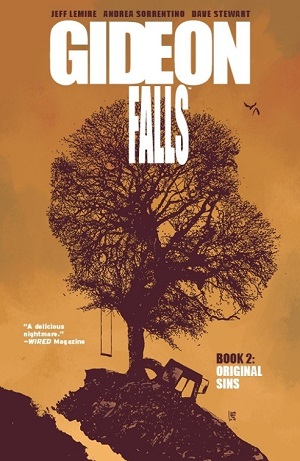
Gideon Falls Volume 2: Original Sins

Gideon Falls Volume 2: Original Sins

This second volume of the Gideon Falls comic feels like marking time. Even the structure repeats that of The Black Barn, with the same slow build to another psychedelic final issue that takes us through the looking glass (or the reassembled doorway) before pulling out and dropping us off in the same desolate locations. Only now there’s been a switcheroo and Father Fred and Norton (really Clara’s missing brother Danny) have crossed over into each other’s worlds. Which really doesn’t feel like it’s moved us forward at all.

There are no new characters aside from the real Norton Sinclair. He’s the Victorian tinkerer who built the thingamajig in his barn that seems to have opened a portal into an evil dimension. There’s still no idea what Norton Sinclair or the Laughing Man or the Bug God or whatever the hell it is might be up to though. If I had to guess I’d say he, or it, is just into doing evil stuff.

I still enjoyed what was going on, but at the same time it felt a bit early for the series to be running out of gas. As I’ve said, they weren’t adding much new here. There are a bunch of elements that felt tired, like seeing the episodes of a couple of the characters as frightened children, Norton strapped into a straitjacket and locked in a padded cell, Doc’s wall of newspaper clippings, and the insect monster breaking out of a human body. Sorrentino’s art didn’t even feel like it was adding much either, aside from the great double-page spread of Gideon Falls turning into Times Square. Maybe the Bug God is an urban developer then. That would actually make a kind of sense. Because if you invented a time machine wouldn’t you want to use it to make some smart investments in real estate?

Worth sticking with then, but at the same time: get on with it!

Graphicalex

Demon Slayer Volume 1: Cruelty

Demon Slayer Volume 1:  Cruelty

Most of the manga I’ve read is of a particular kind, characterized as being full of videogame-style action where the hero proceeds through different challenges or levels, with his adversaries (or level bosses) becoming more powerful as he goes along. That’s the impression I got again here, and I’m not sure how long I’ll stick with the series as these things just tend to go on. They’re not like American comics where you follow individual story arcs through a half-dozen issues or so. It’s more like counting the cars in a long train while you’re waiting for a crossing to clear.

I used to live on a farm that had a freight line running through it. I counted cars a lot when I was a kid.

The setting here is Taisho era Japan, which was in the early twentieth century. I thought we were sometime a lot earlier than that. A kid named Tanjiro who lives in the woods has his family killed by demons. The only survivor is Tanjiro’s sister Nezuko, but she’s been infected by the demons. Tanjiro wants to save her (I guess you have to believe in something) so he sets out carrying her on his back in a basket, with a bit stuck in her mouth so she won’t bite anybody. His goal is to join the elite Demon Slayer Corps, but to do so he has to first go through samurai boot camp.

This combines physical training with a lot of hard-ass hectoring that carries a message I’ve also noticed a fair bit of in the manga I’ve read. This is the presentation of life as an endless and brutal Darwinian struggle, a battle to the death where only the strong survive. So you’d better get tough and not waste time being sentimental or thinking about the meaning of life too much.

I wonder if this is a big thing in contemporary Japanese culture. Is it something picked up from their super-competitive school system? It’s not a theme I’ve noticed reading Japanese novels or watching many Japanese movies (though Battle Royale comes to mind as an exception).

I did find the set-up a bit interesting though, and the line about how “When happiness ends there’s always the smell of blood in the air” stuck with me. I thought the story predictable trash but I may stick with the series for a few volumes anyway. If nothing else, it seems to be a cultural artefact of some weight and so worth taking a look at. From Wikipedia:

By February 2021, the manga had over 150 million copies in circulation, including digital versions, making it one of the best-selling manga series of all time. Also, it was the best-selling manga in 2019 and 2020. The manga has received critical acclaim for its art, storyline, action scenes and characters. The Demon Slayer: Kimetsu no Yaiba franchise is one of the highest-grossing media franchises of all time.

I mean, they made a TV series out of it and then a movie in 2020 that had a budget of $15 million and took in over $500 million! So far I haven’t seen anything to explain that level of popularity, but I’ll try to let it grow on me.

Graphicalex

Holmes: The Boscombe Valley Mystery

A simple story, and not deceptively simple either. Though things do begin with Holmes reminding Watson of his axiom that “The more featureless and commonplace a crime is, the more difficult it is to bring home.”

I don’t think the crime here was featureless or commonplace though. It’s apparent simplicity is that it seems an open-and-shut case, with a young man arrested for the murder of his father. But Holmes sees deeper into these things, and knows how circumstantial evidence can be “a very tricky thing” and lead you astray. “It may seem to point very straight to one thing, but if you shift your own point of view a little, you may find it pointing in an equally uncompromising manner to something entirely different.”

What I mean by calling it a simple story is something different. I mean that as a mystery story, and in particular a Sherlock Holmes story, it doesn’t throw any curves. There’s only one suspect, and the plot follows what had already become a standard script pretty closely. There’s Holmes showing up the police by getting down on the ground with his lens and tracking clues (footprints, tobacco residue) like a bloodhound on the scent. There’s the exercise of his métier of “observation and inference.” There’s the usual backstory involving a crime in a faraway country (in this case Australia), and a pair of young lovers whose path to matrimony has to be made clear. There’s the guilty party who had his reasons, and who is going to expire soon anyway.

I raised an eyebrow at Lestrade calling himself Holmes’s “colleague,” not so much because he’s presuming a lot putting himself on an equal footing with Holmes but because they seem to actually have the same job. Lestrade has been called to Boscombe Valley by some of the locals who believe in the charged man’s innocence. Specifically, he is said to have been “retained.” I’m not sure how that works, or what makes it any different from Holmes’s role as consulting detective. Lestrade’s just not as good at it.

An annotation in the Baring-Gould edition though offers this:

Some have pounced on the word “retained” as used by Holmes to conclude that Lestrade had gone into private practice for a period, but that judgment is not necessarily warranted, for it was not uncommon for Scotland Yarders to aid the provincial police, and Holmes’ use of the word was purely conversational.

This suggests to me that there’s some wiggle room. The line between the police and private practice wasn’t as sharp in the nineteenth century as it is today, and Doyle himself might not have been clear on all the practical distinctions. And some of it can also be attributed to genre logistics. Fifty years later Miss Marple would be routinely given access to crime scenes and even be requested by authorities to conduct official interviews with suspects and witnesses. I just think the conjunction of “retained” with the later use of “colleague,” not to mention the way Holmes is usually employed (retained?) by the police, shows how fluid the boundaries were.

Holmes index

5 Days to Die

5 Days to Die

Version 1.0.0

A hard-as-nails cop named Ray Crisara is in crisis mode. He has a marriage that’s on the skids, and when his car is smashed into by a big rig, killing his wife and seriously injuring his teenage daughter, he becomes obsessed with getting revenge on the drug lord who he thinks is responsible. Also, because of a brain injury he received in the same crash Ray only has five days to live, so the clock is ticking.

You’d be excused for thinking you knew where this was going. The cover has Ray looking like a dead ringer for Marv from Frank Miller’s Sin City, and that neo-noir atmosphere where it’s always night, or it’s raining, or both, is very much the visual style. But there are two wrinkles Andy Schmidt throws into the mix. The first is that Ray, due to his injury, may be hallucinating some of what’s happening. The second is that Ray has to learn something about being a better parent from this experience, and in fact his quixotic mission of vengeance may just be a kind of coping mechanism.

These are interesting ideas to put in play, but in the end I didn’t feel like enough was being done with them. The hallucination angle had horror potential that was unrealized. As for the parenting stuff, maybe I’m being cynical, but noir is nothing if not cynical and the way things wrapped up here struck me as too sentimental. Even the drug lord gets some redemption. I expected, and wanted, something a lot bleaker than that.

Graphicalex