Batman/The Shadow: The Murder Geniuses

Batman/The Shadow: The Murder Geniuses

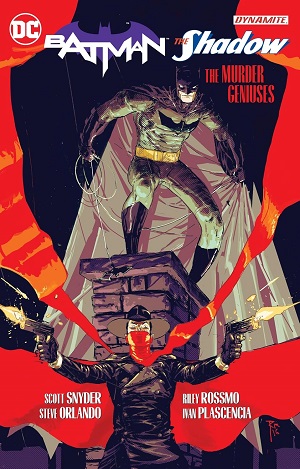
I’ll grant that crossovers can get messy. And crossovers with two writers may get even messier. That said, the idea of having Batman and the Shadow joining forces must have seemed like a good fit, as they’re both dark, mysterious crime-fighters hailing from the same era (both debuted in the 1930s). Unfortunately, it’s hard to think of anything this comic series does right, at least in terms of its storyline.

I found that story impossible to follow. I don’t know the Shadow character very well, but I think even if I did I would have been lost. As far as I can figure out he’s an immortal figure or spirit from another dimension: the fabled city of Shamba-La. What is Shamba-La? Why it’s a “foothold on your plane of existence, anchored by heavy dimensional ballast.” People there live “on a higher thaumic frequency.” Got it?

Anyway, apparently the Shadow has had his eye on Batman for a while and has selected him to be his heir. But then this manga-masked super-villain from Shamba-La named the Stag (because he wears an antler headdress, you see) shows up and starts killing off all the best people in the world. This makes him the reverse Shadow, as the Shadow’s mission is to take out the worst people in the world. So Batman and the Shadow team up to defeat the Stag, who has allied with the Joker. Batman sort of gets killed but then he’s revived by going to Shamba-La and meeting Cthulhu. The Stag is finally beaten and the Shadow is stuck still being the Shadow and Batman stays on as Batman.

I may be getting something wrong in all that. I’m probably getting a lot wrong. I just didn’t know what was going on. The Stag has a backstory but he only speaks a single enigmatic line (“I am an honest signal”) over and over. The Joker is roped into action just because this is a big Batman title and they figured the Joker had to show up and do something. But this is one of his least impressive incarnations. The Shadow looks dramatic in his magic red scarf unrolling like Spawn’s cape, but honestly I didn’t understand what he was going on about most of the time. Harry Vincent and Margo Lane show up too, but just as props. I guess the art isn’t bad, but Batman’s boyish face doesn’t really go with his scarred tank of a physique and the Joker seems like a puppet figure.

I didn’t like this one. The crossover idea had a lot of potential but they needed to keep the script a lot tighter. With all the background mythology I just had the sense that things were getting away from Scott Snyder and Steve Orlando right from the start. It was fairly well received by fans though, which makes me wonder if coherence or intelligibility is something that people even look for anymore in pop entertainment.

Graphicalex

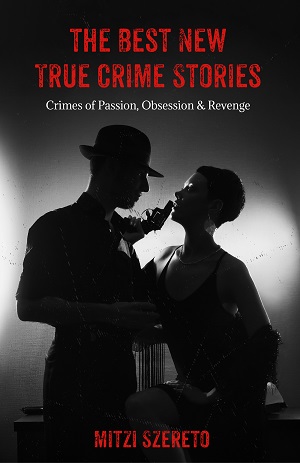
TCF: The Best New True Crime Stories: Crimes of Passion, Obsession & Revenge

The Best New True Crime Stories: Crimes of Passion, Obsession & Revenge
Ed. by Mitzi Szereto

The crimes:

“I’ve Seen the Dead Come Alive” by Joe Turner: a moody teenager crosses the country to meet a girl he met online who shared his interest in “horrorcore rap.” She is less impressed with him in person and he kills her, her parents, and her best friend.

Petit Treason” by Edward Butts: in Ontario in the 1870s a woman kills her abusive husband. Despite being an at least somewhat sympathetic case she is sentenced to hang.

“The Crime Passionnel of Henriette Caillaux: The Murder that Rocked Belle Époque Paris” by Dean Jobb: a Parisian society lady shoots and kills the editor of a newspaper, under the assumption that he was going to publish some of her personal correspondence.

“A Young Man in Trouble” by Priscilla Scott Rhoades: the driver of a Brinks armoured car decides to take off with a shipment of “bad money” (old bills slated for destruction).

“The Madison Square Garden Muder: The First ‘Trial of the Century’” by Tom Larsen: Harry Thaw shoots the starchitect Stanford White dead for having corrupted his wife.

“Facebookmoord” by Mitzi Szereto: a social media dust-up between a pair of teenage girls in the Netherlands turns fatal.

“Death by Chocolate” by C L Raven: in Victorian England a woman goes on a rampage poisoning chocolates.

“The Gun Alley Murder” by Anthony Ferguson: a disreputable bar owner in 1920s Melbourne is executed for the murder of a 12-year-old girl. Witnesses against him seem to have been mainly motivated by the offer of a reward for their testimony, and in 2008 a posthumous pardon was issued.

“The Beauty Queen and the Hit Men” by Craig Pittman: a woman has her husband killed as part of the fallout from a messy divorce.

“Because I Loved Him” by Iris Reinbacher: the Sada Abe case. A Japanese geisha/prostitute kills her married lover and cuts off his penis, which she takes with her as a keepsake.

“A Crime Forgiven: The Strange Case of Yvonne Chevallier” by Mark Fryers: a French woman shoots and kills her husband, an eminent politician, when their marriage hits the rocks.

“Bad Country People” by Chris Edwards: a bitter divorced woman enlists the aid of her family in killing her ex and his new wife.

“The Life and Demise of England’s Universal Provider” by Jason Half: the founder of a successful chain of department stores is killed by a man who claims to be his son.

“Revenge of the Nagpur Women” by Shashi Kadapa: at a court appearance, a brutal Indian crime boss is torn to pieces by a mob.

“A Tale of Self-Control and a Hammer” by Stephen Wade: a British man kills his wife with a hammer, perhaps out of jealousy but more likely because he wanted to free himself to start over with his lover.

The book:

I quite liked a couple of the other true crime anthologies I’ve read that were edited by Mitzi Szereto (Women Who Murder and Small Towns), but I felt this one came up short.

Just the title suggests a lack of focus. Crimes of passion, obsession, and revenge? That covers a lot of ground, as most crimes are either crimes of passion or committed for personal gain. And even then “personal gain” could be someone’s obsession. (A third category, mental illness or insanity, might fall into or overlap with crimes of passion too.) Then take into account that some of the cases here – like the Brinks guard driving off with bags of cash – still seem to fall outside the book’s broad remit and you basically have a true crime potpourri.

There’s nothing wrong with that, and the stable of writers that Szereto works with are capable enough, but it makes it hard to see the book as a whole as illustrating any one particular theme, even as broad as the triple-barrelled passion, obsession, and revenge. As with her other collections there’s a refreshing geographical diversity (a story each from Japan, India, Australia, and Canada, with two from France), and a number of historical cases as well. Among the latter are some celebrated crimes that I think most true-crime buffs will be familiar with, like Harry Thaw’s murder of Stanford White (the first “crime of the century”), the Caillaux affair, and Sada Abe’s mutilation of her dead lover. I didn’t think they were necessary to go over again here. Then there are a number of more contemporary stories, a couple of which – “The Beauty Queen and the Hit Men” and “Bad Country People” – that I found too involved and confusing to follow in this format. I like short true crime stories, but if the cast of characters is too big then as a reader you can quickly get lost.

There are few general observations that are new. One story, “Death by Chocolate,” even begins with the evergreen adage “Hell hath no fury like a woman scorned.” (A quick digression. The origin of that phrase is a play by William Congreve, The Mourning Bride (1697). The actual lines read: “Heav’n has no Rage, like Love to Hatred turn’d,/ Nor Hell a Fury, like a Woman scorn’d.”) The point being one that most people understand and probably even have some experience of. People fall in and out of love. Nobody likes being ditched. When this plays out in cases of murder we most often see men disposing of wives so that they can move on and women taking revenge on husbands who are looking elsewhere. And while poison has been the method of choice for most women in such circumstances (“the perfect way to escape an abusive marriage . . . cheaper than divorce and easier to get away with than bludgeoning an abuser”), in modern times we see guns being used just as often.

There wasn’t much I made notes on. One item that stuck out was in the Australian case of “The Gun Alley Murder.” This was an infamous miscarriage of justice that was apparently at least partially motivated by the large reward offered. As economists tell us, humans respond to incentives. In this case a number of “witnesses” (dubbed “the disreputables” by defence counsel) provided testimony that seemed made up, either for the reward or because of a grudge they had with the defendant. This made me wonder how often rewards actually work. I think most people, if they have information relevant to the solving of a crime, bring it forward freely. In some cases the reward is meant to overcome the stigma, or risk, involved in being a snitch, though I don’t know how often that’s what’s being weighed.

What else does offering a reward do? I suppose it gets attention, but that’s it. This puts rewards in much the same boat as awards in the arts. Those are meaningless and rarely go to the best work, which would be produced anyway. So they’re basically just a form of advertising. Rewards for tips leading to an arrest may work in the same way.

I was curious as to what percentage of these rewards make a difference so did a bit of looking online. According to one report, “A review by the Los Angeles News Group involved a total of 372 rewards offered by the Los Angeles County Board of Supervisors and Los Angeles City Council from January 2008 to April 2013 to solve violent crimes. Only 15 of these rewards were actually paid out to people who provided information that led to convictions.” That doesn’t seem very productive, though I guess you haven’t lost anything if the money doesn’t get paid out. I also found a 2019 NPR story focusing on the Crime Stoppers organization where the people interviewed called rewards “not wildly productive,” even though it’s impossible “to determine how much of a factor Crime Stoppers’ rewards play since tips and payouts are anonymous.”

It seems like we should have a better idea how well rewards work, given that, as the Gun Alley case shows, such incentives can also be abused and lead to perverse outcomes.

Noted in passing:

The sexualisation of young women is not a phenomenon of the Internet age. Evelyn Nesbit was posing for artists and photographers, sometimes in the nude, before making it as a cover girl for major magazines when she was only 16 (“or maybe younger,” as Tom Larsen puts it). Lana Turner was famously discovered when she was playing hooky from high school at the age of 15 (which I believe she later “corrected” to 16, for legal reasons). A casting director was captivated by her physique (read: her bust) and she appeared in her first film the next year in a brief role that earned her the nickname of “Sweater Girl.”

In the 1870s social hierarchies were very much still part of the law:

At that time, the murder of a husband by his wife was still known by the old English common law term “petit treason” (which also included the murder of a master by a servant, and the murder of an ecclesiastical superior by a lesser clergyman). Next to high treason against the monarch or the state, it was officially the worst crime a person could commit.

Something of this attitude persists in the greater criminal liability for shooting a police officer than killing a man on the street. We still have our hierarchies when it comes to things like insurance, health care, and the law. Some lives are worth more than others and considered deserving of greater protection.

Takeaways:

Perhaps the French are more sophisticated in their permissiveness toward men taking mistresses, but that hasn’t stopped Frenchmen paying a price for such behaviour.

True Crime Files

Marvel Comics: Timeless Tales

Marvel Comics: Timeless Tales

Marvel Comics got its start (at least as Marvel Comics) in 1939. This slim volume collects a bunch of all-new genre homages to celebrate their 80th anniversary (in 2019), and is a real treat for fans of the Marvel brand.

We kick off with a spooky psycho-thriller from Crypt of Shadows. Then War is Hell, Journey into Unknown Worlds, Love Romances, Gunhawks, and Ziggy Pig – Silly Seal. I think the titles speak for themselves as to what you can expect, but if you’re wondering, the genres covered are horror, war, SF, romance, Western, and humour.

I thought the first story, written by Al Ewing was the best. I had to go back and read it again to understand what was going on. It’s a complicated narrative involving hypnotic states, but I think in the end it all made sense, which is something I appreciated. Also good were the two stories in Journey into Unknown Worlds. There was nothing fancy about them, but they delivered.

The other genres sampled are ones that haven’t maintained the popularity they once had. War comics and Westerns aren’t so big today, and I think romance titles have mostly disappeared. And I wonder why. Romance novels are still popular, aren’t they? Could romance comics not survive the attention of Roy Lichtenstein?

That’s a point worth dwelling on. Some genres, like SF and horror, can hold up under an ironic gaze. But for war, Westerns, and romance I think it’s harder. Which is why those stories here get cross-genre, ironic treatments. There are twist endings and supernatural elements that I doubt were that common in the originals. One of the romance stories takes place in a steampunk future, and another has a robot falling in love with an alien. The war stories are both strange tales and the Western takes a weird turn at the end as well. Then there’s Ziggy Pig and Silly Seal . . .

I have to admit I don’t know anything about these characters. As I understand it they were the basic comic odd couple, with Ziggy being the smarter one and Silly being the unbeatable goofball. I doubt they were as grown-up as they are here, however, as Silly has become a celebrity while Ziggy is stuck renting prostitutes and throwing up all over his flophouse apartment. Finding out that Silly has put him in his will, Ziggy travels with him to Latveria, home of Doctor Doom, in the hope that the Doctor will kill Silly for being a friend of the Fantastic Four. But that’s not how things work out.

Deadpool has a cameo here and that feels right because the humour is pretty adult and meta. Very Howard the Duck, if you remember that. Again it seems as though this material can’t be done straight today so there have to be layers of irony. At one point the co-writer, Frank Tieri, even puts in an appearance at a back-alley comic-con.

All of this goes down easy, but it’s still worth noting what sort of an homage this is. The genres really aren’t timeless, and these tales are very much of our time.

Graphicalex

Marple: Evil in Small Places

This is the first story in an anthology of new Marple stories written by twelve different authors. I think they must have been specially commissioned by the Christie Estate (Agatha Christie Limited), as the estate holds the copyright, Christie’s name is displayed most prominently on the cover, and the back flyleaf has Christie’s photo and pocket bio. This despite the fact that there isn’t a word in the book that was written by her.

That isn’t something that should put anyone off, however. A lot of franchise fiction is better than the originals. Almost any new James Bond adventure, for example, beats the pants off Fleming’s stuff. And the fact is (or at least in my strongly-held opinion it is) that Christie’s Marple stories weren’t very good. So a line-up of new stories written by bestselling authors is actually something I was looking forward to.

I wasn’t disappointed by Lucy Foley’s entry. It moves quickly, has a nice clue-I-didn’t-notice in the middle, and comes with a good twist at the end, though readers will probably twig to something being off about the killer early on and know that a rug-pull was coming up.

While reading I caught myself smiling at the way Miss Marple and her friend Prudence have to make their way through a dark wood with the aid of a flashlight (or “torch,” as they like to say over there). The reason I got a kick out of this is because we’re told it’s “only about five o’clock or so but it felt much later.” This might seem early for it to be fully dark out, but it’s mid-November (two weeks after Guy Fawkes’ Night) and England runs out of daylight quickly in the late fall.

What made this more interesting though is that Miss Marple gets very technical about the matter of what time it was when she’s interviewed by the police inspector later. He says she was walking through the woods in the evening and she takes exception to this: “You see, it wasn’t the evening. It was a little past five o’clock – though at this time of year, when it gets dark so quickly, it’s so easy to forget.” No, for her “it’s so important to get these things right,” and the fact is she was cutting through the woods in the afternoon.

Was she right? I did some research and it seems as though “evening” is said to begin at either 5 or 6 o’clock. It is only a loose measurement of time that varies in usage, but is usually connected to the setting of the sun. So I don’t know if Jane was correct, and even if she did have a point I don’t think she was right to make an issue out of it. She wants to insist on words being nailed down to a precise meaning so as to avoid being misleading, but I don’t think this was a hill to die on.

The story treats the subject faithfully, which is something that was probably written into the contract. Miss M isn’t fighting alien bodysnatchers or Jack the Ripper’s love child. She’s the familiar Victorian lady (that’s how she thinks of herself, anyway), schooled in human nature, who prefers knitting to just about anything. She also wonders, through experience, “if there aren’t more terrible things happening in England’s villages and hamlets than in its metropolises.” Well, there certainly are whenever she’s around!

Marple index

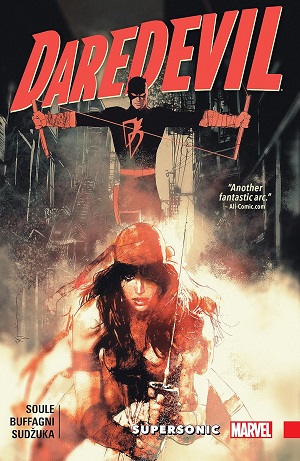
Daredevil: Supersonic

Daredevil: Supersonic

This volume is the sequel to Chinatown. Chinatown was so called because it was set in Chinatown. I’m not sure why this one is called Supersonic. It consists of three stories and the third one has Ulysses Klaw as a giant “kinetic living audio wave” so maybe that was it.

Charles Soule is the writer in charge again, though each of the three stories has a different artist. The last is illustrated by Vanessa R. Del Rey, who I last encountered in The Empty Man, where I said her drawing style was not my thing. I didn’t think it worked any better here. Her art just puts me off.

I didn’t care for the stories much either. The first has Daredevil battling Elektra, because she’s been brainwashed into thinking she had a child that Daredevil abducted. Weird. And it doesn’t go anywhere because her brainwashing is fixed and she just leaves at the end to find out who did it to her, and why.

The second story starts off well, with Matt Murdock crashing a high-stakes poker tournament in Macau. He’s able to beat a telepath because the telepath’s ability to “see” the other players’ hands doesn’t work with Murdock because he’s blind. That said, Murdock’s strategy of just going off of other players’ cues while not knowing any of the cards he’s holding himself doesn’t strike me as a likely winner. In any event, it turns out what he’s really after is a briefcase full of valuable information that he teams up with Spider-Man to steal. Again though I felt like things ended abruptly, leaving me wondering what the point was. Daredevil mentions how everyone has lost their memory of his secret identity but doesn’t say how it happened (you’ll have to wait for an explanation of that). Then Spidey warns him about going through a “black-costume phase” (like Spider-Man did), but even though Daredevil’s uniform has changed I haven’t got the sense that Soule was changing the character much. This isn’t dark Daredevil, or even dark-er.

Finally, the third story has Klaw turning New York into a city of sonic zombies. Daredevil and Echo (who is deaf) team up to stop him. And finally there’s a coda with long-time adversary the Gladiator descending deeper into criminal psychopathy.

I didn’t like any of this as much as I liked the Chinatown storyline. Blindspot shows up briefly in the fight with Elektra before being disabled. I like how Daredevil tries to protect him, recognizing when a challenge is out of his league. As happened when fighting the Hand in Chinatown. Overall I thought there were some good ideas here that just needed more development. The emphasis on action over plot is something I’m usually OK with in a superhero comic, but in this case I thought Soule was just coming up with hooks or concepts and not turning them into stories with any legs.

Graphicalex

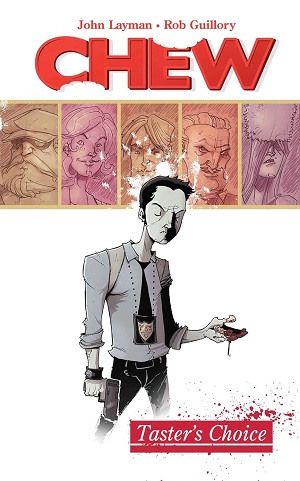
Chew Volume One: Taster’s Choice

Chew Volume One: Taster’s Choice

This is the first volume in the award-winning Chew series, written by John Layman and illustrated by Rob Guillory. And you could tell right away it was going to be great.

Why? I’d start with the terrific world-building. We’re in a world sort of like our own but with a slightly off-kilter history. Sometime previous to the action described, the world has suffered through an outbreak of what authorities determine was an avian flu, though some suspect that calling it bird flu was part of a cover-up for something more nefarious. In any event, tens of millions of people died and one of the results is that chicken is now a black-market menu item while the rest of us have to make do with synthetic substitutes like Poult-free and Chickyn. In the U.S. one of the most powerful government organizations now is the F.D.A., which still stands for the Food and Drug Administration. One of their top agents, Mason Savoy, is what’s known as a cibopath: someone who can, just from tasting food, be given a vision of its entire prehistory. Example: take a bite of an apple and know what tree it came from, what pesticides were used on it, and when it was picked.

And with a bite out of a corpse, a cibopath can tell how said corpse met its end.

There aren’t many cibopaths. One day Tony Chu, also a cibopath, is enlisted by Savoy into the F.D.A. and together they go on various adventures fighting secret gangs and investigating other mysteries. Tony also falls in love with Amelia Mintz, who is a food columnist and also a saboscrivner, which means she can describe food so accurately that her readers have the actual sensation of tasting the meals she writes about. As with Tony’s cibopathic abilities, this is a kind of superpower in the Chewiverse.

It’s nutty, very gross, and lots of fun. The best thing about it though is Guillory’s art, which is a buffet of caricature figures (Savoy’s tank-like torso and spindle legs being the prime example) and bone-crushing action. I actually slowed down to enjoy the different elements in the many fight scenes, they were so good. Guillory’s art is the perfect complement to the weird world Layman conjured, and had me feeling both full at the end and looking forward to more.

Graphicalex

DNF files: Fools on the Hill

Fools on the Hill

By Dana Milbank

Page I bailed on: 38

Verdict:  Washington Post reporter Dana Milbank’s previous book The Destructionists: The Twenty-Five-Year Crack-Up of the Republican Party did a decent job giving an account of the historical process that culminated in the triumph of the Trump MAGA movement. This book is more like a reporter’s notebook though, and is mainly just a collection of pieces on the clown show that Congress turned into in the 2020s.

But if you follow politics you probably already know more than enough already about figures like Marjorie Taylor Greene, George Santos, Lauren Boebert, Matt Gaetz, and all the other “hooligans, saboteurs, conspiracy theorists, and dunces” who attracted so much media attention. And it didn’t take long before I got tired of the litany of outrageous pronouncements made by these whackos on social media, and the scandalous behaviour of this lunatic fringe. One question still in need of answering is how much of this is just performance and how much is the expression of sincerely held beliefs (read: psychosis). Though I suspect that at this point the performance may have created its own alternative reality, making the question moot.

So this is another DNF that isn’t a bad book but that I just didn’t feel any need to stick with for 350 pages, especially as I skimmed ahead and didn’t see where Milbank was coming to any new or profound conclusions about what was going on. “This is no way to run a country and certainly no way for a democracy to function,” he says at one point when talking about the outsized influence the crazies have. “But this is our current reality.”

Except the book came out at the beginning of 2024 and the “current reality” was about to get a lot worse.

The DNF files

Marvel Zombies 3

Marvel Zombies 3

Fresh meat. Meaning a new writer (Fred Van Lente) and artist (Kev Walker). And I was looking forward to a change in the storyline, since (as I’ve previously noted) I wasn’t that thrilled by Robert Kirkman’s first two volumes. I found Walker’s art nearly indistinguishable from that of Sean Phillips so didn’t register any change on that account.

And . . . Van Lente really came through. The story here is tight, not at all like Kirkman’s sprawling and confused cosmic zombie epic. If you want you could see some continuity with the previous books, but basically this is a standalone. There’s a zombie universe in play, meaning one that has been taken over by zombies. Unfortunately, since the zombies have finished eating everything they’re now looking for new worlds to colonize/devour, or whole new universes where they can spread what they’ve taken to calling the “Hunger Gospel.” Which would be the zombie virus. Same thing.

Zombie Kingpin is top dog in this zombie dimension, but he has lots of flunkies. Among them is zombie Doctor Strange, who can cast a portal to other locations in the multiverse. This, in turn, lets zombie Morbius and zombie Deadpool infiltrate a secret inter-dimensional facility that exists in our world.

To what end? Well, the zombies have a wicked plan cooked up whereby they will pretend to inoculate all of our superheroes against the zombie virus while really infecting them with the same, which will then make us easier to take over. Man, that’s what I call dirty pool. Not to mention a storyline that feeds into every anti-vaxxer’s favourite conspiracy theory.

Trying to stop them are Machine Man and Jocasta, who have to visit the zombie universe and then make it back. To be honest, if Jocasta did anything on this mission I’m not sure what it was. But Machine Man really kicks ass. He’s a one-man zombie Armageddon. But will that be enough?

As things got started I was wondering if I was going to be able to get into it. Once again, things are very dark. Dark in a way that deadens the wisecracking and attempts at humour. I get the gore, and the fact that zombies do eat people. But Van Lente continues with Kirkman’s thing for heroes being tied up and then cannibalized, which reminds me of the people kept in the basement of the house in Cormac McCarthy’s The Road. Here they even have a clone farm in the zombie universe to keep the hungry dead fed on vat-grown meat. And even heroes who aren’t as good to eat are also kept vaguely alive, if you can call Morbius or Vision alive, just so that they can be tortured. To be honest, I wasn’t sure why else Morbius and Vision were being kept around, except to add to the whole theatre-of-cruelty effect that’s going on.

If you can handle all that, the story itself is pretty compelling and I read the whole book in a rush. It really helps that things are more streamlined than in Kirkman’s comics, as the action is a lot easier to follow. Given how fast things move, this was a big plus. Throw in some fun stuff like zombie Captain Mexica (a Mexican Captain America preserved from an alternate timeline where the Aztec empire never fell), a bonus section of the usual parody covers (not just of famous comics but of movie posters too), and a relatively happy ending, and I ended up having a good time. In my opinion it was the best Marvel Zombies book yet, and had me finally looking forward to what’s next on the menu.

Graphicalex

TCF: Empire of Deception

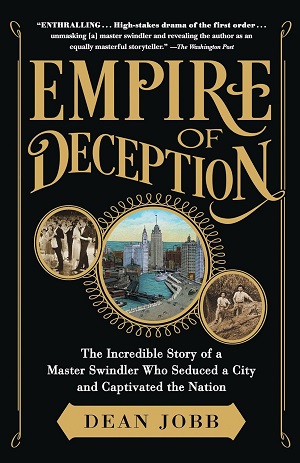
Empire of Deception: The Incredible Story of a Master Swindler Who Seduced a City and Captivated the Nation
By Dean Jobb

The crime:

In 1920s Chicago a lawyer named Leo Koretz who had a taste for the finer things in life – married women, nice clothes, big houses, expensive dinners – went into the financial scam business. What this involved was selling shares in a non-existent company called the Bayano River Syndicate that he said had discovered oil in a remote part of Panama. The scam operated as a Ponzi scheme, paying rich dividends out of the money pumped into the stock by new investors. Just before being exposed, Koretz fled Chicago, abandoning his wife and family, and opened a hunting lodge in Nova Scotia under a new identity. He was eventually discovered and returned to the U.S., where he pled guilty to charges of fraud and was sent to prison. He died shortly thereafter, some say from suicide after eating a box of chocolates that put him into a diabetic coma.
The book:

The psychology of the Ponzi scheme has always puzzled me. Not the psychology of those who invest in them; they’re only in it to make a quick buck. Are they suckers? Some of them. But ignorance, if not bliss, is still advisable in such situations, and Koretz didn’t appreciate doubters. So either way, that part is easy to understand.

What I have trouble understanding is what the person operating the scheme is thinking.

As anyone who considers the matter even for a moment knows, a Ponzi scheme always carries within it the seeds of its own destruction. The music has to stop. Scams where new money is paid out as supposed returns on investment are “doomed to collapse” because of an inherent flaw: “There is never enough money for all . . . and the inflow of new money must ultimately dry up.”

Knowing all that, what is the end game? Do the  fraudsters who run such schemes just find themselves stuck on a treadmill they can’t get off? Do they think there’s some way they’re going to be able to defer the inevitable crash, if not indefinitely at least until something else comes up? I don’t know.

Koretz seems to have been a particularly complicated case. After his arrest he would claim that he almost came to believe in the oil fields himself:

“I talked Bayano, and planned Bayano, and dreamed Bayano, so that I actually believed the stuff. The idea grew and grew. Every day I spoke more of it until, finally, I was confident. It almost seemed that I had those thousands of acres and that oil down there in Panama.”

Ah, yes. It “almost seemed.” I think in the case of Charles Ponzi this might be close to the truth. But Koretz wasn’t as high on his own supply of bunko. “I knew the bubble would burst,” he also later confessed. And he did have a plan for getting away with it. Not that well thought out a plan, to be sure, but still a plan.

It began by sending a team of his most prominent investors on a trip to Panama to inspect the oil fields for themselves. He told them they would be surprised by what they found, and sent a final cable to them saying only BON VOYAGE, signed by THE BOSS. (In turn, the investors’ cable home would summarize their findings: “NO OIL, NO WELLS, NO PIPELINES, NO ORGANIZATION.”) I had trouble figuring this trip out, and the cruel mockery in that “BON VOYAGE.” The investors felt that being sent to Panama “had been a ploy to get them out of the way while Leo planned his escape,” but I think he must have already made his plans to get away by then and I don’t see where it helped him much to have them out of the country. When later asked about why he’d arranged this wild goose chase when he knew what the investors would find, he replied that he “was disgusted at myself and disgusted at the people who had wealth and demanded something for nothing. . . . And I was indifferent as to how the matter ended.”

There may be some truth in this. I don’t think he was indifferent to his likely fate, as he tried hard to avoid it. I’m also not sure how disgusted he was with himself. But his disgust at the people he conned rings true, in part because he must have seen a bit of himself in their wanting something for nothing.

This is a really good book, but I found it hard to be sympathetic toward Koretz. For example, he restricted his list of investors to friends and family. These were the people he took advantage of? He did give family members large gifts of cash just before he disappeared (money that they, miraculously, returned to the authorities), but targeting those closest to him instead of random strangers reveals a certain degree of heartlessness. It came as no surprise to me that he ditched his wife and children when he pulled a runner, not even bothering to get in touch with them while living a life of pleasure in Nova Scotia.

Women made up a big part of that life of pleasure. And here too one finds it hard to warm to Koretz. Canadian observers referred to his “fickle and insatiable appetite for women,” that saw him “passing from one woman to another like a hummingbird in a flower bed.” He was a good dancer, but aside from that the only source of attraction would have been his ostentatious wealth. That, and what later pick-up artists would describe as “negging”: “I am always indifferent to them,” he’d explain about his way with women, “and sometimes I am downright rude, but it just seems to make them want me more than ever. I don’t know what I do to make them behave so foolishly.” But of course he did know. Jobb notes how it’s “the same reverse psychology he had had used so effectively to sell millions of dollars’ worth of bogus stocks.” A con man is always playing a con.

Did he have any good qualities? Jobb thinks so. “Leo, whose ambition and self-confidence knew no bounds, could have been a top-flight lawyer, a business leader, or perhaps a powerful politician. He chose, instead, to become a master of promoting phony stocks.” Is this true? This is one of the abiding mysteries I find about the criminal mind: why people who could make money honestly choose to instead take up a life of crime, which they work every bit as hard at. This leads me to think that they probably couldn’t be successful with a legitimate job. The Illinois state’s attorney, for one, expressed surprise at the success of Koretz’s con: “people seemed to throw their money at him. . . . Koretz is not what one might call a brilliant man. . . . He is not fascinating or particularly impressive. But people threw their money at him! That’s what astounds me.” Yes, this is judging Koretz after the fact, but I don’t think Koretz was “particularly impressive” in any regard. As so often in such cases, his status and power was a gift bestowed upon him by people who should have known better.

I’ll confess I don’t recall ever having heard of Koretz before reading this book. Jobb argues that this is unfair. We still talk about Koretz’s Chicago contemporaries Leopold and Loeb, and Al Capone. And while another financial scammer operating at the same time, Charles Ponzi, became more famous,

Leo had devised his more elaborate and more brazen schemes more than a decade before Ponzi came along; he was a marathoner who was running long after Ponzi’s hundred-yard-dash ended in a prison cell. Fame and notoriety, however, went to the fraudster who stumbled first and died last. It is fitting, perhaps, that a man who spent much of his life cheating others was cheated out of his rightful place in the history of financial scams.

“In terms of the scale of their frauds, staying power, and sheer audacity, Leo Koretz and Bernie Madoff stand apart in the pantheon of pyramid-building swindlers.” At least grant the man a bad reputation.

If Koretz has been forgotten in the mists of time, the Bayano River remains equally hidden from view, “almost as remote and little known as it was when Leo made it the talk of Chicago.” A lot of Panama is still pretty wild, including the nearby Darién Gap, an area so called because it’s the only break in the longest road on the planet: the Pan-American Highway, running from Prudhoe Bay, Alaska to Ushuaia, Argentina. According to Wikipedia the Gap is considered to be “one of the most inhospitable regions in the world.”

But even though the location of the Syndicate’s oil fields was well off any beaten track, Jobb says that a bit of research in one of Chicago’s public libraries would have turned up the fact that Panama wasn’t a major oil producer. Nor did anyone bother to talk to players in the oil industry – people likely to know about a pipeline spanning the Isthmus of Panama and oil fields producing 150,000 barrels a day. Of course today you could go on the Internet and call up satellite images of the Syndicate’s oil fields to see what was going on for yourself. But while in the 1920s willful blindness was easier to maintain, it still took some effort. This is the bitter truth underlying most cons: They’re rarely victimless crimes.

Noted in passing:

The state prison at Joliet that Koretz was sent to was a grim place, with dark, tiny cells where inmates had to use a bucket instead of a toilet. And apparently they didn’t like con men:

How well he [Koretz] would hold up in prison, and for how long, was an open question. Con men were among the lowest of the low in Joliet’s hierarchy, shunned and almost as detested as sexual offenders. They tended to be older and better educated than the men locked up with them, and had betrayed the only things that mattered inside – loyalty and trust.

This surprised me. I would have thought that being a con man would be seen as having some cachet: using your brains instead of violence to take advantage of people who were just greedy anyway. So I was curious enough about this to check Jobb’s source, which turned out to be Nathan Leopold’s prison memoir Life Plus 99 Years. I guess he’d know.

Takeaways:

Cons today are both easier and harder to pull off than they were a hundred years ago. Easier because scammers can use the Internet and social media to infinitely expand their reach. But harder because the same technology makes it quick and easy to check things out. In a time when so much information is literally at investors’ fingertips there’s no excuse for not taking advantage of the tools you have and doing some basic research into claims that would seem to ask for it.

True Crime Files
Titans: The Lazarus Contract

Titans: The Lazarus Contract

If you’ve been following along you’ll remember that I’ve taken note of the presence of Deathstroke lurking in the shadows of the previous two Titans books I’ve reviewed (The Return of Wally West and Made in Manhattan). I’d started in on Titans Volume 3 when I found a reference to the team’s battle with Deathstroke in the past tense. Had I missed something?

Turns out I had. But I picked up a big pile of these comics for a dollar each from the library’s overstock sale so I had the missing piece, which is this book. It didn’t have a number because it was part of what’s known as a “crossover event” involving a bunch of different titles, in this case Titans, Teen Titans, and Deathstroke.

This led me to the next question: Was all the build-up worth it?

No.

Basically what you need to know here is that one of Deathstroke’s kids, Grant Wilson, was recruited by H.I.V.E. (ahem: the Hierarchy of International Vengeance and Extermination), who gave him a serum that turned him into the supervillain Ravager but that ultimately brought caused him to have a heart attack while fighting the Teen Titans. Deathstroke sort of blames Grant’s death on the Titans, and decides he’ll use the Flashes’ (Flash and Kid Flash’s) ability to enter into the time force to go back into the past and save his son’s life. Since everyone knows disruptions in the space-time continuum always go wrong, the Titans and Teen Titans team up to stop Deathstroke. This they manage to do and Deathstroke, more disappointed than angry, decides to “retire” by setting up a new team of hero/villains composed of his other kids.

I don’t like most time-travel stories. This one doesn’t work for all the usual reasons. I particularly didn’t care for the blather trying to explain the mechanics of time travel. You see, Deathstroke modified an extractor made by someone for Flash to keep his speed power under control. Deathstroke uses this device to store that energy in battery cells connected to his fancy new “Ikon suit” (complete with lightning bolts!) that has a “gravity sheath” that allows him to move at near-light speed and enter the “time stream.” Then, when the Titans and Teen Titans want to follow Deathstroke they mimic his combination of Kid Flash’s super-speed and the gravitational properties of his costume by joining Jericho’s gravity sheath with Flash’s speed to create a “time vortex” stabilized by Raven’s “chrono-kinesis” and Starfire’s energy, all while being tethered by Raven’s mind-meld to the rest of the team as Flash goes running into the speed force, at least until Raven’s “vast mystical powers” begin to fray and her soul-self is in danger of being trapped in the “speed force,” which is where Deathstroke has looked into the face of God and achieved a higher consciousness.

Enough already. I lost interest in all of this long before the end. It all just seemed like a bunch of sparks and noise, with too many characters involved and not much for most of them to do but stand around barking at each other. Not that I knew who a lot of these people were anyway, or cared. I do know Deathstroke and have found him an interesting character in the past, but he’s a lot less so here, especially when he starts spouting scripture (a lot of scripture) in the epilogue. I think maybe there are fans who like this kind of story but it wasn’t my thing and by the time I finished I was glad that I was done with it, and nearly done with my Titans book haul.

Graphicalex