Saga of the Swamp Thing Book Two

Saga of the Swamp Thing Book Two

Love him or hate him, and over the years I’ve done a bit of both, you can’t deny Alan Moore always does his own thing. And he was doing it again as he took over Saga of the Swamp Thing and made the title his own. In this one volume there’s a journey to hell that mixes Dante with Dr. Strange, a tribute to Walt Kelly’s Pogo stuffed with wordplay that’s sounds more like James Joyce than swamp-speak, and a full issue that’s nothing but psychedelic sex between Swampy and Abigail Arcane. Or, as Neil Gaiman puts it in his Foreword, “an hallucinogenic consummation between a seven-foot-high mound of vegetation and an expatriate Balkan.” For some fans this issue has always been a favourite but I just give them credit for pulling it off. I can’t say I really enjoy it.

As always, Moore is guilty of sins of excess. He gets out over his skis and takes a tumble. I liked the return of Arcane in the form of Matt Cable, but all the stuff about a great uprising of evil centered on the bayou that’s even visible from space was too much. Rebranding the comic (however temporarily) as “Sophisticated Suspense” was spot on, but the sophistication only works as long as it doesn’t get pretentious. If there was another hint of foreboding here I’d flag the character of Swamp Thing himself, who is just passive and glum most of the time. His rage at Arcane, which even pushes him into red speech bubbles, is the sole exception. The rest of the time he seems mostly content to sink back into the swamp and vegetate, making the drama dependent on supporting players, and of course Moore’s poetic flights of fancy.

Graphicalex

Medieval insomnia

I read a lot of Chaucer thirty years ago but I’m pretty sure I never landed on his dream poem The Book of the Duchess (ca. 1370). I found myself reading it recently however, and, being someone who has trouble sleeping, the description of insomnia really impressed me at how writing can remain fresh over six hundred years later if it’s describing a common human condition. It seemed like Geoffrey was reading my mail!

I have gret wonder, be this lyght,
How that I live, for day ne nyght
I may nat slepe wel nigh noght,
I have so many an ydel thoght
Purely for defaute of slepe
That, by my trouthe, I take no kepe
Of nothing, how hit cometh or gooth,
Ne me nis nothing leef nor looth.
Al is ylyche good to me —
Joye or sorwe, wherso hyt be —
For I have felyng in nothyng,
But, as it were, a mased thyng,
Alway in point to falle a-doun;
For sorwful imaginacioun
Is alway hoolly in my minde.
And wel ye woot, agaynes kynde
Hit were to liven in this wyse;
For nature wolde nat suffyse
To noon erthely creature
Not longe tyme to endure
Withoute slepe, and been in sorwe;
And I ne may, ne night ne morwe,
Slepe; and thus melancolye
And dreed I have for to dye,
Defaute of slepe and hevynesse
Hath sleyn my spirit of quiknesse,
That I have lost al lustihede.
Suche fantasies ben in myn hede
So I not what is best to do.

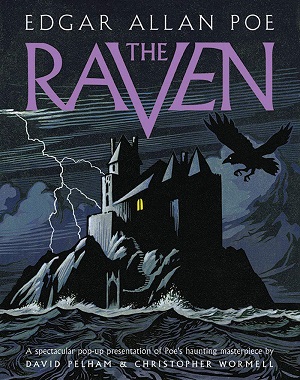
The Raven (pop-up book)

The Raven

Who doesn’t love pop-up books? I always got a kick out of them as a kid, and today, while I don’t have the same sense of wonder I had back then, I think I appreciate the skill and imagination that goes into their design even more.

And who doesn’t love Edgar Allan Poe’s poem “The Raven”? Well, maybe not as many people as love pop-up books. But as I noted in an earlier review, it’s a poem I grew up with. So two childhood favourites came together for me here.

I wasn’t disappointed! There are seven spreads in total here, with the text of the poem concealed behind flaps. I actually took some pictures but when I looked at them they didn’t do the 3-D effect of the designs jumping out from the page justice. They looked flattened.

The art is by David Pelham (the design of the paper work) and Christopher Wormell (the drawing). They work really well together and they’ve chosen moments from the poem that rhyme with the action of the paper models popping up at you. So there’s the opening of a door, or a window, or a hand (to reveal a cameo of that rare and radiant maiden named Lenore). The wings of the raven also open up in a way that in a couple of spreads mimics the action in a sort of visual onomatopoeia.

Another thing I really liked about the art is its range. It goes from the close-up, like the aforementioned cameo, to the super-sized in the book’s final spread of the narrator’s castle. And actually that final spread mixes both, as you’re drawn into the model of the castle to peer deeper into the one room that’s lit, which you can (if you squint hard) peek inside to see the narrator lying on the floor with the shadow of the raven falling over him. Great stuff!

I don’t know how popular pop-up books are these days, or how many are being produced, but if there’s work of this quality being done I hope it’s a form we don’t lose.  You can’t put something like this on an e-reader, that’s for sure.

Graphicalex

The good old days 9

And now, once your tummy starts to “show” you  can broadcast pics of your baby bump on social media. Attitudes have changed.

I think with this chapter I’ll wrap things up with my posts on the good old days. In general I think we’re much better off. But I can’t help thinking that our grandparents would be disappointed and perhaps even ashamed of us. It’s not a good feeling.

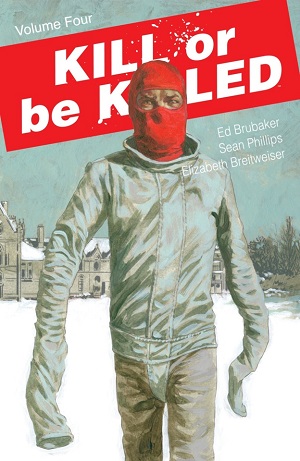
Kill or Be Killed: Volume Four

Kill or Be Killed: Volume Four

A better end to this series than I was expecting. Not because it wraps everything up and answers all my questions, because it doesn’t, but because it went places I didn’t think it would go. I like surprises, especially when I’m not sold in the first place on a story’s trajectory.

As things kick off here Dylan, the red-masked avenger, is cooling his heels in a mental hospital. He seems to have escaped his demon, whatever the hell it was, and as things progress he’s come to accept the fact that he’s just a violent vigilante. Now where all that came from is anyone’s guess, because it doesn’t appear to be part of any family history. He does have family mental health issues but they seem mostly to be associated with depression. My own expert analysis is that he’s just a young man who’s angry at all the exploitation and injustice in the world. That gives him enough of a reason to raise hell.

Anyway, his murderous proclivities don’t go into abeyance in the hospital and soon he’s plotting the murder of a staffer who is sexually assaulting the patients. Meanwhile, on the outside, a copycat killer is at work, Dylan’s girlfriend Kira is still pining over him, and both the detective who has been hunting him and the Russian mob who want revenge are closing in.

There’s a bloody climax and then a bit of a twist at the end that provides a whimsical and not very satisfying answer as to how Dylan has been functioning as a narrator the way he has throughout the series. But by this point I don’t think a satisfying answer on that count was possible. Still, I thought Brubaker did his best, and Phillips came through with some nice snowy effects that give the mental hospital scenes a suitably muffled and wintery feel, a correlative to Dylan’s confused mental state. Another plus was the fact that Kira doesn’t feature as much in this volume except at the end, where she’s made to carry too much weight with regard to the vigilante theme. This seems to arise naturally from a decayed urban environment that summons and I guess empowers what are personal demons.

An interesting series then, but one I didn’t love because of the unbelievable and unlikeable main character, the just as unbelievable love interest, and the strained plot machinery, which really creaks throughout. It’s quite readable though and the action is well handled in all regards. I’ve heard rumours it may be made into a cable series, which sounds about right. It might even work better that way.

Graphicalex

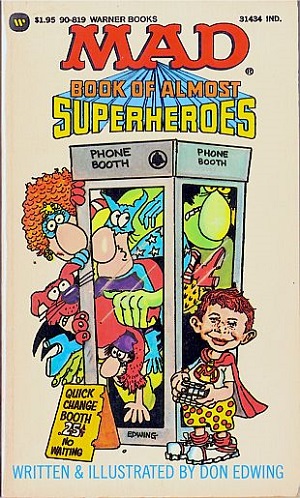
MAD Book of Almost Superheroes

MAD Book of Almost Superheroes

MAD Magazine specialized in satire, or sending up established material. So movies and TV shows. The media, mainly because they loved doing ad parodies. Political figures. That sort of thing.

I’ve previously looked at their take-offs of famous detectives. This book, written and illustrated by Don “Duck” Edwing, does something similar with superheroes. Some of these also-rans are parodies of recognizable heroes – Ms. Wonder Blunder, Fat Bat, The Macho Hunk, Superdud – while others are new inventions. Or at least they seemed like new inventions to me as I couldn’t identify any originals. In this latter camp we get Captain Trivial (“The superhero for the minor annoyances!”), Ragoo of the Jungle (“The gourmet of all comicdom!”), and The Masked Bernard (“Follow the adventures of this wonder dog of the mountain tops in his never-ending search for a fire hydrant!”).

The humour is that of the gag, running for three or four pages with a quick set-up and then a punchline. Aside from the long Ms. Wonder Blunder story, which is also the weakest piece in the book, that’s how everything is presented here. There’s a breathless structure to it, with each new gag being introduced by a quick bit of table-setting: “Meanwhile . . .” “As you remember . . .” “Suddenly . . .” “Later . . .” Different plot lines are adverted to, but they’re left unexplained. The Blue Blowfish is trying to save Buddy and Sue from being turned into jumbo shrimp, or anchovies, or French fries by Doctor Froglips, and I guess he’s successful some of the time, though we never see any of these other characters. It’s always just on to the next gag. You flip through a book like this in a single sitting, and I mean that in a good way. I don’t think I laughed out loud, but I had a goofy smile on my face through all of it.

Graphicalex

Holmes: The Stockbroker’s Clerk

You may not have heard of ghost jobs. If so, consider yourself lucky. A relatively new phenomenon, a ghost job is a fake job listing. Either no such job exists or, more likely, the position has already been filled. Companies do this for various reasons, like making it seem as though business is booming or to have a file of prospective employees at hand should they ever decide to start hiring.

I thought about ghost jobs when reading “The Stockbroker’s Clerk” because it’s another Holmes story where the plot hinges on someone being hired for a phoney job. The connection many people make is to “The Red-Headed League” but it’s also related to “The Adventure of the Copper Beeches.” It’s a device that seemed to stick in Doyle’s head.

A Cockney clerk with the wonderful name of Hall Pycroft realizes something is fishy about the job he’s offered in Birmingham, but as in the other cases I mentioned he’s willing to play along, just as long as he’s being paid. He contacts Holmes, however, to investigate his suspicions, which turn out to be well founded. The job was just a distraction, used to further a robbery scheme.

As it turns out, Holmes doesn’t have to do much. The London robbery is foiled by the police (on their own!) and Holmes only has to deal with the Birmingham side of the operation. And even then the bad guy has already given up. It’s not one of Doyle’s more inspired efforts and you could be forgiven for thinking he was tiring of things already.

Holmes index

Kill or Be Killed: Volume Three

Kill or Be Killed: Volume Three

There’s not much new to report in this review. We begin with our anti-hero Dylan shooting up the brothel run by the Russian mob, which is exactly how Volume One kicked off. And again our narrator is aware of how roundabout he’s been in his duties, leading us to think that “this entire story has been the longest flashback in history.” Some readers, he says, may have “been thinking about that the whole time.” Guilty as charged!

Even so, it’s going to take us nearly another hundred pages before we come back to the brothel and are finally “caught up.” “I know, I know,” he’ll say then, “I’m the worst narrator in history for actually getting to the point” (in history again!) But “it can’t all be action . . . right?” Sometimes there’s a need to fill us in with “some stuff you have to know before the action gets going again.”

So when I say there’s not much new to report here, that’s really a comment on the fact that this story has been spending most of its time running in place and not going anywhere. Which means the things I like are all the things I’ve liked so far, and the things I don’t like are the same as well.

Unfortunately, I wish things had been all action, or at least more action, because Brubaker and Phillips do that well. I really love those star-shaped gun blasts and the way the outbreaks of violence are set up and choreographed. The filler is either dull (Dylan’s love life with Kira) or confusing (the business with the demon).

Still, with only one volume left to go some resolution beckons. Dylan has, singlehandedly, taken out the boss of the Russian mob, an improbability that’s credited to his belief in some wisdom he picked up from the movie The Edge: “What one man can do, another man can do.” Which is absolute bullshit and made me think that getting rid of the demon was actually making the rest of the story even more unlikely. But we shall see how things wrap up before delivering a final judgment.

Graphicalex

Re-reading Shakespeare: Twelfth Night

(1) It’s a cliché to say of the opening speech that it reveals Duke Orsino to be a man “in love with being in love.” Nevertheless, like most clichés, it’s true. What’s less noticed, but I think more significant, is how self-aware he is about it. He analyzes his condition and even rationalizes it. He is fickle, to the point where the Clown later thinks his doublet should be made of “changeable taffeta” as his “mind is a very opal.” He calls for more music and then seven lines later says “Enough, no more!”

This changeableness is of a piece with the “spirit of love” itself, which is “quick and fresh.” Later in the play he will say the lover is “unstaid and skittish in all motions” save the image of the beloved, and then a few lines later he adapts this to say that even those fancies (of love) remain “giddy and unfirm.” Nothing can satisfy the spirit of love, even for a minute, except the work of the imagination. Indeed it is the fancy that is constantly undercutting love. It alone is high fantastical, which is to say it’s even better than the real thing. And so the Duke prefers to live in a world of imagination, especially if it involves lying in a bed canopied with flowers. Perhaps reading romance novels, or watching porn. OK, that modern reference may jar, but you tell me that what the Duke is describing here isn’t the Renaissance version of edging.

The Duke’s mooning over Olivia is often compared to Romeo’s love for Rosalind before he sees Juliet. And I think we all get the feeling by the end of the scene that these two posers deserve each other. But again the difference is that the Duke is aware of the fact that he’s just playing a game, as (or so he supposes) is Olivia, and that the chase is more fun than actually getting what he wants, which will only lead to his loss of appetite. He’d rather be pursued by his fell desires than have them catch up to him. And this is something he’s thought about.

Shakespeare’s great theme is the world as a stage and our lives all performances. This is most obvious in his political plays (kings are always conscious of playing to an audience), but it’s just as important in the romances and comedies. It’s certainly the structuring principle in Twelfth Night, and for the skill with which it’s introduced here I think this the best opening speech in the canon.

(2) Does Orsino’s self-awareness make him cynical? I think the shoe fits. Illyria is a profoundly cynical place. It’s not one of Shakespeare’s magical, topsy-turvy forest worlds of freedom and liberty, where “Nothing that is so is so.” That only happens when everything gets disrupted by the new arrivals. Normally, it’s a world where everything has its place and its price. I think Feste has more coins tossed at him than any other fool of Shakespeare’s. Olivia, when targeting Cesario, calculates what she’ll need to “bestow of him”: “For youth more oft is bought than begged or borrowed.” You have to pay for the young stuff! Toy boys don’t come cheap, even in Illyria. Viola, meanwhile, is offended at the notion of receiving pay for her services (“I am no fee’d post.”). She’s from out of town, and I’m left feeling that neither she nor her brother are going to be happy long in this place.

The final scene goes further in underlining the underlying nastiness. Sir Toby isn’t a jolly Falstaff (to which he’s often compared) but an angry drunk. Which is to say, the worst kind. His line “I would we were well rid of this knavery” after the abuse of the imprisoned Malvolio is often seen as his expressing a moment of conscience. In fact, as the immediate follow-up makes clear, he is only concerned about offending his niece and putting his longer game at risk. In his final lines he explodes on Sir Andrew in an uncalled for way, revealing the hate that fuels his cruel pranks. Orsino threatens Viola with some unspeakable torment (“My thoughts are ripe in mischief”) just to spite Olivia. It’s all about getting back, getting revenge: “I’ll sacrifice the lamb that I do love. To spite a raven’s heart within a dove.” Not nice! But not to be outdone in this orgy of nastiness, Feste turns out to have been a bitter grievance collector all this time, waiting for the “whirligig of time” to bring him his revenges on Malvolio. You’d think a professional fool would have a tougher skin. And finally Malvolio stalks off threatening his own revenge on everyone, and not without cause.

What was Malvolio’s crime? “He hath been most notoriously abused,” but why? Because he’s a Puritan spoilsport? I don’t think so. I think a more likely reason lies in the way cynical people naturally tear each other apart. Malvolio may be a responsible steward (and in that household someone has to do the job), but he’s also a climber who gives himself airs. Imagine him having a chance with Olivia! As the Reverend Elton explains to Emma, “Everybody has their level.” And he (the Reverend) should know, as he was trying to be a climber too. Sir Andrew is, unconsciously, also aware of this: delighting in playing the same trick on Malvolio that is already being played on him. That’s psychologically apt and a very nice touch.

What I mean by cynics tearing each other apart is that when you’re just using people to get ahead the thing that really makes you mad is seeing other people using people to get ahead. Malvolio at least has a job; Sir Toby and Maria are only mean-spirited parasites, feeding off Olivia or Sir Andrew’s three thousand ducats a year. And being parasites they see everyone else as having the same jealous motivations. Malvolio is a threat not because he’s a killjoy but because he’s competition. The same sort of attitude can be seen in Valentine’s suspicion, noted by Viola, of how quickly Cesario has risen in Duke Orsino’s affections. This is just the kind of place Illyria is. Cynical. Nasty.

(3) What with all of the present day’s obsessions over gender fluidity and gender obsessions, Twelfth Night is as current now as it’s ever been. Is the play’s interest in these matters superficial though? Is there anything more to it than just cross-dressing and a change of pronouns?

Instances of true homosexual attraction are rare in Shakespeare. Seeing any of that going on involves a fair bit of reading between the lines, and building up cases of same-sex affection that may have been only literary conventions in 1600. These same conventions may have been strategies to work around the fact that Shakespeare couldn’t very well have presented a loving homosexual couple on stage at the time. Antonio in this play (much like Antonio in The Merchant of Venice) is one example of a same-sex bond that today we’re likely to look at as representing sublimated sexual feelings. It just seems as though there must be something more going on in this place than friendship can account for.

That said, Duke Orsino wins my vote as the most openly gay character in Shakespeare. Of course here we’re reading between the lines here too, but many critics have pointed to the significance of the way Viola never puts on her “woman’s weeds” at the end of the play, and that Orsino takes her hand calling her “boy.” As Tony Tanner puts it: “It is possible that Orsino actually prefers her as Cesario – the adoring, beautiful boy servant.” Which is much like the role Olivia has in mind for him.

But then, Viola seems to like being Orsino’s boy. There’s no particular reason why she adopts male dress in the first place. What should she do in Illyria? Why, play dress-up. Sebastian, in comparison, just wants to wander about and play the tourist: “let us satisfy our eyes / With the memorials and the things of fame / That do renown the city.” Then he’ll hit the pub. But Viola jumps right away at the chance to play a eunuch and then a young man. I wonder if she heard something more about Orsino from her father, and she chooses to put on drag to conquer. All of which makes me ask what Sebastian means when he says that “nature in her bias drew” Olivia to Cesario. Is it a bias in Orsino’s nature that drew him to the same boy?
Druuna: Morbus Gravis II

Druuna: Morbus Gravis II

In my review of Morbus Gravis I I noted parenthetically how Heavy Metal magazine had just recently ceased print publication. This is a real shame, as it was a terrific mag with high standards for art and storytelling throughout most of its history. What it also means though is that these Druuna books have become collector’s items. For a cover image I actually had to take a snap of my own copy of Morbus Gravis II as I couldn’t find one online (sorry for the glare!). On Amazon a copy in the same condition as mine would set you back at least $250.

So everybody’s favourite (well, at least my favourite) post-apocalyptic babe is back, with her boobs out and her red thong only being replaced, as occasion demands, by some vintage lingerie, or nothing at all. Things begin with romantic sex on the beach, followed by some post-coital posing (“I want to admire your body for one last time . . .”), before our hero wakes up and it’s revealed she’s been having some kind of mind-sex with Lewis, the guy who was running the ship before Delta (the computer system) took over. Now he’s just a head floating in a tank, sharing a telepathic link with Druuna, falling in love with her but also dreaming of finally being allowed to die. The story, such as it is, has Lewis sending Druuna on a mission to destroy the “tower of power” that keeps Delta running.

There’s nothing remotely politically correct about any of this. Not only is Druuna raped, but she likes it. Ditto for the bald-and-busty friend she picks up. Which may be meant as empowering but I doubt it. Not when a dominatrix in a leather skirt, wielding a riding crop, shows up and we’re told her name is Seka (the screen name of an actress known in the 1980s as the Platinum Princess of Porn). We know where Serpieri is coming from, and where he’s going to.

But it’s not just sex and violence that are near allied but love and death, Eros and Thanatos still going at it. I do think this is a comic with something to say. And Druuna isn’t just suffering the misfortunes of virtue in this world. She’s a true goddess. “In these times of hunger and death,” one brutal lover says, “the fact that you exist defies reality.” Only in a comic book I guess.

Graphicalex