I don’t rate the Lord Peter Wimsey mysteries by Dorothy L. Sayers among my favourites, but I do give them credit for being better written and less formulaic than the usual detective fare. Sayers wasn’t afraid to try new things, and it’s notable how she plays a bit with the way this story is presented, beginning with a big chunk of exposition taking the form of a transcript from a murder inquest. Then there is the matter under consideration, which is wrapped up in a bait-and-switch fashion that would, I think, leave most mystery lovers shaking their heads and smiling just a bit. When is a murder mystery not a murder mystery? I won’t give that one away.
Unlike Whose Body?, which had a wacky body-swapping premise playing out in London, Clouds of Witness presents itself as a more traditional country-house mystery. A bunch of aristos, including Lord Peter’s brother Gerald, the Duke of Denver, and Peter’s sister Lady Mary Wimsey, have gathered at a hunting lodge in Yorkshire. One night the body of Mary’s fiancé, Denis Cathcart, is found shot dead just outside the conservatory door. Because they’d recently had a big argument, Gerald is arrested for Cathcart’s murder, and he doesn’t help his case any by telling some silly stories about what happened on the night in question. Obviously he has something to hide, as does Mary herself. So “the Sherlock Holmes of the West End,” without a lot of help from his siblings, has to go to work to find the real murderer aided only by his “confidential man and assistant sleuth” Bunter and Parker of the Yard.
Sayers has fun tossing around a basket of red herrings before having Lord Peter descend in an airplane arriving from the U.S. as a deux ex machina to save his brother (and the family name). Along the way there are the sort of references that I said in my review of Whose Body? probably require footnotes today. That is, unless you’re the kind of person already familiar with the story of Earl Ferrers (pass notes: the last peer of the realm to be hanged as a common criminal, in 1760) and the Seddon Case (a notorious case of poisoning that was tried in 1912). You also might want notes to let you know what a clerihew is, or that Lord Peter is freely adapting lines from The Merchant of Venice when addressing a ditch. I’ll admit I wasn’t sure about that one and had to look it up. I did not have to look up the word “taradiddle” though, having already discussed it on this blog. But I have to say its appearance here still bothered me, and left me a bit confused as to how it is (or was) regularly used. I think Lady Mary just means a fib.
Moving on to more important matters, there’s a lot of class commentary that I’d like to say is meant to play as comedy but feels like something more. Of course Lord Peter is the ultimate toff. The novel’s first sentence has him waking in Paris, stretching “himself luxuriously between the sheets provided by the Hôtel Meurice.” Soon after, Bunter arrives to inform him that “Your lordship’s bath-water is ready.” For Lord Peter, being a detective is just a “hobby,” and that only one among many:
To Lord Peter the world presented itself as an entertaining labyrinth of side-issues. He was a respectable scholar in five or six languages, a musician of some skill and more understanding, something of an expert in toxicology, a collector of rare editions, an entertaining man-about-town, and a common sensationalist.
All that, and more, being said, Lord P is also a distinguished veteran of four years of combat on the Western Front and can handle himself against muscular ruffians when things get physical. Truly a man of many qualities.
Where I think the class issue comes more into play is in the sexual hijinks. There’s lots of bed-hopping among the lesser nobility, as both Lord Denver and Lady Mary like to slum it between the sheets in adulterous or nearly-adulterous fashion. Mary has agreed to marry Denis, but only to keep up appearances: “I didn’t care about him, and I’m pretty sure he didn’t care a half-penny about me, and we should have left each other alone.” She’d actually been planning on running off with “some quite low-down sort of fellow,” “a Socialist Conchy of neither bowels nor breeding” with the dismal name of George Goyles who’s a member of the Soviet Club but who only likes to talk the talk. (“Conchy,” in case you were wondering, is short for “conscientious objector.” I had to look that up as well.) Goyles, it turns out, was really just looking to sponge off the family’s wealth. This leads to a family discussion that is the funniest part of the book, and I’m sure intentionally so. Nevertheless, it’s not a very edifying portrait of the nobility, with Mary only agreeing to marry Denis so long as “she should be considered a free agent, living her own life in her own way, with the minimum of interference.” This is the 1920s mind you, and what being a “free agent” means is basically having an open marriage, among other things. Add to this the fact that Denis, much like Mr. Goyles, has no interest in Mary aside from her money and only wants (in his own words) to go on “keeping my mistress on my wife’s money” and we start to think like D. H. Lawrence about how beastly are the bourgeoisie.
Nor is Gerald, the Duke of Denver, much better in this regard. He’s married, but is carrying on an adulterous affair with a local beauty in Yorkshire, who is also married. This actually puts her life at risk as her husband is an abusive brute. You’d like to think that some things just aren’t done, but the fact is that they are done. Apparently quite a lot. It’s easy to skim over a comment made in the report on the inquest, that “In the kind of society to which the persons involved in this inquiry belonged, such a misdemeanour as cheating at cards was regarded as far more shameful than such sins as murder and adultery.” We’ve been warned.
The Duke of Denver does have some standards though, choosing to protect the identity of his rustic mistress even to the point of putting his own life and liberty in jeopardy. And this is a source of comedy too, as comes out when he meets with his brother just before the trial and explains his own theory on how the justice system should work:
“It ain’t my business to prove anything,” retorted his grace, with dignity. “They’ve got to show I was there, murderin’ the fellow. I’m not bound to say where I was. I’m presumed innocent, aren’t I, till they prove me guilty? I call it a disgrace. Here’s a murder committed, and they aren’t taking the slightest trouble to find the real criminal. I give ‘em my word of honor, to say nothin’ of an oath, that I didn’t kill Cathcart – though, mind you, the swine deserved it – but they pay no attention. Meanwhile, the real man’s escapin’ at his confounded leisure. If I were only free, I’d make a fuss about it.”
Ah, such naivety. As the high-powered defence lawyer had earlier explained to Lord Peter, a criminal trial forgoes such illusions. “I don’t care two-pence about the truth,” he says. “I want a case. It doesn’t matter to me who killed Cathcart, provided I can prove it wasn’t Denver. It’s really enough if I can throw reasonable doubt on its being Denver.” This is a point most laypeople should keep in mind. Trials are never about discovering the truth. They are about the preponderance of evidence. To win, a lawyer doesn’t need the truth but “a case.”
It’s a silly story, but at least it’s not quite as silly as Whose Body? Perhaps because I was reading it at the same time, I thought I saw various connections to The Hound of the Baskervilles, from the sucking bog to the exotic beauty of Mrs. Grimethorpe mirroring that of Beryl Stapleton. But perhaps I was just imagining things. In any event, I think most readers will guess what’s going on ahead of schedule. “What frightful idiots we were not to see the truth right off!” Lord Peter says to Parker. And he was. Meanwhile, the actual events of the fatal evening involve such a crazy series of coincidences that one is reminded again of farce. And the business of Lord P hopping on a plane for a quick skip across the pond to get the evidence he needs to save his brother struck me as a bit much. But this was entertainment a hundred years ago. It was a different sort of place. I mean, out in the country Lord Peter is still getting around by dog-cart.
Sayers began working on Clouds of Witness as she was still writing Whose Body?, so obviously she was already planning on Wimsey being a franchise figure she could surround with a cast of recurring supporting characters. The ball was just starting to roll.
Wimsey index
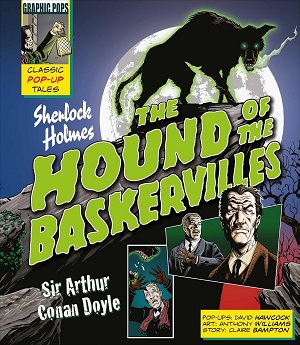 Part of the Graphic Pops series, this is a well done pop-up version of the classic Sherlock Holmes novel. The tale is told in graphic novel form, with most of the text coming in French flaps, leaving the paper artist (David Hawcock) to do his thing in seven showpiece spreads. I thought these were very good, with only a couple (the apartment at 221B Baker Street and Baskerville Hall) being a bit dull. The others are all striking (as pop-ups should be) and make good use of the form for some imaginative effect. The one pull tag is in the spread where Watson draws his gun in the hut on the moor, which also has a door flap to reveal Holmes as he first puts in his appearance. There are a pair of rhyming spreads with the hound and Holmes standing dramatically on clifftops. And there’s a final appearance of the hound’s head that is neat because as it unfolds/pops-up you see inside the hound’s mouth, until its jaws snap shut when the book is fully open and the covers laid flat.
 Alex Good