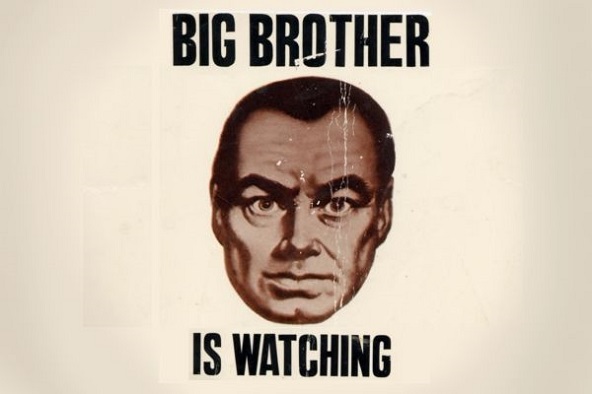
Doing it to ourselves

He seems like a nice enough guy.

He seems like a nice enough guy.

The problem isn’t a new one. It’s been sixteen years since Scott McNealy, co-founder of Sun Microsystems, famously opined “You have zero privacy anyway. Get over it.”

It’s also not an obscure bit of news. The revelations by Edward Snowden about the extent of government surveillance made headlines, at least once they finally broke through the political barriers (there was some initial reluctance to run with the story, especially in the American media).

So the war on privacy is no secret. Nor is the identity of who is behind it: an alliance of big business and big government. Their goal is also openly acknowledged: profit and control. In the digital age information is an asset, identity a commodity.

The more troubling question is why this has been happening, given all of the warnings, and all of the reports of the immense personal costs involved. We may forget, for example, that in the United States a woman’s right to an abortion was located by the Supreme Court in the right to privacy in the landmark Roe v. Wade decision. And the disastrous results of exposing ourselves on Twitter and social media have been recently documented by many commentators, including Jon Ronson, who recently looked at cases where jobs have been lost and lives destroyed by momentary lapses of judgment leading to mass social shaming. At the same time, employers have taken workplace electronic surveillance to new extremes, giving rise to an entire industry described by Esther Kaplan in the most recent Harper’s, in an essay titled “The Spy Who Fired Me.” And it seems there’s no end to the invasiveness, as a report from CBC News (I at first thought it must have been satire from The Onion) indicates:

Workers at a new high-technology office building in central Stockholm are doing away with their old ID cards on lanyards, and can now open doors with the swipe of a hand — thanks to a microchip implanted in the body.

The radio-frequency identification? (RFID) chips are about 12 mm long and injected with a syringe.

“It’s an identification tool that can communicate with objects around you,” said Patrick Mesterton, CEO of the building, Epicenter Office.

“You can open doors using your chip. You can do secure printing from our printers with the chip, but you can also communicate with your mobile phone, by sending your business card to individuals that you meet,” he said.

Mesterton thinks some of the future uses for implanted chips will be any application that currently requires a pin code, a key or a card, such as payments.

“I think also for health-care reasons … you can sort of communicate with your doctor and you get can data on what you eat and what your physical status is,” Mesterton said.

“You have your own identification code and you’re sending that to something else which you have to grant access to. So there’s no one else that can sort of follow you on your ID, so to say. It’s you who decides who gets access to that ID,” he said.

The implant program is voluntary for the workers in the office complex.

“It felt pretty scary, but at the same time it felt very modern, very 2015,” said Lin Kowalska shortly after she had a microchip implanted in her hand.

Yes, it’s voluntary. Any resistance to Big Brother is made all the harder by the most sinister aspect of this erosion of the private sphere: we’ve done this to ourselves. A piece by Andrew Couts in Digital Trends explains the real problem:

Nearly 1 billion people around the world have signed up to divulge endless details about their lives on Facebook, which has in turn used our willingness and need to share ourselves into a multi-billion dollar business. The same goes for Google, Amazon, Twitter, Pinterest, Foursqure, and countless other companies that trade the ability to connect for our personal data.

Yet, despite the growth of these services, an opposing undercurrent still flows through a segment of the population. Anytime Congress or corporations make a grab for our data, “privacy advocates,” that dying breed, cry out “Injustice!” for the rest of us. They warn us of the dangers of allowing such information sharing. “Do you really want the corporations and the government reading your emails and text messages?” they ask in a grave, incredulous tone. Based on the relative quietness of our public outrage, the collective answer seems to be, “Sure, why not?”

McNealy said privacy was dead 12 years ago, and things have only gotten worse. This isn’t just troubling, it’s downright weird. Why do we freely handed over the details of our lives? Is privacy really that invaluable?

Regardless of which came first — Facebook’s desire for greater openness, or ours — it is clear that we have given the social network, and all other companies and governments that benefit from voluntary personal information sharing, exactly what they want without putting up a fight. The death of privacy as a common value is our own fault. We allowed it to die, and continue to expedite the smothering by making it appear as though anyone who wants to maintain pre-Facebook levels of privacy has something to hide. Privacy is no longer an ideal, it’s a dirty word.

In other words, we have come to love Big Brother. But why? In an essay I wrote for Canadian Notes & Queries several years ago I found myself asking the same question with regard to why we were so eager to toss so much of our cultural infrastructure onto a digital bonfire. The resulting “culture crash” was widely predicted (indeed its effect were already being felt), but the warnings were just as widely ignored.

The answer I came up with then was that it was part of the larger culture of narcissism. As we have become less politically active and involved we have retreated into a smaller circle of self, a process predicted by Alexis de Tocqueville and analysed by Robert Putnam (in Bowling Alone). As Colin Robinson, writing in the London Review of Books, put it a few years back: “In an increasingly self-centered society a premium is placed on being heard rather than listening, being seen rather than watching, and being read rather than reading.” When posting status updates on Facebook trumps looking at porn, and studies have shown this is now the case, then you know some kind of threshold has been passed.

It’s a downward spiral. As we’ve become less connected to others we’ve begun to fear them more. We crave security, though not from any of the people collecting all this information. Ten or perhaps twenty years ago anyone suggesting a national DNA registry would have been met with incredulity or even outrage. Now I know a lot of people who support the idea. In the face of such an abject and willing surrender of one’s personal identity to the powers-that-be (both corporate and governmental), what hope is there of mounting popular opposition to such invasive data collection? Humanity is being reduced, and it seems we’re good with that.

Just don’t kid yourself into thinking there’s any way back to the garden.

Would a real liberal please stand up?

Tom Holland chose an interesting pair of contrasting epigraphs by ancient authors who were contemporaries for his book on the fall of the Roman republic, Rubicon:

“Human nature is universally imbued with a desire for liberty and a hatred for servitude.” Caesar, Gallic Wars

“Only a few prefer liberty — the majority seek nothing more than fair masters.” Sallust, Histories

The points of view contrast, but are not contradictory. It’s Sallust’s cynical reflection, however, that gets more play in a recent essay by John Gray reprinted in Harper’s (January 2015):

Most human beings, most of the time, care about other things than more than they care about being free. Many will vote readily for an illiberal government if it promises security against violence or hardship, protects a way of life to which they are attached, and denies freedom to people they hate.

Today these ideas belong in the category of forbidden thoughts. When democracy proves to be oppressive, liberals insist it is because democracy is not working properly — if there were genuine popular participation, majorities would not oppress minorities. Arguing with this view is pointless, since it rests on an article of faith: the conviction that freedom is the natural human condition, which tyranny suppresses.

Liberalism can be its own worst enemy. I don’t mean that in the ancient formula of liberty breeds license, and license chaos, then chaos begs for an end to liberty. Just as prevalent as the liberal mindset Gray critiques is the neo-liberal world view also known as market fundamentalism. Free markets lead to free people, or so we’re told. Yet this isn’t what happened when the Chicago boys put Pinochet in power in Chile. And it’s the opposite of the so-called “Beijing consensus”: the surrender of political rights for economic growth and higher standards of living. Slavery is freedom.

Gray is concerned that the triumphalist idea of freedom as destiny, that history is on the side of liberal values worldwide, makes it harder to deal with the world as it is. “Coping with that world requires realistic thinking of a kind that the liberal mind, as it exists today, is incapable of.” But you have to wonder who believes this liberal myth. George W. Bush was one of its biggest cheerleaders during his presidency, seeing the spread of freedom and democracy not only as America’s mission but as divine providence. (Example: “The momentum of freedom in our world is unmistakable – and it is not carried forward by our power alone. We can trust in that greater power Who guides the unfolding of the years. And in all that is to come, we can know that His purposes are just and true.”) But this was freedom out of the barrel of a gun, and the only form of democracy being promoted was one that gave cover to governments friendly to American interests. Or take as another example today’s digital oligarchs and the mantra “information wants to be free.” Only if it’s other people’s freedom, says the fine print. Google isn’t giving anything away.

I know it’s become a slippery word, especially in American politics, but it still makes you wonder: Just what is a real liberal anyway?