As part of my ongoing series of playing chess at the 1000 Elo level, I present my masterpiece of a smothered mate, defined by Wikipedia as a “checkmate delivered by a knight in which the mated king is unable to move because it is completely surrounded (or smothered) by its own pieces.” This usually occurs at the edge or corner of the board, so this one was especially pretty.
random thoughts
Take it to the bank
Yesterday I visited the local branch of my bank to do a little in-person banking and found myself unable to proceed beyond the vestibule because the inner door was locked. I could see people working inside and since it was only 1 p.m. I knew they were open. I rattled the door to get someone’s attention and a person inside pointed to the door. I assumed this meant to pull harder, but that didn’t work. They pointed again and I saw a small sticker attached to the door saying new (unspecified) security protocols were being put in place. There was no explanation for why the door was locked.
Finally the one customer in the bank at the time left and someone from a back room came out and let me in so I could go to the teller. He informed me that they were only letting one person in at a time for security reasons. He asked if I could do my banking in the vestibule at the ATM. I told him I could not. Why did he think that I was waiting to be let in? I said they really needed to put up a sign explaining what was going on. He said he thought there was a sign. We both looked and he seemed mystified that there was no sign. He was sure there had been a sign at one point. He thought putting up a sign would be a good idea.
At the teller’s, I asked if the bank had been experiencing problems with bank robbers. “You could say that,” the teller said, without lifting his eyes from his computer screen. I later went online and saw that there had been an attempted bank robbery in another part of the city the day before. Apparently a couple of guys came in wearing motorcycle helmets, demanding cash. They didn’t get any and so drove away. It didn’t seem like much of a plan.
As I did my business at the desk another customer entered the vestibule and started rattling at the door, a totally perplexed and increasingly angry look on his face. When I got done the same fellow from the back room appeared and ushered me out and let the new person in. I repeated that they needed to put a sign up explaining what was going on. He agreed and said he was going to “tell them about it.”
In brief, another one of those incidents where you just wonder what’s wrong with the world and the people in it. If you’re going to lock the doors to your business while you’re still open for business, putting a sign on the door explaining what’s going on isn’t just a good idea. Get a sheet of paper and a Sharpie, write a message like “Only One Customer Allowed Entry at a Time,” and then tape it to the door! I know banks are doing all they can to discourage in-person banking, but this is ridiculous. There are days when the world doesn’t make sense to me anymore.
More books!
I’ve been attending the annual Friends of the Guelph Public Library Book Sale for the last several years, and writing about it has become a part of the whole experience (see my take on the 2016, 2019, and 2022 editions). So here we go with notes on the 2023 experience!
First off, they moved the date up a month this year and I approve. It’s still a nice walk downtown in September, whereas in October, at night, it can get pretty cold and it’s hard to decide how to dress since I’m on foot and it’s quite a hike back carrying heavy bags of books, which means I can overheat quickly.
I’m quite proud of myself managing that hike home, by the way. It’s a sort of test of strength and general fitness. Over an hour’s march, carrying approximately 50 pounds of books, up one major hill (at least a major hill for Guelph). And it’s a test I passed again this year! I’m not an old man yet.
Anyway, back to the sale. For whatever reason I arrived quite early for the first day of the sale and was number 20 in line to get in. I’m usually nowhere near that close to the front. This made me consider my book-buying strategy when they opened the doors and we started going in. What were the most popular areas likely to be? I should hit them first, as they’d be picked clean of any treasures fairly quickly.
The areas I spend most time in are history, military history, politics, and true crime. But those rooms also draw the fewest book buyers. On the other hand, I knew that the room for graphic novels would be hit hard, early. Which is what happened. Despite being so close to the front, by the time I got to the graphic novels/comic books room a pair of buyers had already shoveled nearly half of what was on offer into boxes. I mean, they were really clearing things out. I was not impressed, especially as they were both wearing hoodies pulled up over their heads. What was up with that?
Luckily for me, Team Hoody had begun by grabbing all the manga books and I had no interest in them. So I did manage to score six Marvel Essentials anthologies in mint condition. These sell for $45-$50 each if you buy them new. Even from discount booksellers online I pay $15-$20 for them. These cost me $2 each! Quite a haul! I was glad I decided to hit that room first. After a couple of days there were literally no comics left.
Something else that caught my eye was someone getting out their phone to scan titles and one of the volunteers telling him that wasn’t allowed. I’d thought scanning bad behaviour when I first noticed people doing it five years ago, but I didn’t think there was anything strictly wrong about it. Still, when I checked the sale’s webpage there was a notice saying “NO SCANNING PLEASE,” so I guess everyone had fair warning.
I went back twice to visit the sale on subsequent days (it runs for five days), and had a good time even if it seemed as though the selection was a bit poorer this year. Here are some other observations.
I enjoyed buying one history of the Vietnam War that looked like new and when I opened it up I found the sales receipt tucked inside from 20 years ago. Never read! But it will be now.
On my second day I waited in line with a woman who was a big collector of DVDs. There’s a room of DVDs at the sale where you can get any DVD (or boxed set) for $1 and that was the only room she was interested in. She was telling me she had 4,000 DVDs at home. She doesn’t stream and doesn’t even own an iPhone or other such device. An old-school lady after my own heart, except she wasn’t interested in books.
I had a hard time figuring out why puzzles were so expensive. $7? I’ve had to do a lot of puzzles since COVID (helping out with care for a sick family member) and my sister usually picks them up in bulk from flea markets where they run between $1 and $2. Which is what books cost at the sale. Why should a puzzle cost so much more than a book? It’s not like you do many puzzles over and over again, so once you’re done with them they just get donated to charities so they can go back into circulation.
The final day of the sale they price dropped everything, something that, for the first time, they didn’t do last year. This made DVDs 5-for-$1. So I picked up 10 that I likely wouldn’t have bought if they’d cast more than 20 cents each. I also got more books and made the final hike home up Gordon Street Hill.
Until next year!
Jumping the gun
Last week I noticed a couple of houses in my neighbourhood had Halloween decorations out. One clever one I liked had a full-size skeleton pushing a lawnmower. But isn’t mid-September a bit early? I don’t know what the rules are for these things, or if there are rules, but I would have thought three weeks or a month in advance would be the limit.
Everyday rudeness #6: Sidewalk avoidance
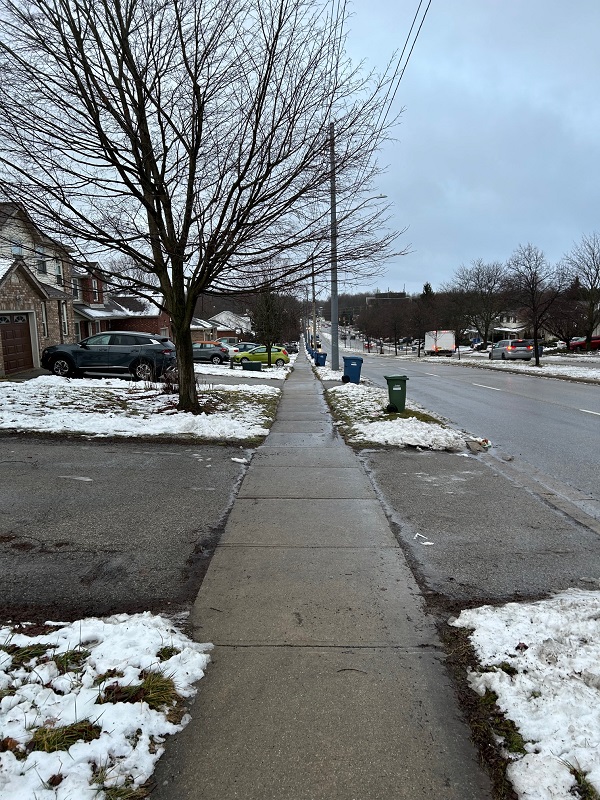
One of the most annoying aspects of the public response to COVID was the insane attitude some people insisted on taking toward social distancing. The one moment that has stayed with me is the young person I was walking toward on the sidewalk in the winter a couple of years ago who scrambled so desperately to get off of the sidewalk and into the road — so she wouldn’t have to walk past me (insisting on keeping a distance of not 6 feet but over 12) — that she got her legs stuck in a snowbank and fell rather awkwardly. I was literally dumbstruck by this performance, and at the time referred to such people as “deeply disturbed.” I mean, by the time this happened it had been made abundantly clear that it was highly unlikely, if not impossible, to get COVID simply by walking past someone outdoors.
A couple of months later I had this to say in my COVID-19 post-mortem:
Even in the first months of the pandemic I never wore a mask outside, thinking just on the grounds of common sense that it was useless. I wasn’t going to get COVID just by walking past someone. And yet wearing a mask outdoors still seems to be a sort of virtuous fashion statement for many, even in the wee hours of the morning when there’s no one about, as does the annoying habit of running to the other side of a street to avoid passing someone on the sidewalk. This is taking hygiene theater to an extreme, and in a way that sends a confusing message. Are such people saying that they’re infected and that we should avoid them? I don’t think that’s what they mean, but it’s the most logical interpretation for their behaviour.
I wonder how much of this acting out will change in the months to come. In an earlier post I referred to the split between double-maskers and anti-maskers. Apparently there is another group known as ultra-maskers, who are defined as individuals who are going to continue to wear masks, everywhere, for the rest of their lives. This suggests a real mental illness.
Well, these people are still with us. Yesterday, while walking through the same neighbourhood I have every day for the last four or five years, I passed no fewer than three individuals who walked out into the road rather than have to share the sidewalk, ducking back onto the sidewalk once they were past me.
Two years later, I no longer see this as a mental illness so much as a way of performing an act of outrageous everyday rudeness. This was an opinion the woman I was with yesterday, a healthcare professional as it happens, heartily agreed with.
I can’t understand this behaviour. It is definitely a product of the COVID hysteria (and look, COVID was real and we all should have got vaccinated and worn masks indoors, but I’m talking about this kind of overreaction). It’s something I can’t remember I ever saw happening once in my entire life before the pandemic. Not only that, it’s now well known that such behaviour was never of much if any utility in avoiding infection in the first place. Pretty much the only way you could get COVID while outside was to stand in close proximity with someone who had it, while talking to them (or better, shouting at them) for an extended period of time. So maybe if you were packed into a crowd at a concert or sporting event. But even then the chances of transmission were said by experts to be exceedingly small.
So swerving out into the road is just meant to be an insult. It’s rude behaviour, shockingly rude in my opinion. Even worse, it looks as though it’s never going to stop. I mean, if these people are still at it now what would it take for them to ever go back to acting normally? They’ll never feel safe.
Disaster tourism
Recent weeks have seen record-setting heat waves in the United States and southern Europe. In Greece wildfires have been raging and thousands of tourists had to be evacuated from the island of Rhodes. Overall, July is set to be the planet’s hottest month ever recorded, leading the United Nations Secretary General to declare “The era of global warming has ended. The era of global boiling has arrived.”
Scientists have pointed to “absolutely overwhelming” evidence of human-induced climate change in the latest wave of high temperatures. One contributing factor to climate change is air travel, though people argue as to how significant a factor it is. From what I’ve read, air travel causes about 3% of the warming all human activities cause. But make not mistake: that’s a lot. One stat I saw says that if the aviation sector were a nation, it would be among the top 10 global emitters, and that it is responsible for 12 per cent of transportation emissions. So it makes a real difference. And it’s almost entirely unnecessary.
Now personally I don’t travel much, and I think the last time I was on a plane was twenty years ago. But I get that a lot of people like to travel. Indeed, that’s the problem. It’s a sector that’s expected to grow significantly in the next couple of decades. Tourism is projected to generate up to 40% of total global CO2 emissions by 2050. The effect of such growth won’t help the planet, especially as any new energy efficiencies in air travel will be more than offset by more frequent flying.
But I’m not flight shaming here (flight shaming being the name of the anti-flying social movement). Like I say, I get that people want to travel. During the COVID lockdown I had to stand witness to two acquaintances, both retirees, literally break down in tears at the fact that they were somehow being cheated of going on more vacations before they died. It was embarrassing, but it revealed just how important travel is to a certain segment of the population. Because I guess there’s nothing else for them to do. So even if it’s not a feeling I share, I can at least say I get it.
Anyway, these recent headlines were brought home to me yesterday as I was talking to a friend whose sister and brother-in-law are currently vacationing in Greece. I gather they’ve been complaining about it. The heat. The fires. And it made me think of the cognitive dissonance this must involve.
The vacationing couple are wealthy retirees (she was a government lawyer, he was an academic) with no kids. And they travel a lot. They have three international vacations planned this year alone, and they travel deluxe all the way. But hearing about how they were grousing over the impact of climate change on their trip triggered me a bit.
As I see it there are several different responses one can have to living this kind of apex-consumer lifestyle in the present day.
(1) The travel Neros: this was a name given to a movement a while back where global warming was taken for granted, with frequent flying being a major contributing factor. But the travel Neros took the position that the world was going to burn to a crisp anyway so they were going to party while it fried. Maybe not socially responsible behaviour, but it’s a position that has its own integrity.
(2) The deniers: climate change is all a hoax foisted on us by the Chinese or global elites or killjoy environmentalists. Don’t listen to them! Keep consuming! After all, if you damage the economy in any way trying to save the planet, the cure will be worse than the disease! Not a position I agree with, but again at least it holds together as a belief system.
(3) Those who acknowledge climate change is real and air travel is only making things worse, but feel that their own personal contribution doesn’t make a difference: here is where I think the cognitive dissonance comes into play. “It would be better if people didn’t fly as much, but since they do it would be stupid for me to give up one of life’s great pleasures just for some benefit to the planet that I likely won’t benefit from anyway.” To my eye, this is just casuistry. How, I wonder, do the tourists in Europe this summer feel the heat and see the clouds of smoke on the horizon and say to themselves “This has nothing to do with me. I hope they get it all fixed up when I come back next year.”
As I say, the whole conversation I had with my friend ended up really triggering me and I said something about how what the the vacationers were experiencing in Greece was due in part to their being there in the first place. This was met with the response that that couldn’t be true because Canada has been wracked with forest fires this summer and those forests weren’t being overrun by tourists. Honestly. This was one of the stupidest things I’ve heard in a long time.
After I explained (in my typical, hard-to-follow and sputtering way) how climate was a global system and was affected by human activity everywhere, with its effects experienced differently in different places, I got a more realistic, though even more depressing response. The vacationers were retired, you see. And, well, what else was there for them to do? How were they going to stay occupied in their remaining years except by traveling? (And they had both taken early retirement and were only in their early 60s, so they potentially still have a lot of time ahead of them to, you know, burn.) And then there was the matter of their being rich. What else were they going to spend all their money on? What could they spend it on?
It may well be that our entire civilization is going to die of affluence and boredom.
Feel the burn
Last week we had a bit of a pre-heat wave in these parts, giving us an early taste of summer. Winter jackets came off and people were walking around in tank tops and shorts. Or less. This leads me to offer the following public service announcement.
People: the sun is not your friend. First off, it leads to skin cancer. Tan a luscious dark brown every summer and you’ll be spending your senior years suffering the death by a thousand cuts of having bits and pieces of yourself sliced off by a skin specialist. And some of those pieces won’t be small!
Even if you avoid cancer, the effect of the sun is to age your skin considerably, causing greater wrinkling and sagging and the growth of thick (non-cancerous) warts and lesions on the skin.
And even if you don’t notice those effects right away, you will feel the burn of having fried your and having it peel for the rest of the week.
Meanwhile, what is the upside? You think you look a little better? I think even here the tide is finally starting to turn against tanning. I anticipate a return to the beauty standards of the 18th century (or earlier), where women cultivated a “moon look” of ivory skin. A tan was the mark of a peasant, someone who spent a lot of time working outdoors. I don’t approve of the class distinctions, but I’m on board for the aesthetic.
Nor is there any need today for outdoor laborers to burn all summer. Wear a shirt! You won’t die! Every summer I see roofers working shirtless all day. When I was having my own roof done five or six years ago I was talking to one of the crew and mentioned my concern, telling him he’d be better off with a shirt on. He said he was aware of the danger but put on sunscreen. I had to shake my head. What is a safe sunscreen these days? SPF 50? 70? And it doesn’t last all day. If you’re doing a job like working on a road crew or roofing you’d have to be slathering it on every couple of hours. Something I very much doubt many workers are doing. So just wear a shirt.
Personally, I always wear a shirt with a collar whenever I go out in the summer now. The collar to keep the rays off my neck. That sun is just too strong. And yet last week I passed yard workers working outside in tank tops with arms so red you could practically hear their flesh sizzling. I winced seeing them. I also passed by a house being rented by a bunch of university kids who were sunbathing on the roof in shorts and bikinis. And as hard as it is for me to say this, I was wishing the girls in bikinis would have covered up.
In the future, and this is something I’ve admittedly been saying since the early ’90s, tanning is going to be looked on as the equivalent of smoking today. Meaning not just stupid and unhealthy but downright dirty. Now I know there are plenty of people out there who will object because they love tanning, or they own a tanning salon, or whatever. But leaving matters like that aside, it seems to me that the health considerations are irrefutable. Exposing your skin to a lot of sun is just plain bad for you. Don’t do it!
NSFW: Archeology edition
When I was in first year of university I took a course that I don’t remember very much from except something about “cultural universals.” This refers to things that people do in every human society, at all stages in their development. Apparently there aren’t many of these. I think one was the avoidance of human waste (feces).
I’ve always thought pornography might be another. Porn gets a lot of attention in the media because it’s a (politically) sexy topic that people can’t seem to get enough of reading about. Does it corrupt youth? Does it program men and women with unrealistic fantasies about what people should look like and behave? Is it addictive? Does it lead to sexual violence, or does it sedate a population of incels who might otherwise act out violent fantasies? Is it inherently misogynist, or empowering for women? Should we even call it porn or, if we feel it’s distinguished enough, do we have to refer to it as “erotic art”?
These points have all been argued endlessly, and the debate will likely continue. What strikes me though is the point that porn in some form has always been with us. The Venus of Willendorf, for example, may be a fertility idol, but it’s also porn. What’s more, while it hasn’t always indulged the variety of today’s smorgasbord of fetish, even in ancient times porn was plenty explicit and stepped well outside the boundaries of sexual activity solely directed toward procreation. Our distant ancestors might not have had alien tentacle sex, but they did have Pan copulating with a goat. What’s more, this historical ubiquity held true from the suburbs of Pompeii (buried in 79 CE) to the valleys of the Moche (a South American civilization that flourished ca. 100-800 CE). It’s even popped into religious sites, from the mithuna figures in ancient Hindu temples to the sheela na gigs in twelfth-century Britain. Porn is a cultural universal.
I’m not saying this makes porn, or any particular variety of porn, good or bad. I’m just saying it’s always been, and something like it will always be, with us.
Crazy chess
Had one of my crazier chess games recently. 32 moves total, and I got to checkmate without losing a piece and only taking a couple of black’s pawns. So things were still really crowded at the end! But a victory is twice itself when the achiever brings home full numbers . . .
But just to make it clear: I really am a terrible chess player. Not just against Mittens either. Most of the time I play against the 1000 ELO avatar, and here’s a snap of a breakdown from one of my recent efforts. Note that basically a blunder is worse than a mistake. If you make a blunder you should lose the game. I actually won this game, but only because I used all three of my “friendly” take-backs.
Mauled by a kitten
The online chess community is having a meltdown over the new chessbot that has as its avatar a cute, saucer-eyed kitten named Mittens. Mittens is rated with an ELO of 1 but that’s a joke because apparently it’s one of the strongest bots ever and chess masters have been posting videos where the frisky feline wipes the floor with them while giggling “hehehehehe” (which I’m pretty sure is a sound that cats don’t make).
I usually don’t even bother playing bots with a higher ranking than 1200, but just because everyone else was doing it I decided to take Mittens on. And I actually survived until move 26 (with two mistakes and one blunder), which I considered a moral victory.
Tempting fate, I tried a second game where I played even worse (three blunders!) but lasted 41 moves. Mittens even gave me a pat on the head: “You have triumphed in existing for longer than many before you. Hehehe. Meow.”