Swamp Thing: The Bronze Age Volume 2

Swamp Thing: The Bronze Age Volume 2
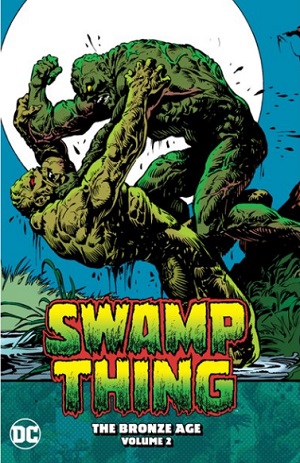
We sort of swing from the good to the bad here. First up we have the back half of the initial run of Swamp Thing comics, issues #14-24. This has lots of the usual nuttiness, including Swampy fighting demons, robots, and even a clone of himself that grew out of the arm that was cut off in an earlier story (this gives us the awesome Swamp Thing vs. Swamp Thing cover for issue #20 that also fronts this omnibus edition). I especially loved the Dr. Seuss-inspired Ultra-Cerebralociter, a machine that has the power to turn the brains of all the world’s leaders into “mush.” It even comes with a DANGER: HIGH VOLTAGE warning label on it. You’ve gotta love this stuff. Then of course there’s the purple writing that was the house style of the time, with Swamp Thing being described so often as a “mockery” (as in a “muck-draped mockery” of a man, or a mockery of life itself) that I was wondering if there was something in the style guide that said the word mockery had to be used a certain number of times every issue.

Unfortunately, sales were really poor so the series was discontinued. Issue #24 was the last, though the script and draft pencils and inks for the never-published issue #25 are included as an appendix with this edition, which is a really nice bonus.

The rest of the book has Swampy (along with Deadman) teaming up with the Challengers of the Unknown, a team of heroes who are now as unknown as their challenges. Who were the Challengers, you ask?

Ace Morgan: Former test pilot – now leader of the Challengers!

Rocky Davis: Onetime champion heavyweight wrestler!

Red Ryan: Electronics expert and world renowned mountain explorer!

Professor Haley: Scientific genius and deep diver into – the unknown!

Oh, and just in case you think this is a boys only club:

June Robbins: honorary Challenger and research physicist.

June is the buxom blonde who Rocky and Red have a falling out over. Yes, it’s that hokey.

Anyway, there are two main Challengers of the Unknown storylines. The first has them going back to the charmingly named town of Perdition to fight the reawakened spirit of the Lovecraft-demon M’Nagalah in a surprisingly yucky bit of horror, and the second has them jumping forward 12 million years to fight a bunch of solar tyrants who are offloading their excess monsters onto twentieth-century Earth. Beginning, alas, with Toronto: “an orderly city. A city of peaceful and pleasant people. A city with one of the lowest crime rates on the continent.” These stories are plenty crazy enough, but Swampy is just an extra, albeit more competent at smashing bad guys than the Challengers. His fight with the Persuader is the highlight.

Also included are a couple of Brave and the Bold team-ups with Batman and a frankly kind of lame crossover that has him fighting alongside Solomon Grundy against Superman (it’s complicated, but Swampy is still a good guy).

I think there are interesting storylines here, some of which had to be left as dead ends when this run was canceled. We never hear anything more about Alec Holland’s brother Edward, for example, a guy who seemed to have a pretty justifiable grudge against his brother. Like his arm restoring itself, however, cutting the series off wasn’t going to be the end of the “mossy man-brute.” He’d be back!

Graphicalex

Trashed

Trashed

The matter of dates niggled at me while reading Trashed. The book grew out of stories that were initially based on Derf Backderf’s stint as a garbageman in 1979-1980 and which were first published in 2002. He then turned the material into two web comics that ran in 2010 and 2011. And finally the stories were fictionalized and turned into this book in 2015.

So the question that bothered me was just when the events being described were happening. One thing I noted is that the story is about a year in the life of garbageman J.B., who along with his pal Mike rides along on the back of a garbage truck, tossing the garbage in. That’s two men hanging on the back of one garbage truck, which is something I have never seen. Not even decades ago. Today, and this goes back at least twenty years now in my hometown, the trucks all have claws that extend from the side of the truck that grab the bins to empty them, so the driver does everything. And even if there is someone riding with the truck, it’s only one person, never two.

This all made me figure the events described were reflective of Backderf’s experiences circa. 1980, and in his endnotes he mentions how he started doing the job six months after the events in My Friend Dahmer, and that Jeffrey Dahmer had cut up the remains of his first victim and put them out with the trash only a few months earlier. This is one timestamp then. But in the book there are also references to online shopping, iPods, and we even see someone using a tablet. None of this is a big issue, but like I say it niggled at me. When is this story taking place?

This question didn’t detract from my enjoyment of the book too much though. Backderf actually packs a lot of information into a fun story arc that actually had me laughing out loud a couple of times (I knew nothing of “yellow torpedoes”). The art is suitably cluttered, with the whole world, indoors and outdoors, turned into a dumping ground right from the first page and the chaos of J.B.’s bedroom. I spent a few minutes reading that. There’s also a realistic presentation of what such a job means to people in J.B.’s position, from his showering after work and sighing “I don’t think I can ever be truly clean again” to his conversations with Mike about their doing such labour (“The irony is, we are both too good for, and also totally incompetent at, this kind of work”). It’s remarkable how much exposition Backderf can drop in, alongside political commentary, without making the book feel like a heavy polemic. Maybe it’s just the subject matter. When J. B. says at one point “Think of the economy as a giant digestive tract. And we’re here at the rectum of the free market to clean it all up.” it doesn’t seem like a lecture point so much as a simple statement of fact.

I really liked My Friend Dahmer and went into this thinking it would probably be a bit of a letdown. It wasn’t, and that’s high praise. What’s more, without serial killers Trashed is a book I can recommend to anyone.

Graphicalex

Grass Kings: Volume Two

Grass Kings: Volume Two

I enjoyed Grass Kings: Volume One, but I liked that this volume went off in a slightly different direction. In the first book I didn’t care much about the fighting between the Grass Kingdom and the town of Cargill, or about the sheriff’s runaway wife Maria. Instead of more of that, what we get here is an investigation into the possible identity of the Thin-Air Killer. This is a plot line that was only vaguely hinted at earlier, and it’s still left pretty shady. Maybe the T-AK killed a schoolteacher in the Grass Kingdom years earlier. Maybe they killed Robert’s kid. Maybe they killed a young man in the town of Raven back when Bruce was sheriff there. The connections weren’t clear to me.

Of course, it’s in the nature of these things that everyone in town has a guilty secret or two. The back stories of Pike and Archie reveal them to be people who know more than they’re going to share, and the Bird Man seems the most sinister of the bunch. But I still don’t feel like I know any of the Grass Kingdom residents well enough though for this part of the story to come into very sharp focus. And I was left wondering how they were going to wrap things up with only one more book to come. I mean, what’s with this guy Neil living on an island in the lake? Where did that private security force come from? I wonder if maybe there’s too much going on for Matt Kindt to resolve in a satisfactory way.

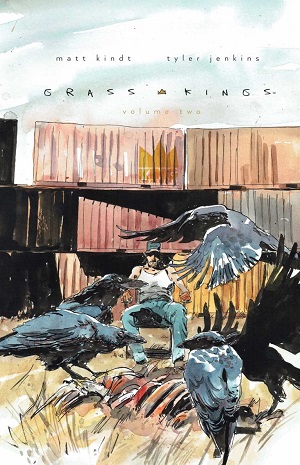
Interesting stuff though, and great art again from Tyler and Hilary Jenkins. The full-page spread of Pike rowing his boat looks like it was inspired by Winslow Homer and the issue covers done up to look like vintage paperbacks are wonderful. Not sure where things are going, and I have concerns on that score, but I’m looking forward to the finale.

Graphicalex

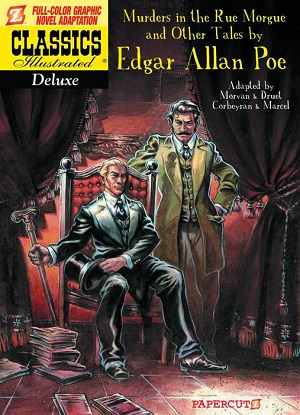
Classics Illustrated: The Murders in the Rue Morgue and Other Tales by Edgar Allan Poe

Classics Illustrated: The Murders in the Rue Morgue and Other Tales by Edgar Allan Poe

Many years ago I was visiting a friend who had a big collection of classical music on vinyl, including a recording of Rachmaninoff’s symphony loosely based on a translation of Edgar Allan Poe’s poem “The Bells.” The poem had been very freely translated into Russian, and the record jacket had helpfully re-translated it back into English. Which is to say, they hadn’t just reprinted Poe’s poem, which had originally been written in English, but had translated the Russian version back into English. I read it and, knowing “The Bells” by heart at the time (I couldn’t recite more than a couple of lines of it now) I couldn’t figure out what was going on. It seemed like “The Bells,” but wasn’t. It took me some time to figure out what was going on. Why translate a poem written in English, into English?

I was reminded of that incident when reading this graphic adaptation of three of Poe’s mystery tales. It’s part of the Papercutz relaunch of the Classics Illustrated imprint, but is actually a translation of French versions of the stories. So the translator gets a credit, which I think he deserves, even though he’s translating what was originally a story written in English back into English.

It’s not true that the French discovered Edgar Allan Poe, but he was popular with the literary crowd there at a time when he was seen more as a novelty act in America. Part of the appeal might have been, as was suggested by some critics, that he read better in translation, the most influential of his translators being the poet and critic Charles Baudelaire. Jean David Morvan, who wrote the versions of “The Murders in the Rue Morgue” and “The Mystery of Marie Rogêt” included here, gives thanks to Baudelaire for his “brilliant translations” in the prefatory material. So as with the album of Rachmaninoff’s symphony things have come full circle.

The three stories here are, in order, “Murders in the Rue Morgue,” “The Gold Bug,” and “The Mystery of Marie Rogêt.” The first and last feature the detective C. Auguste Dupin and are written by Morvan and illustrated by Fabrice Druet. Instead of presenting “The Purloined Letter,” the third Dupin story, “The Gold Bug” is the odd story out, and it’s written by Corbeyran and illustrated by Paul Marcel.

The two Dupin stories are presented in very similar ways. Even their openings, with silent montages revealing the murdered bodies, are nearly identical. After such promising beginnings though things settle down to rather literal transcriptions of the story. The art works hard to mix things up, especially in “Marie Rogêt,” but I just found the pace plodding, with far too much text. I honestly don’t know why they included “Marie Rogêt” at all, since there’s no dramatic action and the “story” is really just a dissection of the case (the Mary Rogers case, out of New York) as reported in various newspapers. When I recently re-read it I had a hard time finishing it, and the graphic version wasn’t any easier.

As a final note on these two stories, I guess we all imagine fictional characters appearing in different ways. And given that I don’t think there is much in the way of a physical description of Dupin in the stories (unlike Holmes, Poirot, and Nero Wolfe, who we could all probably recognize walking down the street), readers have a lot of leeway in forming their own mental portrait. My own idea of Dupin and the narrator has them as a couple of middle-aged oddballs, a bit stuffy and with an air of the antique about them. Here they’re a pair of dashing young bucks, and I had trouble getting sorted who was who. In fact, there was a point in the first couple of pages where I’m sure the names had gotten mixed up because Dupin addresses the narrator character as Dupin. But since they both looked kind of generic it didn’t make much difference.

“The Gold Bug” is something else, at least visually. Paul Marcel has a dedication to Richard Corben (who has done his own Poe adaptations), and you can see some influence at work. But the swirling tendrils of water, smoke, flame, and forestry give everything a unique organic feel, and Legrand’s pointy horns of red hair give him a suitably demonic appearance. Like the other stories it suffers a bit from pacing, getting bogged down in Legrand’s explanation of his code-breaking, but overall I enjoyed it.

Poe has been illustrated in memorable ways for nearly two centuries now. I have half a shelf of examples in my own library. But there is a difference between illustrating Poe and turning him into a comic. These stories in particular don’t seem that well suited to being adapted. I like the art, but it just feels like they were struggling to get as much of the original story in as possible, with results that are often awkward, poorly paced, and even hard to follow. I like the Classics Illustrated brand, but these newer versions are kind of hit and miss. At least they’re trying though.

Graphicalex

Aliens: The Original Years

Aliens: The Original Years

I loved this collection of what originally ran as three Alien-themed miniseries, with an additional prologue and double-barreled coda added to the mix. But before I get to praising it I should give some of the backstory.

First off, despite being a Dark Horse comic this is part of the Marvel Epic Collection line-up because Marvel bought the comic book rights to the Alien franchise in 2020. So I guess they own all this stuff now.

Second, the comics themselves have been “remastered” in various ways over the history of their publication. So if you pay attention to these things you’ll note that the credit for colorist on the first series is given as “Dark Horse Digital.” That’s because the first series originally appeared in black-and-white and was later colorized. Also, the series launched in the wake of James Cameron’s 1986 movie Aliens and follows up with the further adventures of Newt and Hicks (Ripley took a bit longer to appear because of legal issues). As the film franchise went on, however, we found out that Newt and Hicks died at the beginning of Alien3, so in reissues of the comics they went back and changed the names of Newt and Hicks to Billie and Wilks. But for the trade edition they changed them back again, which is how they appear here. Then the final series, Earth War, was renamed Female War and then changed back again to Earth War. Got that straight?

The major change from the original publication is the colorization of the first series (most of the other changes being reversions back to the initial version). I think they did a fair job with the colour, but if you’re a purist you might wonder if it doesn’t take something away from Mark A. Nelson’s underground art, since black-and-white isn’t just an art form that is without colour. It’s its own thing. As with movie colorizations, there’s an artificial feel to these pages and I think something of the original atmosphere is lost. But it didn’t bother me that much.

There are different artists with very different styles in each of the series, but the writer – Mark Verheiden – is constant and there is a strong through narrative. And it’s the story here that I really grooved to, with the arc that takes us from the Xenomorph home planet to Earth having lots of little curves and details along the way. For example there’s one twist that plays off the reveal of who is a cyborg among the ship’s crew that I thought was brilliant. It surprised me and still made perfect sense. Then there’s the cynical video reporter from INS who has been sent out by her boss Kolchak (get it?) to cover the opening of a pyramid with Xenomorph guardians. Going along with the tomb-raiding team is the only known survivor of an alien chest-burster, which is such a cool idea I can’t understand why no screenwriter thought of it. I also loved the idea of how the aliens, who are basically just killing machines or space sharks, have all this meaning projected onto them by humanity. Of course the military-industrial complex is looking to make a weapons program out of them but they’re also worshipped as gods by a bunch of cultists that had me thinking of the plot of Cullen Bunn’s The Empty Man (if only because I’d been reading that title recently).

None of this has much to do with the mythology of the film franchise. And it’s way better than the mystical mumbo-jumbo Ridley Scott gave us with Prometheus. Verheiden was basically off doing his own thing while continuing on from Cameron’s movie and I thought he did a terrific job. Even the “mistakes” turn out to be a lot of fun. Verheiden thought the “Space Jockey” figure from Alien wasn’t wearing a mask but was actually a kind of giant humanoid with an elephant head. And so that’s another alien race that puts in a disturbing appearance here.

I could go on. This was a joy. It’s the Alien franchise that should have been. Just leave the scary monsters as scary monsters and concentrate on the human story. There’s a leitmotif throughout the series that has it that the aliens are basically only props and that humanity is more than capable of destroying itself. That’s the sort of thoughtfulness and liberty toward source material that you don’t get in a lot of comics, and like I say, it’s not even a major theme. It’s just a point that comes up several times in passing.

Though it really diverges from the official Alien canon I think fans of the movies may be the most appreciative audience for this book. As I’ve said, it holds on to the original two movies (the two best, by a long shot) and then goes in a totally original direction that I thought was superior to where the movies ended up. Sure it’s still bubble-gum stuff at heart, but it’s a really nice package that presents a thrilling alternate Alien reality that’s like some giant franchise Easter egg. Or maybe one of those leathery eggs with creatures inside them.

Graphicalex

Bone Parish: Volume Two

Bone Parish: Volume Two

Better than I was expecting. I’d enjoyed the first Bone Parish volume but had just recently read BRZRKR: Volume Two and it was a big letdown that I thought typical of the middle stretch of most series/trilogies. Meaning it was a bore where the story was just marking time. There’s some of that here, but Bone Parish: Volume Two mostly builds quite nicely on the original story, sort of like the second season of Breaking Bad (which is the obvious comparison to make), with the Winters family having to face ever greater threats to their drug business. I also really liked the idea of cooks for other gangs trying to reverse engineer their own brand of Ash and coming up with a bad batch that melts people into composite monsters reminiscent of The Thing. That was a great, and necessary, step up in the horror.

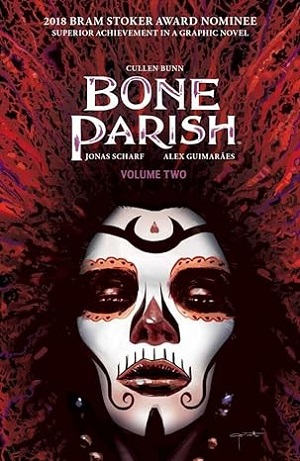
The cover is actually a variant cover for issue #3, as found in the bonus material for Volume One. It’s a good one, and pairs nicely with the cover for Volume One. The art still struck me as being hot and cold though. I still don’t like the faces, which seem further neutralized, at least in some ways, by geometric planes of shadow. But I did get a kick out of signature moments like the fly on Brae’s hand when he enters the mutant flophouse, or the biker’s face reflected in the pool of blood. Those get high marks.

A good story then, which moved things forward nicely if along predictable lines. I can really see this as a cable series now. I was only a little disappointed with how things broke off, with a series of cliffhanger moments. Again, that’s very cable series, but none of the plot points being introduced seemed very important, or were at all surprising. Still, I’m definitely on board for seeing how it wraps up.

Graphicalex

The Haunt of Fear Volume 1

The Haunt of Fear Volume 1

As the brief Introduction points out here, EC originally stood for Educational Comics, but they gave up on that pretty quickly in order to swap in “Entertaining.” In some of the ads included here demonstrate though, they were still selling their Picture Stories from the Bible series. I don’t know how popular those comics were, but I’m guessing somewhat less so than Tales from the Crypt.

This is the first EC Archives volume I’ll be looking at, but there will be many more. I love these stories, and the job Dark Horse has done in bringing them back in beautiful large-format packages. And now getting on with it, let’s dive in with The Haunt of Fear . . . #15?

The numbering had me confused, but gets explained in an instalment of “The Old Witch’s Niche.” Basically (if I have the story right) they started with #15 because there’d been a change of title from a previous magazine, The Gunfighter. Then, after issues #15-17 the U.S. Post Office (which ran these things) told them that their fourth issue (which would have been #18) had to be #4. So this collection includes issues #15-17 and then issues #4-6, in that order. Technically speaking, I guess The Haunt of Fear issues #1-3 don’t exist. Go figure.

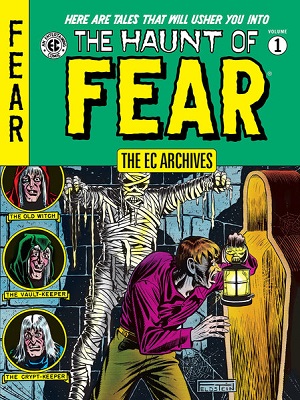
There were three main EC horror imprints and they were entirely interchangeable as they used the same writers and artists and even crossed over a lot. At least I can’t tell any difference between them aside from their mascots: the Old Witch for The Haunt of Fear, the Vault-Keeper for The Vault of Horror, and the Crypt-Keeper for Tales from the Crypt. Even these three can be hard to distinguish, though the Old Witch, the last to be introduced, always looks sadder than the other two. But enough about our hosts.

Things begin with what would be an EC staple, which is ripping off classic horror tales. “The Wall: A Psychological Study” is a remix of Poe’s “The Tell-Tale Heart” and “The Black Cat,” with a hen-pecked husband walling a noisy cat up with his murdered wife. A later story, “Monster Maker,” revisits Frankenstein. Not the most original tales on offer then, but EC was pumping this stuff out on a deadline and they do at least attempt to add some new wrinkles. I’ll just comment now on a few of the stories that struck me as particularly noteworthy.

“Nightmare!”: a construction engineer keeps waking up from nightmares where he’s being buried alive. A “famous psychiatrist” named Dr. Froyd puts him on the couch and tells him these are manifestations of his feeling “buried under too much work.” Feeling cured, the engineer returns to his work site and is trapped in a frame when a bunch of cement gets poured onto him. Instead of fear he grins hysterically at what he is sure is just another dream. “Ha! Ha! Ha! Ha! C’mon! Bring on the cement!” He dies laughing.

“Television Terror!”: a reporter investigates a haunted house on a live TV broadcast, using a portable camera with a very long extension cord. Nearly the whole story (but for a bit of framing) plays out from the camera’s point of view, with things climaxing in a suitably mysterious disappearing act. October 1950, and the found-footage genre is born. The inspiration may have been a short story by H. Russell Wakefield called “Ghost Hunt,” but that was about a DJ broadcasting his night in a haunted mansion so this was the next step in the concept’s evolution.

“Horror Beneath the Streets!”: things get very meta as EC masthead figures “Al” (artist-writer Al Goldstein) and “Bill” (publisher William Gaines) are chased into the sewers by mysterious figures who turn out to be the Keepers of the Crypt and the Vault of Horror, looking for someone to publish their creepy stories.

“The Hunchback!”: he’s not really a hunchback, but a fellow who has been concealing a murderous Siamese twin. Shades of Basket Case and Malignant. Apparently the idea goes back to a Robert Bloch story from the 1930s though called “The Mannikin.”

So enjoy! Even if the lettering is crude, the stuttering and exclamation marks are overused, and the spelling has some surprising glitches. I mean, how could the writers of such material not know how to spell “cemetery”? It’s baffling. But there’s a lively spirit of gruesome fun at work throughout, with colours that really pop off the page and stories that never drag. Even the ads are worth a grin. You could subscribe to this mag for 75 cents, which got you six issues, including delivery! And who wouldn’t want to order a “Genuine Hollywood Wolf Ring” for $3.95: “Warns the girls (or boys) that you are OUT FOR NO GOOD, and they’ll LOVE YOU EVEN MORE FOR IT!” Ah-wooooo!

Graphicalex

Green Lanterns Volume 1: Rage Planet

Green Lanterns Volume 1: Rage Planet

I have to imagine the creative team at DC sitting in a boardroom pitching ideas for the new arch-enemy of Green Lantern and the Green Lantern Corps. I guess they knew he was basically going to look like Thanos, but what was his name going to be? Then someone blurted out “Atrocitus!” and there were wide smiles all around. Atrocitus! That’s gold.

Atrocitus is the leader of the Red Lanterns, who are sort of like the dark side of the Force in the Star Wars universe, running on rage instead of willpower. And, like Thanos, The Big A actually has an argument to make about why being the heavies is important: without them there would be no balance of justice in the universe and everything would just be chaos. To that end he has decided to plant a “rage seed” at the centre of the Earth that will turn into some apocalyptic rage beast when it germinates. Or something like that. As part of the same “Red Dawn” operation he’s also going to infect humanity with a “rage virus” that turns people into violent zombies. If that sounds like the rage virus in 28 Days Later, well, I guess that’s where they got it from.

Opposing Atrocitus are Simon Baz and Jessica Cruz, Earth’s two newest Green Lanterns. They’re newbies and they’ve got to learn to work together as a team because they’re forced to share the same lantern supply source. So taking on Atrocitus and the Red Lanterns is kind of a big first challenge, especially as the Justice League aren’t taking any calls.

I wish I could say I liked this more. The action art is good, and Atrocitus and his conflicted but sexy sidekick Bleez (spandex garters!?) make good villains. But I wish more had been made of the rage magma that they vomit out (another nod to 28 Days Later). If that’s the superpower of the Red Lanterns it doesn’t hold up well against the “constructs” of the Greens.

What really drags things down though is the amount of interior monologue, which is colour-coded but still hard to sort out and isn’t very interesting anyway. Jessica’s character arc is the main thing to follow, as she learns to overcome her fears and focus her willpower. This is something she takes a long time to do, and when she finally does get the hang of it it’s almost automatic.

I guess it’s OK. I liked Green Lantern when I was a kid, but this is part of the DC Universe Rebirth project and it’s a long way from what I grew up with. I thought the characters – heroes and villains – were more interesting and well-rounded than usual, but something about it left me feeling kind of cold. Maybe it was the whole “fighting to save the universe” thing getting played out again. It felt very MCU, complete with the Hell Tower functioning as a sort of portal that dragged in the usual army of mooks to do battle with. For a launch of some new heroes maybe they should have started out taking some baby steps.

Graphicalex

The Emperor’s New Clothes

The Emperor’s New Clothes

Folktales keep hanging around because the sorts of lessons they teach are timeless and universal. That said, some gain more relevance than others over the years, and I’ve always thought The Emperor’s New Clothes one of the most pertinent to our own time.

Do we still believe in the wisdom of crowds? I think it’s hard to in the present day and age. What this parable warns us against is the danger of mass delusion, or “pluralistic ignorance.” It’s a top-down phenomenon, first infecting the court, which turns out to be the easiest part. Courtiers, aware of how slippery the greasy pole of advancement is, will do anything to get along. As for the Emperor himself, the whole idea works out pretty well for him. It’s a sort of shit test for the courtiers: if they’ll go along with this, they’re likely to go along with anything.

The tailors, meanwhile, are our influencers. We know they must be good because they’re making so much money. And the scam finally takes on a life of its own. Because even when exposed (literally) the Emperor has to keep pretending. The show must go on. The kid can say what he wants; if there’s enough money at stake the illusion will continue to be propped up.

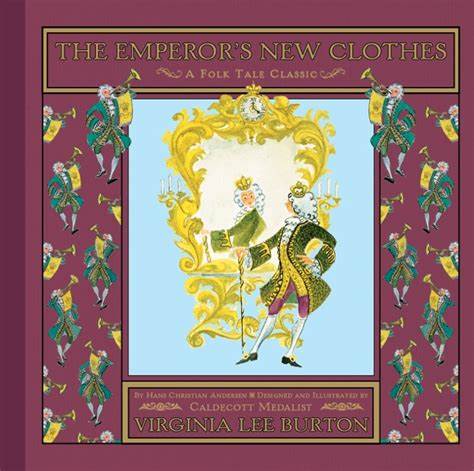
Virginia Lee Burton’s illustrations go back to 1949 but they stand up well in terms of how she conceived the story, emphasizing mirror effects. Because we don’t see ourselves as we appear in a mirror, in an accurate reflection, but only as others see us. Reality is a carnival or funhouse. And even if we know that everything about it is a lie, we’ll all still play along.

Graphicalex

The King in Yellow

The King in Yellow

The King in Yellow is a book by Robert W. Chambers first published in 1895 that is nearly as mysterious as the sinister work it takes its name from. It’s a collection of short stories, the first four of which are linked and have some connection to a fictional play, The King in Yellow, which has the effect of driving anyone who reads it crazy. In this graphic adaptation by I. N. J. Culbard it’s these first four stories – “The Repairer of Reputations,” “The Mask,” “The Yellow Sign,” and “In the Court of the Dragon” – that are represented.

I say it’s a mysterious book because despite being in the public domain and freely available on the Internet I don’t think it’s that widely read except by people interested in its influence on H. P. Lovecraft. But even Lovecraft had reservations about how good it was. As a side note of some interest, on the copyright page to this book we’re told that it’s an “Original story by H. P. Lovecraft / Adapted and Illustrated by I. N. J. Culbard.” That gives you some idea of how much cultural cachet Chambers has lost to his successor.

I don’t think much of Chambers’s book. To be honest, I never made it all the way through. So I was happy to come across this comic crib, which struck me as playing fair with the source material while having a vision of its own that nicely complements Chambers while making a fair job of stitching together the different stories. I liked the presentation of the pale, ghoulish figures who represent the King’s servants in our dimension, and could get behind the decision to switch from a first-person narrative. It’s a good comic, but at the end of it all I didn’t feel I had any greater understanding of what was going on and I still can’t say I think the original is a work of the first rank.

Graphicalex