Asterix the Gaul

Asterix the Gaul

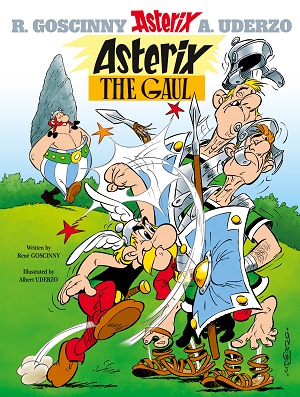
This is the first of the Asterix comic books written by René Goscinny and illustrated by Albert Uderzo, and was published in 1961. I grew up reading these in English translations, and I think I had a French edition of one of them too. But this time I wasn’t the English version I remembered, as it was an “all-new more American translation” done in 1999. Back when I read the comics the village druid was named Getafix, but here he’s Panoramix, which is actually his name in the original French even though I don’t like it as much. And I wondered if, when Panoramix says he can make soup in various flavours, including “bacon cheeseburger,” this was a literal translation or something more “American.” Did they have bacon cheeseburgers in France in 1961?

For being the first in the series they hit the ground running with Asterix the Gaul, as the series was basically born full grown with everything in place. Except maybe for Dogmatix. I might have missed Obelix’s little dog but I don’t think he was here. And they even let Cacofonix sing at the final feast, which wasn’t going to happen again very often.

The story has a nice a mix of goofiness (the Romans playing musical chairs to see who will be the secret agent sent to the Gauls’ village), wordplay, and basic moral instruction. When Panoramix explains to Asterix that he doesn’t need the magic potion to beat the Romans but only has to use his native wit, it’s a point that a lot of superhero comics like to make.

The real star though is Uderzo’s art. It’s what impressed me the most when I was a kid and it still does today. And it’s all the more impressive because I can’t think of any comic artist who has created anything quite like it in all the years since. One panel here that really stood out has a Roman troop marching beneath a tree, with Asterix and Obelix perched in silhouette on a branch overhead. There’s so much action and information put into that one drawing, not to mention just how beautiful it is to look at. There aren’t many books you can return to after so many years that hold up so well.

Graphicalex

Bone Parish: Volume Three

Bone Parish: Volume Three

The last volume – or is it just the season one finale? – of the Bone Parish saga. And up to the final issue I was wondering how they were going to manage to wrap everything up in the few pages remaining. Well, much to my surprise Cullen Bunn managed to pull it off. It’s a quick ending, and feels a bit rushed, but it’s satisfactory and does manage to tie up most of the loose ends while holding out the promise of the story continuing. Colour me impressed. I didn’t think it was going to work.

There were no big twists or revelations, while the action seemed bloodier than usual even though the regular gang violence was toned down and the mutants created by the bad batch of Ash weren’t back. I was getting used to Jonas Scharf’s art, and while he has a real weak spot for faces, especially in profiles that he tends to just repeat, he does some good action scenes here, including a couple of nice fights and one great explosion drawing.

So that’s a wrap, with most of the Winters family now deceased and bottled up. But what might be going on in the land of the dead is left a little vague. Is there a voodoo king of the underworld, or is it all just hallucinations? Maybe if the series is continued things like this will be explained, but I’m fine if they just leave it the way they did. Solid work all around.

Graphicalex

Batman: Damned

Batman: Damned

Batman: Damned is a sequel of sorts to the Joker comic put out by the same writer and artist ten years earlier but it was also the first comic to be published under the imprint of DC’s Black Label, which was targeted at mature audiences. The first printing of Damned even included a picture of a nude Bruce Wayne with his dick hanging out, and there are few things as adult as Batman’s dick. So . . . it was something old and something new. But what I really found it to be was overblown and confusing.

The blame, in my opinion, falls on Brian Azzarello. I really didn’t like the writing on any level. Most of it is woefully ungrammatical, no matter who is speaking. The Enchantress I could give a pass too since she’s a demon zombie witch or something so I figure she can say “I be fate written. Die cast. Why you no remember?” But why are Batman’s “diaries” full of stuff like “what don’ kill us eats us alive”? Why are the rapper’s rhymes so weak? Why does the homeless guy say things like “seen him with my own too [sic] eyes”? Why would the mandarin Waynes say things like “Don’t be here when I do get back”? Were these typos? In a prestige publication like this? Or did they have some meaning I was missing? Hell, I even hated the lettering. This was all terrible.

Then there was the plot, which was another take on the idea of the journey of the soul after death. The aim was to do a sort of horror comic, but I was too confused to find any of it very scary or unnerving. So as usual it just turned out dark. There were cameos from figures I didn’t know well (John Constantine, the Spectre) or barely at all (the Enchantress). And there’s an uncomfortable appearance by Harley Quinn, who nearly rapes Batman at one point because . . . she hates him. I didn’t need any of this. But then Swamp Thing shows up and I always like to see Swampy so that was a plus.

It looks fantastic. Lee Bermejo’s art is on point with the noir-horror vibe throughout, making me almost wish DC had done the book as one of those comics without words. I might have followed the story just as well. I’ve really liked some of Azzarello’s stuff, but this struck me as a poorly developed idea that tried to make up for its deficiencies with lots of heavy breathing and broken English. And that’s a shame because I did have the sense it could have been something great.

Graphicalex

Garbage Man

Garbage Man

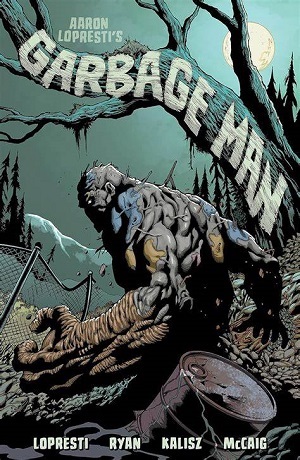
There’s a bit at the beginning of Aaron Lopresti’s Garbage Man comic (which is not the sequel to Derf Backderf’s Trashed) where the hero, now an animated pile of toxic sludge complete with bits of rebar sticking out of him, has flashbacks as to how he got that way. As things turn out, he was a corporate lawyer named Richard Morse investigating the goings-on at Titan Chemicals. Titan had been given a government contract to create super-soldiers by injecting test subjects with an HGH (Human Growth Hormone) derivative, combined with a bit of creative gene splicing. The mad doctor in charge at Titan, figuring Morse knew too much, had made him into one of the project’s guinea pigs, and in a lab explosion Morse was propelled into a nearby swamp, from which he then arose as Garbage Man.

When the mad doctor is letting Morse know what he’s going to do to him he says “Stop me if you’ve heard this one before.” Which is Lopresti’s way of letting you know that, yeah, we’ve all heard this one before. Basically Garbage Man is a cross between Swamp Thing and the Toxic Avenger, with Hellboy’s granite hand thrown in for good measure. He actually looks a lot like Swamp Thing too, so much so that when another experiment gone bad appears that looks even more like Swampy it seems redundant (this latter figure is called Mossy Man).

I liked the art and colours here, but the story really is pretty basic stuff, and the not-so-basic stuff (like the guy who dreams dinosaurs into life) is a mess. Garbage Man slowly remembers, in fits and starts, what happened to him and so he goes after the people responsible. Along the way he’s helped by a preacher who lives among the homeless in the city’s sewers, and an old flame who, remarkably, isn’t too freaked out by his appearance. There’s also a trio of superhero types called the Night Club that play an ambiguous role. Maybe if the series continues we’ll find out more about them. But as far as I know this is all the Garbage Man we’ve got.

The individual comics/chapters are only ten pages long so things move really quickly. And it’s fun. But at the same time it didn’t really strike me as anything special and the story itself is very worn. Good as a diversion then, but not a comic I’m likely to remember very long or want to bother re-reading anytime soon.

Graphicalex

Man-Bat

Man-Bat

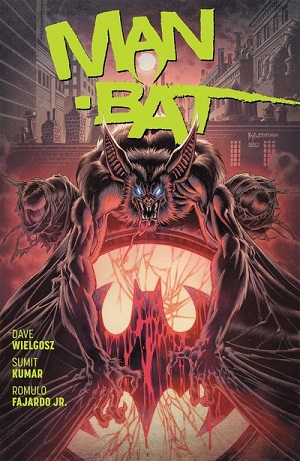
A straightforward, self-contained five-issue story arc by Dave Wielgosz that has Batman sort of fighting and sort of teaming up with Man-Bat (Dr. Kirk Langstrom) to take on Scarecrow.

I don’t really know much about Man-Bat but he struck me as a very similar character to Marvel’s Lizard: another doctor with a monstrous alter ego he keeps trying to find a cure for. But then I guess you could take the same model further back to Dr. Bruce Banner and the Hulk, and before that to Dr. Jekyll and Mr. Hyde. There’s some truth, maybe a lot of truth, to the idea that there are only a handful of stories and characters that we keep recycling. This one expresses the notion that we all have a dark side or primal id that we try to control but that keeps erupting in violent and dangerous ways.

The Freudian model or myth (which can be taken as another version of the same story) is useful here because Langstrom/Man-Bat is literally put on the couch by Harley Quinn (a trained psychologist, she reminds us), and subliminally conditioned by Scarecrow (Dr. Jonathan Crane being another doctor of psychology). Is Langstrom barking up the wrong tree in trying to find a cure for his Man-Bat condition in a lab? Maybe all he needs is therapy. Then again, therapy doesn’t seem to have rid Batman of any of his demons, which are released here by a sonic gun Scarecrow invented that unleashes the basest instincts of all the citizens of Gotham.

It’s not a ground-breaking comic in any way, but I found it quick and entertaining. Sumit Kumar’s art has a bit of a manga flavour to it, and the covers by Kyle Hotz and Alejandro Sánchez are great. I even had to laugh at the cover for issue #1, which clearly has the silhouette of the Bat Signal looking like Man-Bat’s balls hanging down from his crotch. I don’t think that was an accident. They knew what they were doing!

Graphicalex

The Immortal Hulk Volume 1: Or is He Both?

The Immortal Hulk Volume 1: Or is He Both?

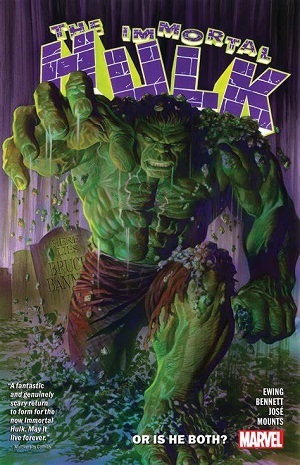
I don’t know how much credit to give them for saddling this first volume of the Immortal Hulk series with such an obscure title. It’s a bold move that may appeal to die-hard fanboys, but when I was a kid I had a reprint edition of The Incredible Hulk #1 – the cover of which asks “Is He Man or Monster or . . . is He Both?” – and even I didn’t make the connection here.

So much for the “Or is He Both?” part. How about The Immortal Hulk? Well, as things kick off the world thinks Bruce Banner/The Hulk is dead. I’m not sure how or when this happened. There’s a bunch of excerpts from different comics at the end of this volume that are less than informative on the subject, and I didn’t feel like doing any further research (and you can certainly find answers to all these questions, and more, on the Internet).

In any event, as you will have guessed, the Hulk isn’t dead. In fact, he can’t be killed. He can even get a giant hole blown through his chest and it fills back in again. This leaves Bruce Banner to “walk the earth” in a hoodie, righting the odd wrong and filled with existential angst because when he looks in a mirror he sees the big green guy glaring back at him. And before long the cops, the media, and even an old friend are on to him.

I have to say I didn’t care very much for anything going on here. The art didn’t strike me as anything special, even with the way they tried to change things up in issue #3 (different styles for different narrative voices). And the stories weren’t all that good. Instead of being triggered by anger, Banner turns into the Hulk now at night. I don’t know why. In the first issue the Hulk avenges the accidental killing of a girl in a gas station hold-up. Then he encounters a guy who turned himself and his son into glowing green Hulk knock-offs. Then he fights Sasquatch, who is another Hulk-wannabe gone bad. This is a theme that’s played on throughout, as the reporter tracking the Hulk confesses at the end that she wants to be like him too. But of course they don’t understand.

There’s also something going on about Banner’s father, but I couldn’t figure out what that was. I think he abused Bruce when he was a boy. So on top of everything else the Hulk has daddy issues.

I’ll probably give this run some more time to get its feet, but in the first five issues I didn’t get the sense that it was going anywhere, and to be honest I don’t find the Hulk that interesting, so I might not stick with it for long.

Graphicalex

The Object-Lesson

The Object-Lesson

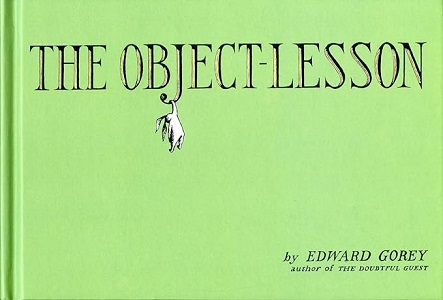
I love the work of Edward Gorey but you have to take it in small doses. As I go along (if I keep going along) I’ll be revisiting his various Amphigorey collections, but until I get to them this little book will do as an entry point to his dark universe.

Dark because danger and death and loss and mutilation are always lurking around the corner. Some monster is no doubt waiting behind that thick network of wallpaper we’re faced with on the first page. A beast hiding in the mists on the moors. In the trees . . . “a bat, or possibly an umbrella.” You can’t even tell what it is when it flies away. “Something happened to the vicar,” and from the looks of it nothing good. Perhaps a bicycle accident.

The horizontal nature of the book leads you to believe there’s some sort of continuity at work in the way landscapes seem to run from page to page. Your eyes are moving at speed across a sweep of space. But is there a thread that holds it all together? Not an obvious one, but that just means we have to fill in the gaps and make the links ourselves. The text may suggests temporal relations. “Meanwhile, on the tower . . .” And we seem to be moving from morning through day to night. But are there also traps? When the people in the dinghy cry “Heavens, how dashing!” are they talking about the “erstwhile cousin” stepping backwards into the water? They seem to be looking at him, but is that just a coincidence? And is that water the same lake the lordship meets the Throbblefoot Spectre by? And are odd figures who are never identified recurring, or different people? Take the lady in mourning by the edge of the lake (she appears again from a distance, walking either away from or towards the tower), or the lady with the flowerpot.

Surrealism? Yes, or at least the absurd. It’s in the dreamlike symbolism of the landscape mostly. That tower in the middle of nowhere. The ornate gates to the asylum with no adjoining walls. The lonely kiosk. Detached structures that again might be understood as in the same neighbourhood, or be located on different continents and in different eras.

A haunted world, and by what? “The miseries of childhood.” That kid on the second page has seen too much that can never be forgotten. He (or she) will lose much that will never be found.

Graphicalex

Xerxes: The Fall of the House of Darius and the Rise of Alexander

Xerxes: The Fall of the House of Darius and the Rise of Alexander

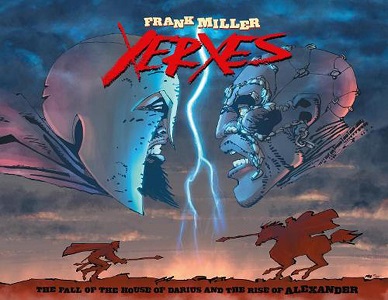
I guess you could call this a sequel to 300, but it came out in 2018, which was 20 years later, and doesn’t have much to do with the events of Thermopylae, which it skips in its race through over 150 years of Persian history. There’s also no real connection to the movie 300: Rise of an Empire, which actually had come out four years earlier.

The treatment of history is weaker than in 300 too. The “House of Darius” would be the Achaeminids, wouldn’t it? Or that’s what Darius I would have claimed. But I would have thought that would be the House of Cyrus, if anyone. The jeweled bodysuits of Xerxes and other Persian emperors was, and remains, mystifying to me. I was rolling my eyes a lot at some of the architecture and statuary, like the colossi on the Athenian acropolis. Aeskylos (Aeschylus) is reimagined as a cross between Darth Maul and a ninja. And Alexander the Great, when he shows up, is basically the reincarnation not of Hercules but Leonidas (because beards are manly). It all seemed a lot sillier than the earlier book. And the art felt lazier too. More full-page splashes (a good word for the splatter effect being used so often), with a few great sequences (the imagined deaths of Xerxes) and some very uninspired and pointless ones (the Ethiopian archers). Given the minimal and disjunctive text, it felt like a bunch of posters with big titles: Marathon! Xerxes Assassinated! Gaugamela! I’ve added the exclamation marks but they feel like they should be there.

300 managed to be an original and quite effective retelling of a particular historical incident. This book covers vastly more ground (both in time and space) and ends up just being a bunch of odd pictures. As I’ve said, some of them are great but most are just more of the same and I came away feeling that none of it added up to much.

Graphicalex

Bleedout

Bleedout

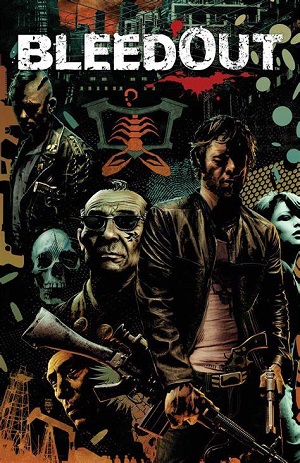
From the publisher: “Bleedout was created to provide back story for CrimeCraft, a free-to-play online video game in which players create characters, form gangs, and engage in fast-paced shootouts for cash and bragging rights.” The book came out in 2011, and when I checked CrimeCraft is no longer going. So what we have here is the back story for a game that doesn’t exist anymore. At the end of ten short chapters we’re told this is the “End of Book One,” but I don’t think there was ever a Book Two. And I think it’s unlikely there are any plans for one now.

I could leave it at that. Really, this is a nicely produced, hardcover (!) graphic novel that reminded me of the booklets that used to come with video games you bought in a box, giving players some fictional context for the world they were entering. Two things stand out about it. First: Mike Kennedy is the author of all the stories, but each chapter has a different artist. This was kind of neat, and while a few of the artists seemed similar, I thought the art was pretty good overall and there were some different styles on tap (albeit not radically different). Second: There is no dialogue. The story is told entirely through narrative exposition. And there is a lot of back story to get through, and quite a few major characters to be introduced: basically our hero and the various leaders of the different Sun City gangs.

Yes, Sun City. There’s a video game location if ever there was one.

There’s not much more to say. We’re in an urban environment after the collapse of civilization as we know it, due to a bacteria that ate up all the world’s oil reserves (which were quickly diminishing anyway). A bunch of criminal gangs have taken over. A mysterious guy called Pilot, who may be a genetically engineered super-soldier, is out for vengeance against one or all of the gang leaders, for something they did, sometime in the past. I guess all of this was going to be explained in Book Two, but now we may never know. Or maybe you figured out what was going on if you played the game . . . but if so then we may still never know.

It is a nice looking comic and I actually thought the world it created was kind of neat, but as things turned out it’s an orphaned world that nothing was ever done with.

Graphicalex

Scooby Apocalypse Volume 1

Scooby Apocalypse Volume 1

I’m happy to say this was something I wasn’t expecting. Of course, by this point in history every bit of pop culture has been zombified, and our obsession with end times seems in no danger of letting up (for good reason, I might add), so why not give the Scooby-Doo gang their own apocalyptic saga? I was on board for it. I mean, I wasn’t counting on it being anything special but I was on board.

Well, as things turned out it was kind of special. First off, there aren’t any zombies. Instead, the apocalypse is brought about by those darn scientists with their lab coats and their desire to remake the world, and specifically humanity, into something better. Yeah, we know how that usually works out. We learn about this from Velma, who is the goggle-eyed brainiac in a lumpy orange sweater that we all know and love but who now has a much more complicated backstory. Rounding out the rest of the crew are Daphne and Fred as a pair of crusading “new media” citizen journalists (hey, they have a late-night show on the Knitting Channel) and Shaggy as a dog trainer who is helping out with a new program meant to create special dog soldiers at the same top-secret underground compound where Velma is working on her nanite plague. And the dog program has one washout of a recruit named Scooby-Doo. Rat’s right!

The characters are all easily recognizable, down to their signature lines. A refresher: Daphne says “Jeepers!”, Velma says “Jinkies!”, Scooby says “Zoinks!”, and Scooby says “Ruh-roh!” And they also have the same basic personalities you’ll remember from the classic TV show. Fred is the well-meaning but dense muscleman,  and he’s in love with Daphne. Daphne, in turn, is the professional woman warrior. Velma is the brains. Shaggy is a hipster. And they even get around in a revamped Mystery Machine, which is now a tricked-out war wagon. I’ll mention Scrappy-Doo too, but won’t give any spoilers for how he turns out.

The art is great and the colourful monsters a lot of fun. As I said, they’re not zombies. Velma’s corrupted nanites have turned the world’s human population into a motley assemblage of demons, vampires, and other freaks. How much of this was part of a deliberate plot is left undetermined, as is the extent of Velma’s involvement, but we still feel she’s on the side of the angels. Because who doesn’t have a bit of a nerd fetish for Velma?

If I had one complaint it’s that there’s too much going on. It’s a good story, and the characters are reimagined in a way that’s original but not degrading or overly political (this isn’t Mindy Kaling’s Velma). There’s no agenda to any of it. But there’s a lot of talk here. A lot. This is a comic that takes a long time to read, and I felt a good part of it was unnecessary. We’ve lived with the apocalypse long enough now for us to hit the ground running. We know the drill and it doesn’t take that long for us to be brought up to speed. I also had a hunch that whatever the mysterious Four were up to wasn’t actually that interesting. But that’s a question for the next volume to answer.

Graphicalex