Apocalypse Nerd

Apocalypse Nerd

“Apocalypse” is a word that has undergone a bit of a transformation in the modern age. In terms of Biblical literature it refers to a genre of spiritual writing characterized by a revelation (what the word means in Greek) of the end times, typically accompanied with commentary provided by a celestial interpreter or guide. What the end times usually involve is a final battle between the forces of good and evil, but in the end evil is defeated and both sides receive cosmic justice.

In this regard the apocalypse is actually optimistic in tone, with the world being made new and the kingdom of heaven being realized. It’s prophetic literature, but like most prophecy (a word whose meaning has also changed) it’s not meant so much as a prediction of the future but as a description of what is happening in the world right now, and specifically the persecution of the godly at the hands of the wicked. Within the Bible as we have it the chief examples of apocalypse are the Books of Daniel and Revelation, but there were plenty of other apocalypses being written in the ancient world and they all fit the same general pattern.

Today, when we say “apocalypse” we mean something a lot simpler and darker. What the word refers to is a catastrophic end-of-the-world scenario. Earth being hit by an asteroid, for example. Or civilization collapsing due to climate change. Or an outbreak of plague. Or people turning into flesh-eating zombies. Apocalypse Now begins with The Doors singing about “The End,” meaning the end of “everything that stands” in a bath of napalm. In Marvel comic books Apocalypse is a big, bad guy who wants to kill off most of the human race. You get the picture. There’s no battle between good and evil but just a brutal struggle for survival. And there’s no vision of a New Jerusalem but only a charred wasteland where whoever’s left behind might be able to start over.

I get it. The world is too much with us. I think a lot of us feel the need to press some kind of a reset button on civilization. There are many issues facing us that now seem intractable, and some kind of shift of gears into reverse, if not outright collapse, seems inevitable. That doesn’t mean we’re all building bunkers in our backyards or pimping out our basements in survivalist décor, but it does go some way to explaining current interest in the genre.

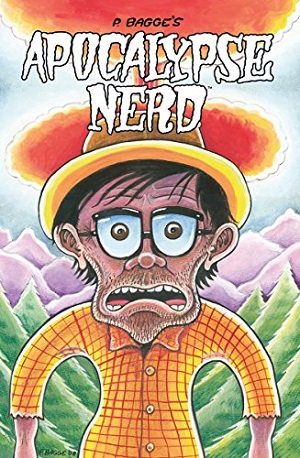
I don’t know why I just wrote all that, but it seemed as good a way as any to introduce Peter Bagge’s Apocalypse Nerd. The apocalypse in the title here is actually a bit retro – not going all the way back to Biblical days, but to the fear of nuclear Armageddon that was big in the 1980s. Though things have changed a bit. What we get here isn’t global thermonuclear destruction but a nuke launched from North Korea taking out Seattle. A pair of buddies who live in Seattle are camping in the Cascades at the time and soon find out that they can’t go home. This leaves them not so much wandering in a wasteland as semi-roughing it in the bush. They survive by hunting deer, foraging for berries in the woods, and raiding cottages for preserves and packaged foods.

The story itself doesn’t amount to much. It’s episodic and doesn’t build to any kind of climax. Indeed, in the final panel we’re left with the suggestion that it’s all been a wild goose chase. But despite this I felt swept along by the sort of urgency that’s expressed in the sweating, buggy faces of Bagge’s rubber-limbed figures, who always seem on the edge, or over the edge, of a total breakdown. Though it’s not a short book, Apocalypse Nerd is a very fast read. It doesn’t have a message beyond human beings going back to nature reverting to being cavemen, but that was enough for me to enjoy it.
Graphicalex

1872

1872

Over the years there have been lots of entertainment columns written on the subject of promotional blurbs, to the point where you have to wonder what the point of them still is. In our time the pull quote of critical praise has become such debased coin that they’re widely recognized as not only worthless but laughable. Even a sticker announcing that a book has won some big literary prize is meaningless. Who cares what the last book was that won the National Book Award or Man Booker Prize? What does it matter that a book was named one of the New York Times’ Best Books of the Year? I guess it helps move a few copies, and as far as advertising is concerned it’s about all that publishers can do, but that’s it.

You can scrape the bottom of a deep barrel though in trawling for pull quotes. To the point where the blurbs I find on most new DVDs are usually from sources I’ve never heard of. The ratings from Rotten Tomatoes probably mean more, which isn’t saying much. I don’t even know if these are real people writing the “reviews” that quotes are drawn from now, as I think it’s something an AI could probably do more effectively, and better. A point that the team promoting Megalopolis apparently took to heart.

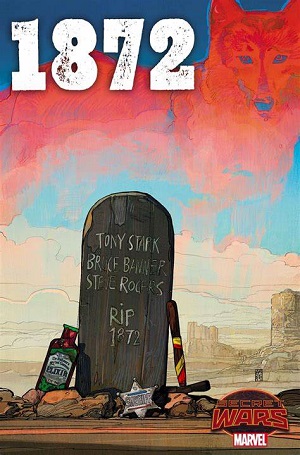
I say this because the cover of 1872 has “A rootin’ tootin’ good time” appearing on it, a bit of ad writing that comes courtesy of IGN.com, which as far as I can tell is just a blurb farm now. Then on the back cover we get “I’m not a fan of Westerns, but this comic book may have just changed my opinion of them,” which is attributed to ComicWow.com, a site that was offline when I went to find out if the blurb had actually come from a review and who might have written it.

Anyway, this is all beside the point. It’s just sort of a pet peeve of mind I thought I’d mention. I mean, there’s a really misleading bit of information scratched onto the Boot Hill tombstone on the cover too, but I won’t get after them for that.

I’m not even going to try to put 1872 into its context within the Marvel Secret Wars/Battleworld multiverse because that’s about as deep a rabbit hole as you can head down. Suffice it to say that we’re in the Old (and Wild) West, specifically the company town of Timely, which is populated by various Marvel superheroes and villains in period dress. Steve Rogers is the sheriff, Tony Stark is the town drunk, Bruce Banner is an apothecary, Natasha Romanov is the widow of former sheriff Bucky Barnes. Among the bad guys is Kingpin as the mayor and Wilson Fisk with his gang of hired guns: Bullseye, Grizzly, Electra, and Doctor Octopus.

The centre of the story though is Red Wolf, a Native American out to blow up the Roxxon Corporation’s dam. Red Wolf isn’t a very well-known Marvel hero, so also included in this collected edition of the 1872 series is his origin story from way back in Avengers #80 (1970, and not 1963 as is stated on the back cover), as well as a later appearance in Marvel Comics Presents #170.

I did like the story here. It’s straightforward while at the same time being clever in how it adapts characters we’re familiar with to their new surroundings. I loved Doc Ock’s multiple-gun contraption, and the appearance of Vision in one of those fortune-telling booths. The storyline follows a standard Western formula, but it’s punched up with extra violence that has a lot of the characters being killed. Steve Rogers is even thrown into a hog pen, where he gets eaten! That was a real shocker.

Not an epic Western maybe, but a great B-film that hits all its marks and has a genuinely fresh spin on the action by putting the old characters in some new costumes. Good stuff! And if anyone wants they can blurb that.

Graphicalex

Thor: First Thunder

Thor: First Thunder

I’ll start off by saying that Thor has never been a favourite superhero of mine. Being a god and all I find him pretty dull and very full of himself. I also really don’t like the way Marvel renders his speech here and in other contemporary Thor titles. The Asgard lettering looks too flowery and it’s not at all necessary.

Since I’m on a negative roll here I’ll also say I’ve given up on all the reboots and multiverses these characters now exist in. For what it’s worth, this is basically an origin story, showing how Dr. Donald Blake came to bond with the spirit of Thor, and their subsequent rocky relationship. As such it sticks pretty close to the canonical Thor backstory, at least as I understand it. But again I question the necessity.

That said, it looks great. Tan Eng Huat’s artwork hits all the right action notes, and while the plotting here was nothing special (Radioactive Man just sort of pops up before being tossed away in a whirlwind) I thought Bryan J. L. Glass made something out of the whole Christian parallel, with Odin (God the Father) sending Thor to Earth (or Midgard) and giving him a human form where he can atone for his sins if not for humanity’s. Some of the big fights were also well imagined, from the statuary of New York (the lions in front of the Public Library, the bull of Wall Street) coming to life to the Fantastic Four being defeated in what I thought was a dark and gruesome style. I expect a bit more out of Loki, who’s once again presented as Marvel’s Joker, down to his inverted pyramid face, fancy suit, and full pages of HAHAHAHAHAHA!s. But then Loki has never been a big favourite of mine either. He keeps having these great plans for taking over the world and ends up getting spanked like the naughty boy I guess he basically is.

So I didn’t go in expecting much but I was really happy with what they did with it. Given the foundation that’s laid, I’d even look for more.

Graphicalex

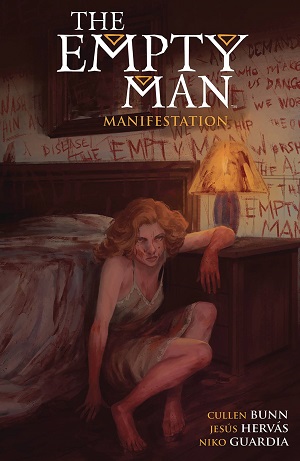
The Empty Man: Manifestation

The Empty Man: Manifestation

Manifestation is the third and final (so far) volume in Cullen Bunn’s Empty Man series, with Jesús Hervás again providing the raw and scratchy artwork and questions still flying every which way as to what’s going on.

We begin with a nod to Kubrick’s 2001 and a caveman finding a pillar or monolith of blood and bone. Where are we? When are we? I suppose this is the dawn of man, and more particularly the dawn of human consciousness, a point at which the Empty Man came into existence. Or so, I think, Agent Langford explains when he shows up back in our dimension, carrying shotguns and with cancerous tumors spilling out of his guts.

Any idea of the meaning of all this is going to have to be found in Langford’s account of his trip to the Empty Man’s world, but I found this just as mystifying as the rest of the story. My own interpretation is that the virus is the physical expression of malignant narcissism, with the Empty Man looking to create peace and unity among all the peoples of the world but only on his/its own terms. Its need to project itself by way of various media platforms is sort of like the amplifier effect of social media. The way people worship it as a god reflects our own cults of celebrity.

Well, that’s a stretch but it’s my story and I’m sticking to it. As I say, it’s left pretty vague. We can’t even be sure if this is the end of the story, as we leave things with the Kerry family (who are relegated to the role of luggage in this volume) locked and loaded, ready to go after the cult in a cosmic horror “holy war.” The apocalypse beckons. But as for what has happened to Jensen, again I have no idea. Apotheosis? And the creepy kids? Are they better now? I guess we’re supposed to stay tuned.

I don’t know how much of the mystery here was deliberate and how much was Bunn just not being sure what it was he was trying to say. But I’m inclined to think it was more the latter, as looking back on the series as a whole it really is a mess. There are some interesting ideas raised, I think, but they’re covered in a whole lot of psycho-spiritual stuff that doesn’t gel. Being left to guess what the point of it was after three books was disappointing.

Graphicalex

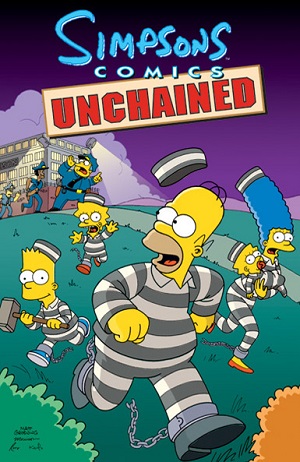
Simpsons Comics Unchained

Simpsons Comics Unchained

I first read Matt Groening when I was in university in the late 1980s and his strip “Life in Hell” was appearing in one of the alt-entertainment weeklies. It was the only thing worth reading in that rag. Everyone thought it was really funny. It was just after this, however, that The Simpsons took off and Groening became mainstream, the name behind a franchise.

I don’t begrudge him any of his success, as the TV show The Simpsons, at least in the early days, was really very funny. I haven’t seen it in twenty years, but I hope it’s still going strong. And the comics are good too. The question I had reading Unchained is whether Groening himself has anything much to do with them. And the reason I ask is because his name is on every credits page, even though he’s always given a joke title like “Reformed Nerd,” “Cue Card Boy,” or “Lard Lad’s Best Customer.” I had to wonder if there was some legal reason for that. Because he wasn’t writing or drawing or colouring, I think all he’d normally get a credit for is as publisher, or for “characters created by” (just as every Batman comic even today has to credit Bob Kane for creating Batman). So I just don’t know.

In any event, this is a selection of stories taken from the pages of The Simpsons comic, specifically issues #36-#42. There’s not much in the way of connective tissue, though many of the stories deal with members of the family getting in trouble with the law. So that fits with the jailbreak theme of the cover. Overall it’s a typical Simpsons effort, with a gag in nearly every panel, and sometimes several, and with even more hidden in with the fine print (which in one instance I honestly couldn’t read without a magnifying glass because I guess I’m getting too old for this stuff). Some pieces land better than others. I thought the Charlie and the Chocolate Factory spoof got away from them and the Jabberwocky send-up didn’t work. The story where Homer and the Comic Book Guy go to court was one of the better ones, in part because comic nerd-dom has always been close to the heart of the franchise.

I don’t think the line-up here is as good as that found in the Colossal Compendiums or the Treehouse of Horrors comics. I felt these stories were more like B-sides than the best of the best. But it was enjoyable enough while it lasted.

Graphicalex

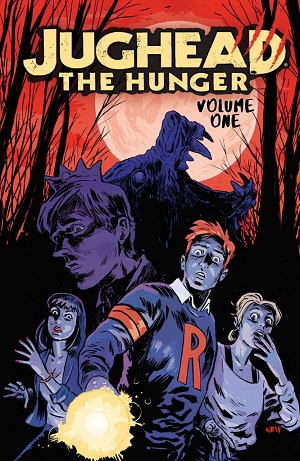
Jughead: The Hunger Volume One

Jughead: The Hunger Volume One

This title is part of a series published under the Archie Horror imprint, coming after Afterlife with Archie and Chilling Adventures of Sabrina and just before Vampironica. The basic idea is that Jughead is one of a long line of Jones family werewolves, with Betty being the latest werewolf hunter of the Cooper clan.

Volume One contains the one-shot comic that launched the series and then issues 1-3, along with some supplemental material and a teaser for Vampironica. The art is in a more realistic style than the usual Archie stuff, so things like Jughead’s needle nose are played down, though he still has his stupid hat and Archie is easily identified by his cross-hatching at the temples and dusting of freckles. Veronica and Reggie I found unrecognizable: Ronnie for being so skinny (a marker of her affluence?) and Reggie for just looking generic without any of the slick smugness of what I was used to. But otherwise the story leans into the characters as we all know them. Betty as werewolf hunter is the tough and practical girl next door; basically Buffy with bullets, a belly shirt, and torn jeans. Jughead is a reluctant monster, slave to his appetites. Reggie is the consummate schemer. Veronica is corruptible. Archie is the Everyman caught between all these different forces. Victims include the old (Ms. Grundy), the fat (Pop Tate), and the nerdy (Dilton Doiley).

This consistency in character underlines a point made by Archie writer Matthew Rosenberg in his introduction: that horror like this doesn’t subvert Archie’s vision of Americana so much as extend it. Horror is as American as apple pie and Norman Rockwell and the rest of the Riverdale gang anyway.

So everything seems to actually follow quite naturally, and I thought it made for a pretty good story. The only point where I had to complain was when the one werewolf gets shot up by the police and then later heals himself by squeezing all the bullets out of his flesh. Only these clearly aren’t bullets but bullet casings, which are discharged by the gun when the bullet is fired. There’s no way they would have been in the werewolf. I was kind of surprised somebody didn’t catch that, as even for someone who doesn’t work with guns a lot it’s a howler of a mistake.

Graphicalex

Grass Kings: Volume Three

Grass Kings: Volume Three

The finale of the Grass Kings trilogy, and I think it does a great job wrapping things up. That’s not to say that everything gets wrapped up though. I think Matt Kindt put too much into this series and there wasn’t enough room for all of it. He would have been better to just stick with the serial killer story, which is quite well handled, and not brought in all the stuff about the billionaire with his own private army garrisoned on an island in the lake. Then the way the killer was blackmailing the sheriffs in Cargill just got dropped in without a lot of explanation. And I never understood how such a community was viable “off the grid,” or what its legal status was. When Maria here says that she’s in the Kingdom “illegally” I couldn’t figure out what she was talking about.

The art by Tyler Jenkins was firing on all cylinders. I loved the full-page pic of the sheriffs looking down off the dock to the bound body in the water. I was also impressed at how well Jenkins can draw horses and helicopters. You wouldn’t expect him to do both well. And even the faces seem filled out a little more, allowing a greater range of expressions and emotion.

Well, you want to end a series on a high note and I’d say this is the best of the three volumes so mission accomplished there. The whole concept was bigger and stranger than I think it had to be, but they brought it home in a way I thought was satisfactory.

Graphicalex

Contagion

Contagion

A little disappointing. But I started out with low expectations that were quickly surpassed. I was thinking it would be a kind of Marvel Zombies, which it is, but the story really whips along and throws in what feels like half the Marvel Universe without losing too much focus. The main hero is the ever-lovin’ Thing, who is called into action when zombie-like creatures are found roaming the New York City subway (beneath Yancy Street, even). And yes, C.H.U.D. is referenced, which scored them an extra point.

What’s happened is an ancient evil in the form of a magic fungus (think green mold, not mushrooms) has been raised beneath the ancient city of K’un-Lun. And . . . then it travels to NYC. Don’t ask me how. It has the ability to take people over and absorb their powers, which makes it pretty tough to beat once it’s taken out the rest of the Fantastic Four and then the Avengers. The Thing is immune, as this sort of mold can’t infect his rocky exterior, but he can’t go clobberin’ it either because it just brushes him aside.

But here the story also got pretty hard to follow, since the consciousness of everyone the mold defeats goes into a sort of hive-mind repository within whoever the primary host happens to be. It’s up to Moon Knight to get inside the hive mind and figure out how to beat the mold, but I can’t for the life of me tell you how it’s done.

So it’s a decent idea, and I liked the range of heroes assembled, even if Iron Fist and Luke Cage, one of my favourite teams, had nothing much to do. Generally I felt that things sort of went downhill though, both in terms of the story (written by Ed Brisson) and the art (each of the five issues has a different artist, and I felt they got progressively weaker). The ending, which I’ve said I didn’t understand, was particularly soft, although there’s a nice coda with the Thing back in the ‘hood.

So, it’s a quickie and winds up feeling rushed what with having so many characters involved, but don’t expect too much and you should enjoy it.

Graphicalex

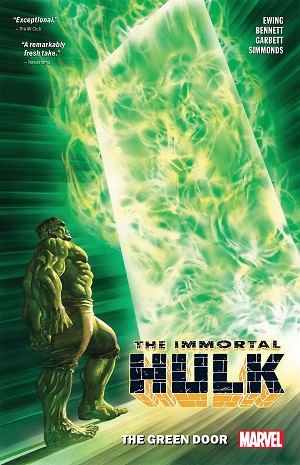
The Immortal Hulk Volume 2: The Green Door

The Immortal Hulk Volume 2: The Green Door

On the plus side, there were some crazy fights here, as the Hulk’s new-found immortality is pushed to the limit and beyond. He’s approaching god-level power and is strong enough take on all of the assembled Avengers. Even if you blow him up with a space laser and then dissect him with adamantium blades his parts keep reassembling, which just leads to another big green can of whoop-ass being opened up. The effects can be grotesque in a truly novel way, and his various pieces coming back together to take out one of his tormentors is well worth the double-page spread. Meanwhile, Skinny Hulk, with his gamma power being drained by Absorbing Man is also freaky, and what happens to poor Absorbing Man is off the charts.

In the negative column . . . just what the hell is going on? The Hulkster is possessed by both a literal and metaphorical demon. The latter being the spirit of his abusive father, who still shows up in visions, and the former being I’m not sure what. Maybe an actual emissary from hell, which is where we end up in the end after going through the eponymous green door (which is, sadly, not an homage to one of the signal films of porn chic).

In sum, this is a really weird take on the Hulk mythos – maybe the weirdest yet, which is saying something since it has gone in a lot of strange directions. I have a hunch that writer Al Ewing was trying to do too much. Even the issue epigraphs rarely seemed on point. That said, I enjoyed this volume a lot more than the first, even if it is a dog’s breakfast of crazy. I still don’t know if there’s anywhere it’s going that’s worth getting to, but the trip is turning into a lot of fun.

Graphicalex

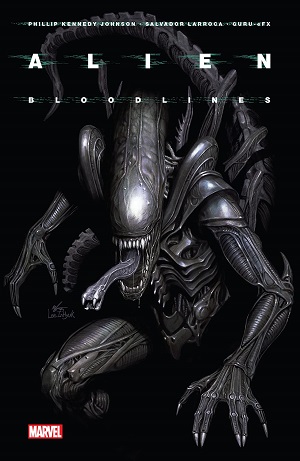
Alien: Bloodlines

Alien: Bloodlines

In my notes on Aliens: The Original Years I said how much I loved the writing. The way that Mark Verheiden took the story in so many interesting new directions put what happened to the film franchise after James Cameron’s Aliens to shame.

I don’t think what writer Phillip Kennedy Johnson does in this six-issue story arc is on quite the same level as Verheiden’s work, but it’s very good. A tough-as-nails security chief named Gabriel Cruz has to go back to a space station orbiting Earth when his son joins up with an activist group that wants to throw a monkey wrench into what the Weyland-Yutani Corporation is doing up there. Unfortunately, what they’re doing up there is breeding a bunch of Xenomorphs, so of course things get out of hand. It seems that despite all the time spent studying them we’ve never learned how to handle these critters.

Throw in some Bishop-model cyborgs that all look like Lance Henriksen, a super “Alpha” Xenomorph and a mysterious dark queen of the hive, and a strange subplot that has the Xenomorphs forming a psychic bond with Gabriel because he’d survived incubating a facehugger (it was cut out of him before it matured and made its own exit), and I thought there was a lot of interesting stuff going on here, most of which I enjoyed.

What I didn’t like was the art by Salvador Larroca. To give him some credit: the aliens look good and some of the action sequences, like the guy getting his head blown off with a shotgun, are nicely done. But where Larroca really falls down is in his drawing of the human characters, and particularly their faces. Everyone seems made of plastic, or like they’re the product of an AI art-generator, and not a very advanced AI program either. (I also thought the colorist was a program, as the credit is to Guru-eFX, but apparently that’s a real person.) Emotion doesn’t register at all, even when characters are yelling or screaming, and there’s little sense of movement in the way the figures are drawn. From what I’ve been able to gather, there’s a lot of strong opinions on Larocca out there in the comic community and I can only say that while I can see some people liking his style it’s not my thing and it took my grade on this comic down quite a bit.

But if you’re a fan of the franchise I’d definitely recommend this just for the story. You may not like the art any more than I do, but it’s something you’ll be able to put up with.

Graphicalex