The Highwayman

The Highwayman

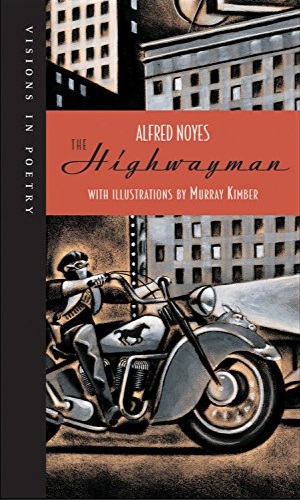
This is one of a half-dozen great little books in the Visions of Poetry series, each illustrating a popular poem taking the ballad (narrative) form. I really loved this series when it came out in 2006 and thought each book offered up a wonderful visual interpretation of classic texts. Unfortunately, they didn’t publish any more of them and looking around they seem to be hard to find today.

This instalment has the poem “The Highwayman” by Alfred Noyes illustrated by Murray Kimber. Like most of the poems in the series, “The Highwayman” has a repetitive, incantatory quality that draws you in right from the famous opening stanza. This is the sort of thing a generation of schoolkids had to commit to memory, and it did them no harm.

The wind was a torrent of darkness among the gusty trees.
The moon was a ghostly galleon tossed upon cloudy seas.
The road was a ribbon of moonlight over the purple moor,
And the highwayman came riding—
Riding—riding—
The highwayman came riding, up to the old inn-door.

The poem is set in the 18th century but Kimber updates everything so that now the titular desperado is a biker outlaw riding an iron horse with a mustang logo through the canyons of Manhattan, and the king’s soldiers are FBI G-men. That’s quite a leap, but I thought it worked wonderfully well. I also thought Kimber did a good job illustrating the business of Bess the landlord’s luscious daughter being tied up with a musket pointed at her breast. That’s one of those things that’s really hard to visualize, and seeing it illustrated doesn’t make it any more believable, but that’s not on Kimber. I don’t know what Noyes was thinking. Otherwise, I had no trouble buying the outlaw as biker, even if the “tlot-tlot” of the horse’s  hooves in the poem made it seem like his bike had a flat. Noyes’s Highwayman is already a bit of a retro cliché anyway, especially given how he’s armed to the teeth with a rapier, two pistols, and a whip. He’s ready for anything, almost.

Kimber’s obvious influence was film noir and I thought the way the story is told like a storyboard, cutting between extreme close-ups and dramatic architectural settings, was quite effective. But then I was on board with all of his creative decisions here. This is a great book not just for kids but for anyone with a love of poetry.

Graphicalex

Doctor Strange Omnibus Volume 1

Doctor Strange Omnibus Volume 1

I felt sympathy for Stan Lee’s response to one of the fan mails sent to “Strange Mails,” the letters page for Strange Tales (the title of the comic Dr. Strange started off in). Lee admits that they “use the same characters over and over again” in the Dr. Strange stories mainly because it’s so hard to make up new names, and then adds parenthetically: “We can make ‘em up all right – it’s learning how to spell ‘em that’s the killer! We still have to look up Cyttorok, or is Cyttorak? – each time we use it!”

This is something I could relate to. The names are so off-beat and unrelated to anything I was familiar with that I had to keep looking up even recurring ones like Dormammu (or the “dread Dormammu” to friends, enemies, and indeed everybody). The flame-headed Dormammu is Dr. Strange’s archenemy, playing a leading role in almost all of these early comics, but when I started writing these notes up I was never sure how it was spelled.

The character of Doctor Strange was inspired by the radio show Chandu, the Magician, but he was always something . . . stranger than that. And he also evolved, even in the early days covered in this omnibus volume. Just in the matter of his looks, in his first few appearances he seems to have an oriental slant to his eyes, which remain nearly closed most of the time. It took a while for them to fully open.

His origin story plays to Marvel’s strength in creating less-than ideal heroes. Dr. Strange is an arrogant jerk who becomes a derelict after a car accident puts an end to his career as a star surgeon. A trip to the Ancient One, however, sets him on the road to recovery, not to mention becoming a master of the mystic arts.

But he remains a loner, occupying a mansion in Greenwich Village where he is attended by a rarely seen manservant. Otherwise he has no assistant or friends

He was also very much a second banana in these years. As noted, the comic he appeared in was Strange Tales, but despite the title he was never the headliner. First he was the B-player to the Human Torch, and then he took a back seat to Nick Fury, Agent of S.H.I.E.L.D. And I do mean a back seat. The main story line here has Doctor Strange seeking out Eternity, a figure who possesses the knowledge he will need to defeat Dormammu. When he finally encounters Eternity it gets a dramatic full-page reveal, but the issue where this climactic event occurs doesn’t even mention it on the cover, which (as usual) is given over to Nick Fury fighting the agents of Hydra. And in the one crossover appearance included, Doctor Strange again plays guest in another hero’s comic, joining forces with Spider-Man.

The actual employment of the mystic arts doesn’t amount to much. The all-seeing Eye of Agamotto is a handy device. Plus there’s a lot of ectoplasmic astral projection as Doctor Strange goes flying around in his spirit form. So much so that it starts to feel old pretty quickly. But what I enjoyed is the way our hero, like a good stage magician, so often just tricks his enemies with some simple stratagem that they’re not expecting because it doesn’t involve any invocations of supernatural powers at all.

The plots get repetitive as well, with Doctor Strange being whisked off to various weird dimensions to do battle with their rulers, or else just taking on another sorcerer (his most frequent adversary being Baron Mordo). But it’s the other dimensions that really set the Doctor’s adventures apart. Artist Steve Ditko went crazy creating a psychedelic ‘60s environment of colours and shapes that make it all seem like a druggy trip. It’s that trippiness that, at least in these early days, set Doctor Strange apart from the usual superhero fare. And fifty-plus years later, it’s what would make him a figure totally at home in the MCU’s plastic multiverse.

Graphicalex

The Mammoth Book of Best Crime Comics

The Mammoth Book of Best Crime Comics
Ed. by Paul Gravett

It’s interesting how the golden age of crime comics pretty neatly overlaps with that of noir cinema, peaking in the 1940s and 1950s. For comics, the body blow of the formation of the Comics Code Authority in 1954 effectively put an end to things. So it feels right that the comics reproduced here are in black and white, even though I’m not sure if that’s how they were all first published. Johnny Craig’s “The Sewer,” for example, from Crime SuspenStories #5 (1951), was. I think. originally in colour. But in any event, it feels right in black and white because that’s how we imagine all crime stories of the period.

The pieces collected here by editor Paul Gravett aren’t all from the golden age, but they look like they might be. Neo-noir and noir are indistinguishable visually. Even the fashions remain much the same. And. if anything, I think the stories were better back in the early days too. For some reason, I suspect fandom, Gravett bookends the material with two relatively recent stories by Alan Moore which I thought the two weakest pieces in the entire book. Neither is really a crime comic either. Nor did I think the entry by Neil Gaiman any better.

So it’s up to the old masters to carry the load. Luckily, they’re up to the task. The stories by Dashiell Hammett, Will Eisner, and especially Mickey Spillane are highlights, as is the aforementioned piece by Johnny Craig. They help make this a collection well worth checking out, even if you’re not a big fan of the genre. And one final thing I’ll note is how much fun I had sampling from a showcase of the letterers’ often invisible art. To be sure there’s some bad lettering in the mix – these were cheap pulps mostly, after all – but there’s a range of different styles here that show how key a role lettering could have in making a comic work. Sadly, noticing it so much here only made me aware of how it’s an art that’s in decline today, where so much lettering seems to be automated and generic.

Graphicalex

Phoenix

Phoenix

This is where I came in.

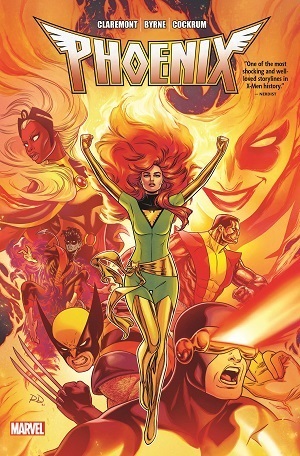
What I mean is that it was the story arc that had the X-Men taking on the Hellfire Club, with “Jason Wyngarde”/Mastermind seducing Jean Grey/Phoenix and turning her into Dark Phoenix in the process, that made me an X-Men fanboy. These were issues I bought when I was a teenager and I think I still have them in storage somewhere — but they’re in pretty bad shape because I re-read them dozens of times. This was simply one of the best superhero stories I’d ever read, and Wolverine rising from the dead, claws extended, snarling “Now it’s my turn!” (at the end of issue #132) is the greatest comic panel ever. It looms so large in my memory that I was sure it was a full-page spread. It isn’t, but it works even better with the build-up to the hand reaching out of the water and grabbing the sewer pipe first.

So when this deluxe edition of the full Phoenix saga came out I figured I’d splurge on it, albeit at a discount price. I mean, $125 in Canada is steep. I paid $40, which I thought was fair. You get 34 comics basically covering Phoenix’s origin through her evolution into a God-like cosmic power and then her eventual death. Bonuses include interviews with the creative talent behind the saga, like writer Chris Claremont and penciler John Byrne. It took me quite a while to get through the whole book, but I enjoyed most of it very much. I especially liked seeing how the X-Men managed to deal with Proteus, “The Deadliest Mutant Alive.” I had issue #127, you see, but not #128, so I never saw what they did to take him down. For forty years I’ve lived in suspense. And I have to say I was not disappointed.

As far as the larger story arc we follow here, I wasn’t as thrilled at the cosmic Phoenix “goddess on a mountaintop” as I was by the Hellfire Club plot. This is a complaint I make with a lot of superhero comics. As heroes and villains keep leveling up, to the point where they’re single-handedly destroying galaxies and universes, it’s hard to care anymore. And everyone knew that was a problem here, as it’s something they talk about in the roundtable at the end. Phoenix was going to be an analog to Thor in being a “female cosmic hero,” but when she turned into a god “she was so powerful that she . . . made the rest of the group kind of redundant.” That’s a feeling I shared. I mean Phoenix is a force that can’t be stopped by anyone, and when she dies at the end she’s really committing suicide.

Meanwhile, what Claremont does so well is present the story on a human level. First and foremost this means setting up the fights. Of course, most superhero comics follow a conventional format where the story is all about building up to climactic fights between heroes and their rivals. What Claremont did was to infuse these battles with a shot of emotional intensity that you rarely found in other comics. You always get the sense that the heroes fighting in these comics are angry, that they really hate each other. Wolverine pulling himself out of the storm drain is just the best example. He’s pissed off now and someone’s going to pay!

Speaking of making someone pay, I laughed out loud at the scene in the diner/grocery store where Wolverine/Logan is flipping through a Penthouse magazine and the store owner tells him “This ain’t no library, fella. You want to read the magazine, buy the magazine.” This triggers Logan, who “don’t like bein’ tapped, bub. Or ordered around.” The owner holds his ground, saying “I don’t like people readin’ without payin’. Wanna make something of it?” Wolverine is about to tear into him before the bad guys arrive. Our heroes can be such squalid types. But something about Wolvering perving out to a dirty mag seemed so right. If you were a teenage boy at the time, you could relate.

Getting back to Claremont’s ability to humanize these figures, I also really liked the way the seduction of Jean Grey played out. That’s genuinely erotic, even without the crazy fetish outfit she dresses up in as the Black Queen. And the thing is, Jean is a hot lady. When she’s going through her transformation into Dark Phoenix Storm senses “pain, great sadness – and an awful, all-consuming lust” within her. Then, when Phoenix summons the lightning she laughs “as the awesome bolts of energy caress her body like a lover.” All this power is turning her on in more ways than one.

The X-Men comics are great. The Classic X-Men titles also included here are not. I just had the sense that Phoenix was a character Claremont couldn’t leave alone, though he really should have. Still, if you want as much Phoenix as you can get in a single volume this is the place to find her. And the central part of the book, meaning the X-Men vs. Hellfire Club storyline remains a classic in every dimension of comic art. I haven’t mentioned Tom Orzechowski’s lettering, but it’s always impressed me as setting a certain standard too. Though rigorously standardized, it has a thickness to it that carries a human timbre. It’s the way I thought all comic dialogue should be written, and has a distinctive character to this day.

So I’m still a fan. And if you want to know why the X-Men (and Wolverine) became the franchise figures they did, it’s all right here. They’d go on to have a pretty good run in comics after this, but more recently they’ve lost the plot in the chaos of the Marvel multiverse meltdown that’s pretty much wrecked everything, even while harkening back to the characters, plotlines, and even tag lines from these glory days.

Graphicalex
The Immortal Hulk Volume 4: Abomination

The Immortal Hulk Volume 4: Abomination

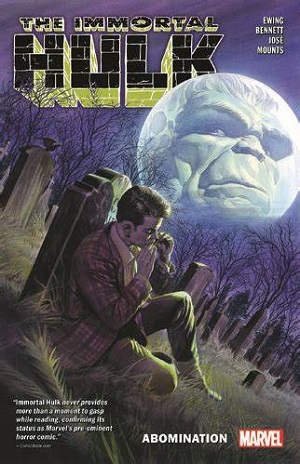
At the end of Hulk in Hell I mentioned how immortality seemed to be catching, with characters like Rick Jones and Betty Ross climbing out of their graves. They’re both back here, reborn as the Abomination and Harpy respectively. How could you imagine unquiet slumbers for the sleepers in this quiet series? I mean, Harpy even tears the Hulk’s heart out and eats it here, not in order to destroy him but as a way of giving him a “hard reset” that will jump-start his healing after he’s basically been dissolved by the Abomination’s acid reflux.

Aside from this, the roller coaster I’ve been on with the Immortal Hulk series continues even within this volume, which abruptly mixes good and bad. In the latter parts we get blocks of exposition with repetitive art as characters try to give us some idea of what is going on. Which helped a bit, though I was still confused even when Bushwacker held up a helpful chart on which he’d broken down the different Hulk identities in play. On the plus side though there’s a pretty good three-way battle between the Hulk, Abomination, and Harpy. The main monster motif throughout this series is a plasticity in form that recalls the shape-shifting monster in John Carpenter’s The Thing. The Hulk can get big or skinny and even displays the faces of victims he’s eaten when he transforms. Inside the head of Abomination he sees various smaller heads. Bushwacker’s very body is some military-grade plastic and can transform into various weapons. All these bodies keep melting and reconstituting over and over, Thing-style. This means that the fight scenes get really messy, even though given that no matter how badly characters get torn apart they keep coming back it plays out less as horror than as a sort of gory kaiju.

On the strength of the monster mash stuff I’d recommend this. I still don’t understand what’s going on with the “Cosmic Satan,” the “one below all” who’s coming through the green door, and I have a suspicion that I’m not going to be terribly impressed when I find out, but it’s a series worth sticking with a bit longer.

Graphicalex

Archie vs. Predator

Archie vs. Predator

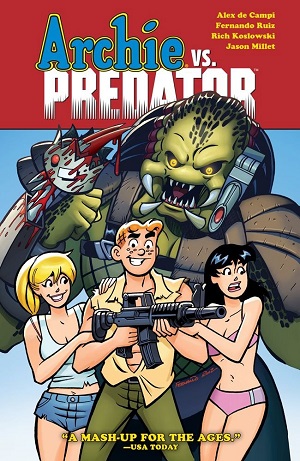
Archie vs. Predator isn’t part of the Archie Horror imprint that launched in 2013 with the zombies-in-Riverdale title Afterlife with Archie, but is instead a mash-up from Dark Horse Comics that was no doubt inspired by the success of Afterlife but also by a much earlier crossover, Archie Meets the Punisher (1994). And indeed it’s closer in spirit to the latter in that it’s illustrated in the classic Archie style (very unlike the Archie Horror comics where even Archie himself is unrecognizable) and keeps something of the sweetness and innocence of the Archie-verse going in a story filled with splatter and just the slightest suggestion of an adult gaze (as both Betty and Veronica provocatively strip down to their underwear at different points). It’s a comic that wants to have its cake and eat it, and for the most part it works. When Betty says to the Predator “You are one ugly melon farmer,” it’s a good line.

But while enjoyable, I thought the writing was quite a letdown from the Archie Horror comics I’ve read. There are no funny jokes and the plot is incredibly slapdash, even by Archie standards. Why whisk the gang down to the Caribbean for a holiday? Why wouldn’t the Predator just land in Riverdale? Why introduce all the nonsense about the curse of the local Jaguar Goddess into a Predator story? Did it even mean anything? Is the teenage Predator in love with Betty and Veronica? Does that add anything? The skips in the narrative made the breaks between the individual issues invisible, and led me on at least two occasions to try to pull pages apart because I was sure something had gone missing. As a way of shuttling things along, Mr. Lodge’s medi-lab serves as a really awkward plot device. I mean, it gets us Super-Archie and the gag ending, but you’d think they would have come up with something a little more grounded. A lot of what goes on here doesn’t feel like it belongs in either the Archie or the Predator universe.

There are some parts that did share a strange continuity with the Archie Horror titles. Like the pre-eminence of Jughead as the ultimate victim (he’d been the first human zombie in Afterlife, and the werewolf in Jughead: The Hunger). Here he gets his severed head and spinal column stuffed in a snack machine. Meanwhile, Dilton Doiley has gained in importance from the classic Archie days as Reggie Mantle has all but disappeared. There’s one great panel that has Reggie taking a selfie of himself blasting away at the Predator with a machine gun, but I think he’s blown up just after this. And the fact that I have to say I think he gets blown up is telling, because I wasn’t sure and anyway that’s it for him. He doesn’t get a signature execution scene or anything. He just disappears. I find this strange because Reggie was one of the four main characters in the comic, being the dark foil to Archie, so that the two balanced out the equally light/dark competition between frenemies Betty and Veronica. He was a more interesting character than Jughead, and more worthy of receiving a gory comeuppance, but in the alt-Archie comics he’s largely forgotten.

Overall then, Archie vs. Predator is a lot of fun but not as good as I was expecting. I really liked seeing the Predator drawn in the Archie style, along with the assorted mayhem, but as I’ve pointed out the writing doesn’t deliver. It’s just not as clever a comic as it could and should have been.

Graphicalex

Talent

Talent

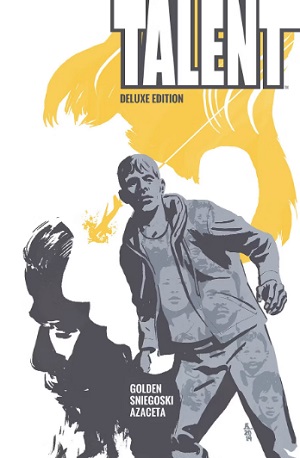
I give Talent high marks for its premise. It’s brilliant. A bomb takes out a passenger jet and there is one survivor, Nicholas Dane, who has somehow taken on the memories and talents (there’s your title) of everyone else who was on the plane. This serves him in good stead when the ruthless gang that bombed the jet come hunting after him, because now he instead of just being a lowly English professor (and that’s really low!) he is a trained killer, among other things.

The potential such an idea has is immeasurable. But it remains potential. A great premise is not a great story, it’s just the start. And the story here is lousy. The criminal enterprise that’s hunting Dane is a clichéd conspiracy of hooded figures known as the Cardinals. I had no idea who they were or what they were up to. After four issues the series abruptly ended in 2006 and hasn’t been continued.

Nor do I have any idea of how Dane got his powers. A mysterious female figure appears to him on occasion to try to explain what’s going on, but things remain pretty . . . vague. Basically he has become an agent of something called “the balance.” What is the balance? “It is what it is. The balance of all things, light and dark – yin and yang – good and evil, if the concepts do not offend you. The balance is the power that keeps the two opposing forces in check.”

Wow. “It is what it is.” I do not think they put a lot of time into figuring this balance thing out.

What disappointed me the most about Talent is that the concept could have been taken in so many interesting directions. There’s so much talent out there! Nearly everyone you meet has a talent for doing something. I could imagine storylines where Dane is tapping into the talents of an electrician or a cab driver or a dental hygienist. But they don’t do anything like that. The only talents sampled are those of a hired killer, a champion boxer, and a woman who makes origami. Now the first two are very useful in terms of their particular set of skills, but also a bit dull. There’s nothing interesting about how their talents are put to use. Dane just beats people up and shoots them.

So in the end I can’t say I liked this very much. Paul Azaceta’s art is very chunky, turning people into shapes and thick lines, so you don’t get to read any emotion on the faces. Indeed, it can be hard telling some of the characters apart. And the story is just a mess. Is Dane only staying alive, or is he on a mission of vengeance? Or is something else going on? I guess at some point they had plans for taking this further but for whatever reason that didn’t happen so what we’re left with is something that doesn’t add up and doesn’t come to any sort of a conclusion.  But apparently it’s in development as a cable series, and they still might be able to make something good out of it. I hope they do, because as I say the idea here is great.

Graphicalex

1984

1984

One of the points I sometimes make about film and comic adaptations of classic novels is whether they provide a decent crib for students who don’t want to bother reading the book they’re based on. Because let’s face it, that’s what students do. Most of the time these “classics illustrated” are no substitute at all for the original works, but Fido Nesti’s adaptation of George Orwell’s famous dystopian text is an exception.

I’m not saying people can or should pass on Orwell and just read this comic version. I’d never recommend that for any book. But what Nesti gives us here is a remarkably thorough adaptation, including not only the complete text of Goldstein’s book but also “The Principles of Newspeak” appendix. You’re going to do a lot of reading here. Of course you’re not getting the full book, but there are times when you may feel like you are.

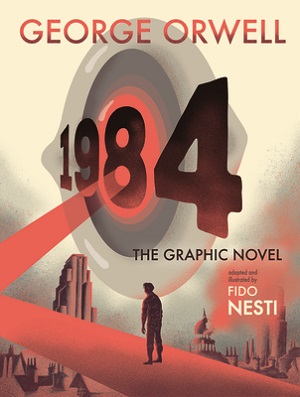
And that’s not to put down Nesti’s art. I really like what he’s done here. The generally drab colouring and layouts only make the imaginative moments (like the surveillance technology becoming a snaky network of wires, tubes, and monitors) stand out more. Plus the world of Airstrip One is supposed to be drab, with Winston and Julia just a couple of Claymation potato people with holes for eyes, fishy lips, and lumpy overalls. The lead comes straight from Orwell: “It was curious how that beetle-like type proliferated in the Ministries: little dumpy men, growing stout very early in life, with short legs, swift scuttling movements, and fat inscrutable faces with very small eyes. It was the type that seemed to flourish best under the dominion of the Party.” So if eyes are the windows to the soul it makes sense that O’Brien doesn’t seem to have any, as they’re either hidden behind his glasses or are just dots (in the case of the former there may be a nod here to Orwell’s description of speakers of propaganda in “Politics and the English Language” whose spectacles become “blank discs which seem to have no eyes behind them”). The only time O’Brien seems to come to life is when he’s really laying it on Winston. But soul by this point has leached out of everyone anyway.

I think of a good graphic novel adaptation as being like a band covering a classic song. The artist needs to bring something fresh to the table, some display of talent, imagination, and personality that does justice to the original while adding to it and making it new. I think Nesti does that here and his 1984 is more than a cut above the usual run of these things. Not a substitute for reading Orwell, but a worthy complement to his timeless prophecy.

Graphicalex

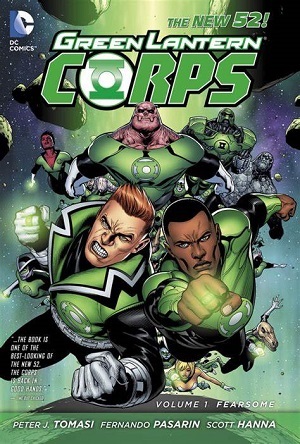
Green Lantern Corps Volume 1: Fearsome

Green Lantern Corps Volume 1: Fearsome

I’ve mentioned somewhere before about how inflation is built into superhero comics. The good guys have to take on increasingly powerful bad guys, or more of them. Then the good guys have to multiply so that you get more of them too, either by being paired with regular sidekicks or assembled into teams of heroes.

For the Green Lantern this translated into series like the Green Lanterns (plural) for the DC Universe Rebirth (I made some notes on Rage Planet here), and the Green Lantern Corps for the New 52. I don’t follow these things closely enough, so I wasn’t sure which came first. On checking into it, the New 52 was launched in 2011 and Rebirth in 2016. So now I know.

In any event, the GL Corps weren’t new in 2011 since they’d been around since near the beginning (I even remembered them from when I was a kid), but having armies of “Lanterns” (as they’re called) in every issue felt to me like just part of the same “more is more” mentality. And what makes it worse in the case of the Lanterns multiplying is that they’re all basically the same. They’re different species united from all the far corners of the universe, but their super powers are all just whatever “constructs” they generate from their rings. So having two of them, or 7,000, just feels redundant if not overkill.

Well, on to this iteration of the Corps and its ceaseless battle against evil in all its forms.

Things kick off here on a very dark note indeed. Some evil force attacks a Lantern Corps “sector house” and quickly disposes of the two Lanterns stationed there, decapitating the one and slicing the other in two. This sets off an alarm back at Lantern HQ (on the planet Oa), and a team of Lanterns, headed by Earth representatives Guy Gardner and John Stewart (not of The Daily Show), is sent out to investigate. They soon discover another major crime against the universe: All the water has been sucked off of a planet inhabited by a race of friendly-looking beaver creatures, leaving behind a dry sea-bed of corpses. Then, just to send a further message, the resident Lantern guardians of the blue beaver planet have been left impaled on stakes.

To be honest, after reading the first couple of issues of this one I wasn’t sure I wanted to keep going. It just seemed grim. I’m no prude when it comes to splatter, but there was an incongruous cruelty to the proceedings here, with various scenes of torture thrown into the mix that I really didn’t care for. And nobody rises above it. I didn’t even like Guy and John very much, and thought the only way they were being made bearable was because of how bad the bad guys were.

As for those bad guys . . . they weren’t working for me at all. They go by the name of the Keepers because of the role they had watching over the Great Green Lantern Power Supply (a.k.a. the Central Power Battery), before the Lanterns decided to up sticks and move, leaving the Keepers to rot on their miserable home planet. So they had a legitimate grudge, but I didn’t really understand all the politics. As for the Keepers themselves, they’re just the usual army of mooks, made to look like zombies. They have incredible will power and an imperviousness to the constructs of the Lanterns, so they can just sort of overwhelm the Lanterns until the green guys power up with some old-school weaponry. Even so, they’re looking likely to take over until Guy hits upon the expedient of dropping a fear bomb on them that turns them into a bunch of crybabies who are then sentenced to dig graves for all their victims on the blue beaver planet.

I didn’t care for this at all. It’s dark but not very smart and even by the end I hadn’t managed to keep any of the Corps members’ names straight. But I picked up almost the whole series of these when the library got rid of them in an overstock shelf-clearing, so I’ll read a few more anyway and see if things get better.

Graphicalex

The Immortal Hulk Volume 3: Hulk in Hell

The Immortal Hulk Volume 3: Hulk in Hell

This series is yanking me up and pulling me down. I thought the first volume (issues #1-5) lacking, but the second (issues #6-10) very good. Expectations raised, I was ready to enjoy Hulk in Hell, which kicks off with skinny Hulk and various tag-alongs having passed through the sadly unerotic Green Door and winding up in some sub-dimension of evil. But I was in for a disappointment.

Writer Al Ewing feels like he’s channeling Alan Moore (bad Alan Moore) with a sporadically literary pastiche of psycho-mythology. Thus the explanation for what’s going on here: “Gamma radiation is science. It’s measurable, predictable, it has rules . . . until it doesn’t. Until it makes Hulks and Sasquatches and Leaders. Metaphor people. Until it’s magic. When the first gamma bomb went off, it unleashed forces beyond our control. Unified forces. It opened a door, deep down into the pit of reality. Into the lowest hell. And any high concentration of gamma – that’s a door too. Including gamma people.”

What does all this add up to? Just another example of the old trope of a portal to another dimension that our heroes have to close in order to save the world from an evil invasion. Except that the Hulk himself is a door. So “What will the Hulk be? The accuser or the adversary? Khamael or Satan? Is he of Geburah or of Galachab?” Etc. The Hulk’s abusive father again puts in an unwelcome appearance, which is an angle I care for less and less. And the way things are going it looks as though immortality is a side-effect of all the gamma energy flowing everywhere, as various characters – Crusher Creel (Absorbing Man), Thunderbolt Ross, Doc Samson, Betty Banner, Rick Jones – start climbing out of their graves. Throw in the usual shadowy government agencies who are up to no good, epigraphs drawn from the Bible, Shakespeare, Dostoyevsky, and Camus, and I thought it all a lot too much. There’s even a “Devil Hulk” which is the big green guy’s id, and a Moore-ish master plot about the Hulk (the basic model) wanting to destroy humanity in order to save it.

Still, I can’t help thinking there’s something here worth sticking with. So I’ll see what volume 4 has to offer anyway.

Graphicalex