Asterix and the Golden Sickle

Asterix and the Golden Sickle
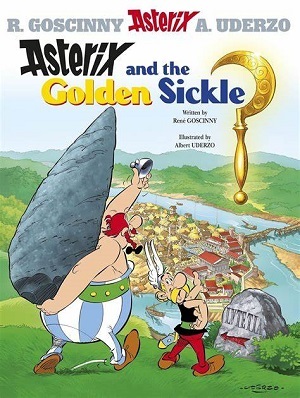
Outside of the central characters and the basic formulas, I only recall bits and pieces of the Asterix comics from when I read them as a kid. But I do remember thinking that Asterix and the Golden Sickle was one of the best. It’s actually a nice little mystery story, with Asterix and Obelix traveling to Lutetia to find Metallurgix, Obelix’s cousin who is also a manufacturer of the golden sickles that druids like Panoramix need to harvest mistletoe. Unfortunately, when they get to Lutetia they find that someone has kidnapped Metallurgix as a way of cornering the market on golden sickles just before the big druid festival.

It’s eventful, fast-moving, and the plot holds interest throughout. The secondary characters are also interesting, from the little guy in the drunk tank who gets a shot of magic potion to the Roman prefect Surplus Dairyprodus, whose appearance was based on that of the actor Charles Laughton. Dairyprodus is one of the most original villains ever, taking up a life of crime and hanging out with lowlifes just because he’s bored of enjoying all the good things in life. He’s even looking forward to rowing in a galley at the end, just for a change of pace.

The only false note came by way of the new “North American” translation, which even has Obelix saying “Cool!” at one point. Not cool!
Graphicalex

Road of the Dead: Highway to Hell

Road of the Dead: Highway to Hell

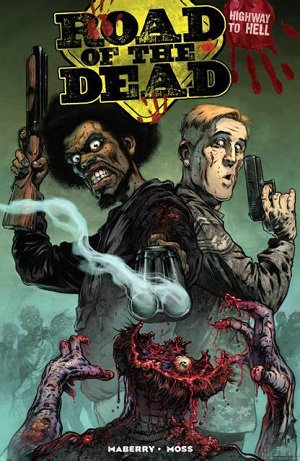
Damn, now that’s a zombie comic cover! Nothing like an eyeball floating in the bowl of a hollowed out skull with a smoking shotgun barrel in the background. Could the comic itself live up to this?

No, it doesn’t. And in fact the cover is by Santíperez while the comic itself is illustrated by Drew Moss. So different artists. There’s a gallery of covers by Santíperez included in the bonus material here though and they all look nearly as cool.

In my review of the movie Zombieland I suggested that 2007 might be taken as the year of “peak zombie.” It just seemed like zombies were everywhere and nothing new was being done with the genre. So this comic, billed as a prequel to Road of the Dead though I’ve never heard of that book, was coming very late to the party (it was published in 2019). In particular, this really feels like a colour version of Kirkman’s The Walking Dead mixed with even older elements borrowed from the Romero films. There are highways jammed with stalled vehicles. There are warrior biker gangs. There’s a pair of pet zombies kept on chain leashes. There’s a guy with a spiked baseball bat. There’s a battle tank that turns out to be surprisingly (and unrealistically) effective in taking out zombies. There’s a story involving the attempt to transport a scientist working on a cure for the zombie virus to a safe haven in . . . you guessed it: Canada!

I don’t think there’s any way writer Jonathan Maberry wasn’t aware of all this. He even kicks things off with a billboard advertising the Monroeville Mall (setting of Romero’s 1978 classic Dawn of the Dead). But it’s hard to draw much of anything from a well that’s already been pumped dry. You can go the route of zombie parody, but even that was getting stale by this time. So there isn’t much to do here but watch the splatter. There’s a slightly more contemporary wrinkle added by the fact that the gang chasing our heroes are members of a sort of conspiracy cult, believing that a cure is being kept from them by government elites. But that’s never developed. And of course the underlying philosophy of the zombie genre is still in play: that the zombie apocalypse only reveals the state of nature as it already exists, a war of all against all with civilization a transparently thin membrane stretched over the abyss. Our lives so routine, meaningless, and devoid of human attachment we might already be dead. As the narration explains:

This is how it is now. Everywhere is a trap. Everyone is an enemy. Each of us is a traitor to the living the second we die.

Ten thousand years of human civilization. Everything we learned, everything we built, all we know about the world and the universe. And now the only thing that defines us is whether we’re predators or prey.

No dignity left. Hope and optimism are getting bitch-slapped. Compassion’s lying dead in a ditch somewhere.

It’s not that I don’t have sympathy for this sort of end-of-days nihilism, but as I say it’s something that’s foundational to the zombie genre and the fact is that Road of the Dead: Highway to Hell doesn’t have a new story to package it in. It’s the sort of comic I’d usually recommend only if you’re a huge fan of zombie stuff, but actually if you’re a huge zombie fan then you might feel let down by how unoriginal it all feels, since I’m sure you’ll have seen it all before. So while it’s an OK comic, it’s kind of hard to recommend to anyone except splatter-action devotees.

Graphicalex

Green Lantern Corps Volume 2: Alpha War

Green Lantern Corps Volume 2: Alpha War

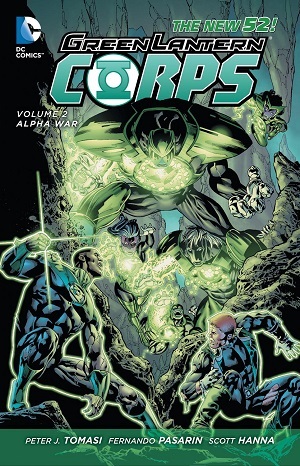
There are actually two different storylines here. The first is the Alpha War one, which has an excessively rigorous bunch of super-Lanterns on the HQ planet of Oa tasked with policing the rest of the Corps. Quis custodiet ipsos custodes? Who will guard the guardians? The Alpha Lanterns, that’s who!

And who is watching over the Alphas? The bobbleheaded Guardians hanging out in their Planetary Citadel. And you wouldn’t want to trust that lot.

Anyway, one of the dark moments in the previous volume had John Stewart kill a fellow Lantern who was being tortured by the Keepers into giving up the pass code they needed to break into Oa. As things kick off here, Stewart is judged by the Alphas and sentenced to death. But then Guy Gardner and some of his buddies break John out of his prison (what they call the “sciencell”), and have a battle royale with the Alphas, who end up being defeated.

I didn’t care for any of this. I couldn’t tell any of the Alphas apart except for the centaur guy and nothing about the plot seemed right to me. To be honest, by the time they wrapped things up I was thinking of giving up on this series.

I’m glad I didn’t, because in the next story line, that only gets introduced here, we learn about some space zombies who are just floating around turning everyone, including any Lanterns who cross their path, into more zombies. These zombies form a “third army” that the Guardians seem to be behind in some way. I told you those bobbleheads can’t be trusted. They’re also up to something when they release Xar from his prison and send him out to stir things up. Meanwhile, Kilowog and Salaak are on to the Guardians but they’re a little slow in piecing things together.

Then John Stewart, who has been sent off on a wild goose chase, meets up with the busty Fatality, and Guy Gardner gets his team of Lanterns wiped out by the space zombies, which results in him getting kicked out of the Corps and sent back home to Earth without any of his Lantern powers.

I don’t know where any of this is going, but I’m interested enough in what Fatality, Xar, the Guardians, and the space zombies are all doing to keep reading for another volume. Power up!

Graphicalex

Beowulf

Beowulf

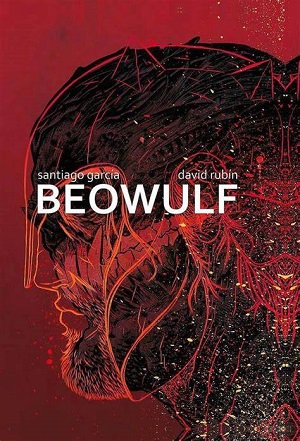
This is a big book, 8.5”x12” format, which helps sell it as an epic, with the heroic, larger-than-life figures going at it in a giant mythic landscape. The double-page spreads, most often given over to climactic points in the hero’s three great battles (against the monster Grendel, Grendel’s mother, and finally a dragon), feel like paintings in a coffee-table art book and you want to enjoy them at scale. But they also mean that you can get more out of the inset art, which in a regular-size comic is harder to read.

I also thought that in most respects this was a faithful adaptation of the Old English poem. The colour scheme favours a bloody-fiery scale of reds, and Beowulf looks like his nose has been busted a fair few times, along with picking up a cauliflower ear. The monsters are believable, with Grendel’s mom maybe looking a bit too much like the Xenomorph from the Alien movies. But the dragon is pretty original, given that there’s less artistic leeway when it comes to drawing dragons.

There were a couple of odd interpretive flourishes. Grendel seems to fall in love with the naked, sleeping Beowulf, fingering his penis and then ejaculating all over him when Beowulf awakes. I wonder what that was all about. I do wonder.

Then a lot is made of Beowulf as an older man feasting at his hall. There is a focus on his mouth as he’s eating, with close-ups of his teeth and his tongue and even one cell that gives the point of view from inside his mouth as he pours a drink down his gullet. I can sort of see wanting to emphasize the eating, but I didn’t think this worked. It felt like overkill for a point that wasn’t that important in the first place.

As W. H. Auden said of the poetry of Yeats: “The words of a dead man / Are modified in the guts of the living.” Perhaps that was part of what was meant in making such a big deal out of all the eating. Because we end on an interesting note, with the words of the Old English text appearing in print and then being digitized before finally taking the form of this graphic novel. It’s remarkable that the story of Beowulf has hung around as long as it has, but to have that kind of afterlife means putting a lot of work into adaptation, or digestion in our cultural guts.

Graphicalex

The Immortal Hulk Volume 5: Breaker of Worlds

The Immortal Hulk Volume 5: Breaker of Worlds

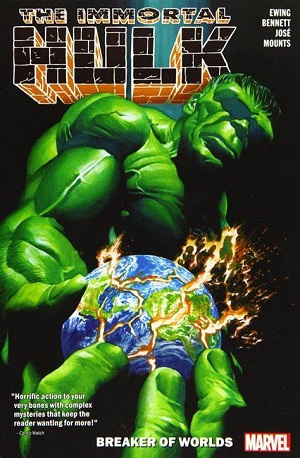
Another Immortal Hulk volume, another up-and-down ride. I liked the main storyline, which had the Hulk squaring off against the Hulk-hunting Shadow Base headed up by Major Fortean, who is now wearing the Abomination’s hide like a kind of symbiote. That was all well set-up and had some good action to it, albeit action of a kind that, if you’ve been following this series, is starting to feel a little stale. More bodies melting into grotesque forms and then getting killed but not really being killed because they just end up being sent to that limbo beyond the green door. Still, issues #21-24 were solid. But then issue #25 took off in another direction entirely, jumping “eons” ahead into the future with the Hulk eating the Sentience of the Cosmos and a giant Hulk becoming a god – the “Breaker of Worlds.” I mean, literally. He flies through space and crushes a planet. There’s a survivor of this Hulk apocalypse though and we’re left with the promise that veteran Hulk enemy the Leader has plans to address the situation. Which at this point you really have to wonder at.

I suppose this could all go somewhere interesting so I won’t outright condemn it. But I don’t personally care for Marvel titles when they go cosmic. I feel like they always lose the plot whenever a character becomes a god, from Dark Phoenix on down. I like it when they keep things simple. But there’s a sort of inflation built into most comic storylines, you also see it in a lot of manga, where you have to keep pumping things up until in some cases (like this) you get to a point where they collapse under the weight of some vision of infinite power.

That certainly seems to be what’s happening here. But I’ll continue.

Graphicalex

The Approach

The Approach

A mid-size airport is nearly shut down due to a massive winter storm. Then a small engine-prop plane flies in out of nowhere, crashing and exploding into a fireball on landing. A body is pulled from the wreckage. Later, that body comes to life, transformed into a flesh-eating, tentacle monster. It kills people and gets bigger, and bigger. I mean, it grows like a Xenomorph. An old lady worships it, reciting Lovecraftian catch-phrases (“Yoth anon par a koth . . . Shun ara soth”). The skeleton crew at the airport, apparently cut off by the storm from any help, set out to hunt the beast down and kill it.

Like a lot of the horror comics from Boom! Studios, The Approach very much feels like a 1980s horror flick, most obviously in this case John Carpenter’s The Thing. And having spent a good chunk of my teenage years enjoying those movies, I’m not saying that’s a bad thing. I thoroughly enjoyed the story here by Jeremy Haun and Jason A. Hurley precisely for its most familiar (to me) elements. What pulled it down a couple of notches were two things.

In the first place, I thought they threw too much stuff into the pot. The story could be continued at the end (yes, you get a final panel/shot that suggests the monster isn’t all dead yet), but it seems pretty complete otherwise and there are two major points that are introduced that receive no explanation whatsoever. First: the plane that crashes is said to have gone missing 27 years earlier, so it not only appears out of nowhere but out of no-when. Where, or when, was it all that time? No idea. Nothing more is said of the matter. Second: does the old lady who chants to the monster know something about its provenance? Or is she just a gibbering idiot? Again, no idea.

The second reason I’d knock it down is the art. Jesús Hervás took over from Vanessa R. Del Rey as the artist of the Empty Man series in The Empty Man: Recurrence and The Empty Man: Manifestation, and I’ve already said I’m not a fan. He definitely has his own style, I give him credit for that, but it’s really not my thing. It’s just too hard to figure out what’s going on in a lot of the action scenes. And the monster here looks (and sounds) too much like the buggy creatures in The Empty Man. It’s just not that interesting.

But despite being full of stuff that isn’t explained and having a plot that’s so predictable I was calling how it was going to end by page 6 I still enjoyed this. I don’t know if it would appeal as much to people who weren’t students of ‘80s horror though.

Graphicalex

BRZRKR Volume Three

BRZRKR Volume Three

If you read my review of BRZRKR Volume Two you’ll know I went into this final part of the trilogy with really low expectations. Expectations that were, in the event, barely met.

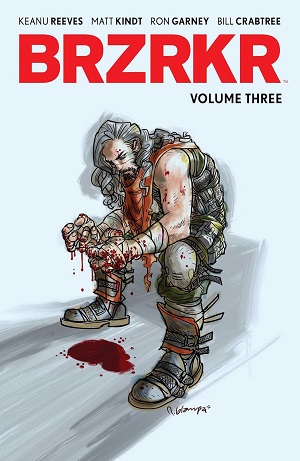
On the plus side, this is a really fast read. There isn’t a lot of talking, and what there is can be ignored, so you’re basically just flipping the pages looking at Ron Garney’s explosive art. And by that I mean there are lots of explosions.

Our hero B (or Unute, or Keanu Reeves) is feeling tapped out, so now’s a good time to introduce a Lady Berserker, a scientist guy who turns himself into a Berserker, and finally a pair of Berserker twins who are heading off at the end to grow and plant their seeds. Which sounded kind of creepy, but what do I know. Meanwhile, Unute becomes mortal but then is reborn so he’s immortal again and at the end he’s back on another planet or in another dimension or something.

No, none of this makes any sense. It might mean everything and nothing. And of course the story is left open-ended. I guess the Berserker twins could go on to have further adventures and the bad guy could re-assimilate and come back to haunt them. But I’m out. Some readers (especially if they’re fans of the Tao of Keanu) might still find the elevation of an action hero into a god interesting or even deep, but I feel like it’s been done to death and overall this struck me as one of the laziest comics I’ve read in recent years. So even if they do go on I won’t be hanging with it.

Graphicalex

Batman: Justice Buster Vol. 1

Batman: Justice Buster Vol. 1

I’m sure Batman must have gone manga before this comic, which I think launched in 2021, but in any event that’s the hook here. Manga Batman.

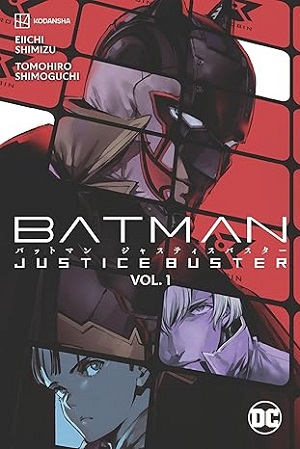
What is manga Batman like? Basically he’s a cross between Iron Man, in a very robotic-looking armoured suit, and Spider-Man with the way he goes swinging through the canyons of Gotham on cables fired from his wrists. In terms of art style I wouldn’t call it excessively manga-ish, though you do get some faces characterized by the trademark pointy chins and missing noses. And of course you read the whole thing back-to-front.

Author Eiichi Shimizu plays some interesting riffs on the Batman mythos. Which is saying something, given how many times that mythos has been reinvented and reimagined over the last hundred years. Robin (or ROBIN) is now Batman’s AI assistant, and there are definitely some kinks in that system that need working out. Batman has the idea that his super-computer is going to help him stop criminals before they actually commit any crimes. What could go wrong with that? Meanwhile, Dick Grayson is a kid working with a detective who’s investigating the murder of his *(Grayson’s) family. There’s not much explained about that angle, but I’m sure it will be developed as the series goes on. And finally there’s a new Joker, now a masked nut who wants to be Batman’s sidekick. Yeah, he’s a good guy. Or at least that’s what he’s pretending to be.

Other familiar names are more recognizable. Alfred and Commissioner Gordon are the same as they’ve always been. Clark Kent shows up trying to get Bruce Wayne to join the Justice League, but gets turned down. Firefly, Killer Croc, Penguin, and Deathstroke are all here. There’s actually a fair bit of action, but one thing about the art I had trouble with were the fight scenes. They’re really hard to follow. I liked their “look,” which is less manga than the rest of the comic, but it’s not easy to make out what is happening. Which is a shame because the fight with Killer Croc seemed like it was quite something.

In other words, a mixed bag. More interesting for the storylines that are introduced than the look of the thing, but in any event worth sticking with a little longer. Even if the Justice Buster (the name given what appears to be a blocky-looking Batboat here, but which turns out to be one of those monster exo-suits) seems a silly sort of thing.

Graphicalex

Ravencroft

Ravencroft

After setting things up with the backstory of the Ravencroft Institute in the miniseries Ruins of Ravencroft, this title continues with more things happening in the present day. This includes an uprising by the Unwanted, led by their leader Bud, and an attempt by sinister forces to get hold of the Journals of Jonas Ravencroft.

As with the first Ravencroft volume I thought it was well executed. I like how the opening panels repeat as the images on the security camera screens on the next page, for example. But again it didn’t seem like there was much of a story. The main protagonists are John Jameson, Misty Knight (with a bionic hand attachment that has Wolverine claws), and Dennis Dunphy, as a guard who isn’t Demolition Man. It’s telling that the cover images rarely have much if anything to do with the contents of the individual comics until you get to issue #5. The dual climax combines the battle between the Unwanted and the security forces at Ravencroft and the long-delayed transformation of John Jameson into Man-Wolf. Too long delayed, in my opinion. And I felt sorry for the Unwanted, who really seem hard done by. Despite being grotesque vampire monsters I was cheering them on and hoping they’d destroy Ravencroft at the end. But instead they’re left even worse off. Meanwhile, Norman Osborn is hanging around and we suspect he’s up to no good. Dr. Ashley Kafka is back from the dead. And the Punisher is being held at Ravencroft too, though again I’m not sure why except to make a couple of dramatic entrances and then disappear.

As things leave off it seems as though the spiral death cult of Knull is getting ready to reawaken so maybe things are going to step up (or down) a notch. But two volumes into this series I still feel as though I’m waiting for something to happen. That’s not to say there isn’t a lot of action, because there is, but it seems like running in place.

Graphicalex

Ruins of Ravencroft

Ruins of Ravencroft

OK, just based on the name I’ll give you one guess what Ravencroft is.

Did you get it? If you said it’s the Marvel Comics version of DC’s Arkham Asylum, with its full name being the Ravencroft Institute for the Criminally Insane, and that it’s a maximum security prison that houses a mixed bag of baddies and is run by some highly dubious “doctors,” then you win a prize! A prize to be determined at some later date.

Wilson (don’t call him Willie) Fisk, a.k.a. Kingpin, is now mayor of NYC and he has decided to rebuild Ravencroft after it got destroyed by Carnage in a previous comic, so this three-part miniseries provides a historical backstory for the demon-haunted place. And I mean demon-haunted literally. It seems it was built on the site of an ancient Indian cannibal cult that worshipped the dark lord Knull. That doesn’t seem to be the worst thing about it though, as they’re also stuffing the results of experiments in turning humans into vampiric monsters into a hole labeled “Unwanted,” where they’re fed fresh victims all the time so they don’t ever die.

This was an odd sort of a comic. The three stories feature an early incarnation of Carnage, though Carnage isn’t really present (ignore the cover, which, like a lot of the covers in this series, is quite misleading). There’s just an ancestor of Cletus Kassady here who gets involved in a Bone Tomahawk adventure in colonial days. Then there’s a story about Sabretooth, and finally we get Dracula himself (the Marvel Dracula, complete with pencil moustache) facing off against Captain America.

I found it all interesting, with good writing by Frank Tieri, but the flashbacks stayed pretty murky. The Journal of Jonas Ravencroft seems important for some reason, but Jonas himself irrelevant. And once again we’re in the world of a shadowy cabal or deep state star chamber pulling the strings. What’s their agenda? You’ll have to wait and see.

So it’s just an intro or origin story and I guess it does a fair enough job of setting the table, but that’s all there is.

Graphicalex