Batman: Year 100

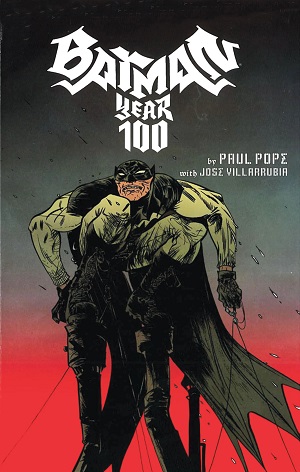
Batman: Year 100

Batman: Year 100 begins with our hero being chased across the rooftop of an apartment building by a pack of dangerous-looking dogs while helicopters hover overhead and a police dragnet draws tighter. It’s a moment that’s effective for a couple of reasons. In the first place it throws us right into the middle of the action, which is set in the year 2039 (that’s a hundred years after Batman’s first appearance in 1939). What is Batman doing here? Did he invent a time machine? Get sucked into a dimensional vortex? Is this even the same, original Batman, now dimly remembered only as an urban legend or bogeyman? We don’t know the answers to these questions and indeed we never find out. It’s all just a given, and I think the comic is stronger for not trying to explain any of it.

The second reason I like this way of starting out is that it sets the tone for much of what follows. Batman is constantly being chased in this series, a wanted man in a dystopic future police state. The federal police (“wolves”) are the usual jackbooted thugs, but they’re only the foot soldiers of an oppressive surveillance apparatus that puts cameras in eyeballs and even includes the use of mind-reading telepaths. It’s all Batman can do to stay one jump ahead of these guys, and when they do catch up he really takes a beating.

One reason he suffers so much damage is that he’s not encased in his usual body armour. Instead, his costume looks like a lumpy pair of sweats. Paul Pope even deliberately made the sleeves too short so that his wrists poke out of the gap between the cuffs and his gloves, giving “a sense of his concealed human vulnerability.” This isn’t the mecha-Batman of Justice Buster or the more conventional massively-muscled All-American Batman. He looks more like a guy in burlap pyjamas, and I loved it.

In fact I loved almost everything about this comic. I’m constantly being impressed at how writers and artists can continue to make something not only new out of this old warhorse of a character but something really good. The story here is first-rate, with a really neat plot twist I wasn’t expecting, and while I’m not personally fond of Pope’s style of drawing I did get used to it and thought it made for an interesting complement to the violence the characters endure. Faces seemed slapped together out of clay, especially with regard to mouths, and when the beatings come they look like they’re being slapped apart again. There’s also a lot of room for ambiguity, beginning with the cover of the trade paperback which I had to look at for a long time to figure out. I think I finally got it, but there I felt like they should have gone with something different.

This collection of the full four-part series runs without breaks, which were so seamless I couldn’t identify them. Also included is Pope’s “The Berlin Batman,” which re-imagines Batman as a crime fighter in Weimar Germany. Batman in this story is the alter ego of “Baruch Wayne,” a wealthy socialite. I wasn’t blown away by this story, but it makes for a nice extra.

So there you have it. Off the top of my head I’d rank it only behind classics like Frank Miller’s The Dark Knight Returns and Loeb and Sale’s The Long Halloween in the running for my favourite Batman storyline. Maybe every ten years you can count on something this good coming out.

Graphicalex

Asterix and the Goths

Asterix and the Goths

I think the Asterix comics were all stand-alone stories. At least I never thought there was any sort of continuity in the series. But as things kick off here we have Panoramix heading into the Forest of the Carnutes for the annual druid convention, which is an event that had been foreshadowed in the previous volume, Asterix and the Golden Sickle. What set the ball rolling in that story was that Panoramix had broken his sickle just before the meeting of druids in the Forest of Carnutes. So it does feel like there’s a shared timeline in place.

There’s a lot of plot stuff here that already had become established. Like Asterix and Obelix letting themselves get captured and then turning the tables on their captors. What I found most interesting though was the way the Goths (broadly: Germans) are among the few non-Romans in the series to be presented in an almost entirely negative light. I’m guessing there’s some political-historical stuff going on there, especially when they’re wearing Pickelhaube and their standards have a Nazi colour to them. Gauls vs. Goths is French vs. Germans, and this time the French get to win.

Graphicalex

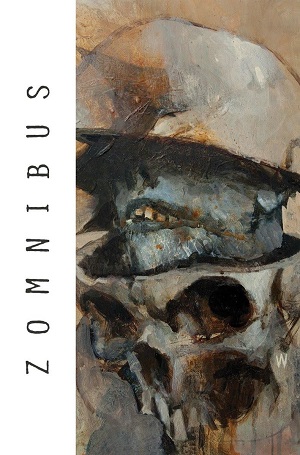
Zomnibus

Zomnibus

The title actually means something here, as this is an omnibus edition of three very different comic series, all dealing with zombies. It’s a bit unevenly weighted though, as the first two series are pretty standard after-the-apocalypse, Walking Dead kind of stuff, while the third is billed as the “Complete Zombies vs. Robots,” which is something else entirely. So let’s break it down.

Feast!: this was a very meat-and-potatoes zombie story. A busload of dangerous convicts crashes just after the zombie apocalypse, leaving the cops and cons having to work together to survive. They wind up in a small town where some other survivors have boarded up a building hoping to ride things out. The usual small-group dynamics and power struggles ensue as the number of survivors gets whittled down.

Being a fan of all (or most) things zombie, I enjoyed reading it. And the downbeat ending helped give it a bit more punch. Because all things considered, there was nothing exceptional about it.

Eclipse of the Undead: I mentioned in my lede how the first two stories here are standard zombie stuff, and evidence for that includes the way characters in both recognize immediately that they are living in a world already defined by the rules laid down in zombie movies. In “Feast!” the first character to twig to what’s going on says “You fuckers ain’t ever watched the movies? Zombies, man . . . Zombies!” In this story, while nobody knows how it happened, the zombie apocalypse is old news on arrival. “We saw them in the movies, in the funnies, we were almost used to them – a joke like Frankenstein or Dracula – but the fact is . . . the dead came back.” Specifically, George Romero’s living dead came back. Welcome to the metaverse.

The story in “Eclipse” (so titled because there is an eclipse, though I don’t know what the significance of that is) is even more basic than “Feast!” What we have is a bunch of people, abandoned by the military, breaking through the zombies besieging their refugee camp, which has been set up in the Los Angeles Coliseum. The usual small-group dynamics and power struggles ensue. The same good-guys and bad-guys having to work together, or falling out in ways that lead to their destruction.

I guess this was OK, but again there was nothing new about it. Even the old samurai guy seemed like a cliché.

The Complete Zombies vs. Robots: here we have the meat and the brains of this particular zombie feast. A now classic comic written by Chris Wyall and illustrated by Ashley Wood, Zombies vs. Robots is  fun, smart, and looks great. I don’t know if the series is complete even now though, so I don’t know how accurate the title is. What you get here are the first two volumes: Zombies vs. Robots and Zombies vs. Robots vs. Amazons.

This is not a comic you can just breeze through. The first time I read it, which was I guess fifteen years ago, I remember being confused as to what was even going on. There’s a complicated plot that involves time-jumping and the unexplained appearance of mythical beasts to join in the fun. I don’t think there are layers to the story though, and it’s enough to just enjoy the general parallel drawn between “the inhuman and the no-longer-human.” Or as the first page breaks it down: “Zombies! Braindead automatons and rotting reminders of man’s hubris! Robots! Brainless automatons and constructed remainders of man’s potential!” That’s great stuff.

If I were to sort it out a bit, I thought the first volume was the best. I love the possessed warbot that looks like a cross between R2-D2 and a tank, with a Punisher logo for a face. I couldn’t really figure out where the Amazons were coming from in the second volume, and didn’t think they were as interesting as the scientists. But it still played well and I thought it made an original contribution to the annals of zombie lore. Alas, I’ve heard rumours of a movie being in the works, and I don’t see how that will pan out. I guess all we can do is hope for the best.

Graphicalex

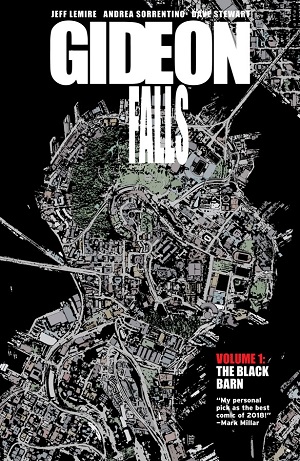
Gideon Falls Volume 1: The Black Barn

Gideon Falls Volume 1: The Black Barn

There are a lot of horror comics out there. I’m not sure why this particular genre should be so popular, but it’s always been a thing from back in the day when EC got into its groove (that is, after giving up on being “Educational Comics”). And while horror comics did suffer a lengthy time out in the doghouse when the censors cracked down, since the Comics Code fell into disuse they’ve been on a tear.

That said, with so many horror titles coming out you can expect a lot of variation in the quality. There are some series I’ve recently really liked and a few I didn’t get into at all. And the blame seems to attach equally to writers and artists when things don’t go right. Either the story makes no sense or the visuals are confusing or indecipherable.

I think Gideon Falls walks up close to this line, but for the most part I was really impressed with it. Jeff Lemire and Andrea Sorrentino team up again after working together on the Old Man Logan series, with results that feel really different but are equally effective. I thought the way Sorrentino’s experimental layouts and how he fragments a page worked really well, especially the double-page spread when Dr. Xu has her vision. It’s disorienting in a way that’s a perfect fit for what she’s experiencing. I might even call it creepy. Let’s face it, most horror comics aren’t actually very scary, but this one had its moments.

The story was vague and a bit generic. The Black Barn seems like the Black Lodge from Twin Peaks, in being an inter-dimensional place of evil that scary things come out of and that you don’t want to visit. One of the heroes is a priest with the usual worldly issues to deal with, and heaven knows that’s a clichéd figure. The business about him needing to reclaim his faith was something I didn’t need. The other main character is a guy whose visions have turned him into a mental patient. Again, the kind of person you expect to meet in this kind of tale, but all the same not unwelcome as a sympathetic figure we can relate to.

So it’s not a story that feels all that original, but I thought Lemire did just enough to make it fresh and interesting. The two threads of the story were, a bit to my surprise, nicely interwoven both visually and with the text, and the plot builds to a satisfying break. It doesn’t end on a cliffhanger, but takes us to a point where I was hooked and wanted to see what comes next.

Graphicalex

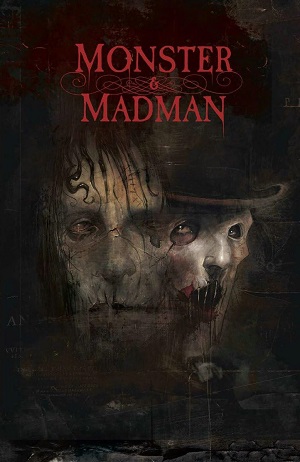
Monster & Madman

Monster & Madman

A simple idea nicely turned out.

I want to emphasize the latter part. I like the look of this three-issue comic. Damien Worm’s art is very dark, as you’d probably expect just from the cover. It reminded me a bit of Dave McKean’s work on Arkham Asylum. There are pages where figures and faces are hard to make out, but that fits with the overall atmosphere. Frankenstein’s monster looks a bit too much like a buff goth dude, and his bride is a Marilyn Manson clone, but John Moore (formerly a doctor, now a mortician and part-time serial killer) is convincing as Saucy Jack. I only wondered why he never appears in the wonderful mask he’s wearing on the cover and in some of the drawings in the supplemental materials. I wanted to see more of that.

The let down here is the simple idea I mentioned, and the text by Steve (30 Days of Night) Niles. Basically the Monster tried to kill himself in the Arctic but wasn’t successful so he hitched a ride back to England where he winds up sharing digs with Dr. Moore, who is Jack the Ripper. Dr. Moore studies the Monster and decides he can make him another bride, this time out of the remains of the Ripper’s victim. This doesn’t go that well because (this is a point made earlier in the book) these reanimated people carry with them the memories of the former inhabitants of their dead flesh. So the bride obviously doesn’t care for Dr. Moore because he’s the guy who killed her. Which leads to a falling out between the Monster and Jack and then the Monster kills his bride because she doesn’t want to be alive anyway and he knows that dead is better.

That’s more like a premise than a story, and it doesn’t feel like much happens here. I also thought some of the writing was in need of an editor. The first words are “The Monster’s creator was dead, father, murder, creator and destroyer of life.” Was that supposed to say “murderer”? Because I don’t see how it makes sense as it is. Then later we get this narrative passage: “As the crewmen laughed and boasted, the Monster would hide in the dark, living conjure images of the bride he’d almost had . . .” What does “living conjure images” refer to? I can’t even think of a way to correct this to the point where it means anything. “Conjuring living images”? Beats me.

So it’s not very long, and like I say I don’t think it has much of a story to tell, but I think it’s the comic Niles and Worm wanted to make. It looks good, but I just didn’t think it was bringing anything new to the table or doing anything special with these classic characters.

Graphicalex

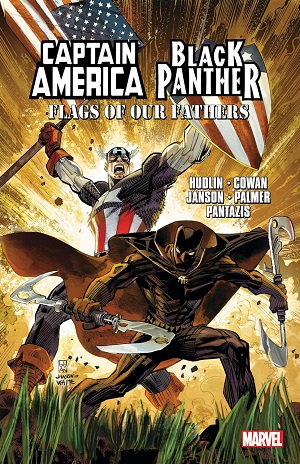
Captain America/Black Panther: Flags of Our Fathers

Captain America/Black Panther: Flags of Our Fathers

The basic story here is meat-and-potatoes stuff. It’s World War 2 and an elite force of Nazis headed by the Red Skull, Baron Strucker, Master Man, Warrior Woman, and Armless Tiger Man are off to Wakanda to steal some of that awesome vibranium stuff to power their secret weapons. But the African kingdom is protected not only by its reigning Black Panther (T’Challa’s grandfather), but some (very) paleface visitors in the form of Captain America and Nick Fury and his Howling Commandos.

What follows is a lot of fighting as the good guys kick Nazi ass in a manner a little bloodier than usual. The Wakandans decapitate an advance party of Nazis and stick their heads on stakes as a warning. Armless Tiger Man is a cannibal with sharpened teeth who tears into people mouth-first (since he doesn’t have arms, you see).

I actually liked this better than I thought I was going to. There were a couple of places where it seemed like a page was missing though, as the story kept skipping around different parts of the battlefield. And I wasn’t sure what Black Panther was using to take out Master Man and Warrior Woman. Vibranium? Perhaps I just wasn’t paying close enough attention.

The other thing I could have lived without was the lecturing from Black Panther about how post-war America will have to live up to its ideals of freedom, meaning civil rights and all that. “The true test of your ideals will come when the war is over. A nation at war has an enemy to unify them. A nation with no enemy often looks for one within its own borders.” The Panther was becoming a mouthpiece for stuff like this around this time, and it just sounds stiff.

Still, if you want a violent shoot-‘em-up you get it here. Also included as a bonus (since the Flags of Our Fathers storyline is only four issues) is Rise of the Black Panther #1 but I thought this was dreadful. Nothing at all happens, as it’s just backstory about T’Chaka, leading up to the point where he’s killed by Ulysses Klaw. And boy is the action ever talky! Now to be sure Black Panther has often been a talky comic. The Christopher Priest years were thick with text. And he’s always been political too, again in the Priest years but also going back to his fights with the Klan. But the talk here is really dull, just reciting biographical material I mostly already knew, and the art wasn’t working for me either. So that finished the book on a down note.

Graphicalex

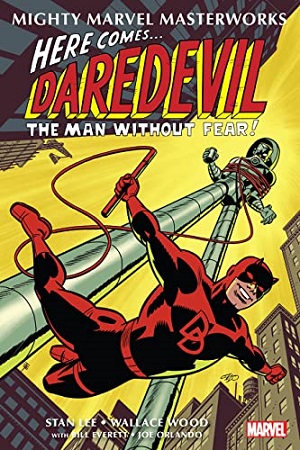
Mighty Marvel Masterworks: Daredevil Volume 1

Mighty Marvel Masterworks: Daredevil Volume 1

Another ‘Sixties superhero start-up, this time with Daredevil finding his legs.

It took a bit of time. He started out with a yellow uniform that had a black vest with a single red D on the front. It would later turn into the all-red outfit he’s best known for wearing, with the iconic double-D on its chest, but it’s never explained why they made that change. I mean, his name isn’t Dare-Devil.

The other issue they had trouble sorting out was his blindness. Championed (especially in recent years) for being a superhero with a disability, it’s actually nothing of the sort. In fact, the one thing the “man without fear” admits to being afraid of is having surgery to get his sight back and then losing his super powers. You see, the accident that caused Matt Murdock’s blindness involved being hit by a truck carrying radioactive material, resulting in his compensatory senses being jacked up to god-like levels. Because we all know that’s the way radioactivity works. You don’t just die a slow, lingering death from cancer but turn into a superhero. Or villain. Or expire right away in agonizing pain, like Dr. Van Eyck in issue #9.

So while Daredevil is blind that’s not a disability because his “atom-induced radar sense” can accurately judge the precise size, speed, and location of any physical body. His sense of smell is so advanced he can trace an individual, hours later, through the streets of New York City by the scent of their “unusual hair tonic.” Hair tonic, for Daredevil, being as distinctive as a man’s fingerprints, he can pick up a scent at any point “approximately within one city block of his quarry.” He can sense the heart rate of individuals standing anywhere near him and tell if they are lying or experiencing any stress. He can read books, not in braille but “merely by feeling the impression of the ink on the page!” He can tell what people are wearing by the sound the fabric makes when they move. He can detect (by radar, not by touch) whether someone is wearing a ring on their finger, and what sort of ring it is. Flying in a jet over the petty  European state of Lichtenbad he can “sense a walled city” thousands of feet below . Then, once inside the castle of the Lord of Lichtenbad his radar senses can “see” through several stone floors “as though it’s [the castle’s] made of glass.” That’s some radar!

You can tell by this that they were winging it. Effectively, Daredevil isn’t blind at all. Anything he needs to be able to do, he can do. Just like that billy club of his can do everything, including allowing him to swing through the streets of the city like Spider-Man.

If you put all that aside, what you got here was still a really enjoyable comic in the grand Marvel manner of the time. For the most part Daredevil is taking on B-list baddies who are nonetheless a lot of fun. People like Killgrave the Purple Man, the Matador, the Stilt Man, and the animal cos-players of the Organization. But when he goes up against Namor (in what is a genuinely funny adventure) he’s beaten up pretty badly, and this in his own comic! Even Iron Man got to knock out the Hulk in the pages of Iron Man.

Most of the titles here were written by Stan Lee, and that includes the usual good and bad. Fast-paced stories that don’t want to spend a lot of time explaining things. Colorful characters. Relentless boosterism. Item: the issue that has Daredevil’s “epic battle” with Electro “may well be remembered as long as literature endures!!” Right on the first page of issue #1 the lucky reader is congratulated for having purchased “another prized first edition! This magazine is certain to be one of your most valued comic mag possessions in the months to come!” Well, maybe not in the months to come. But if you held it for seventy years . . . in 1964 it had a cover price of 12 cents and now goes for between $1,500 and $5,000. That’s a decent return. Smilin’ Stan didn’t tell many lies. He just ran away with the hyperbole.

On the downside, and as I’ve mentioned before, there’s his hopeless portrayal of women. The love triangle going on between Matt, his law partner Foggy Nelson, and their secretary Karen Page is just an annoyance. This was a day when women really knew their place, and had no shame in delivering such self-deprecating lines as “I guess I’m just a silly female!”

I was never a fan of Daredevil when I was a kid but I enjoyed this book a lot more than I was expecting. In later years he’d go through some “adult” makeovers, especially highlighting his Catholic faith, but for sheer entertainment value these early adventures stand up well. I even love the “Here Comes Daredevil” titling, with its in-your-face promise of “get ready for fun!” And as for disabilities, they’re no handicap at all.

Graphicalex

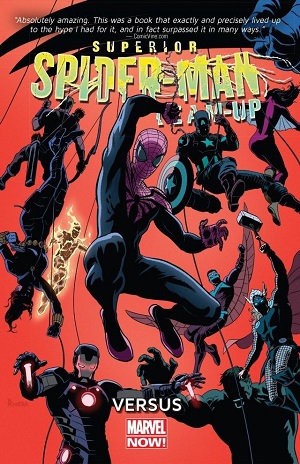
Superior Spider-Man Team-Up: Versus

Superior Spider-Man Team-Up: Versus

As the Marvel Universe began splintering every which way a lot of familiar names came in for makeovers. The Hulk, for example, turned Red and Grey and took on a host of different personalities on different Earths and different timelines. But I think Spider-Man probably had the most variations, to the point where it’s hard to speak of Spider-Man in the singular at all.

Superior Spider-Man, in case you were wondering, is the name adopted by the webslinger after Doctor Octopus switches bodies with Peter Parker (who then expires in Doc Ock’s body). But Doctor O doesn’t want to be a bad guy anymore, intending instead to become a better superhero and better guy all around than the old Peter Parker/Spider-Man. Hence, “Superior.”

Normally a premise like that would have lost me right away, but Superior Spider-Man is actually an interesting character. Doc Ock is a real snob and it’s fun to listen in on his interior monologues running down everyone he meets. What’s more, the storylines here are pretty good. In the first, Spidey is chasing down a body-hopping version of Carrion, which means taking out all the superheroes Carrion temporarily inhabits. In the second he grudgingly joins forces with his clone, the Scarlet Spider, to do battle with the Jackal and his army of genetically-modified critters. And in the third a creature possesses a young lady studying in the Cloisters, turning her into a being of pure electricity who gives herself the name Fulmina and who has the power to knock civilization all the way back into her beloved Middle Ages. Spider-Man has to juggle fighting her with beating back an alien invasion of NYC.

You’ll note that each of those storylines involves a lot of fighting, and the comics here deliver in that regard. And the way the fighting is represented is great, being both dramatic and easy to follow. The series used different artists for every issue and they all knew how to bring the action.

But the best part is the writing. The dialogue feels real, whether it’s just the usual banter or something more developed. I particularly liked the argument between Spidey and Fulmina. As noted, she wants to take humanity back to medieval times, a world with “days measured by the hours of the sun . . . nights softened by the glow of candlelight.” Spidey accuses her of being a tyrant, and she responds that she’s not a tyrant but someone “freeing humanity from the tyranny of progress to devote themselves to poetry . . . to prayer . . . to song . . .” Spider-Man has to consider this, but returns later with his put-down of the good old days:

So you can roll back the centuries, and restore the world of the Middle Ages? A world without the clamor of industry, the pace of technology, the blare of the media? A world without the lockstep conformity of the modern world . . . the onerous duties of citizenship . . . the burdens of personal freedom . . . a world of poverty and plague, crude, primitive medicine . . . rampant superstition . . . brutal class divisions . . . incessant, internecine warfare . . . You want to return us to this?

As Spidey talks a medieval scene plays out in the background slowly being taken over by the specter of death. It made me think of the medieval poem about the three kings and the three dead. Meanwhile, Fulmina objects that he’s “twisting it all around . . . making it ugly.” And she’s right. But he is too.

I’m not saying there’s anything profound in all this, but I did think Fulmina one of the more compelling and original villains Marvel has come up with in recent years and the rest of the stories here are at the same high level. It’s a good comic.

Graphicalex

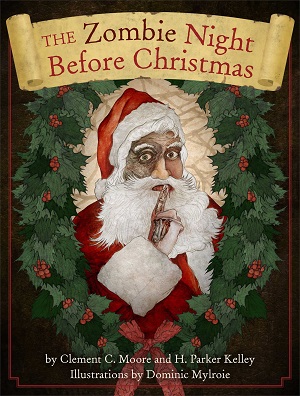
The Zombie Night Before Christmas

The Zombie Night Before Christmas

Along with “peak zombie,” the early twenty-first century saw the mass zombification of classic literature, the seminal text being Pride and Prejudice and Zombies. The Zombie Night Before Christmas was published a year later, and what I was reading was the 10th anniversary edition, though I don’t know if they made any significant changes.

What we have here is most of Clement C. Moore’s classic poem – whose original title was “A Visit from St. Nicholas,” and which Moore may not have written – mixed in with some references to rotting corpses and flesh-hungry zombies. Basically the world has been overtaken by the zombie apocalypse and now everyone is a zombie, but still going about living their normal lives. For some reason, however, nobody has told Santa about this turn of events (he knows if you’ve been bad or good, but not if you’re still alive). So on Christmas Eve he’s in for a rude surprise, and soon finds himself on the run from the hungry dead.

To be honest, I felt kind of sorry for Santa in this one. He manages to avoid an initial zombie attack by landing on a roof, but then gets jumped by a zombie as soon as he comes down the chimney. Again, I don’t know why he’s bothering at this point, seeing as he knows the situation. But anyway, he’s bitten and then “A blink of his eyes / and twist of his head, / Soon let me know / he was now living dead.” And all his reindeer too.

It’s a cute little book and a bit of fun. But maybe they needed to take a freer hand with the poem to come up with something really new. Either that or just illustrate the original text with zombies. Mad Magazine used to do adaptations like that, and it’s an approach that might have worked here. This sort of tries to have it both ways, and the result is more a light work of whimsy than a deathless Christmas classic.

Graphicalex

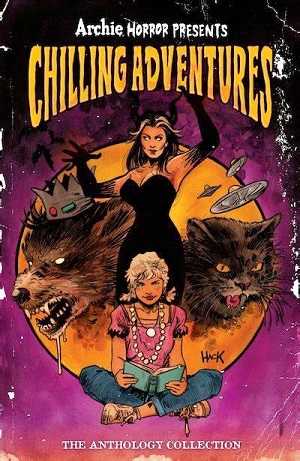
Archie Horror Presents Chilling Adventures

Archie Horror Presents Chilling Adventures

As you know if you’ve been reading any of my previous posts, I’m a fan of the Archie Horror imprint. I think they’ve done a lot of really creative work and been successful in expanding the Archie brand in ways I wouldn’t have thought likely. That said, Chilling Adventures is a total dud.

The idea here was to present a horror anthology, with a bunch of short stories from a variety of authors and artists. According to the editor’s introduction the model was supposed to be something like EC’s Tales from the Crypt, which I can see, but I think the more immediate reference might have been The Simpsons’ Treehouse of Horror. And if that’s the comparison being made I think Chilling Adventures suffers by it. In fact, I can’t think of any comparison it doesn’t suffer by.

The blame can be laid squarely at the feet of the writers. Normally in a variety-show effort like this you can expect a mix of good and bad. Here I had trouble identifying anything that was good. Pretty much everything on tap was either tired and clichéd or confusing. Sometimes both. There’s a gesture at a frame story as Madame Satan gets bored with ruling hell and takes up being a high school principal. Archie gets trapped in a killer video game. Veronica is possessed by a demon dress. Jinx (Sabrina’s “familiar”) rescues a bunch of stray animals from a sorcerer. Jughead (the werewolf version) fights Krampus. Shape-shifting aliens land in Riverdale. Some of this might have been interesting, especially given the talent assembled, but it’s just a dull mess that never got any better as it stumbled along. Were they in a rush? Uninspired? I don’t know, but nothing here worked for me.

Graphicalex