Gideon Falls Volume 4: The Pentoculus

Gideon Falls Volume 4: The Pentoculus

Ah, things were really clicking in this series now. There’s a lot of jumping around, from the different dimensions accessed by the Pentoculus (that’s the multiverse machine Norton Sinclair built in his barn) to the different bodies that the Laughing Man (or as I call him, the Bug God) inhabits, but I found it all reasonably easy to follow. In part because the threads were starting to be drawn together, as the main characters (it is written that there must be five, constituting a kind of Fellowship of the Bug) all finally find themselves on the same page. Dr. Xu even gets to see herself as Old Dr. Xu in the village dimension, which is somehow at the center of everything.

In addition to the Fellowship of the Bug there are also other networks in play, including the uninspiring Ploughmen and the Bishop’s gathering of bug-fighting priests. Meanwhile, the Laughing Man is vomiting his bugs into his victims in the sort of mouth-to-mouth process that has long been popular in horror movies (see my note on this in my review of The Invasion). Once possessed, these people go on bloody rampages, all (I think) just to get attention since the Laughing Man only needs to possess Danny in order to open all the doors. I wasn’t sure why. Maybe it’s just because Danny, as a character, seems like such an empty vessel thus far.

Lots of slam-bang action, and Andrea Sorrentino was really pulling out all the stops when it comes to fragmenting the page into hallucinogenic collages. This is always been his style, and with this series he gets to indulge it fully. So overall it’s a series that’s finishing strong, making me hopeful for the conclusion.

Graphicalex

The Avengers: Four

The Avengers: Four

Tight. I liked it.

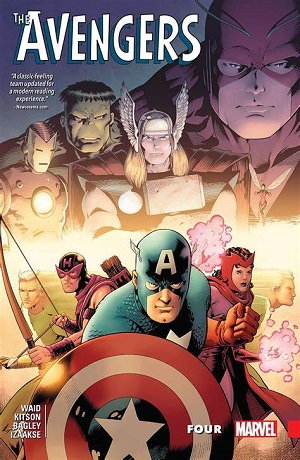
Four is a retro-flavoured miniseries written by Mark Waid that has Captain America heading a new Avengers team after the OGs “decided to take some time off.” So they’re now down to four members: Cap, Hawkeye, Scarlet Witch, and Quicksilver. Since the newbies are all “reformed villains” and relatively underpowered Cap has his work cut out for him whipping them into a functional unit. A point that’s underlined by the way they get their butts kicked out of the gate by the Frightful Four, with all the bad press that follows. Egged on by the media, even the public start getting into it, mocking the “Mighty Pretenders.” Things are really not off to a good start for the not-so-fab four.

Things get much worse however when they rescue a young Thai lady named Cressida from the Stranger. Cressida has the power to drain the life force from others, leaving them dried-up husks. She can either absorb that life force or transfer it to someone else, making them “better, faster, stronger.” Which sounds a bit like being a coach for the Olympics.

The Avengers basically adopt Cressida and start calling her Avenger X. But she has nefarious plans of her own, apparently being motivated by revenge. I don’t know for what. Her character isn’t filled in very much, and she even mocks the suggestion made at one point of providing an origin story. The Stranger considers her to be not a mutant, even though she says she’s had her powers since she was a kid. I think we just have to take her as a given.

She’s a formidable enemy though, both in how she schemes to set the Avengers against one another and for her (borrowed) superpowers. Indeed, she’s basically too much for this new team and at the end the OGs have to come back and lend a mighty hand. Which I thought was a bit of a cop-out. The story arc seemed to be the familiar one of the team coming together and solving their own problems. The way they’re thrown a literal lifeline here undercut all that.

Still, I loved the throwback feel to the art and the way the story held together. It’s a nice, satisfying unit, with all the different sub-adventures contributing in different ways to the main Cressida storyline. In terms of character the good guys are conflicted and the bad guys wicked in their usual bickering, arrogant way. Good and evil are complementary and evenly matched, and Waid can bring both darkness and humour to the proceedings (Wizard’s epitaph for Avenger X was a bitchy twist I wasn’t expecting!). In sum, it’s nothing wildly out of the ordinary, but it does everything a superhero comic is supposed to do, which was a treat.

Graphicalex

Cla$$war

Cla$$war

In which a bunch of cynical, burnt-out, and horny superheroes, created by an ex-Nazi scientist with a thing for human experimentation, dress up in stars-and-stripes costumes and fight America’s wars. But when one of the members of the team (he’s just called “American”) develops a conscience the world’s mightiest heroes are soon fighting among themselves.

With a synopsis like that I was expecting something very much along the lines of The Boys, and that’s what Cla$$war is. But Cla$$war actually came first, running from 2002 to 2004 while The Boys was 2006-2012. And Marvel’s Civil War storyline, which also shares some similarities to what we get here, kicked off in 2006 as well. Actually, at the time Cla$$war was thought to have been influenced by DC’s The Authority, but Rob Williams says he didn’t know The Authority before he started writing and that his inspiration was more drawn from the Noam Chomsky he’d been reading.

The title, complete with dollar signs, is a bit misleading. In fact, I’m not sure why it was chosen. Nothing in the comic addresses class war in the sense of economic exploitation and the effects of entrenched social inequality. Instead, its target is American imperialism. The Enola Gay team (that’s what they’re called) are more supersoldiers than superheroes, fighting alongside the troops in foreign countries while the political rot deepens at home.

I wasn’t thrilled by the story here, not because of any political leanings (I like Chomsky too) but because the political message wasn’t new. The references here are up to date, with the president that American begins by attacking (he publicly brands the word “LIAR” on his forehead) being a stand-in for George W. Bush, and the U.S. invasions of Afghanistan and Iraq being referenced as earlier forays by Enola Gay. But it also felt a lot like the 1970s, with the Vietnam War and the political conspiracy thrillers of the time. And the invasion of Glenada is clearly a reference to the 1983 invasion of Grenada.

That said, I came away thinking this is a comic that should be better known. Perhaps being published by Com.x, a smaller British comic publisher, meant it didn’t get as much exposure. I thought the art by Trevor Hairsine and Travel Foreman was first-rate, and while the story was pedestrian I liked the way the different characters sparked off one another. American is a bit of a stick, but the other members of Enola Gay, while jerks, have distinct and complicated personalities. And the new superfreak the Nazi doctor whips up in his lab had real potential. I wanted to read more about all of these guys, but for whatever reason the series didn’t continue. It was initially planned to run for 12 issues but they only did six. As things stand the story breaks off, with only the character of Heavyweight now removed from the picture. Twenty years later I doubt we’ll see the series continued, at least in the way Williams might have intended. But I wouldn’t be surprised if we get a sequel.

Graphicalex

Shaft: Imitation of Life

Shaft: Imitation of Life

No, this comic doesn’t t have anything to do with the 1959 Douglas Sirk melodrama of the same name. Instead, it takes its title from a long interior monologue our hero Shaft has over the question of whether art imitates life (mimesis) or life imitates art (Oscar Wilde). Doesn’t that seem a little heady for Shaft? Well, in my review of the 1971 film Shaft I did remark upon the well-stocked bookshelves in his apartment. He’s not just a complicated man but a  guy who reads!

That monologue has a point here because Shaft is looking for a missing person and his investigation takes him (as per usual) into the seedy underbelly of a rotten Big Apple, specifically a mob-run porn operation. But at the same time some indie filmmakers, financed by the same mob outfit, are making a movie about Shaft’s adventures (called The Black Dick, if you can dig it) for which Shaft has been hired as a consultant. So before long it feels like the line is being blurred between what’s real and what’s movie moonshine.

It’s a simple story, of the kind that was popular at the time (that time being the 1970s). Think of movies like Hardcore. The bit of a twist they give it is that the missing person is a young gay man rescued by another gay man who teams up with Shaft. But to be honest, I didn’t find this part that interesting. It does benefit though from keeping things simple, and Dietrich Smith’s clean artwork is an incongruous but oddly effective fit with the sleazy proceedings. With his skin-tight turtlenecks showing off an overdeveloped chest that casts a pronounced shadow in any light, Shaft himself seems more than a bit like a plastic action figure, but that works too. They could have gone with a generic look, which is what I was expecting, but I like how they went with a more cartoonish change-up. Yeah, I could dig it.

Graphicalex

Mighty Marvel Masterworks: Daredevil Volume 2

Mighty Marvel Masterworks: Daredevil Volume 2
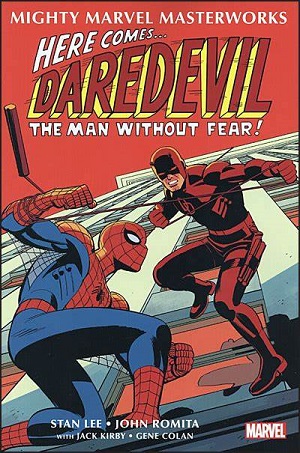
This volume is a direct continuation of Daredevil’s beginnings as collected in the first Mighty Marvel Masterworks: Daredevil. As such, a lot of what I said about the character there still applies. To take just a few of the points I raised in my review of that book:

(1) “Effectively, Daredevil isn’t blind at all. Anything he needs to be able to do, he can do.”

To take some examples from the issues collected here: In the boat to Ka-Zar’s home of Skull Island (not that original, is it?) Daredevil can “sense vegetation . . . such as Earth has never known for millions of years! As though I’ve been transported to the dawn of time!” Now how would he know what vegetation smelled like (I assume he’s smelling it) millions of years ago? Also, he can identify people at a distance not just from their smell (as in previous issues) but from reading their emotions. How does that work? Just reading heartbeats?  And what are we to make of his “indescribably accurate hearing” that allows him to “tune in” to police short-wave radio broadcasts as he vaults above the city? There seem to be no limits to his (dis)abilities.

(2) “For the most part Daredevil is taking on B-list baddies who are nonetheless a lot of fun.”

So in this volume the “omnivorous”(?) and “omnipresent”(?) Owl is back. The Masked Marauder shows up, is defeated, and then teams up with the Gladiator, and is defeated again. Not the Strontian Gladiator, by the way, but Melvin Potter, a big guy with a chip on his shoulder who runs a superhero costume shop. So they’re a pair of B-listers. Then there’s the Ox, who is a big dumb guy (I’ll bet you never would have guessed) who gets a genius-level intelligence upgrade when a mad scientist switches bodies with him. The Plunderer (or Lord Parnival Plunder, to give him his full title) is a modern-day pirate who would have more of a Marvel afterlife because of his family connections (he’s actually the brother of Ka-Zar). Because I wasn’t as familiar with these guys I actually enjoyed them a lot more. They don’t have god-like super powers but are mostly just either really strong or really smart. And they’re all driven by a sense of bitterness at the world for not respecting them enough. I think this might have had been one of Stan Lee’s hang-ups.

(3) “On the downside, and as I’ve mentioned before, there’s his hopeless portrayal of women. The love triangle going on between Matt, his law partner Foggy Nelson, and their secretary Karen Page is just an annoyance.”

The office-romance stuff with Foggy always lusting after Karen who in turn has a secret crush on Matt plays out again here. And at least Lee seems to have recognized how painful it all was. After one cutaway to the land of thought-bubbles revealing hidden desires we get this editorial comment: “See how we try to please everybody? We even presented the preceding page for the benefit of soap-opera lovers!” And in a later issue, after another such romantic interlude, we get this apology: “Many thanks, Marvelite, for staying with us during the hearts and flowers portion of our yarn!”

This self-awareness, however, only goes so far. This part of the Daredevil story is painful. It does play a bit of a role when Foggy dresses up as Daredevil in an attempt to gain Karen’s affection, but otherwise it’s pointless. Pointless and annoying. At one point “Sensation-monger Stan” even gives his “batty bullpen” a “no-prize award” for presenting seven thought balloons in one panel. Which is as awkward as it sounds.

Speaking of Foggy putting on a Daredevil costume, it’s interesting how this is a motif in several of the comics here. When the Ox goes on a rampage he dresses an unconscious Daredevil in his clothes so that the police will mistake him for the troublemaker and lock him up. And then later the Masked Marauder has his entire gang wear Daredevil costumes as a way of diverting DD from the heist that the Marauder is planning. By sheer coincidence I read this volume at the same time as I was reading Chip Zdarsky’s Daredevil comics and the idea of people dressing up as Daredevil was a significant plot point there too. I also remembered that this was something that turned up in Frank Miller’s Born Again story arc, when Kingpin got a psycho killer to wear a DD costume to kill Foggy and Karen. Were imposters something Daredevil had a special problem with?

On a final note, when a gang of thugs break into Matt Murdock’s office he tells them that he has “business with Murdock too – and I hate to take sloppy seconds!” Today the expression “sloppy seconds” basically has only one meaning, and it’s one that goes back quite a ways. Though I’m not sure what it would have meant to readers in September 1966, the date of the issue Daredevil uses it in here. Good for a laugh anyway.

Graphicalex

Old Man Logan 2: Bordertown

Old Man Logan 2: Bordertown

Let’s start off talking about place. I don’t like visiting the Marvel multiverse because I’m never sure what timeline or alternate Earth we’re in or on, but at least I was getting adjusted to the set-up in this series after the Berserker volume. In that book Wolvie was sent back from a dystopic (post-supervillain takeover) Wild West to what I guess is our current reality. But things kick off here at X-Haven: “Refuge for mutantkind and headquarters of the X-Men. Located in the Limbo Dimension.” Damn it, we’re in another dimension now? I had to look X-Haven up online and found out that it was created in 2015. Who can keep up with all this except the most determined fanboys and –girls?

Anyway, after a bit of talking between Wolverine and Storm at X-Haven, Logan is back (via teleportation) to the present day and driving his motorbike north. “Really north. Through Canada and beyond . . .” Wait, north of Canada? What does he mean? Russia? Because to get there he’d have to drive over the North Pole and technically be heading south. But then we’re told he arrives at Killhorn Falls in the Northwest Territory: “Nothing but a few rows of trailers and shacks along the Alaskan border. Whole community is built around a gravel quarry sitting on a small port in the Gulf of Alaska.”

Now wait just a minute. The Northwest Territories (it’s a plural) does not share a border with Alaska. That would be Yukon Territory. And the shoreline of the Gulf of Alaska is all part of Alaska (the panhandle), and notably not northern Alaska but the south-east part.

And this was all written by Jeff Lemire, who is Canadian. I don’t get it. Are we in another weird dimension or is Lemire just lost when it comes to geography?

Putting this to one side, I liked this instalment of the Old Man Logan series, but in terms of the larger story I felt like there wasn’t much there. Basically Logan heads off to this remote mining town when Lady Deathstrike and the Reavers show up, so he destroys them while defending a little girl who in one timeline he is going to eventually marry. At least I think I have that right, but don’t hold me to it.

The fighting is good and Sorrentino’s art is aces again in evoking the dark world of aging butchery that Wolverine inhabits. That double-page spread of skeleton Wolverine laughing with skulls dropping from his mouth is quite something. Then in issue #8 we get a vision of the depressing Gotterdammerung that was the supervillain uprising and it’s pretty bleak. But as Logan knows, getting old is itself pretty bleak. That’s just the kind of series this is. I was going to say that’s the kind of world this is, but since it’s many worlds I can’t.

The bonus comic is Uncanny X-Men #205 from 1981, a Chris Claremont story that has Wolverine fighting Lady Deathstrike and the Reavers again. Or not really again, but before. Or maybe not before because time is as loose a construct as geography in the multiverse. It’s a good comic though.

So lots of Wolverine’s claws coming out with a Snikt! sound and lots of limbs being detached. Plus Wolverine learning to accept his identity as agent of chaos, madness, and death, which is a familiar character arc for him. You do get the sense that he’s growing tired of all this though, and that now the game is playing him.

Graphicalex

Swamp Thing: The Bronze Age Volume 3

Swamp Thing: The Bronze Age Volume 3

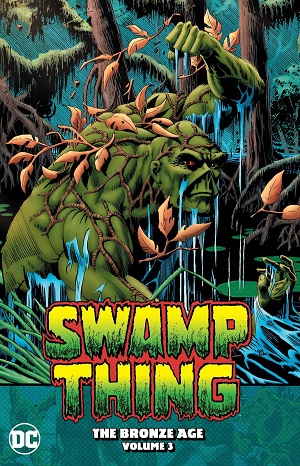
After the initial run of Swamp Thing comics ended, along with Swampy’s brief sojourn with the Challengers of the Unknown (covered in The Bronze Age Volume 2), it looked as though the character was going to be left on the shelf for a while. Luckily, DC changed their mind and so we got a new series titled The Saga of the Swamp Thing, which was written by Martin Pasko. This omnibus edition presents #1-19 of that run, along with The Saga of the Swamp Thing Annual #1, which is a comic adaptation of Wes Craven’s 1982 movie and doesn’t really fit into the canon.

Because they were sort of starting over here we get a quick recap of the origin story. Which is understandable. What’s harder to get is why they keep coming back to retell this same bit (Alec Cross blowing up in his lab and then jumping into the swamp, where he’s transformed by his “biorestorative” formula). After a while, wouldn’t they think that regular readers knew how Swamp Thing came about? But perhaps there weren’t enough regular readers yet.

Immediately a depressing note is struck. Swampy is still mourning the loss of his beloved Linda, and wishing to God that he could join her in death. And as things proceed it seems as though that wish may be granted, not through mortal combat with the forces of evil but because we’re constantly being told that the mucky monster is “dying of some as-yet-unknown-ailment.” But why they keep making such a fuss over this is beyond me, for two reasons: (1) the ailment doesn’t seem to slow him down much, if at all; and (2) in the end it just turns out to be a bit of E. coli that’s quickly cured with a dip in his bio-restorative swamp. This seems to be the sort of thing that an editor should have been asking Pasko about. “Martin, where are we going with this disease angle?” And perhaps there was a point to it all in the beginning but things took a different direction. That happens.

The first 13 issues tell a single story, with a couple of minor digressions. This has Matt Cable and Abigail Arcane being replaced by Lizabeth Tremayne and Dennis Barclay as Swampy’s traveling companions. These three are opposed by the Sunderland Corporation, which is a generic bunch of baddies who basically run the U.S. military-industrial complex, and a “herald of the Antichrist” figure in the form of a fast-growing girl who is clearing a path for the coming of the Beast. She’s also tied in with Nazi occultism and such. Basically, she’s just everything bad. Her Van Helsing is a former concentration camp kapo named Dr. Helmut Kripptmann who soon joins the monster-hunting team.

It’s all wildly overwrought in a mythic kind of way (you can see what Alan Moore saw in the franchise), but I found it quite interesting and compelling on its own. My main problem with it is that Swamp Thing sort of became someone just along for the ride a lot of the time, especially since he was feeling poorly. And indeed I think this is a problem that all these early Swamp Thing titles had. They had good stories and well-drawn supporting casts, but Swampy himself keeps fading into the background. Maybe it’s because he has such trouble communicating, barely able to croak out a few words at a time. That’s quite a limitation for a leading man. Also, he’s obviously without any love interest (though one story here does play with the idea of him missing out on a woman who would understand him).

The digressions from the main storyline are also a lot of fun. The empaths who are used to absorb the injuries to Sunderland operatives were a neat idea, and the island of shipwreck survivors who reshape reality into classic old movies (King Kong, Casablanca) was a laugh. Things didn’t just fall apart after the initial 13-issue run either, as we then get a two-parter with Swampy facing off against a crystal man/living computer and then having to deal with the return of Arcane in a revolting insect form. There’s no keeping that guy down, even if he keeps coming back more damaged than ever.

A dark comic, what with the empaths, the town of vampires, and the child slayer storyline (dedicated, in 1982, to “the good people of Atlanta, that they may put the horror behind them . . . but not forget”). But it’s still full of the free-form imaginings that made Swamp Thing something just a bit different in the comic book canon. The outlier is the final comic, which, as mentioned already, is an adaptation of Wes Craven’s movie. It’s pretty standard stuff, and doesn’t connect well with the rest of the Swamp Thing mythology (Arcane, for starters, is a completely different sort of character), but fans will like having it in here anyway.

Graphicalex

The Last Days of American Crime

The Last Days of American Crime

The Last Days of American Crime is a fairly standard neo-noir heist story about a tough guy who works as a security guard who teams up with a pair of crazy-sexy punks to make a big score. A lust triangle ensues, and one of the guys has to be the odd man out.

If it had stayed on that level I think it would have worked reasonably well. But author Rick Remender wanted to add more than just a twist to the proceedings and I’m not sure if all he added to the mix was a plus.

Here’s what’s new. First of all, the U.S. is switching to an all-digital currency and the trio are looking to steal one of the machines that will control said currency. How? I really wasn’t sure about this, but chalked it up as just a MacGuffin. They could just as easily have been stealing gold or jewels from safety deposit boxes. Second: the heist is on a strict schedule because it has to be done before the government begins broadcasting a signal that will operate as a neuro-inhibitor, preventing people from committing any crimes or doing anything that they know is wrong. How? Well, I couldn’t explain the science to you, because there isn’t any, but even granting such a signal was possible I don’t see how it would work on a practical level. There are thousands of laws people break every day because they’re unaware of them. Do those get shut down as well? Or what happens when a psychopath who doesn’t know the difference between right and wrong decides he wants to keep killing people? This latter is a question that gets asked, and answered, in the finale here, and it underscores how little thought went into what’s called the American Peace Initiative.

Why add such a gimmicky pair of plot elements to such a basic heist story? Maybe just because the heist story was so basic Remender thought he needed something really “out there” to jazz it up. And I guess digital currencies and behavioral control are current issues, playing off fears of things like China’s social credit system. But meanwhile, the America we see before the signal is a hellscape of carnage: all domestic terrorism, gang violence, and bodies piling up in the streets. I guess something should be done about that. I mean, the bad guys are thinking of fleeing to either Mexico or Canada, and Mexico seems to be ahead of the country that’s full of “moose-fucking, commie-Mountie, hockey motherfuckers.”

In sum: it’s very violent, somewhat hard to follow, and unnecessarily futuristic, but I did find it a stylish riff on an old story that has some juice in it yet.

Graphicalex

Titans Vol. 1: The Return of Wally West

Titans Vol. 1: The Return of Wally West

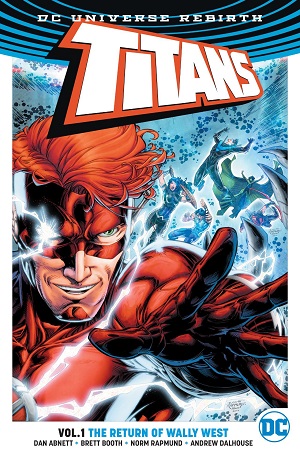
To set the scene, this series was part of the 2016 DC Rebirth program, which was a reboot of the DC Universe. So the Teen Titans are now all grown up (or at least in their 20s) and are now just called the Titans. They’re also in a different shard of the multiverse that Wally West, formerly Kid Flash and now just the Flash (because he’s “not a kid anymore,” get it?), comes blasting into as things kick off. He reunites with his Titan pals – Nightwing (Dick Grayson), Tempest (formerly Aqualad), Omen, Arsenal, and Donna Troy. They don’t recognize him at first but somehow he makes a synaptic connection with them and before long they’re a team again.

Unfortunately, Wally’s return also triggers the reawakening of Abra Kadabra, the techno-mage adversary of the Flash who had also lost his memory and been reduced to playing children’s birthday parties as Mister Hocus Pocus. Once he remembers who he is, and the power in his magic wand, he sets out to re-disappear Wally West, over the dead bodies of the other Titans and Wally’s normie girlfriend (as stock a character in superhero comics as you can get).

It’s a nicely structured story arc but the arc itself is the usual blather that ultimately gets lost in the mystic mumbo-jumbo of Wally having to access the “speed force.” Which means he has to run really, really, really fast. But he runs so fast he blasts himself clear out of this dimension. Luckily, the power of love and friendship provides an anchor capable of drawing him back, defeating Kadabra, and saving all his buddies. There’s even a full-page group hug.

This is cheesy stuff, and I’d be inclined to write this volume of the Rebirth off completely but for the character of Kadabra. He’s drawn by Brett Booth in the manner of Gris Grimly, and driven by a very contemporary obsession with fame. “It’s true,” he explains, “I do it all for fame and adoration. You must think that’s pathetic. You probably call it narcissism, or other derogatory psychological terms. You probably think I need therapy. But you should realize I come from a far future that is sterile and cold. Nothing there is wonderful at all. I came to your time craving fame or infamy. Either is fine.”

I don’t know why he’s bothering with the magic acts. He could be a successful politician or tech oligarch in the twenty-first century with that kind of an attitude. Other villains suffer from megalomania or have a need to dominate the world or the universe. Kadabra is just doing it for the likes and the clicks. He has almost godlike powers (until, of course, he doesn’t) but all he wants to do is play at being an edgelord. Maybe he really is from our future! Certainly in 2016 he was arriving just ahead of time.

Graphicalex

Old Man Logan: Warzones

Old Man Logan: Warzones

This is the second volume in the Old Man Logan series, though it’s usually labeled as Volume 0 since it provides a sort of prologue to the series later set on Earth-616 and written by Jeff Lemire that kicked off with Berserker. You’ll probably feel a bit lost if you haven’t read Mark Millar’s Old Man Logan and don’t know something about Earth-807128 and the whole concept of Secret Wars and the Battleworld. There’s no way I’m going to try and explain all that here, in part because I don’t think I’d be able to get it right. Suffice to say that things kick off with our hero, now on Earth-21293 (I think) living on a ranch in what looks like Monument Valley cohabiting with Luke Cage’s daughter and bringing up Baby Hulk. When Logan/Wolverine/James Howlett escapes from the borders of the Wastelands he runs afoul of powerful authorities serving “Lord Doom” (he dropped the title of Doctor when he became God of this world).

I’m not going to say anything more. It’s nuts. You really have to know your Marvel universes backwards and forwards to follow along as everything gets chewed up and spat out again like this. At times it’s suggested that the whole thing is an illusion put on by Mastermind or Mysterio or Mystique. Emma Frost also shows up a couple of times and manipulates reality into a “mindscape” that forms another alternate reality. There are good guys who are now bad guys and bad guys who are now good guys. And of course there are zombie versions of everyone too. Because why not?

But I don’t want to be dismissive. This is a weird story but it’s also something genuinely new and different. A lot of this due to the art by Andrea Sorrentino, which is riveting all on its own. You can enjoy a comic like this without reading any of the text (and it might even make more sense that way). What Sorrentino does in infusing each cell with a jolt of kinetic energy is magic. There are knocks against his style, like the fact that he really can’t seem to draw torsos, but even that adds to the effect, as the universe being evoked is such a dark and grotesque place anyway.

I doubt there are many people who sit on the fence when it comes to this series. It’s either the greatest thing going or a headache. I definitely think that as it went on it became repetitive, but this prelude is a comic that I’ve gone back to re-read several times and my appreciation of it hasn’t diminished. Some of the Battleworlds are better than others, but the one conjured here feels truly epic, and if it doesn’t add up to much or goes off the rails that’s OK because they were aiming for a nightmare aesthetic anyway. If you do fully enter into the spirit of things what you get is what feels like a total re-imagination of all things Marvel. And by that I don’t just mean the Marvel universe but the Marvel brand. Of course they were trying to do a lot of that around this same time, but I don’t think ever as successfully and at this scale.

Graphicalex