Easter design fail

Whose bright idea was this? I can just kind of get behind those Terry’s chocolate oranges, but who thinks chocolate and carrots go together? I guess some people do, but to me they’re like ice cream and mayonnaise. Not that this chocolate has a carrot taste. At least I didn’t detect any.

What bugged me the most though was the way that the green plastic stem goes right down into the carrot, so you can’t bite through it but have to nibble around the edges. The whole thing seems like a swallowing hazard for small children, and was super annoying for me. Too clever by half!

Green Lanterns Volume 1: Rage Planet

Green Lanterns Volume 1: Rage Planet

I have to imagine the creative team at DC sitting in a boardroom pitching ideas for the new arch-enemy of Green Lantern and the Green Lantern Corps. I guess they knew he was basically going to look like Thanos, but what was his name going to be? Then someone blurted out “Atrocitus!” and there were wide smiles all around. Atrocitus! That’s gold.

Atrocitus is the leader of the Red Lanterns, who are sort of like the dark side of the Force in the Star Wars universe, running on rage instead of willpower. And, like Thanos, The Big A actually has an argument to make about why being the heavies is important: without them there would be no balance of justice in the universe and everything would just be chaos. To that end he has decided to plant a “rage seed” at the centre of the Earth that will turn into some apocalyptic rage beast when it germinates. Or something like that. As part of the same “Red Dawn” operation he’s also going to infect humanity with a “rage virus” that turns people into violent zombies. If that sounds like the rage virus in 28 Days Later, well, I guess that’s where they got it from.

Opposing Atrocitus are Simon Baz and Jessica Cruz, Earth’s two newest Green Lanterns. They’re newbies and they’ve got to learn to work together as a team because they’re forced to share the same lantern supply source. So taking on Atrocitus and the Red Lanterns is kind of a big first challenge, especially as the Justice League aren’t taking any calls.

I wish I could say I liked this more. The action art is good, and Atrocitus and his conflicted but sexy sidekick Bleez (spandex garters!?) make good villains. But I wish more had been made of the rage magma that they vomit out (another nod to 28 Days Later). If that’s the superpower of the Red Lanterns it doesn’t hold up well against the “constructs” of the Greens.

What really drags things down though is the amount of interior monologue, which is colour-coded but still hard to sort out and isn’t very interesting anyway. Jessica’s character arc is the main thing to follow, as she learns to overcome her fears and focus her willpower. This is something she takes a long time to do, and when she finally does get the hang of it it’s almost automatic.

I guess it’s OK. I liked Green Lantern when I was a kid, but this is part of the DC Universe Rebirth project and it’s a long way from what I grew up with. I thought the characters – heroes and villains – were more interesting and well-rounded than usual, but something about it left me feeling kind of cold. Maybe it was the whole “fighting to save the universe” thing getting played out again. It felt very MCU, complete with the Hell Tower functioning as a sort of portal that dragged in the usual army of mooks to do battle with. For a launch of some new heroes maybe they should have started out taking some baby steps.

Graphicalex

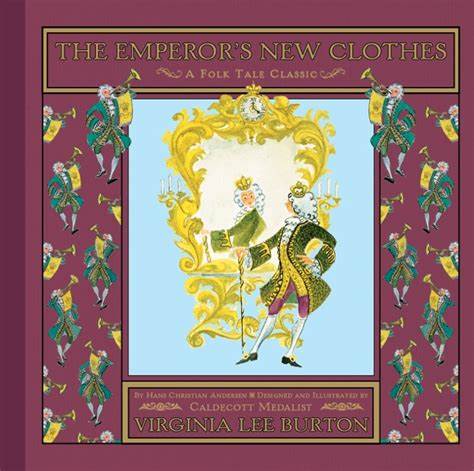
The Emperor’s New Clothes

The Emperor’s New Clothes

Folktales keep hanging around because the sorts of lessons they teach are timeless and universal. That said, some gain more relevance than others over the years, and I’ve always thought The Emperor’s New Clothes one of the most pertinent to our own time.

Do we still believe in the wisdom of crowds? I think it’s hard to in the present day and age. What this parable warns us against is the danger of mass delusion, or “pluralistic ignorance.” It’s a top-down phenomenon, first infecting the court, which turns out to be the easiest part. Courtiers, aware of how slippery the greasy pole of advancement is, will do anything to get along. As for the Emperor himself, the whole idea works out pretty well for him. It’s a sort of shit test for the courtiers: if they’ll go along with this, they’re likely to go along with anything.

The tailors, meanwhile, are our influencers. We know they must be good because they’re making so much money. And the scam finally takes on a life of its own. Because even when exposed (literally) the Emperor has to keep pretending. The show must go on. The kid can say what he wants; if there’s enough money at stake the illusion will continue to be propped up.

Virginia Lee Burton’s illustrations go back to 1949 but they stand up well in terms of how she conceived the story, emphasizing mirror effects. Because we don’t see ourselves as we appear in a mirror, in an accurate reflection, but only as others see us. Reality is a carnival or funhouse. And even if we know that everything about it is a lie, we’ll all still play along.

Graphicalex

DNF files: The Last Week

The Last Week: What the Gospels Really Teach About Jesus’s Final Days in Jerusalem

By Marcus J. Borg and Dominic Crossan

Page I bailed on: 126

Verdict: This is a good book. I just didn’t feel I was learning much from it. And stuff I didn’t know anything about, like Mark’s narrative “framing technique” or how exceptional Caiaphas was at remaining high priest for so long, weren’t the kinds of things I’m likely to remember long. But you never know.

I think you’re in good hands with Borg and Crossan. What they’ve written here is a commentary on the events of Holy Week, using the account from Mark (because it was the earliest Gospel and the one that sticks most closely to a timeline that can be easily followed) as a spine. It’s basically the historical-critical method, though they address the meaning and significance of what happened from a Christian perspective, not as historians.

I had some issues with the amount of time spent repeating the passages they subjected to close reading, and while I usually like it when points of translation are gone into they seem to have been excessively nit-picking here. I guess it’s sort of interesting that the frequency of the Greek word hodos is concealed in English translations where it’s variously rendered as “way,” “road,” or “path,” but I didn’t find it all that important. And I couldn’t understand the point being made about the Greek lutron being misleadingly translated as ransom, and how it didn’t mean vicarious atonement, because it isn’t used in the Greek translation of the Hebrew Bible in that way, but rather participation in Jesus. My understanding is that the idea of vicarious atonement in the Christian sense was something new, so why would it be used earlier in that sense? I got the feeling a particular theological interpretation was what was being argued here more than an objective reading.

If you’ve read other books by Crossan (I’m not as familiar with Borg) you’ll know that his Jesus is the prophet against empire, very much a political figure, and that’s the route taken again here. It starts with contrasts drawn in the opening pages between “God’s passion for distributive justice” and Rome’s for “punitive justice,” and then two entries into Jerusalem on Palm Sunday: Jesus on a donkey and Pontius Pilate as part of an imperial procession.

Borg and Crossan aren’t wrong in emphasizing this. The fact is that the region was a hotbed of political turmoil at the time, and Jesus was executed for what were political reasons. I did wonder though about how much they were leaning on the idea of Jesus standing against the “domination systems” of the time. This is a pretty broad idea, and while Jesus did oppose the contemporary political and religious power elites, I don’t know if he was against political and religious power structures as such. Few rebels are, and I think this is probably reading a lot back into him. But then I’m a cynical sort of guy.

A good book that I’d even recommend for a lot of people, and I feel a little bad about including it in the DNF files. But I didn’t finish it, so.

The DNF files

TCF: El Jefe

El Jefe: The Stalking of Chapo Guzmán
By Alan Feuer

The crime:

For nearly thirty years Joaquín Archivaldo Guzmán Loera, commonly referred to by his nickname El Chapo (“shorty” or “stocky”), was one of the biggest drug traffickers in the world, being the leader of Mexico’s notorious Sinaloa cartel. After a long and colourful history of evading and escaping the law he was finally tracked down and apprehended by Mexican and American authorities in 2016, extradited to the U.S., and sentenced to life in prison.

The book:

I didn’t like this one much. It’s very limited in scope, telling the story of the pursuit of El Chapo from the perspective of American FBI and DEA agents. So don’t expect to find out much about the operation of Guzmán’s empire, or what was happening in Mexico. Also, Alan Feuer’s reporting deals primarily with the various ways agents tried to locate and track the boss through his communications network, which is something that either wasn’t explained all that well or was just over my head since I couldn’t follow any of the details. At no time did I fully understand how the monitoring of Guzmán’s messaging system actually worked.

As for the gangster lifestyle, for all of his money, influence, celebrity, and power it doesn’t seem like Guzmán enjoyed himself much. He was, of course, always on the run, and lived a fair amount of the time in very primitive conditions, even in caves. Then there was the constant threat of violence from other gangs and having to respond to ever-changing market conditions, or the more mundane work of a CEO. It all sounds like a grind to me, not to mention dangerous.

But the Hollywood image of a drug lord – think of Pacino’s Scarface in his trashy Florida mansion – looms large in the popular imagination. And I guess there’s some truth to the tales of excess. Pablo Escobar had his hacienda, stocked with hippos and other exotic creatures. And El Chapo had a gold-plated AK-47 and lots of mistresses. But mostly the life just seems, like Guzmán himself, nasty, brutish, and short.

Even so, Guzmán seems to have been aware of the Hollywood mythology, and sought to promote it. One of the more interesting sub-plots here involves the fact that he kept a screenwriter on staff and was planning on making a movie about himself (with the rather unoriginal working title of El Padrino, Spanish for The Godfather). One of the raids to grab him was even thrown for a loop when it was discovered that Sean Penn had scheduled a visit at the same time. Penn was interested in interviewing Guzmán for Rolling Stone while Guzmán and his team were hoping the Hollywood actor would want to get involved in their film project.

This conflict between Guzmán’s notoriety, or celebrity status and his need to stay anonymous and hidden is one of the more interesting parts of his story. As Feuer puts it, “The ‘paradox of visibility’ was paradoxical only in the sense that Guzmán never wanted to be invisible; he wanted to be seen.” But I don’t think this is quite right. Guzmán did want to be invisible some of the time. He just also wanted to be famous. This is typical of most celebrities: they want to be in complete control of their brand, enjoying all the perks of fame without any of the downsides. But that’s not the way it works. At least not yet.

This isn’t a book about Guzmán though, so we don’t get any deeper into his psychology on this matter. Instead, the main reflection I was left with had to do with Guzmán as folk hero. Not so much for being a provincial big shot, the hometown boy who made good and gave a boost to the local economy while showing up the federal government as corrupt and incompetent fools, as for his fighting against the ineluctable web of digital surveillance. The story here is of an incredibly complex and long-running police investigation that was basically driven by tech people and all their wonderful toys and software. Guzmán was alert to the dangers, and seems to have done a good job protecting himself, but if you want to communicate in the digital age you’re going to be vulnerable to hackers. As terrible a person as Guzmán was, this does make you almost want to root for his escape. Because if he couldn’t free himself from the web, who can?

Noted in passing:

As Guzmán expanded his drug trade into Canada we’re told by Feuer that “It hadn’t gone unnoticed that a kilo of cocaine sold for almost ten thousand dollars more in Montreal and Toronto than it did in Chicago or Los Angeles.” This surprised me a bit. Cocaine costs that much more in Canada? So I did some Internet sleuthing and found that prices for cocaine (this is mostly from the Global Drug Surveys that can be accessed online) vary widely not just between countries but different regions within countries. Overall though, it seems that Canada, which consumes a lot of cocaine, enjoys (if that’s the right word) low cocaine prices. The main rule seems to be that the further the distance from the source (Colombia, say), the higher the price. So cocaine costs a lot in Australia and Dubai. I don’t think Canada is a very difficult country to smuggle drugs into, but I’m guessing most of the cocaine we get comes through the U.S. first so crossing two international borders drives up the price. Still, the amount of mark-up that Feuer cites sounds high.

“Whenever his safety and schedule permitted it,” Feuer writes, El Chapo “loved slipping off to havens like Los Cabos where he could eat well, drink among his friends and have his pick of the local professional talent.”

Is this use of “talent” widely understood? My own understanding is that what’s being referred to are escorts or prostitutes, but that’s mainly an inference from the word’s use in the porn industry, where “talent” refers to performers, with everybody else being business or tech support. I didn’t think “talent” meaning prostitutes was that common an expression, capable of being tossed off here in such a casual way. But I might just be out of the loop.

Takeaways:

Certain human beings have the power to hold a gaze. Without even asking for it, they command our attention, the most valuable commodity we have. . . . Guzmán had been right about one thing: the world had been watching him, much like it had always watched him, millions of people, across the planet, for nearly thirty years. The important questions – Why had it been watching? Did he deserve it? And what was the point of all that concentration? – never seemed to have occurred to him. Perhaps he took it for granted. Or perhaps he understood what we did not: that no matter what he did and no matter what he said – no matter what happened – all of us were going to look at him.

True Crime Files

The King in Yellow

The King in Yellow

The King in Yellow is a book by Robert W. Chambers first published in 1895 that is nearly as mysterious as the sinister work it takes its name from. It’s a collection of short stories, the first four of which are linked and have some connection to a fictional play, The King in Yellow, which has the effect of driving anyone who reads it crazy. In this graphic adaptation by I. N. J. Culbard it’s these first four stories – “The Repairer of Reputations,” “The Mask,” “The Yellow Sign,” and “In the Court of the Dragon” – that are represented.

I say it’s a mysterious book because despite being in the public domain and freely available on the Internet I don’t think it’s that widely read except by people interested in its influence on H. P. Lovecraft. But even Lovecraft had reservations about how good it was. As a side note of some interest, on the copyright page to this book we’re told that it’s an “Original story by H. P. Lovecraft / Adapted and Illustrated by I. N. J. Culbard.” That gives you some idea of how much cultural cachet Chambers has lost to his successor.

I don’t think much of Chambers’s book. To be honest, I never made it all the way through. So I was happy to come across this comic crib, which struck me as playing fair with the source material while having a vision of its own that nicely complements Chambers while making a fair job of stitching together the different stories. I liked the presentation of the pale, ghoulish figures who represent the King’s servants in our dimension, and could get behind the decision to switch from a first-person narrative. It’s a good comic, but at the end of it all I didn’t feel I had any greater understanding of what was going on and I still can’t say I think the original is a work of the first rank.

Graphicalex