Miss Marple of St. Mary Mead

An index to my reviews of the Miss Marple stories and novels by Agatha Christie (and others).

The Tuesday Night Club
The Idol House of Astarte
Ingots of Gold
The Bloodstained Pavement
Motive v. Opportunity
The Thumb Mark of St. Peter
The Blue Geranium
The Companion
The Four Suspects
A Christmas Tragedy
The Herb of Death
The Affair at the Bungalow
The Murder at the Vicarage
Death by Drowning
Miss Marple Tells a Story
Strange Jest
The Body in the Library
The Case of the Perfect Maid
The Case of the Caretaker
Tape-Measure Murder
The Moving Finger
A Murder is Announced
They Do It with Mirrors
4.50 from Paddington
Greenshaw’s Folly
Sanctuary

Deuterocanonical Works

Evil in Small Places by Lucy Foley
Miss Marple’s Christmas by Ruth Ware
Miss Marple Takes Manhattan by Alyssa Cole
The Second Murder at the Vicarage by Val McDermid
The Unravelling by Natalie Haynes

Mystery and Detective Fiction

Bookmarked! #34: By Way of an Obit

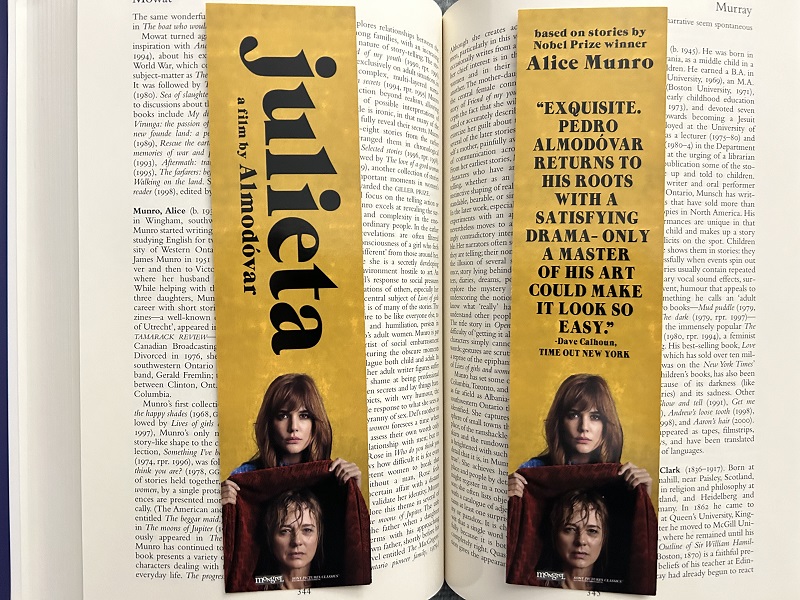
Alice Munro died this week. I know I have some Munro bookmarks, but couldn’t locate them in storage. I’m still getting my collection organized. So this bookmark promoting Pedro Almodóvar’s Julieta, a 2016 adaptation of some of the stories in Runaway, will have to do.

Book: The Concise Oxford Companion to Canadian Literature ed. by William Toye

Bookmarked Bookmarks

TMI

From The Twittering Machine (2020) by Richard Seymour:

We naively think of ourselves as either “information rich” or “information poor.” What if it doesn’t work that way? What if information is like sugar, and  a high-information diet is a benchmark of cultural poverty? What if information, beyond a certain point, is toxic?

All-New X-Men: Here to Stay

All-New X-Men: Here to Stay

Well, as the title indicates the classic X-Men are here to stay in our own time, where they will have to deal with the Scott Summers/Cyclops-led evil X-Men. Meanwhile, Jean Grey continues to come to grips with her growing psychic powers, people start to question Hank McCoy’s messing with the space-time continuum, Kitty Pryde gets exasperated trying to bring the teenage X-Men up to speed, Angel meets a new friend, Mystique assembles her own gang of supervillains, and Wolverine is angry all the time.

I had a feeling that they were sort of marking time here, especially given that there are two big fight scenes, one a battle with Hydra that feels like a simulation in the Danger Room and the other being a fight against Sentinels that is a simulation in the Danger Room. Neither amounts to much. But overall Brian Michael Bendis keeps the different balls in the air pretty well and the writing is better than average. I particularly like the way Bendis spices up dialogue scenes in interesting ways. In the previous volume it was the two Hank McCoys talking to each other via psychic link-up. In this one we get a heated conversation between Beast and Captain America as filtered through Iceman and Kitty Pride. I thought that was neat.

Unfortunately, I really didn’t like the art from David Marquez (issues #6-8). It felt very generic and crude, with a blandness that seems almost AI generated, and there’s not a lot going on in the individual cells, either in the background or expressed on faces. It’s similar to Stuart Immonen’s work (who did issues #9-10 here), but more cartoonish, if I can make a distinction between a cartoon and a comic style. I can see some people liking it, but it’s not my thing.

Not a great instalment then, but the story interests me and I’ll stick with it for a while. I may not be here to stay, but I’ll hang around for a bit longer.

Graphicalex

What does that even mean? Part II

I can’t figure this out. First off: what is a promise? Is it anything like a guarantee? Probably not. Second: how do they define “fresh”? Past the expiry or best-before date? Visibly starting to go bad? Unfit for human consumption? Third: if something is not fresh, should they even be giving it away for free? Shouldn’t they be getting rid of it? Lots of times you can get stuff at the grocery store for 50% off because it’s getting old, and in some cases (like bread) stale and even moldy. Clearly it’s been marked down because it’s no longer fresh, or at least as fresh as it should be. Can I take it to the cashier and demand I get it for free?

Index

TCF: Summer for the Gods

Summer for the Gods: The Scopes Trial and America’s Continuing Debate Over Science and Religion
By Edward J. Larson

The crime:

A media circus came to Dayton, Tennessee for a couple of weeks in July 1925 as high school teacher John T. Scopes was put on trial for teaching evolution in a state-funded school. William Jennings Bryan joined the prosecution, while Clarence Darrow served on the defence team. Scopes was found guilty and fined $100, a verdict that was later overturned on a flimsy technicality so that there was no conviction to be appealed.

The book:

In my review of Blood & Ink I brought up the subject of a “trial of the century.” I don’t know if the Hall-Mills trial was ever referred to as such, but the author Joe Pompeo uses it as a chapter heading in that book. In any event, the Scopes Trial took place the year before and Edward Larson notes how calling it the trial of the century was already a “shopworn designation,” especially since Darrow’s previous case, the Leopold and Loeb trial that took place just the year before, had been widely referred to in the same terms.

Was the Leopold and Loeb trial the first trial of the century, or the first trial to be named as such in the media? I don’t know. But the Scopes Trial was a big deal and so probably belongs on a shortlist of contenders for that title. There is a strong counterargument to be made against its inclusion in such a list though. Just for starters, it was always meant to be a media event – a symbolic statute, a show trial – and very little was at stake. Technically it was a criminal misdemeanour case, though as the Chicago Tribune would sniff at the time, “It is not a criminal trial, as that term is ordinarily understood.” But then, they were saying that because they were broadcasting it live via radio and they wanted to allay concerns that this wasn’t in some way improper. Then, after the verdict, the media were quick to dismiss the whole show as a sort of nine days’ wonder. The New York Times would say that the abrupt end of the trial saved “the public from having its ears bethumped with millions more of irrelevant words.” This from the paper of record that, as Larson observes, had “used as many as five telegraph wires at a time to carry reports from Dayton.”

Another point against its century status is that it was unclear, even at the time, what the trial was actually about or what the different sides were trying to prove. For Bryan, the issue had to do with the principle of majority rule. “It is the easiest case to explain I have ever found,” he wrote to a fellow prosecutor at the start of the trial. “The right of the people speaking through the legislature, to control the schools which they create and support is the real issue as I see it” (emphases in the original). Darrow was playing for different stakes: “Nothing will satisfy us but broad victory, a knockout which will have an everlasting precedent to prove that America is founded on liberty and not on narrow, mean, intolerable and brainless prejudice of soulless religio-maniacs.”

Given these different agendas, both sides were able to claim victory: “The prosecution claimed a legal victory; the defense a moral one.” At the same time, neither side was satisfied: the defence complaining that nothing had been settled while supporters of the statute “could scarcely hail a ruling that all but directed prosecutors not to enforce the law.” Which makes you wonder to what extent a win-win is always a lose-lose.

A final point against calling it a trial of the century is that the verdict seems never to have been in doubt. This was evidenced by its immediacy:

The jury received the case shortly before noon and returned its verdict nine minutes later. They spent most of this time getting in and out of the crowded courtroom. “The jurors didn’t even sit down to think it over,” one observer noted, “but stood huddled together in the hallway of the courthouse for the brief interval.”

Nine minutes! I’m not sure, but that must be some kind of record, especially for a case this long.

Given the larger-than-life personalities of Bryan and Darrow the table was set for high drama, but the great debate between the two comes off, at least to my ear listening to it a century later, sounding scripted and pointless. Maybe it’s the effect of having Inherit the Wind playing in my head (a text that’s duly questioned here). But more than that, you really can’t defend the Bible as history or science. Religion doesn’t make any kind of sense if you look at it that way. So all the back-and-forth about when God created the world is silly, as I think most people understood at the time.

But, to advocate for the other side, you can still make an argument for its “trial of the century” status. But this is mainly because of its long cultural afterlife. “Dozens of prosecutions have received such a designation over the years,” Larson concludes, “but only the Scopes trial fully lives up to its billing by continuing to echo through the century.” That probably has more to do with political developments though, and in particular the rise of evangelicalism as a political force in the U.S., than with the trial itself. In the battle between modernists and fundamentalists that the Scopes trial represented it seemed at the time as though the fundamentalists had been thoroughly beaten. They would, however, rise again, gaining strength from a resurgent Southern pride and sense of regional identity.

Given its now “mythic” status, it’s nice to have something like an authoritative version of the events setting the record straight. That said, I can’t say I enjoyed Summer for the Gods very much. It’s not a great read and the characters are poorly drawn. Darrow comes off a bit worse for wear and Bryan a bit better. The secondary players are indistinguishable and the legal maneuvering difficult to follow. It did win the Pulitzer Prize for history and I’m guessing that was for its research.

Noted in passing:

I don’t think Bobby Franks is properly described as a “former schoolmate” of Leopold and Loeb. He lived across the street from Loeb, to whom he was related, and went to the same high school Leopold had attended, but he was quite a bit younger.

Takeaways:

Trying to establish the “truth” of a religion, whatever that might mean, is pointless. And even if that were your goal, a criminal trial wouldn’t be the place for it.

True Crime Files
Swamp Thing: The Bronze Age Volume 2

Swamp Thing: The Bronze Age Volume 2

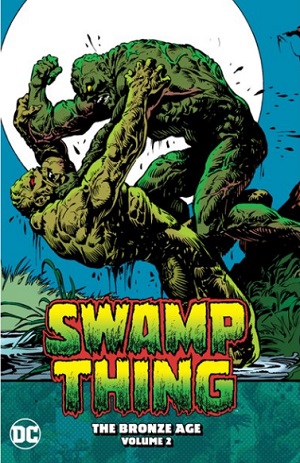
We sort of swing from the good to the bad here. First up we have the back half of the initial run of Swamp Thing comics, issues #14-24. This has lots of the usual nuttiness, including Swampy fighting demons, robots, and even a clone of himself that grew out of the arm that was cut off in an earlier story (this gives us the awesome Swamp Thing vs. Swamp Thing cover for issue #20 that also fronts this omnibus edition). I especially loved the Dr. Seuss-inspired Ultra-Cerebralociter, a machine that has the power to turn the brains of all the world’s leaders into “mush.” It even comes with a DANGER: HIGH VOLTAGE warning label on it. You’ve gotta love this stuff. Then of course there’s the purple writing that was the house style of the time, with Swamp Thing being described so often as a “mockery” (as in a “muck-draped mockery” of a man, or a mockery of life itself) that I was wondering if there was something in the style guide that said the word mockery had to be used a certain number of times every issue.

Unfortunately, sales were really poor so the series was discontinued. Issue #24 was the last, though the script and draft pencils and inks for the never-published issue #25 are included as an appendix with this edition, which is a really nice bonus.

The rest of the book has Swampy (along with Deadman) teaming up with the Challengers of the Unknown, a team of heroes who are now as unknown as their challenges. Who were the Challengers, you ask?

Ace Morgan: Former test pilot – now leader of the Challengers!

Rocky Davis: Onetime champion heavyweight wrestler!

Red Ryan: Electronics expert and world renowned mountain explorer!

Professor Haley: Scientific genius and deep diver into – the unknown!

Oh, and just in case you think this is a boys only club:

June Robbins: honorary Challenger and research physicist.

June is the buxom blonde who Rocky and Red have a falling out over. Yes, it’s that hokey.

Anyway, there are two main Challengers of the Unknown storylines. The first has them going back to the charmingly named town of Perdition to fight the reawakened spirit of the Lovecraft-demon M’Nagalah in a surprisingly yucky bit of horror, and the second has them jumping forward 12 million years to fight a bunch of solar tyrants who are offloading their excess monsters onto twentieth-century Earth. Beginning, alas, with Toronto: “an orderly city. A city of peaceful and pleasant people. A city with one of the lowest crime rates on the continent.” These stories are plenty crazy enough, but Swampy is just an extra, albeit more competent at smashing bad guys than the Challengers. His fight with the Persuader is the highlight.

Also included are a couple of Brave and the Bold team-ups with Batman and a frankly kind of lame crossover that has him fighting alongside Solomon Grundy against Superman (it’s complicated, but Swampy is still a good guy).

I think there are interesting storylines here, some of which had to be left as dead ends when this run was canceled. We never hear anything more about Alec Holland’s brother Edward, for example, a guy who seemed to have a pretty justifiable grudge against his brother. Like his arm restoring itself, however, cutting the series off wasn’t going to be the end of the “mossy man-brute.” He’d be back!

Graphicalex

The recall recalled

Regular readers of this site (a select and treasured few) may remember a post I had back on January 15 of this year where I mentioned how I’d sent away proof of purchase of a bunch of Quaker brand food products as part of a recall they were having due to concerns over salmonella contamination.

I ended that post with this: “I’m curious to see what happens. Do manufacturers actually pay out when they have a recall? You’re on the clock, Quaker! I’m not expecting anything, but let’s see how you do.”

When I originally applied for the refund online I was notified that my request would take up to 8 weeks to process. Then I received an email notification on January 24 from Quaker saying “We reviewed your submission, and you will be receiving compensation in the mail in the next 8-10 weeks.”

Well, by my reckoning it’s now been 14 weeks and no sign of a cheque! Are they just being slow, or do you think they just won’t be paying up? As I said back in January, “I’m not expecting anything.” Still, the email did raise my hopes. Let’s see if anything happens!

Sweet stuff

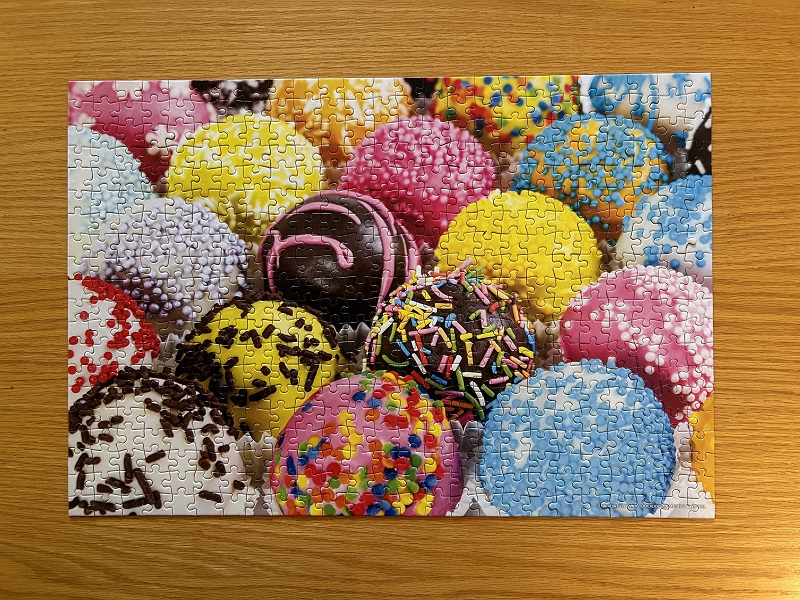
A tasty treat of a puzzle for you. Not as hard as it looked at first, but the pieces were kind of small and thin. I’ve done it a couple of times now and I don’t think I’ll be doing it again.

Puzzled