The Immortal Hulk Volume 1: Or is He Both?

The Immortal Hulk Volume 1: Or is He Both?
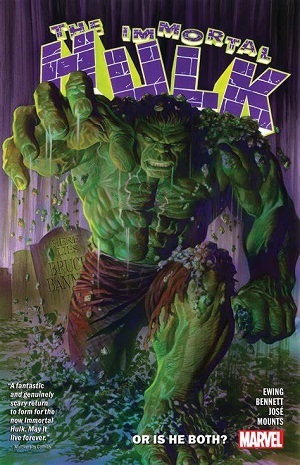
I don’t know how much credit to give them for saddling this first volume of the Immortal Hulk series with such an obscure title. It’s a bold move that may appeal to die-hard fanboys, but when I was a kid I had a reprint edition of The Incredible Hulk #1 – the cover of which asks “Is He Man or Monster or . . . is He Both?” – and even I didn’t make the connection here.

So much for the “Or is He Both?” part. How about The Immortal Hulk? Well, as things kick off the world thinks Bruce Banner/The Hulk is dead. I’m not sure how or when this happened. There’s a bunch of excerpts from different comics at the end of this volume that are less than informative on the subject, and I didn’t feel like doing any further research (and you can certainly find answers to all these questions, and more, on the Internet).

In any event, as you will have guessed, the Hulk isn’t dead. In fact, he can’t be killed. He can even get a giant hole blown through his chest and it fills back in again. This leaves Bruce Banner to “walk the earth” in a hoodie, righting the odd wrong and filled with existential angst because when he looks in a mirror he sees the big green guy glaring back at him. And before long the cops, the media, and even an old friend are on to him.

I have to say I didn’t care very much for anything going on here. The art didn’t strike me as anything special, even with the way they tried to change things up in issue #3 (different styles for different narrative voices). And the stories weren’t all that good. Instead of being triggered by anger, Banner turns into the Hulk now at night. I don’t know why. In the first issue the Hulk avenges the accidental killing of a girl in a gas station hold-up. Then he encounters a guy who turned himself and his son into glowing green Hulk knock-offs. Then he fights Sasquatch, who is another Hulk-wannabe gone bad. This is a theme that’s played on throughout, as the reporter tracking the Hulk confesses at the end that she wants to be like him too. But of course they don’t understand.

There’s also something going on about Banner’s father, but I couldn’t figure out what that was. I think he abused Bruce when he was a boy. So on top of everything else the Hulk has daddy issues.

I’ll probably give this run some more time to get its feet, but in the first five issues I didn’t get the sense that it was going anywhere, and to be honest I don’t find the Hulk that interesting, so I might not stick with it for long.

Graphicalex

Bookmarked! #42: Going Big

I have some big bookmarks. So big that they’re actually hard to use. You can’t tell from the picture but this one is 14″ from top to bottom, so I had to find a really big book to put it in.

There’s a lot going on here. Some metal filigree. Textile. And a Turkish evil eye ornament at the bottom. So I’m guessing this came from Turkey, as I have a few bookmarks from there and I had an uncle who was Turkish. But I don’t remember now when I got it.

Book: Science Fiction of the 20th Century: An Illustrated History by Frank D. Robinson

Bookmarked Bookmarks

Marple: The Body in the Library

Again Miss Marple remains in the background. At least in the early going, this was a big part of her character and her method. Recall her quietly knitting through the stories of The Tuesday Night Club, or the fact that she isn’t the narrator of The Murder at the Vicarage and indeed isn’t a major presence in that book at all. In The Body in the Library she doesn’t even appear very often. She’s not the sort of detective to lead a very active investigation, looking for clues, or interviewing witnesses. Sure she does a bit of that, but mostly she just notices things. Luckily, the police are willing, if not always happy, to have her along for the ride.

Marple’s process of ratiocination goes from the local to the universal, the incidental to the supremely important. We’re told she “had attained fame by her ability to link up trivial village happenings with graver problems in such a way as to throw light upon the latter.” But to be honest I never see a lot of that happening. We just have to take it on faith, since any village happenings are only slightly alluded to. What seems more on tap here is a literary diversion. “Bodies are always being found in libraries in books. I’ve never known a case in real life,” says gruff Colonel Bantry, just before finding a body in his library. Christie herself introduced the book as having been written out of a desire to play a “Variation on a well-known Theme,” with the theme being the body in the library, recognized to be a cliché of the detective story. This made me wonder how many bodies had been found in libraries before this book (which was first published in 1942). I guess a lot.

Otherwise this seems much the usual puzzle for Jane to solve. The killers hatch an insanely complicated plot, which is made even more difficult to untangle because the innocent guy they attempt to frame behaves in a ridiculous manner. He’s the one who thinks it would be a neat idea to hide the body in the library of Colonel Bantry, just because he doesn’t like the Colonel very much. And I guess he was drunk. Throw in the absurd idea that only one person has to (mis)identify the dead body or else the whole scheme would instantly fall apart and you’ve got something so farfetched I don’t think it’s being fair to the reader. And then you get another of those clues that depends on a bit of specifically British knowledge, like the “banting” and “hundreds and thousands” that I pulled a blank on in “The Tuesday Night Club.” The clue here is a passing reference to Somerset House, which at the time was where the Registry of Births, Marriages and Deaths had its offices. But the Registry moved in 1970 and I don’t think that’s something anyone would be likely to get today. I didn’t understand what its mention meant even after I’d been alerted as to its significance.

Of course there are other Britishisms that I failed to grasp, like “beer and skittles,” but they weren’t as important and only gave the proceedings a bit of period charm.

And finally, since I’m on a roll here, the business with the fingernails is quite obscure.

To be honest, after having re-read the first Miss Marple stories and then the first two novels I’ve come away thinking they’re markedly inferior to Christie’s Poirot mysteries. And I’m not sure I liked them any better when I read them the first time forty or more years ago. As noted, the plots are bonkers, and not in a good way, as much as Miss Marple herself would want to object.

“An intricate plot,” said Colonel Melchett.

“Not more intricate than the steps of a dance,” said Miss Marple.

“I suppose not.”

Of course, the undoing of the intricacy is the point of the exercise, which is why the plot has to be so complex. There’s a nice moment here where it’s suggested that the “explanation of the whole case” may be criminal insanity, but this is immediately dismissed by the police superintendent as being “too easy.” “There are such cases,” he had earlier admitted, “but we’ve no knowledge of anyone of that kind operating in this neighbourhood.” “One does see so much evil in a village,” Miss Marple explains at another point. But not that kind of evil. As I’ve mentioned before, for Christie there are only three motives for crime: sex, greed, and lunacy. And she has no interest in lunacy because it can’t be explained in a clever way. We’re more used to psychopaths in our own time because they get so much media attention. Back in Miss Marple’s day they weren’t as interesting.

Marple index

Disney all-stars

This is a very old puzzle that I think we picked up at a flea market somewhere. You’ll be able to tell how old it is by the fact that the crowded cast of Disney characters doesn’t include anyone from The Lion King, Pocahontas. or any of their later hits. Instead you get the Disney pictures that I grew up with. Except for The Sword in the Stone. I never saw that one. Which means I had no idea who those characters were. Luckily there was an index on the back of the box that labeled everyone.

The thing that impressed me the most about this one though is that all the pieces were still there. For a puzzle this old, and one that has passed through several hands, that’s very rare. And I think this is especially remarkable for a puzzle where the pieces don’t fit together very well. They really just sit next to each other and if you nudge your work in progress, however slightly, they come apart.

Puzzled

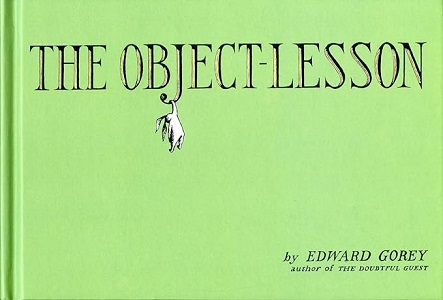
The Object-Lesson

The Object-Lesson

I love the work of Edward Gorey but you have to take it in small doses. As I go along (if I keep going along) I’ll be revisiting his various Amphigorey collections, but until I get to them this little book will do as an entry point to his dark universe.

Dark because danger and death and loss and mutilation are always lurking around the corner. Some monster is no doubt waiting behind that thick network of wallpaper we’re faced with on the first page. A beast hiding in the mists on the moors. In the trees . . . “a bat, or possibly an umbrella.” You can’t even tell what it is when it flies away. “Something happened to the vicar,” and from the looks of it nothing good. Perhaps a bicycle accident.

The horizontal nature of the book leads you to believe there’s some sort of continuity at work in the way landscapes seem to run from page to page. Your eyes are moving at speed across a sweep of space. But is there a thread that holds it all together? Not an obvious one, but that just means we have to fill in the gaps and make the links ourselves. The text may suggests temporal relations. “Meanwhile, on the tower . . .” And we seem to be moving from morning through day to night. But are there also traps? When the people in the dinghy cry “Heavens, how dashing!” are they talking about the “erstwhile cousin” stepping backwards into the water? They seem to be looking at him, but is that just a coincidence? And is that water the same lake the lordship meets the Throbblefoot Spectre by? And are odd figures who are never identified recurring, or different people? Take the lady in mourning by the edge of the lake (she appears again from a distance, walking either away from or towards the tower), or the lady with the flowerpot.

Surrealism? Yes, or at least the absurd. It’s in the dreamlike symbolism of the landscape mostly. That tower in the middle of nowhere. The ornate gates to the asylum with no adjoining walls. The lonely kiosk. Detached structures that again might be understood as in the same neighbourhood, or be located on different continents and in different eras.

A haunted world, and by what? “The miseries of childhood.” That kid on the second page has seen too much that can never be forgotten. He (or she) will lose much that will never be found.

Graphicalex

Canada Day 2024

On those annual lists you’ve probably seen, lists that are calculated in all kinds of different ways, Canada usually rates as one of the best countries in the world, if not the best, to live in. Though I haven’t lived anywhere else, it’s a judgment I’m on board with. I can complain about the government (terrible and always getting worse) and unpleasant aspects of the national character (we’re passive-aggressive snobs), but being born and raised in Canada was one of the luckiest things that ever happened to me. To paraphrase Robert Frost’s “Birches”: Canada’s the right place for living. I don’t know where it’s likely to go better.

The Battle of Cape Matapan remembered

HMS Valiant, in her glory days.

The Battle of Cape Matapan was a naval engagement fought between ships of the British and Australian navies and the Royal Italian Navy from 27 to 29 March 1941 in the Mediterranean Sea. It was a clear victory for the allies, as they sank five Italian ships without losing any of their own, but it didn’t have great strategic importance, mainly serving to limit Italy’s operations in the Eastern Mediterranean for a while. For military historians, however, it is distinguished as “the first big naval battle of World War II” and “the only large fleet action in the war which took place outside the Pacific theater.”

Such, anyway, is the judgment of William Koenig in his chapter on the battle included in a coffee-table book called Two Centuries of Warfare. That book was published in 1978 and it was hanging around the house when I was a kid. At some point, I believe around 1980, in fell into the hands of a family acquaintance who had actually been involved in the battle as a member of the Royal Canadian Naval Volunteer Reserve, serving I believe as a radar operator on the battleship Valiant (the use of radar played an important role in the British victory). He wrote up a note on his own observations in response, and it was kept stuck in the pages of the book. I recently rediscovered it when the book was getting ready to be tossed out in a house-cleaning exercise. I thought I’d post a transcript of it here just because it’s worth holding on to these eyewitness/participant accounts of history before they’re lost entirely. Unfortunately I no longer remember the name of the fellow who wrote the note and I can’t make it out from his signature. But for anyone interested in the battle, here’s what he had to say (I’ve given a literal transcript, with no editing for spelling or grammar).

This is not quite as it happened. The Italian ships Pola, Zara and Fiume were first picked up by Valiant’s radar at about 15 mile range which permitted the British ships Warspite, Valiant and Barham to close the Italian ships. At about 3000 yards range the ships were [?] to starboard in line a head and passed the Italian ships at about 2900 yd. range. Using radar range bearings the search lights were turned on and the battle ships opened fire with the results as indicated in the book. Of interest is the fact that Prince Philip now Duke of Edinburgh a midshipman at the time manned one of the search lights. I was passing range and bearings to him over the ships intercom system.

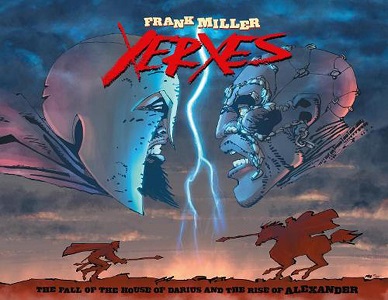
Xerxes: The Fall of the House of Darius and the Rise of Alexander

Xerxes: The Fall of the House of Darius and the Rise of Alexander

I guess you could call this a sequel to 300, but it came out in 2018, which was 20 years later, and doesn’t have much to do with the events of Thermopylae, which it skips in its race through over 150 years of Persian history. There’s also no real connection to the movie 300: Rise of an Empire, which actually had come out four years earlier.

The treatment of history is weaker than in 300 too. The “House of Darius” would be the Achaeminids, wouldn’t it? Or that’s what Darius I would have claimed. But I would have thought that would be the House of Cyrus, if anyone. The jeweled bodysuits of Xerxes and other Persian emperors was, and remains, mystifying to me. I was rolling my eyes a lot at some of the architecture and statuary, like the colossi on the Athenian acropolis. Aeskylos (Aeschylus) is reimagined as a cross between Darth Maul and a ninja. And Alexander the Great, when he shows up, is basically the reincarnation not of Hercules but Leonidas (because beards are manly). It all seemed a lot sillier than the earlier book. And the art felt lazier too. More full-page splashes (a good word for the splatter effect being used so often), with a few great sequences (the imagined deaths of Xerxes) and some very uninspired and pointless ones (the Ethiopian archers). Given the minimal and disjunctive text, it felt like a bunch of posters with big titles: Marathon! Xerxes Assassinated! Gaugamela! I’ve added the exclamation marks but they feel like they should be there.

300 managed to be an original and quite effective retelling of a particular historical incident. This book covers vastly more ground (both in time and space) and ends up just being a bunch of odd pictures. As I’ve said, some of them are great but most are just more of the same and I came away feeling that none of it added up to much.

Graphicalex

Bookmarked! #41: In the Beginning

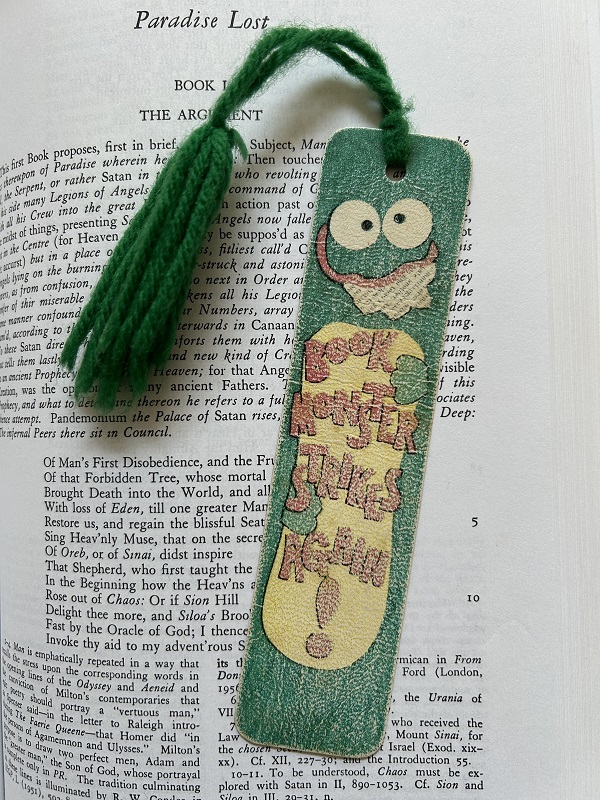
A very, very special bookmark post today! Yes, this is the one that started it all. My first bookmark. I think I got it back when I six or seven years old. And it received heavy use in those early days, as you can tell from the fading. I certainly have more expensive and exotic bookmarks in my collection, but none that mean as much to me as this one.

Book: Complete Poems and Major Prose by John Milton (ed. Merritt Y. Hughes)

Bookmarked Bookmarks

Marple: The Murder at the Vicarage

A characteristic of a lot of detective fiction is that it’s quickly consumed and just as quickly forgotten. We remember the classics – The Hound of the Baskervilles, Murder on the Orient Express – but the others disappear from our minds so quickly that we can read the same book just a year or even months later and be unable to remember the first thing about them. At least this is true for me, as it was for my mother, who always had a mystery novel (or several) by her bedside. When I commented on the fact that she’d read some of them before she’d reply that it didn’t matter because she could no longer remember whodunit.

One reason I think this happens is because a lot of what goes on in a mystery novel is supposed to be quickly forgotten. Important clues are skimmed over in such a way that you’re meant to miss them. Is it any wonder they vanish from our minds when the book is done?

That’s just a theory of mine. But it helps explain how, when I came to write up these notes on The Murder at the Vicarage only a couple of weeks after finishing reading it, I could no longer recall who it was that had been killed at the vicarage, who had done the killing, and why. And this wasn’t a momentary lapse of recall. I tried for hours to think of what had happened in the book and couldn’t come up with anything.

At any rate, the story has it that Colonel Protheroe is shot in the vicar’s study, and there are no end of suspicious characters floating around. The vicar himself is the narrator, and he finds the discovery of a body in his study quite upsetting not just for personal reasons but because “nothing exciting ever happens” in town. “There are had been no murder in St. Mary Mead for at least fifteen years,” and as a result they “are not used to mysteries.” Seeing as this was the first Miss Marple novel, these might be taken as famous last words. But once Jane is on the case he knows things are in good hands. “There is no detective in England equal to a spinster lady of uncertain age with plenty of time on her hands.” Especially when that spinster is “not the type of elderly lady who makes mistakes. She has got the uncanny knack of always being right.”

Miss Marple operates, as usual, in the background. I’ve mentioned how the vicar tells the story and the truth is we don’t get to see the detective spinster doing much. Which isn’t too much of a problem as it also seems natural for the police to invite any respectable citizens to join them in the investigation by sitting in on interviews of suspects and inspecting evidence and the like. Those were the days!

It’s also nice that Miss Marple isn’t as direct a presence because she is a pain in the ass. As Robert Barnard remarked of this novel, “the strong dose of vinegar in this first sketch of Miss Marple is more to modern taste than the touch of syrup in later presentations.” I don’t know. I don’t like the vinegar or the syrup, to be honest. She’s either bitchy or a quietly superior know-it-all with the uncanny knack of always being right? Those aren’t great options.

The plot is pure Christie, and features most of her staple elements. The theatricality of the crime, with its ridiculously complicated staging (the business of faking the gunshot had me rolling my eyes in a loop). The importance of a strict time scheme, which can also be cleverly manipulated. Two or more killers working together to give each other alibis. The simplicity of motive, which always comes down to lust or greed. A third category, of mental disturbance or “queerness,” is never in play. The doctor may have his medical theories to explain crime, but Miss Marple knows better, being a student of that great generality “Human Nature.”

There are also those dated references that a twenty-first century reader may take some time figuring out. One of the girls here is described as having “Lots of S.A.” It took me a while to decide that this must mean sex appeal. (In the story “The Herb of Death” Miss Marple herself had to have it explained.) And here’s another siren who the vicar observes with disapproval: “Her legs, which were encased in particularly shiny pink stockings, were crossed, and I had every opportunity of observing that she wore pink striped silk knickers.” This struck me as shocking until I realized that “knickers” in this context must have been referring to something like a slip.

But in the end I didn’t care for this one very much. It’s a weak mystery, and the explanation confusing, far-fetched, and uninteresting. For a book only too aware of its status as a mystery (there are repeated references to the events being just like a mystery novel), it doesn’t play as very clever or arch. And as I say, as soon as it’s finished it’s forgotten.

Marple index