In the gutter

This is a house near mine that was sold five or six years ago and is now rented out to students. I think five or six years ago was probably the last time the eavestroughs were cleaned. Click on the pic to make it bigger to see what I mean. I could have included this as one of my Gardening posts. Shocking!

But this week I also had to go clean out a neighbour’s eavestrough. This is what I found. Quite the blockage. You need to stay on top of these things. One of these days I’ll be too old to lug a ladder around. There is a service that cleans them out twice a year but that (clearly) isn’t enough. Plus they only clear the troughs and not the downspouts. Which is quite a scam, seeing as it’s the downspouts that get blocked. What a racket.

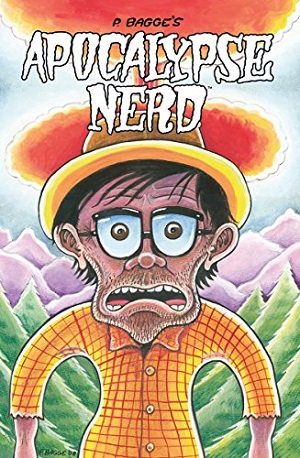
Apocalypse Nerd

Apocalypse Nerd

“Apocalypse” is a word that has undergone a bit of a transformation in the modern age. In terms of Biblical literature it refers to a genre of spiritual writing characterized by a revelation (what the word means in Greek) of the end times, typically accompanied with commentary provided by a celestial interpreter or guide. What the end times usually involve is a final battle between the forces of good and evil, but in the end evil is defeated and both sides receive cosmic justice.

In this regard the apocalypse is actually optimistic in tone, with the world being made new and the kingdom of heaven being realized. It’s prophetic literature, but like most prophecy (a word whose meaning has also changed) it’s not meant so much as a prediction of the future but as a description of what is happening in the world right now, and specifically the persecution of the godly at the hands of the wicked. Within the Bible as we have it the chief examples of apocalypse are the Books of Daniel and Revelation, but there were plenty of other apocalypses being written in the ancient world and they all fit the same general pattern.

Today, when we say “apocalypse” we mean something a lot simpler and darker. What the word refers to is a catastrophic end-of-the-world scenario. Earth being hit by an asteroid, for example. Or civilization collapsing due to climate change. Or an outbreak of plague. Or people turning into flesh-eating zombies. Apocalypse Now begins with The Doors singing about “The End,” meaning the end of “everything that stands” in a bath of napalm. In Marvel comic books Apocalypse is a big, bad guy who wants to kill off most of the human race. You get the picture. There’s no battle between good and evil but just a brutal struggle for survival. And there’s no vision of a New Jerusalem but only a charred wasteland where whoever’s left behind might be able to start over.

I get it. The world is too much with us. I think a lot of us feel the need to press some kind of a reset button on civilization. There are many issues facing us that now seem intractable, and some kind of shift of gears into reverse, if not outright collapse, seems inevitable. That doesn’t mean we’re all building bunkers in our backyards or pimping out our basements in survivalist décor, but it does go some way to explaining current interest in the genre.

I don’t know why I just wrote all that, but it seemed as good a way as any to introduce Peter Bagge’s Apocalypse Nerd. The apocalypse in the title here is actually a bit retro – not going all the way back to Biblical days, but to the fear of nuclear Armageddon that was big in the 1980s. Though things have changed a bit. What we get here isn’t global thermonuclear destruction but a nuke launched from North Korea taking out Seattle. A pair of buddies who live in Seattle are camping in the Cascades at the time and soon find out that they can’t go home. This leaves them not so much wandering in a wasteland as semi-roughing it in the bush. They survive by hunting deer, foraging for berries in the woods, and raiding cottages for preserves and packaged foods.

The story itself doesn’t amount to much. It’s episodic and doesn’t build to any kind of climax. Indeed, in the final panel we’re left with the suggestion that it’s all been a wild goose chase. But despite this I felt swept along by the sort of urgency that’s expressed in the sweating, buggy faces of Bagge’s rubber-limbed figures, who always seem on the edge, or over the edge, of a total breakdown. Though it’s not a short book, Apocalypse Nerd is a very fast read. It doesn’t have a message beyond human beings going back to nature reverting to being cavemen, but that was enough for me to enjoy it.

Graphicalex

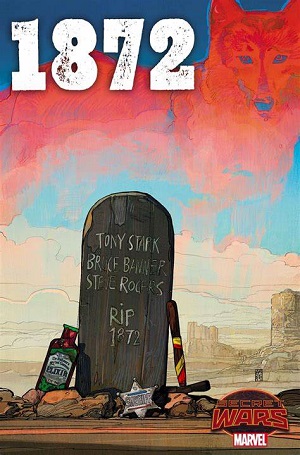
1872

1872

Over the years there have been lots of entertainment columns written on the subject of promotional blurbs, to the point where you have to wonder what the point of them still is. In our time the pull quote of critical praise has become such debased coin that they’re widely recognized as not only worthless but laughable. Even a sticker announcing that a book has won some big literary prize is meaningless. Who cares what the last book was that won the National Book Award or Man Booker Prize? What does it matter that a book was named one of the New York Times’ Best Books of the Year? I guess it helps move a few copies, and as far as advertising is concerned it’s about all that publishers can do, but that’s it.

You can scrape the bottom of a deep barrel though in trawling for pull quotes. To the point where the blurbs I find on most new DVDs are usually from sources I’ve never heard of. The ratings from Rotten Tomatoes probably mean more, which isn’t saying much. I don’t even know if these are real people writing the “reviews” that quotes are drawn from now, as I think it’s something an AI could probably do more effectively, and better. A point that the team promoting Megalopolis apparently took to heart.

I say this because the cover of 1872 has “A rootin’ tootin’ good time” appearing on it, a bit of ad writing that comes courtesy of IGN.com, which as far as I can tell is just a blurb farm now. Then on the back cover we get “I’m not a fan of Westerns, but this comic book may have just changed my opinion of them,” which is attributed to ComicWow.com, a site that was offline when I went to find out if the blurb had actually come from a review and who might have written it.

Anyway, this is all beside the point. It’s just sort of a pet peeve of mind I thought I’d mention. I mean, there’s a really misleading bit of information scratched onto the Boot Hill tombstone on the cover too, but I won’t get after them for that.

I’m not even going to try to put 1872 into its context within the Marvel Secret Wars/Battleworld multiverse because that’s about as deep a rabbit hole as you can head down. Suffice it to say that we’re in the Old (and Wild) West, specifically the company town of Timely, which is populated by various Marvel superheroes and villains in period dress. Steve Rogers is the sheriff, Tony Stark is the town drunk, Bruce Banner is an apothecary, Natasha Romanov is the widow of former sheriff Bucky Barnes. Among the bad guys is Kingpin as the mayor and Wilson Fisk with his gang of hired guns: Bullseye, Grizzly, Electra, and Doctor Octopus.

The centre of the story though is Red Wolf, a Native American out to blow up the Roxxon Corporation’s dam. Red Wolf isn’t a very well-known Marvel hero, so also included in this collected edition of the 1872 series is his origin story from way back in Avengers #80 (1970, and not 1963 as is stated on the back cover), as well as a later appearance in Marvel Comics Presents #170.

I did like the story here. It’s straightforward while at the same time being clever in how it adapts characters we’re familiar with to their new surroundings. I loved Doc Ock’s multiple-gun contraption, and the appearance of Vision in one of those fortune-telling booths. The storyline follows a standard Western formula, but it’s punched up with extra violence that has a lot of the characters being killed. Steve Rogers is even thrown into a hog pen, where he gets eaten! That was a real shocker.

Not an epic Western maybe, but a great B-film that hits all its marks and has a genuinely fresh spin on the action by putting the old characters in some new costumes. Good stuff! And if anyone wants they can blurb that.

Graphicalex

Marple: The Herb of Death

A very slight story but nonetheless effective, and one that plays fair with the reader. I mean, it helps if you have Christie’s (and Miss Marple’s) encyclopedic knowledge of toxins, but you might twig to what’s going on without it. And once again the matter of gender age gaps plays a big part. No doubt this is a reflection of the time, when it would be assumed that a man of means would marry a woman young enough to be his daughter, but if Miss Marple and Christie are right that human nature is a constant everywhere and at all times, then we’re getting on too high a horse if we complain about it. This is what Miss Marple’s remembered story from the village and Mr. Badger marrying his young housekeeper alerts her (and us) to. “Don’t tell me it’s absurd for a man of sixty to fall in love with a girl of twenty. It happens every day. . . . These things become a madness sometimes.” Indeed they do.

As a postscript, I’ll add that it’s in this story that someone finally explains the meaning of SA to Miss M. I’d mentioned before how it’s never spelled out, but that I figured it must refer to sex appeal. And so it does. Or, as Miss Marple puts it, “What in my day they used to call ‘having the come hither in your eye.’”

Marple index

Thor: First Thunder

Thor: First Thunder

I’ll start off by saying that Thor has never been a favourite superhero of mine. Being a god and all I find him pretty dull and very full of himself. I also really don’t like the way Marvel renders his speech here and in other contemporary Thor titles. The Asgard lettering looks too flowery and it’s not at all necessary.

Since I’m on a negative roll here I’ll also say I’ve given up on all the reboots and multiverses these characters now exist in. For what it’s worth, this is basically an origin story, showing how Dr. Donald Blake came to bond with the spirit of Thor, and their subsequent rocky relationship. As such it sticks pretty close to the canonical Thor backstory, at least as I understand it. But again I question the necessity.

That said, it looks great. Tan Eng Huat’s artwork hits all the right action notes, and while the plotting here was nothing special (Radioactive Man just sort of pops up before being tossed away in a whirlwind) I thought Bryan J. L. Glass made something out of the whole Christian parallel, with Odin (God the Father) sending Thor to Earth (or Midgard) and giving him a human form where he can atone for his sins if not for humanity’s. Some of the big fights were also well imagined, from the statuary of New York (the lions in front of the Public Library, the bull of Wall Street) coming to life to the Fantastic Four being defeated in what I thought was a dark and gruesome style. I expect a bit more out of Loki, who’s once again presented as Marvel’s Joker, down to his inverted pyramid face, fancy suit, and full pages of HAHAHAHAHAHA!s. But then Loki has never been a big favourite of mine either. He keeps having these great plans for taking over the world and ends up getting spanked like the naughty boy I guess he basically is.

So I didn’t go in expecting much but I was really happy with what they did with it. Given the foundation that’s laid, I’d even look for more.

Graphicalex

Something skunky this way comes

I hope you appreciate this Wildlife instalment. There are a lot of these guys around, but they are very camera shy and tend to keep odd hours, so getting a good picture is difficult. Once this one heard the shutter on my phone camera he turned around and trundled off in the other direction.