The Highwayman

The Highwayman

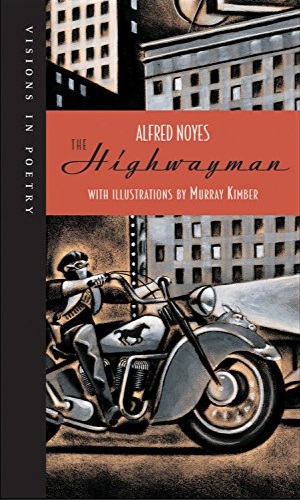
This is one of a half-dozen great little books in the Visions of Poetry series, each illustrating a popular poem taking the ballad (narrative) form. I really loved this series when it came out in 2006 and thought each book offered up a wonderful visual interpretation of classic texts. Unfortunately, they didn’t publish any more of them and looking around they seem to be hard to find today.

This instalment has the poem “The Highwayman” by Alfred Noyes illustrated by Murray Kimber. Like most of the poems in the series, “The Highwayman” has a repetitive, incantatory quality that draws you in right from the famous opening stanza. This is the sort of thing a generation of schoolkids had to commit to memory, and it did them no harm.

The wind was a torrent of darkness among the gusty trees.
The moon was a ghostly galleon tossed upon cloudy seas.
The road was a ribbon of moonlight over the purple moor,
And the highwayman came riding—
Riding—riding—
The highwayman came riding, up to the old inn-door.

The poem is set in the 18th century but Kimber updates everything so that now the titular desperado is a biker outlaw riding an iron horse with a mustang logo through the canyons of Manhattan, and the king’s soldiers are FBI G-men. That’s quite a leap, but I thought it worked wonderfully well. I also thought Kimber did a good job illustrating the business of Bess the landlord’s luscious daughter being tied up with a musket pointed at her breast. That’s one of those things that’s really hard to visualize, and seeing it illustrated doesn’t make it any more believable, but that’s not on Kimber. I don’t know what Noyes was thinking. Otherwise, I had no trouble buying the outlaw as biker, even if the “tlot-tlot” of the horse’s  hooves in the poem made it seem like his bike had a flat. Noyes’s Highwayman is already a bit of a retro cliché anyway, especially given how he’s armed to the teeth with a rapier, two pistols, and a whip. He’s ready for anything, almost.

Kimber’s obvious influence was film noir and I thought the way the story is told like a storyboard, cutting between extreme close-ups and dramatic architectural settings, was quite effective. But then I was on board with all of his creative decisions here. This is a great book not just for kids but for anyone with a love of poetry.

Graphicalex

Time Lapse: Basement VII

I admit, this picture looks very similar to my last library picture, but if you think they’re the same then you are lousy at “spot the difference” puzzles. If you look closely you will see that there is now carpet on the floor and a railing on the stairway. Railing that still has bubble wrap on it. Next step: Books! (You can click on the pic to make it bigger.)

Doctor Strange Omnibus Volume 1

Doctor Strange Omnibus Volume 1

I felt sympathy for Stan Lee’s response to one of the fan mails sent to “Strange Mails,” the letters page for Strange Tales (the title of the comic Dr. Strange started off in). Lee admits that they “use the same characters over and over again” in the Dr. Strange stories mainly because it’s so hard to make up new names, and then adds parenthetically: “We can make ‘em up all right – it’s learning how to spell ‘em that’s the killer! We still have to look up Cyttorok, or is Cyttorak? – each time we use it!”

This is something I could relate to. The names are so off-beat and unrelated to anything I was familiar with that I had to keep looking up even recurring ones like Dormammu (or the “dread Dormammu” to friends, enemies, and indeed everybody). The flame-headed Dormammu is Dr. Strange’s archenemy, playing a leading role in almost all of these early comics, but when I started writing these notes up I was never sure how it was spelled.

The character of Doctor Strange was inspired by the radio show Chandu, the Magician, but he was always something . . . stranger than that. And he also evolved, even in the early days covered in this omnibus volume. Just in the matter of his looks, in his first few appearances he seems to have an oriental slant to his eyes, which remain nearly closed most of the time. It took a while for them to fully open.

His origin story plays to Marvel’s strength in creating less-than ideal heroes. Dr. Strange is an arrogant jerk who becomes a derelict after a car accident puts an end to his career as a star surgeon. A trip to the Ancient One, however, sets him on the road to recovery, not to mention becoming a master of the mystic arts.

But he remains a loner, occupying a mansion in Greenwich Village where he is attended by a rarely seen manservant. Otherwise he has no assistant or friends

He was also very much a second banana in these years. As noted, the comic he appeared in was Strange Tales, but despite the title he was never the headliner. First he was the B-player to the Human Torch, and then he took a back seat to Nick Fury, Agent of S.H.I.E.L.D. And I do mean a back seat. The main story line here has Doctor Strange seeking out Eternity, a figure who possesses the knowledge he will need to defeat Dormammu. When he finally encounters Eternity it gets a dramatic full-page reveal, but the issue where this climactic event occurs doesn’t even mention it on the cover, which (as usual) is given over to Nick Fury fighting the agents of Hydra. And in the one crossover appearance included, Doctor Strange again plays guest in another hero’s comic, joining forces with Spider-Man.

The actual employment of the mystic arts doesn’t amount to much. The all-seeing Eye of Agamotto is a handy device. Plus there’s a lot of ectoplasmic astral projection as Doctor Strange goes flying around in his spirit form. So much so that it starts to feel old pretty quickly. But what I enjoyed is the way our hero, like a good stage magician, so often just tricks his enemies with some simple stratagem that they’re not expecting because it doesn’t involve any invocations of supernatural powers at all.

The plots get repetitive as well, with Doctor Strange being whisked off to various weird dimensions to do battle with their rulers, or else just taking on another sorcerer (his most frequent adversary being Baron Mordo). But it’s the other dimensions that really set the Doctor’s adventures apart. Artist Steve Ditko went crazy creating a psychedelic ‘60s environment of colours and shapes that make it all seem like a druggy trip. It’s that trippiness that, at least in these early days, set Doctor Strange apart from the usual superhero fare. And fifty-plus years later, it’s what would make him a figure totally at home in the MCU’s plastic multiverse.

Graphicalex

Bookmarked! #60: Canoodling

I’ve had occasion to say before how bookmarks make such great collectibles because you can pick them up anywhere you visit. Or anywhere people you know visit. This past week my neighbours went to Algonquin Park and brought me back this peaceful bookmark. On the back it says “The haunting wail of the loon; your paddle gently slicing the still water; the sun rising through the mist; a perfect start to any day while interior camping in Algonquin Park. In Algonquin there are over 2,000 lakes for you to explore.”

Is there anything as Canadian as paddling your canoe on a lake while listening to the haunting wail of the loon? Not unless it’s some activity involving maple syrup. So here’s some pure Canadiana for you to enjoy.

Book: Evelyn Waugh: A Life Revisited by Philip Eade

Bookmarked Bookmarks

Maigret: The Two-Penny Bar

Things get off to an odd start here, with Maigret visiting a guy on death row who puts him on the scent of a murder that had gone unnoticed some six years earlier. A trip to a hatshop to buy a new bowler gives him a clue to follow up and before long he’s getting miserably reacquainted with what the back cover describes as “the sleazy underside of respectable Parisian life.”

Familiar ground then for the detective chief inspector, but what struck me as strange is how the plot seemed to move ahead by a series of random coincidences. Though I guess we shouldn’t be too surprised at how a case comes together, as this one does, by “a combination of scientific deduction and sheer luck.” That’s the way a lot of life works.

The respectable Parisians also seemed odd to me. Doctors, business owners, tradespeople, engineers: they work hard all week and then hang out together every Sunday at a bar in the suburbs where they play dress-up and drink a lot. Is this something people did back in the 1930s?

Party time also involves a lot of adultery, which blows up in the usual way. Though Maigret is less interested in who plugged the poor cuckold than he is in who killed the mystery man six years ago. But the list of suspects isn’t long, and when you spot the biggest red flag in any Maigret case – a husband and wife living apart together, with “No hint of intimacy whatsoever” – then you’ll probably figure things out as quickly as he does. Such couples are the opposite of the happily married Maigrets who are always in touch and feel like they’re together even when they’re apart (as they are for all of this novel). So the real challenge here is for Maigret to prove what happened, which becomes a series of duels because nearly everyone he meets plays coy with him, starting with the condemned man at the beginning. They all let on that they know something he doesn’t, and then challenge him to find out what it is.

This wasn’t one of the better Maigret stories, and really the only thing that makes it stand out is the treatment of the scummy blackmailer at the end. This guy is such a piece of shit he even uses his terminal illness as leverage. That was an appropriate touch to further blacken his miserable character. It just seemed perfectly right. Meanwhile, the killer has no trouble deciding he’d rather go to jail than pay him off. Everybody has their principles, and blackmail is a dirty game that even cold-blooded killers can rise above.

Maigret index

The Mammoth Book of Best Crime Comics

The Mammoth Book of Best Crime Comics
Ed. by Paul Gravett

It’s interesting how the golden age of crime comics pretty neatly overlaps with that of noir cinema, peaking in the 1940s and 1950s. For comics, the body blow of the formation of the Comics Code Authority in 1954 effectively put an end to things. So it feels right that the comics reproduced here are in black and white, even though I’m not sure if that’s how they were all first published. Johnny Craig’s “The Sewer,” for example, from Crime SuspenStories #5 (1951), was. I think. originally in colour. But in any event, it feels right in black and white because that’s how we imagine all crime stories of the period.

The pieces collected here by editor Paul Gravett aren’t all from the golden age, but they look like they might be. Neo-noir and noir are indistinguishable visually. Even the fashions remain much the same. And. if anything, I think the stories were better back in the early days too. For some reason, I suspect fandom, Gravett bookends the material with two relatively recent stories by Alan Moore which I thought the two weakest pieces in the entire book. Neither is really a crime comic either. Nor did I think the entry by Neil Gaiman any better.

So it’s up to the old masters to carry the load. Luckily, they’re up to the task. The stories by Dashiell Hammett, Will Eisner, and especially Mickey Spillane are highlights, as is the aforementioned piece by Johnny Craig. They help make this a collection well worth checking out, even if you’re not a big fan of the genre. And one final thing I’ll note is how much fun I had sampling from a showcase of the letterers’ often invisible art. To be sure there’s some bad lettering in the mix – these were cheap pulps mostly, after all – but there’s a range of different styles here that show how key a role lettering could have in making a comic work. Sadly, noticing it so much here only made me aware of how it’s an art that’s in decline today, where so much lettering seems to be automated and generic.

Graphicalex

TCF: When the Moon Turns to Blood

When the Moon Turns to Blood: Lori Vallow, Chad Daybell, and a Story of Murder, Wild Faith, and End Times
By Leah Sottile

The crime:

Lori Vallow, her lover (and soon-to-be fifth husband) Chad Daybell, and Lori’s brother Alex Cox conspired to kill Lori’s then-husband Charles, Chad’s then-wife Tammy, and Lori’s two children, Tylee and J.J. Alex later died of natural causes, while Chad was sentenced to be executed and Lori to life in prison.

The book:

I’ve already gone over a lot of the facts in this case in my notes on John Glatt’s The Doomsday Mother. Both books came out before either Lori or Chad went to trial, but I don’t think they miss a lot. There are pros and cons with being timely. All too often true crime books spend far too much time on trial coverage, but trials do add information previously unknown to the public and it would have been nice to read an account of this case that took us to closure. In any event, I don’t expect more books about these events anytime soon so it looks like Glatt and Sottile are the last word. Public attention has moved on.

What makes this book different from Glatt’s is the focus Sottile places on the religious and cultural milieu that Lori and Chad were a part of. Here’s how she sets it up:

In one interview with a podcast about the Vallow/Daybell case, the managing editor at East Idaho News said people had made the case out to be a story of religion, when it in fact had everything to do with sex and greed. And to an extent, that became an early theory of the case, the reason two children were found dead in the yard of Chad Daybell was actually quite simple: two people wanted to be together and killed the people in their way. Even Lori’s own father seemed to imply that was his theory in his email to me.

But the more I sunk into the world of Lori Vallow and Chad Daybell, the more clear it became that their story could only have happened inside a culture that festers in the LDS Church: a cancer that even men of God cannot seem to cut out.

Does Sottile make good on this claim? Well, she does her best. Personally, I think this was, mainly, a case of sex and greed. But those motives were mixed with religious views that take some time to unpack.

While they were both part of the LDS (Mormon) Church, Chad and Lori’s personal belief system was more a kind of pop-culture amalgam of stuff ranging from the Bible and the Book of Mormon to the Left Behind and Harry Potter series of novels. I don’t know if Chad wanted to be the head of an end-times cult or a bestselling author, or if there’s a distinction to be made there. There’s really no sorting any of it out, what with the possession by light and dark spirits, people being transformed into zombies, and a magic crystal on a pendant used to do readings.

Two things stand out however as key ingredients in Chad and Lori’s peculiar personal religion, and both are pretty familiar to cult watchers. In the first place there’s the idea that the members of the cult are among the saved. Chad took his lead from the Book of Revelation in figuring that only 144,000 individuals were going to be counted among the elect, which in a global population now of 8 billion is around 0.01 percent of us. Considering that all the immediate members of Chad’s circle were among this elite, that’s a serious sense of exceptionalism.

That exceptionalism is also seen in the way that in their past lives cult members enjoyed a lot of upward social mobility. Throughout all of human history, the vast majority of humanity have been peasant farmers or labourers who have left behind no material or historical record of their ever having existed. But if you’ve ever listened to anyone talk about their past lives all you’ll hear is of how they were Napoleon or Cleopatra. And so Chad, according to his own testimony, had previously lived as James the Just (the brother of Jesus), while Lori had been James’s wife Elena. Nor did it end there. “Almost everyone but Chad and Lori was a granddaughter or a spouse of a saint – some peripheral biblical character. But Chad and Lori were special, more important. Lori, in yet another life, had been married to Moroni, the Nephite warrior who appeared as an angel in a blinding holy light at the bedside of Joseph Smith.” That’s Mormon royalty for the rest of us.

As always when reading about the operation of a cult one is left wondering just how much of this anyone really believed. Tragically, I think in this case they believed a lot. But one can understand a lot of the psychological and cultural factors at play. Everyone has the need to feel they’re special, if not one of the elect. Having been a king or a saint in a previous life fills the same need to think that we’re somehow destined for greater things, that we have some biological marker that makes us better than the herd.

Take the matter of Chad’s “zombies.” These were imagined to be people whose souls were dead and who were inhabited by evil demons. But zombies are a big part of contemporary media culture (books, movies, videogames), fitting especially well with our sense of living at or near the end times. As I’ve argued at greater length elsewhere (see my review of Glenn Kay’s book Zombie Movies), what the zombie represents is simply other people, the apocalypse is only the revelation that all these creatures that look like human beings that we encounter every day aren’t even truly alive, or at least not as alive as we are. And so it’s no surprise that in addition to Chad’s theory of evil possession, Lori’s father also argued that anyone who paid taxes was a zombie. “Like hypnotized zombies the general population systematically and begrudgingly allow the IRS operations to steal their hard-earned money,” he wrote in a book. General population = zombies. Which means the elect, those 0.01 percent, are like the gang of survivors in The Walking Dead. And from here, how big a step is it to just getting rid of (that is, killing) other people? I mean, they’re already dead anyway.

The impression I had is that Lori was a hot mess from the get-go. Her family was likened to a psychological “hornet’s nest” that may have involved some form of sexual abuse. As early as 2007, more than ten years before the killing started, a court-appointed mental health examiner assessed her during custody proceedings as being someone whose “belief system is riddled with ghosts and seemingly fanatical religious dogma.” Once she fell in with Chad’s end-times cult she was casting witchy hexes and curses on her enemies by way of texts and seeing all kinds of bizarre spiritual phenomena operating in her daily life. It should go without saying that none of this had anything to do with Mormonism. I’m no apologist for the LDS, but you can find wingnuts in every religion, and at the end of the day I was left unconvinced by Sottile’s argument that there was something peculiar to the Mormon Church that gave rise to a case like this. Lori and Chad “had grown up with some elements of the far-right fringes of Mormon culture in their lives.” But while she mentions the Rafferty brothers (whose story was told by Jon Krakauer in Under the Banner of Heaven) and Warren Jeffs, and it’s true they based their crimes on what they took to be divine direction, there have always been people of every faith you can think of who have justified bad behaviour in such a way.

At first, the story of Chad and Lori and their missing children looked like a complicated version of a stock true-crime trope: a love affair gone wrong, a story of sexual desire so intense it drove two people to kill. They collected the insurance money from former loved ones and ran away together. But the story is so much more complicated than that. This is a story of faith, and of all the things we allow ourselves to believe.

I just can’t get totally on board with this. Yes, faith played a role in what happened, but it wasn’t “so much more complicated” than the stock true-crime trope. This was a case, primarily, of sex and greed. And failure. Lori and Chad were a pair of not very bright losers who wanted more out of life but felt they’d come to the end of the line. I found it most telling that neither of them invited any friends or family to attend their beach wedding in Hawaii. That just seemed sad. Then, recognizing that they’d come to their own, personal end of the line they projected this onto the rest of the world, seeing this as the end times. It’s the narcissistic apocalypse, and speaks very much to the spirit of the age.

Noted in passing:

It’s not clear what happened the morning Charles Vallow was shot and killed by Alex Cox (Lori’s brother). Charles and Alex are both now dead, as is Tylee, who may also have been present. And the only other possible witness is Lori, who says she wasn’t there. The story that Lori and Alex came up with, and that Tylee went along with when questioned by the police, is that Tylee had grabbed a baseball bat and tried to come between Charles and Lori when Charles was threatening his wife. Charles then wrenched the bat away from her and she ran out of the house. Alex then shot Charles after, he said, Charles started swinging the bat at him.

I don’t think this is what happened. It doesn’t seem to fit at all the kind of guy Charles was, or the frame of mind he was in. But Sottile takes it as established that Tylee “hadn’t flinched to stand between Lori and Charles Vallow with a baseball bat, ready to protect her mother.”

I was really surprised to read this. As I’ve said, I don’t think there’s any way now we can be sure of exactly what happened, but I really doubt it went down like this. I think it more likely Lori coached Tylee what to say, and even then their stories didn’t agree with each other anyway. There were plenty of reasons to be sceptical about it then, which is something Sottile should have registered.

Takeaways:

If you think everyone else is a zombie, perhaps you are the zombie.

True Crime Files
Phoenix

Phoenix

This is where I came in.

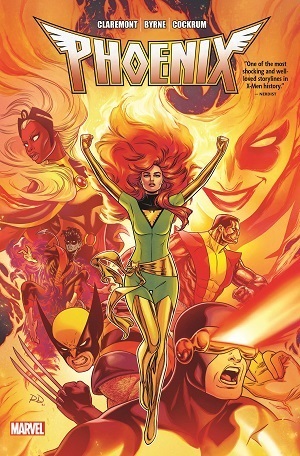
What I mean is that it was the story arc that had the X-Men taking on the Hellfire Club, with “Jason Wyngarde”/Mastermind seducing Jean Grey/Phoenix and turning her into Dark Phoenix in the process, that made me an X-Men fanboy. These were issues I bought when I was a teenager and I think I still have them in storage somewhere — but they’re in pretty bad shape because I re-read them dozens of times. This was simply one of the best superhero stories I’d ever read, and Wolverine rising from the dead, claws extended, snarling “Now it’s my turn!” (at the end of issue #132) is the greatest comic panel ever. It looms so large in my memory that I was sure it was a full-page spread. It isn’t, but it works even better with the build-up to the hand reaching out of the water and grabbing the sewer pipe first.

So when this deluxe edition of the full Phoenix saga came out I figured I’d splurge on it, albeit at a discount price. I mean, $125 in Canada is steep. I paid $40, which I thought was fair. You get 34 comics basically covering Phoenix’s origin through her evolution into a God-like cosmic power and then her eventual death. Bonuses include interviews with the creative talent behind the saga, like writer Chris Claremont and penciler John Byrne. It took me quite a while to get through the whole book, but I enjoyed most of it very much. I especially liked seeing how the X-Men managed to deal with Proteus, “The Deadliest Mutant Alive.” I had issue #127, you see, but not #128, so I never saw what they did to take him down. For forty years I’ve lived in suspense. And I have to say I was not disappointed.

As far as the larger story arc we follow here, I wasn’t as thrilled at the cosmic Phoenix “goddess on a mountaintop” as I was by the Hellfire Club plot. This is a complaint I make with a lot of superhero comics. As heroes and villains keep leveling up, to the point where they’re single-handedly destroying galaxies and universes, it’s hard to care anymore. And everyone knew that was a problem here, as it’s something they talk about in the roundtable at the end. Phoenix was going to be an analog to Thor in being a “female cosmic hero,” but when she turned into a god “she was so powerful that she . . . made the rest of the group kind of redundant.” That’s a feeling I shared. I mean Phoenix is a force that can’t be stopped by anyone, and when she dies at the end she’s really committing suicide.

Meanwhile, what Claremont does so well is present the story on a human level. First and foremost this means setting up the fights. Of course, most superhero comics follow a conventional format where the story is all about building up to climactic fights between heroes and their rivals. What Claremont did was to infuse these battles with a shot of emotional intensity that you rarely found in other comics. You always get the sense that the heroes fighting in these comics are angry, that they really hate each other. Wolverine pulling himself out of the storm drain is just the best example. He’s pissed off now and someone’s going to pay!

Speaking of making someone pay, I laughed out loud at the scene in the diner/grocery store where Wolverine/Logan is flipping through a Penthouse magazine and the store owner tells him “This ain’t no library, fella. You want to read the magazine, buy the magazine.” This triggers Logan, who “don’t like bein’ tapped, bub. Or ordered around.” The owner holds his ground, saying “I don’t like people readin’ without payin’. Wanna make something of it?” Wolverine is about to tear into him before the bad guys arrive. Our heroes can be such squalid types. But something about Wolvering perving out to a dirty mag seemed so right. If you were a teenage boy at the time, you could relate.

Getting back to Claremont’s ability to humanize these figures, I also really liked the way the seduction of Jean Grey played out. That’s genuinely erotic, even without the crazy fetish outfit she dresses up in as the Black Queen. And the thing is, Jean is a hot lady. When she’s going through her transformation into Dark Phoenix Storm senses “pain, great sadness – and an awful, all-consuming lust” within her. Then, when Phoenix summons the lightning she laughs “as the awesome bolts of energy caress her body like a lover.” All this power is turning her on in more ways than one.

The X-Men comics are great. The Classic X-Men titles also included here are not. I just had the sense that Phoenix was a character Claremont couldn’t leave alone, though he really should have. Still, if you want as much Phoenix as you can get in a single volume this is the place to find her. And the central part of the book, meaning the X-Men vs. Hellfire Club storyline remains a classic in every dimension of comic art. I haven’t mentioned Tom Orzechowski’s lettering, but it’s always impressed me as setting a certain standard too. Though rigorously standardized, it has a thickness to it that carries a human timbre. It’s the way I thought all comic dialogue should be written, and has a distinctive character to this day.

So I’m still a fan. And if you want to know why the X-Men (and Wolverine) became the franchise figures they did, it’s all right here. They’d go on to have a pretty good run in comics after this, but more recently they’ve lost the plot in the chaos of the Marvel multiverse meltdown that’s pretty much wrecked everything, even while harkening back to the characters, plotlines, and even tag lines from these glory days.

Graphicalex

Bookmarked! #59: Book Sale Bookmarks

Since this past weekend was the annual Friends of the Guelph Public Library Book Sale I thought I’d post a pic of this year’s bookmark, and one from way back in 2017. A long time ago! At some point I guess they got demoted from a Giant Book Sale to a Big Book Sale. I don’t know why. This year it was held at a bigger location.

Book: Astounding: John W. Campbell, Isaac Asimov, Robert A. Heinlein, L. Ron Hubbard, and the Golden Age of Science Fiction by Alec Nevala-Lee

Bookmarked Bookmarks