Oh, the Humanities

From Why Liberalism Failed (2018) by Patrick J. Deneen:

doubts within the humanities were a fertile seedbed for self-destructive tendencies. Inspired by Heideggerian theories that placed primacy on the liberation of the will, first poststructuralism and then postmodernism took root. These and other approaches, while apparently hostile to the rationalist claims of the sciences, were embraced out of the need to conform to the academic demands, set by the natural sciences, for “progressive” knowledge. Faculty could demonstrate their progessiveness by showing the backwardness of the texts; they could “create knowledge” by showing their superiority to the authors they studied; they could display their antitraditionalism by attacking the very books that were the basis of their discipline. Philosophies that preached “the hermeneutics of suspicion,” that aimed to expose the way texts were deeply informed by inegalitarian prejudices, and that even questioned the idea that texts contained a “teaching” as intended by the author, offered the humanities the possibility of proving themselves relevant in the terms set by the modern scientific approach. By adopting a jargon comprehensible only to “experts,” they could emulate the scientific priesthood, even if by doing so they betrayed the humanities’ original mandate to guide students through their cultural inheritance. Professors in the humanities showed their worth by destroying the thing they studied.

Ravencroft

Ravencroft

After setting things up with the backstory of the Ravencroft Institute in the miniseries Ruins of Ravencroft, this title continues with more things happening in the present day. This includes an uprising by the Unwanted, led by their leader Bud, and an attempt by sinister forces to get hold of the Journals of Jonas Ravencroft.

As with the first Ravencroft volume I thought it was well executed. I like how the opening panels repeat as the images on the security camera screens on the next page, for example. But again it didn’t seem like there was much of a story. The main protagonists are John Jameson, Misty Knight (with a bionic hand attachment that has Wolverine claws), and Dennis Dunphy, as a guard who isn’t Demolition Man. It’s telling that the cover images rarely have much if anything to do with the contents of the individual comics until you get to issue #5. The dual climax combines the battle between the Unwanted and the security forces at Ravencroft and the long-delayed transformation of John Jameson into Man-Wolf. Too long delayed, in my opinion. And I felt sorry for the Unwanted, who really seem hard done by. Despite being grotesque vampire monsters I was cheering them on and hoping they’d destroy Ravencroft at the end. But instead they’re left even worse off. Meanwhile, Norman Osborn is hanging around and we suspect he’s up to no good. Dr. Ashley Kafka is back from the dead. And the Punisher is being held at Ravencroft too, though again I’m not sure why except to make a couple of dramatic entrances and then disappear.

As things leave off it seems as though the spiral death cult of Knull is getting ready to reawaken so maybe things are going to step up (or down) a notch. But two volumes into this series I still feel as though I’m waiting for something to happen. That’s not to say there isn’t a lot of action, because there is, but it seems like running in place.

Graphicalex

TCF: Fatal

Fatal: The Poisonous Life of a Female Serial Killer
By Harold Schechter

The crime:

At the end of the nineteenth century the Boston-area private nurse Jane Toppan went on a killing spree that would end up seeing her claim at least 12 victims before she was finally arrested in 1901. At trial she was convicted of murder but found not guilty by reason of insanity and so was sentenced to spend the rest of her life in an asylum.

The book:

There have been many attempts to psychologize the differences between male and female serial killers, and given the gender stereotypes at play in the story of Jane Toppan’s criminal career it’s not too surprising that Harold Schechter begins with this. But while I’ve found Schechter to be a trustworthy guide when it comes to historical true crime, I often pull back at some of his more speculative conclusions, and I did so again here with what he says about lust-murder being “a specifically male phenomenon” and the “quintessential male form of serial killing” (emphasis in the original). I think it’s worth quoting from what he has to say on the subject here at length:

Generally speaking, female serial killers differ from their male counterparts in roughly the same way that the sexual responses and behavior of women typically differ from those of men.

A useful analogy here (and one that seems particularly apt to so lurid a subject) is pornography. It is a truth universally acknowledged that – while men are aroused by extremely raw depictions of abrupt, anonymous, anatomically explicit sex – women in general prefer their pornography to involve at least a suggestion of emotional intimacy and leisurely romance. Whether these differences in taste are a function of biology or culture is a question I’ll leave to others. The indisputable fact is that the differences are real.

An analogous distinction holds true for serial killers. Female sociopaths are no less depraved than their male counterparts. As a rule, however, brutal penetration is not what turns them on. Their excitement comes not from violating the bodies of strangers with phallic objects, but from a grotesque, sadistic travesty of intimacy and love: from spooning poisoned medicine into the mouth of a trusting patient, for example, or smothering a sleeping child in its bed. In short, from tenderly turning a friend, family member, or dependent into a corpse.

To be sure, there may be other motives mixed up with the sadism – monetary gain, for example. Indeed, certain female serial killers may never admit, even to themselves, the true nature or extent of the gratification they deprive [sic] from their crimes. Their actions, however, speak for themselves. Whatever other benefits may accrue from their atrocities – a windfall of inheritance money, for example, or a release from the burdens of motherhood – there is, at bottom, only one reason why a woman would, over the span of years, kill off the people closest to her, one by one, in ways that are to guaranteed [sic] make them undergo terrible suffering: because she gets pleasure from doing it.

There is no doubt that male serial sex-murder tends to be more lurid – more gruesomely violent – than the female variety. Whether it is more evil is another matter. After all, which is worse: to dismember a streetwalker after slitting her throat, or to cuddle in bed with a close friend you’ve just poisoned, and to climax repeatedly as you feel the body beside you subside into death? Ultimately, of course, it’s an impossible question to answer.

I’m not sure how persuasive I find this. Isn’t, for example, the main reason for the different forms male and female homicide take the fact that women aren’t strong enough to strangle or bludgeon their male victims to death? Every killer has different opportunities.

But digging a bit deeper, this is the sort of analysis I see a lot of, especially online. The core issue being addressed is probability. Reality is always only probabilistic. Even the laws of physics allow for the craziest, most counterintuitive results. How much more is this the case when it comes to speaking of laws of human behaviour? All we can really speak of is the chance that some particular outcome will occur, or that some particular cause will be determinative. The long passage quoted is typical of the slippery rhetoric you get so often in such discussions. We go from what seems true “generally speaking” or “typically” to “truths universally acknowledged” and “indisputable facts.” “There is no doubt,” we are told about some matter that “tends” toward being seen a certain way. Actions “speak for themselves,” but then need to be interpreted. And finally there is the shrug at the end. Some questions, at least in the moral sphere, are impossible to answer.

Schechter has to be given some leeway here though, as what he’s trying to do is fill the gap in our understanding of Jane Toppan’s motives at a century’s distance. And since some speculation is necessary we have to go with generalizations and the perhaps questionable “confession” she made to the yellow press of the day.

Among female serial killers the two most common sub-types are the Black Widow and the Angel of Mercy. Not surprisingly, these identities plug into two stereotypically feminine roles: wife and nurse. Jane was the Angel of Mercy, and occasionally made use of the killer-nurse justification for her homicidal proclivities. She would conclude that a patient would be better off dead and take it from there.

During her nursing school days, she had made that decision about at least a dozen people, who – in her estimation – were too old, sickly, or just plain bothersome to live. Telling herself that she was doing them a favor by ending their miserable existences was, of course, simply a way of rationalizing her own sadism.

As I’ve said before in one of my film reviews, a nurse is the most terrifying figure in all of modern life. “A bureaucratic guardian at the gates of life and death. A dark fetish stereotype, invasive and maternal. Helpless in our hospital beds, they have us at their mercy.” You don’t mess with these people.

Schechter is right, however, to dismiss this as only a flimsy rationalization. And I don’t think the favoured analogy reached for by the newspapers of the day was any better. Toppan was repeatedly likened to a Borgia, on the basis of that family’s supposed fondness for poisoning their enemies. But I’m not sure how historically accurate this is (a book I reviewed a while back cast doubt on the “black legend” of the Borgias), and in any event I don’t think Jane Toppan was cut from the same cloth as Lucrezia Borgia at all. This was just something to sell papers.

What would have probably sold more papers was a more honest account, but given what you could put in print at the time Toppan’s sexual drives had to be talked around. This is where the kind of analysis that Schechter meditates on in his introduction comes in to play. As far as we can tell, Toppan did find killing people to be arousing. She would climb into bed with her patients after poisoning them and (in the language used by reporters) experience “a stress of passion, a craving for the satisfaction of her strange emotions. It amounted to the strongest uncontrollable impulse.” Then, after “the climax of her paroxysm came, she became normal once more.”

So Jane Toppan was a sexual serial killer, but I don’t know if we can ascribe any gendered psychological difference to her methods. She was a poisoner because that’s what she knew and it’s what she had the best opportunity to employ, with the added benefit of the poison she used being hard to detect. If a knife or a hammer would have made more sense, she probably would have used them.

Noted in passing:

Nursing is a demanding job, especially when you’re just starting out. But at the end of the nineteenth century they really put you to it:

For the two years of their training, student nurses were subjected to a brutal regimen. They worked seven days a week, fifty weeks a year, with no Christmas, Easter, or Thanksgiving holidays. They slept in cramped, dimly lit, unheated cubicles, three women to a cubicle. Typically, they were roused from their cots at 5:30 A.M. by the clanging of a wake-up bell. After making their beds, dressing, and consuming a hurried breakfast (which they were required to fix for themselves), they repaired to a parlor for morning prayers. By 7:00 A.M., they were on the job. Between their shifts on the various wards and their professional instruction, they typically worked twelve- to fourteen-hour days, with about seventy-five minutes off for lunch and supper. Their meals tended to be so sparse and unpalatable that many of the women spent all their meager wages on extra food.

***

Typically, the trainee had charge of about fifty patients. Besides her medical duties – which involved everything from catheterizing patients to draining their suppurating wounds – she was responsible for keeping her ward in proper shape. Among her daily housekeeping tasks, she was expected to sweep and mop the floors, dust the furniture and windowsills, keep the furnace fed with coal, make sure the lamps were filled with kerosene. She was also required to prepare and serve the patients’ meals, change their beds, launder their clothes, roll bandages, and keep her writing quills sharply whittled so that her records would be legible to the head nurse and attending physicians.

As a young woman in her late twenties, Toppan started getting plump, reaching 170 pounds while standing 5’3”: “unattractively plump even by the generous standards of her age, when, according to one guidebook, the ‘recognized perfection for a woman’s stature’ was five-feet-five inches tall and 138 pounds (‘if she be well formed,’ advises the book, ‘she can stand another ten pounds without greatly showing it’).” Ah, they liked thick girls back in the day. And I approve. But after her arrest and a diet of “hearty meals” in jail combined with a lack of physical activity Toppan packed on another fifty pounds (!) which meant she was no longer plump but “now bordered on the obese.” That’s a pretty wide border, and I think she may have crossed it. Then, after this, when she was moved from her jail to the asylum the medical superintendent wrote that under their care she “grew fat and was in excellent physical condition.” She got even bigger? And was considered in excellent condition? Now that’s generous!

Takeaways:

Nurses are great, but they’re scary.

True Crime Files

Ruins of Ravencroft

Ruins of Ravencroft

OK, just based on the name I’ll give you one guess what Ravencroft is.

Did you get it? If you said it’s the Marvel Comics version of DC’s Arkham Asylum, with its full name being the Ravencroft Institute for the Criminally Insane, and that it’s a maximum security prison that houses a mixed bag of baddies and is run by some highly dubious “doctors,” then you win a prize! A prize to be determined at some later date.

Wilson (don’t call him Willie) Fisk, a.k.a. Kingpin, is now mayor of NYC and he has decided to rebuild Ravencroft after it got destroyed by Carnage in a previous comic, so this three-part miniseries provides a historical backstory for the demon-haunted place. And I mean demon-haunted literally. It seems it was built on the site of an ancient Indian cannibal cult that worshipped the dark lord Knull. That doesn’t seem to be the worst thing about it though, as they’re also stuffing the results of experiments in turning humans into vampiric monsters into a hole labeled “Unwanted,” where they’re fed fresh victims all the time so they don’t ever die.

This was an odd sort of a comic. The three stories feature an early incarnation of Carnage, though Carnage isn’t really present (ignore the cover, which, like a lot of the covers in this series, is quite misleading). There’s just an ancestor of Cletus Kassady here who gets involved in a Bone Tomahawk adventure in colonial days. Then there’s a story about Sabretooth, and finally we get Dracula himself (the Marvel Dracula, complete with pencil moustache) facing off against Captain America.

I found it all interesting, with good writing by Frank Tieri, but the flashbacks stayed pretty murky. The Journal of Jonas Ravencroft seems important for some reason, but Jonas himself irrelevant. And once again we’re in the world of a shadowy cabal or deep state star chamber pulling the strings. What’s their agenda? You’ll have to wait and see.

So it’s just an intro or origin story and I guess it does a fair enough job of setting the table, but that’s all there is.

Graphicalex

Bookmarked! #61: A Strange Bird

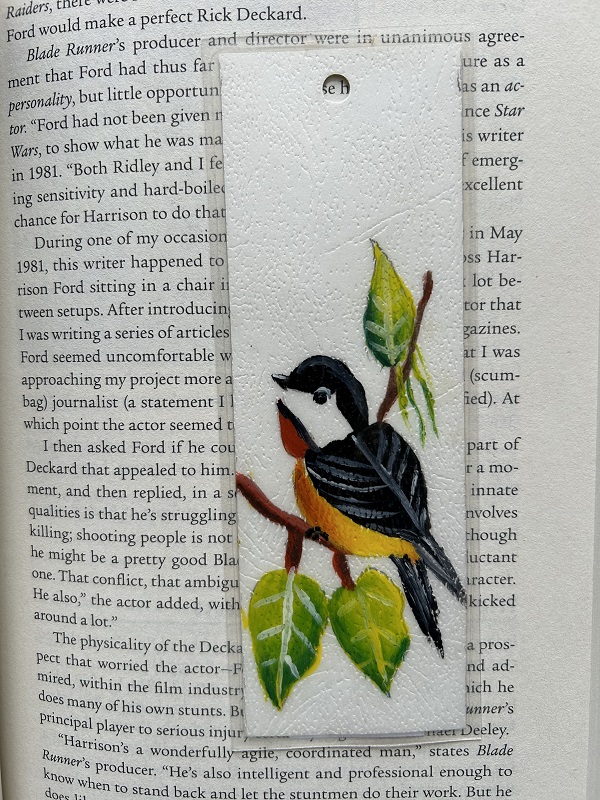
This is one of the more mysterious items in my bookmark collection. It’s a picture of a bird but I don’t know what kind of a bird. Possibly because it’s not a bird from around here. I’m also not sure where the bookmark came from, who gave it to me, or when. My only clue is a boy’s name on the back and the information that he was “10 años.” So perhaps someone brought this back from Spain or Portugal? Or a Spanish-speaking country? I don’t know. But it looks pretty.

Book: Future Noir: The Making of Blade Runner by Paul M. Sammon

Bookmarked Bookmarks

Marple: Death by Drowning

As with “The Affair at the Bungalow,” the sense I had here was of Christie having some fun with detective-story conventions. And again she comes up with a clever concept. A village girl has drowned after being pushed off a bridge. The police seem ready to arrest the most likely suspect, but Miss Marple goes to Sir Henry Clithering, Ex-Commissioner of Scotland Yard, and writes the name of who she thinks is the real murderer on a slip of paper that she gives to him. But we don’t find out until the final line of the story whose name she wrote down, and Miss Marple herself only briefly appears a couple of times in the story. Instead we follow Sir Henry around as he questions all the suspects, guided by Miss Marple’s suspicions since, being a veteran of the Tuesday Night Club, he knows she’s always right.

I enjoyed this story and thought it was one of the better Miss Marple mysteries. It goes about its business quickly and there’s a sweet twist at the end. There’s nothing much in the way of clues to follow though, and at the end I was left scratching my head as to the source of Miss Marple’s suspicions in the first place. I guess it just had some connection to a parallel case years ago, but we aren’t given any information. In other words, it seems to have been a pure hunch, even though she protests that “it’s not really that at all.” She knows but can’t explain her “specialized knowledge.” Meanwhile, the obvious suspect is so obvious – a somewhat dandyish modern architect from London described as a “Bolshie” with “no morals” – that the police going after him even strikes Sir Henry as a cliché: “He perceived a strong undercurrent of local prejudice. A new-fangled architect was not likely to be popular in the conservative village of St. Mary Mead.”

As for the Britishisms I like to flag, I took note of the local girl being described as making “a dead seat” at the modish architect. The term I’m used to is “dead set,” meaning focused and determined on a particular outcome, so I wasn’t sure if “dead seat” was a typo. But it might have another meaning. I just couldn’t find any explanation of making a dead seat at someone anywhere I looked.

I also shook my head at Sir Henry, who is staying with the Bantrys, “coming down to breakfast at the pleasant guestly hour of ten-fifteen.” Now I know I get up early, but at 10:15 I’m usually starting to make lunch. If someone was a guest at my house and they only came down at 10:15 I’d be long gone, and they wouldn’t be getting “a plate of kidneys and bacon” either, at any time of day.

Marple index

Taking it easy

So a couple of days ago I went down one of those click-bait rabbit holes where you keep answering odd multiple-choice questions that are meant to determine your personality type. In this case the purpose was to be assigned a “spirit animal.”

Before long I started having regrets, as the questions just went on and on. I think it must have taken me at least ten minutes to click through all of them. And in many cases none of the choices were any good. But after a while I just figured it made sense to keep going seeing as I’d already invested so much of my precious time. A few minutes seems like an eternity online!

Anyway, from the pictures that kept coming up as I was doing the quiz, and just because of the nature of these things in general, I got the sense that my spirit animal was going to be either a tiger or, more likely, a wolf. Imagine my surprise then when I finished up and was taken to this final screen:

That didn’t seem very flattering! I mean, I wasn’t even a sloth but a “slot,” which sounds kind of indecent.

But the more I thought about it, the more I think the algorithm probably got it right. I am a lazy guy. And this is an animal named for its laziness! In Spanish-speaking countries, where they are native, they are even known as osos perezosos, which translates to “lazy bears.”

And the question I would ask is “What’s wrong with that?” Being cool and collected and letting nothing really bother you sounds pretty good to me.

Nevertheless, sloths generally get a lot of bad press. In fact, they are kind of disgusting creatures, whose dirty habits I won’t get into. But sloth as a pejorative term is, I think, harsh. It’s rooted in ideas propagated by Christian moralism and the industrial work ethic: “idle hands are the devil’s workshop” and “time is money.” Meanwhile, I hang my hat on Blaise Pascal’s dictum that “All of humanity’s problems stem from man’s inability to sit quietly in a room alone.”

Seeing my spirit animal made me think back to the appearance of Idlenesse in the procession of the Seven Deadly Sins in Edmund Spenser’s Faerie Queene. In that poem the Redcrosse Knight visit the evil House of Pride, where he witnesses Lucifera (Pride) being pulled in a chariot by the six other Deadlies, each counselor riding a representative animal and holding an iconic object. This is how it kicks off:

XVIII

But this was drawne of six unequall beasts,
On which her six sage Counsellours did ryde,
Taught to obay their bestiall beheasts,
With like conditions to their kinds applyde:
Of which the first, that all the rest did guyde,
Was sluggish Idlenesse the nourse of sin;
Upon a slouthful Asse he chose to ryde,
Arayd in habit blacke, and amis thin,
Like to an holy Monck, the service to begin.

XIX

And in his hand his Portesse [a book of prayers] still he bare,
That much was worne, but therein little red,
For of devotion he had little care,
Still drownd in sleepe, and most of his dayes ded;
Scarse could he once uphold his heavie hed,
To looken, whether it were night or day:
May seeme the wayne was very evill led,
When such an one had guiding of the way,
That knew not, whether right he went, or else astray.

XX

From worldly cares himselfe he did esloyne [retire],
And greatly shunned manly exercise,
From every worke he chalenged essoyne [claimed exemption],
For contemplation sake: yet otherwise,
His life he led in lawlesse riotise;
By which he grew to grievous malady;
For in his lustlesse limbs through evill guise
A shaking fever raignd continually:
Such one was Idlenesse, first of this company.

Idleness isn’t just any deadly sin here, but the one leading the way and nurse to all the others! That said, this guy doesn’t sound like he’s representing sloth or idleness very well. He’s just another hypocritical churchman, of which there were plenty in the literature of the Renaissance. A truly idle man doesn’t save himself up for riotous living and party times. He can’t be bothered. Nor is he ruled by a shaking fever of passions. He is beyond care.

I’d write more on this subject, but I can’t be bothered. It’s too much effort. But thanks for making it this far, and if you did then you should know that you are not a lazy person at all and that your characteristic sin (or spirit animal) is no doubt something different. And probably much worse!

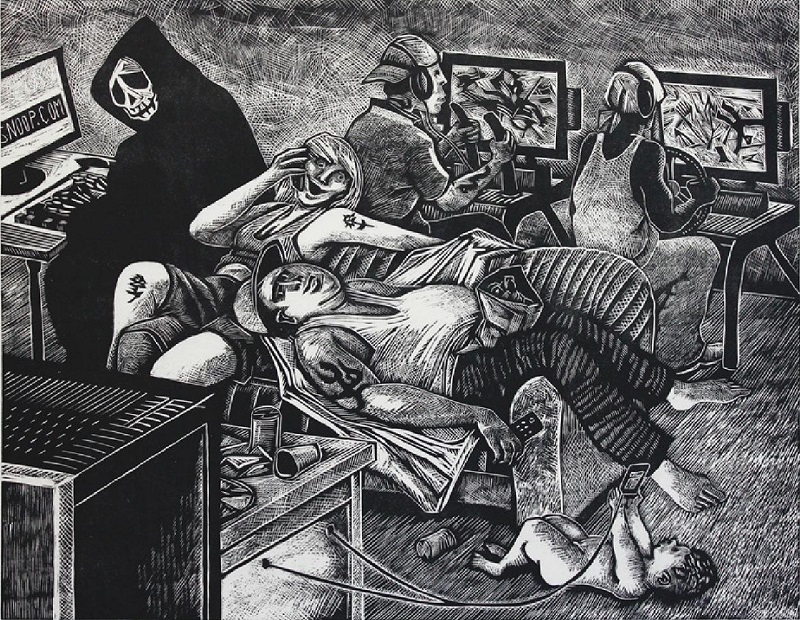
“Sloth” by James Todd (2010).

The Highwayman

The Highwayman

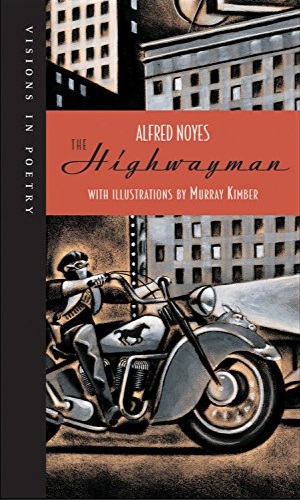
This is one of a half-dozen great little books in the Visions of Poetry series, each illustrating a popular poem taking the ballad (narrative) form. I really loved this series when it came out in 2006 and thought each book offered up a wonderful visual interpretation of classic texts. Unfortunately, they didn’t publish any more of them and looking around they seem to be hard to find today.

This instalment has the poem “The Highwayman” by Alfred Noyes illustrated by Murray Kimber. Like most of the poems in the series, “The Highwayman” has a repetitive, incantatory quality that draws you in right from the famous opening stanza. This is the sort of thing a generation of schoolkids had to commit to memory, and it did them no harm.

The wind was a torrent of darkness among the gusty trees.
The moon was a ghostly galleon tossed upon cloudy seas.
The road was a ribbon of moonlight over the purple moor,
And the highwayman came riding—
Riding—riding—
The highwayman came riding, up to the old inn-door.

The poem is set in the 18th century but Kimber updates everything so that now the titular desperado is a biker outlaw riding an iron horse with a mustang logo through the canyons of Manhattan, and the king’s soldiers are FBI G-men. That’s quite a leap, but I thought it worked wonderfully well. I also thought Kimber did a good job illustrating the business of Bess the landlord’s luscious daughter being tied up with a musket pointed at her breast. That’s one of those things that’s really hard to visualize, and seeing it illustrated doesn’t make it any more believable, but that’s not on Kimber. I don’t know what Noyes was thinking. Otherwise, I had no trouble buying the outlaw as biker, even if the “tlot-tlot” of the horse’s  hooves in the poem made it seem like his bike had a flat. Noyes’s Highwayman is already a bit of a retro cliché anyway, especially given how he’s armed to the teeth with a rapier, two pistols, and a whip. He’s ready for anything, almost.

Kimber’s obvious influence was film noir and I thought the way the story is told like a storyboard, cutting between extreme close-ups and dramatic architectural settings, was quite effective. But then I was on board with all of his creative decisions here. This is a great book not just for kids but for anyone with a love of poetry.

Graphicalex