The Approach

The Approach

A mid-size airport is nearly shut down due to a massive winter storm. Then a small engine-prop plane flies in out of nowhere, crashing and exploding into a fireball on landing. A body is pulled from the wreckage. Later, that body comes to life, transformed into a flesh-eating, tentacle monster. It kills people and gets bigger, and bigger. I mean, it grows like a Xenomorph. An old lady worships it, reciting Lovecraftian catch-phrases (“Yoth anon par a koth . . . Shun ara soth”). The skeleton crew at the airport, apparently cut off by the storm from any help, set out to hunt the beast down and kill it.

Like a lot of the horror comics from Boom! Studios, The Approach very much feels like a 1980s horror flick, most obviously in this case John Carpenter’s The Thing. And having spent a good chunk of my teenage years enjoying those movies, I’m not saying that’s a bad thing. I thoroughly enjoyed the story here by Jeremy Haun and Jason A. Hurley precisely for its most familiar (to me) elements. What pulled it down a couple of notches were two things.

In the first place, I thought they threw too much stuff into the pot. The story could be continued at the end (yes, you get a final panel/shot that suggests the monster isn’t all dead yet), but it seems pretty complete otherwise and there are two major points that are introduced that receive no explanation whatsoever. First: the plane that crashes is said to have gone missing 27 years earlier, so it not only appears out of nowhere but out of no-when. Where, or when, was it all that time? No idea. Nothing more is said of the matter. Second: does the old lady who chants to the monster know something about its provenance? Or is she just a gibbering idiot? Again, no idea.

The second reason I’d knock it down is the art. Jesús Hervás took over from Vanessa R. Del Rey as the artist of the Empty Man series in The Empty Man: Recurrence and The Empty Man: Manifestation, and I’ve already said I’m not a fan. He definitely has his own style, I give him credit for that, but it’s really not my thing. It’s just too hard to figure out what’s going on in a lot of the action scenes. And the monster here looks (and sounds) too much like the buggy creatures in The Empty Man. It’s just not that interesting.

But despite being full of stuff that isn’t explained and having a plot that’s so predictable I was calling how it was going to end by page 6 I still enjoyed this. I don’t know if it would appeal as much to people who weren’t students of ‘80s horror though.
Graphicalex

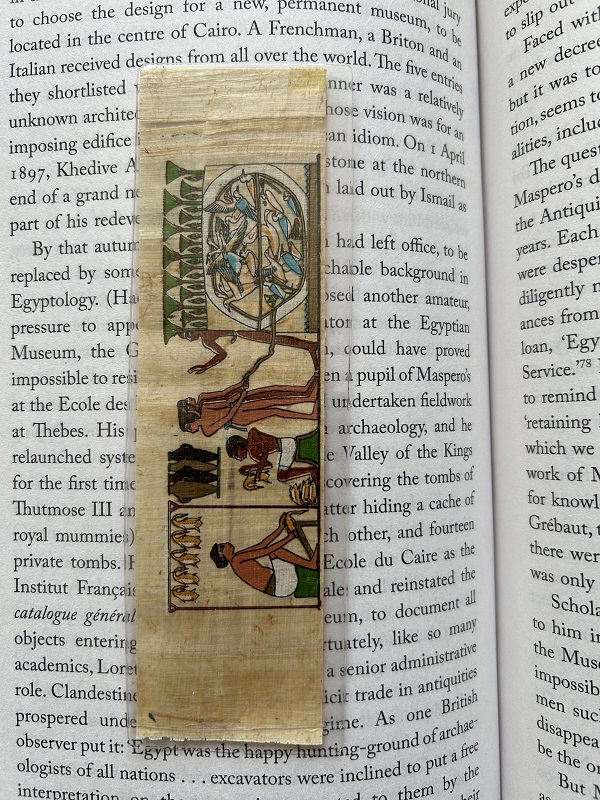
Bookmarked! #63: Bookmark Like an Egyptian

Actually, I don’t think the ancient Egyptians used bookmarks because they didn’t have books. They kept written works on scrolls.

This is kept in a plastic sheath because it’s painted on papyrus, and it’s very thin and delicate. I can’t remember where I got it, but it wasn’t Egypt. So most likely some museum.

Book: A World Beneath the Sands: The Golden Age of Egyptology by Toby Wilkinson

Bookmarked Bookmarks

The good old days 1

Just got back from a visit to a Long Term Care facility where this book on insights into how the world has changed was lying around. It all seemed impossibly long ago, but the thing is, for my parents’ generation milk delivery was a reality, and there were still horse-drawn wagons being used both on the farm and in the streets.

I’ll post a few more of these in the weeks ahead.

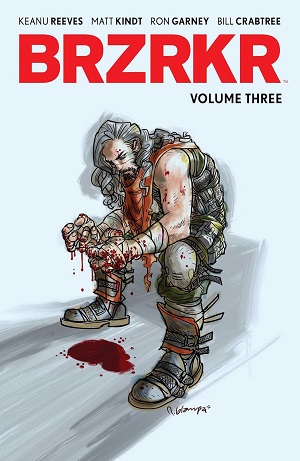
BRZRKR Volume Three

BRZRKR Volume Three

If you read my review of BRZRKR Volume Two you’ll know I went into this final part of the trilogy with really low expectations. Expectations that were, in the event, barely met.

On the plus side, this is a really fast read. There isn’t a lot of talking, and what there is can be ignored, so you’re basically just flipping the pages looking at Ron Garney’s explosive art. And by that I mean there are lots of explosions.

Our hero B (or Unute, or Keanu Reeves) is feeling tapped out, so now’s a good time to introduce a Lady Berserker, a scientist guy who turns himself into a Berserker, and finally a pair of Berserker twins who are heading off at the end to grow and plant their seeds. Which sounded kind of creepy, but what do I know. Meanwhile, Unute becomes mortal but then is reborn so he’s immortal again and at the end he’s back on another planet or in another dimension or something.

No, none of this makes any sense. It might mean everything and nothing. And of course the story is left open-ended. I guess the Berserker twins could go on to have further adventures and the bad guy could re-assimilate and come back to haunt them. But I’m out. Some readers (especially if they’re fans of the Tao of Keanu) might still find the elevation of an action hero into a god interesting or even deep, but I feel like it’s been done to death and overall this struck me as one of the laziest comics I’ve read in recent years. So even if they do go on I won’t be hanging with it.

Graphicalex

We’ll always have Colmar

This pretty place is Colmar, France. If you do an image search for Colmar you’ll find this same picture coming up again and again. So maybe these colorful houses on this one street are all there is to see in Colmar. I don’t know as I’ve never been there. I just did the puzzle. Which had one piece missing! See if you can spot it. Argh.

Puzzled

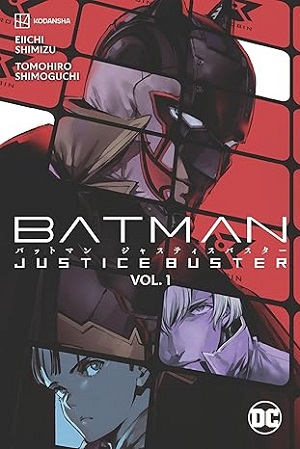
Batman: Justice Buster Vol. 1

Batman: Justice Buster Vol. 1

I’m sure Batman must have gone manga before this comic, which I think launched in 2021, but in any event that’s the hook here. Manga Batman.

What is manga Batman like? Basically he’s a cross between Iron Man, in a very robotic-looking armoured suit, and Spider-Man with the way he goes swinging through the canyons of Gotham on cables fired from his wrists. In terms of art style I wouldn’t call it excessively manga-ish, though you do get some faces characterized by the trademark pointy chins and missing noses. And of course you read the whole thing back-to-front.

Author Eiichi Shimizu plays some interesting riffs on the Batman mythos. Which is saying something, given how many times that mythos has been reinvented and reimagined over the last hundred years. Robin (or ROBIN) is now Batman’s AI assistant, and there are definitely some kinks in that system that need working out. Batman has the idea that his super-computer is going to help him stop criminals before they actually commit any crimes. What could go wrong with that? Meanwhile, Dick Grayson is a kid working with a detective who’s investigating the murder of his *(Grayson’s) family. There’s not much explained about that angle, but I’m sure it will be developed as the series goes on. And finally there’s a new Joker, now a masked nut who wants to be Batman’s sidekick. Yeah, he’s a good guy. Or at least that’s what he’s pretending to be.

Other familiar names are more recognizable. Alfred and Commissioner Gordon are the same as they’ve always been. Clark Kent shows up trying to get Bruce Wayne to join the Justice League, but gets turned down. Firefly, Killer Croc, Penguin, and Deathstroke are all here. There’s actually a fair bit of action, but one thing about the art I had trouble with were the fight scenes. They’re really hard to follow. I liked their “look,” which is less manga than the rest of the comic, but it’s not easy to make out what is happening. Which is a shame because the fight with Killer Croc seemed like it was quite something.

In other words, a mixed bag. More interesting for the storylines that are introduced than the look of the thing, but in any event worth sticking with a little longer. Even if the Justice Buster (the name given what appears to be a blocky-looking Batboat here, but which turns out to be one of those monster exo-suits) seems a silly sort of thing.

Graphicalex

Bookmarked! #62: Sweet Liberty

Unlike a lot of my tourist bookmarks, which I get as gifts from people who travel more than I do, I may have bought this one myself. But I don’t think I did. I know I have been to the Metropolitan Museum of Art though so it’s at least possible.

It’s quite nice, which is one reason it’s still in its plastic holder. Gold-plated brass with an applied decal image of a coloured lithograph of the Statue of Liberty.

Book: Liberty is Sweet: The Hidden History of the American Revolution by Woody Holton

Bookmarked Bookmarks

Maigret: The Shadow Puppet

Despite being one of the earlier Maigret novels, The Shadow Puppet was one of the last I read in the series of new English translations published by Penguin. Because of this, and because it was written during the years when Simenon was near the top of his game, I thought it might be fun to stand back and take a wider view at how well it fits into the rest of the Maigret canon.

Of course Maigret never changes. He’s the same rock as always, with no crime-solving “method,” no matter what others may say. Instead, he proceeds by an almost unconscious, sponge-like absorption of facts and personal observations, not allowing himself to have any opinions in advance. Indeed, he even denies having any thoughts on a case at all until he begins to grow heavy with a picture of what’s going on and the solution just develops on its own like a photo in a chemical bath. He’s the sort of man Keats would have described as being possessed of Negative Capability, comfortable with uncertainty and doubt. And that’s a remarkable quality in a detective, who we usually think of as bloodhounds. But the thing is, keeping an open-mind is a huge intellectual advantage in pretty much any walk of life, and I think this is a point Simenon wanted to emphasize.

As for the investigation here, I thought I’d quote from something I said in my review of Maigret and the Tall Woman:

Something about wicked women seems to have got Simenon’s creative juices flowing. Looking back on the books I’ve read in the series, it’s the bad girls who stand out the most. Madame Le Cloagulen in Signed, Picpus was probably the worst, but Madame Serre gives her a run for the money here. Related to this fascination with such women is an instinctive loathing of men who are excessively mothered.  The Flemish House and My Friend Maigret are the best examples. I wonder if there was some psychological projection going on here, as Maigret himself is waited on hand and foot by his wife.

This is The Shadow Puppet all the way. In the first place there’s the villain of the piece, who is a total psycho bitch from hell. Or, to use the language of today’s pop psychology, an extremely toxic individual. One of those people who just ruin the lives of everyone they come in contact with, mainly out of their own sense of frustrated ambition. And as for the mothered baby-men, they’re here too. Tragic cases, and Maigret does feel sorry for them, but it’s hard not to miss the contempt he holds them in as well. A real manly man, like the burly detective chief inspector, spends long hours at work and comes home to a set table and a fresh-cooked meal from his loyal wife, who doesn’t talk too much. That’s the ideal marriage.

I think it’s that old-fashioned sort of masculine identity that makes Maigret so sympathetic to the murdered man here. “Good old Couchet!” he finds himself repeating. What makes Couchet such a jolly (or actually not so jolly) good fellow? That he loves lots of women. He’s on his second wife but he’s taken lovers and has a regular mistress on the side. But it’s OK because he runs his own company and he’s rich and he lives in Paris so what do you expect?

Finally, as with most of the Maigret novels there’s little mystery for the reader to figure out. You just have to wait, along with Maigret, until the situation resolves itself. And in this case in particular it’s pretty clear who the bad guys are from the start, since they’re the ones who put Maigret’s back up. Meanwhile, the murder is itself almost incidental and what Simenon really wants to expose us to: the “syrupy greyness” of the moral squalor of the bourgeoisie. The lives of the Martins is full of “day-to-day unpleasantness, which was more repulsive than the murder itself.” The point being that murder only marks the end point in lives and relationships that are already rotten to the core.

Maigret index

Oh, the Humanities

From Why Liberalism Failed (2018) by Patrick J. Deneen:

doubts within the humanities were a fertile seedbed for self-destructive tendencies. Inspired by Heideggerian theories that placed primacy on the liberation of the will, first poststructuralism and then postmodernism took root. These and other approaches, while apparently hostile to the rationalist claims of the sciences, were embraced out of the need to conform to the academic demands, set by the natural sciences, for “progressive” knowledge. Faculty could demonstrate their progessiveness by showing the backwardness of the texts; they could “create knowledge” by showing their superiority to the authors they studied; they could display their antitraditionalism by attacking the very books that were the basis of their discipline. Philosophies that preached “the hermeneutics of suspicion,” that aimed to expose the way texts were deeply informed by inegalitarian prejudices, and that even questioned the idea that texts contained a “teaching” as intended by the author, offered the humanities the possibility of proving themselves relevant in the terms set by the modern scientific approach. By adopting a jargon comprehensible only to “experts,” they could emulate the scientific priesthood, even if by doing so they betrayed the humanities’ original mandate to guide students through their cultural inheritance. Professors in the humanities showed their worth by destroying the thing they studied.

Ravencroft

Ravencroft

After setting things up with the backstory of the Ravencroft Institute in the miniseries Ruins of Ravencroft, this title continues with more things happening in the present day. This includes an uprising by the Unwanted, led by their leader Bud, and an attempt by sinister forces to get hold of the Journals of Jonas Ravencroft.

As with the first Ravencroft volume I thought it was well executed. I like how the opening panels repeat as the images on the security camera screens on the next page, for example. But again it didn’t seem like there was much of a story. The main protagonists are John Jameson, Misty Knight (with a bionic hand attachment that has Wolverine claws), and Dennis Dunphy, as a guard who isn’t Demolition Man. It’s telling that the cover images rarely have much if anything to do with the contents of the individual comics until you get to issue #5. The dual climax combines the battle between the Unwanted and the security forces at Ravencroft and the long-delayed transformation of John Jameson into Man-Wolf. Too long delayed, in my opinion. And I felt sorry for the Unwanted, who really seem hard done by. Despite being grotesque vampire monsters I was cheering them on and hoping they’d destroy Ravencroft at the end. But instead they’re left even worse off. Meanwhile, Norman Osborn is hanging around and we suspect he’s up to no good. Dr. Ashley Kafka is back from the dead. And the Punisher is being held at Ravencroft too, though again I’m not sure why except to make a couple of dramatic entrances and then disappear.

As things leave off it seems as though the spiral death cult of Knull is getting ready to reawaken so maybe things are going to step up (or down) a notch. But two volumes into this series I still feel as though I’m waiting for something to happen. That’s not to say there isn’t a lot of action, because there is, but it seems like running in place.

Graphicalex