Holmes: The Red-Headed League

I kicked off my thoughts on A Study in Scarlet by talking about the duality that the Holmes stories have been taken as embodying, and how one critic saw Holmes and Watson as just such a doubling, not unlike the “duality of man” theme explored in the Strange Case of Dr. Jekyll and Mr. Hyde. I thought of that again reading this story, not only because Watson explicitly draws attention to Holmes’s “dual nature” and its bipolar swinging “from extreme languor to devouring energy,” but for the way the pawn shop faces two ways: onto a quiet square and then, just around the corner, onto a fashionable main traffic artery. The two streets present “as great a contrast . . . as the front of a picture does to the back.” “It was difficult to realize as we looked at the line of fine shops and stately business premises that they really abutted on the other side upon the faded and stagnant square we had just quitted.” This is not unlike the home of Dr. Jekyll, which presents “a great air of wealth and comfort” at the front, while the back door (which Mr. Hyde uses) is in a state of dirty disrepair.

It’s just another connection that leads you to think not that Doyle was systematically building up this kind of dualistic model but that this was just the way his mind worked. And to be sure it was an idea that psychology was beginning to explore in more depth at the same time.

Putting all that aside, this was a favourite story of Doyle’s and has been for many of his readers, in large part I think because it’s so silly and relatively easy to solve. Mr. Jabez Wilson is slow not to see through the transparent ruse to get him out of the house for a few hours a day: paying him a goodly salary just for having red hair and being able to copy out pages of the Encyclopedia Britannica. Then again, he needed the money so we have to excuse him. People always believe what they want or need to believe to get them through the day. As readers, however, it’s pretty clear what’s going on, and at the first mention of the bank’s location you should be locked in.

I wonder when this particular criminal plot was first seen. The story came out in 1891 and I have to think somebody had come up with the idea before that. It may have been something Doyle got from an actual heist. In 1828 Australia’s first bank robbery had a gang of men tunneling off a sewer drain into a bank vault. I don’t know if there’d been many fictional accounts of similar operations though. There was a robbery in London (on Baker Street, no less) in 1971 that was apparently based on “The Red-Headed League.” “Life imitates Art far more than Art imitates Life” (Oscar Wilde, 1889).That Baker Street robbery was in turn dramatized in a 2008 film called The Bank Job, and may have also provided the inspiration for the heist in Sexy Beast. There are only so many plots for criminals, or authors, to make use of.

Holmes index

DNF files: There Is No Ethan

There Is No Ethan: How Three Women Caught America’s Biggest Catfish

By Anna Akbari

Page I bailed on: 20

Verdict: I had really, really high hopes for this one. A woman, with the help of some similarly situated friends, tracking down an Internet romance scammer sounded like a great story. And in fact the story turned out to be a lot weirder than I was expecting. As it turns out, the scammer here, who presented himself as “Ethan Schuman” online, was actually a New Jersey woman named Emily Slutsky who had degrees in nuclear science, biomedical engineering, and literature from M.I.T. and who was at the time a medical student in Ireland. She would later become a practicing gynecologist back in the U.S. That’s weird! And interesting. I mean, she wasn’t even getting any money from these women she met online. She just seemed addicted to the game.

But boy did the first chapter, which is all I read, put me off reading any more. I did skip ahead and read the Afterword, but after Ethan’s initial “courtship” of Akbari I had to pull the plug.

So what triggered me?

Akbari is a sociologist with a special interest in the construction and performance of identity. She also was a veteran of the online dating scene when “Ethan” hooked her. So no excuses there. What led to her undoing then? As has been stated countless times before, but is still worth repeating, a con works when it tells people what they want to hear, and encourages them to believe what they already want to believe. And for most people this isn’t something that’s hard to figure out, as most people want the same things. You may get upset at someone “telling you what you want,” but in fact this is easy to do. When it comes to dating it’s even easier, as there are mountains of data telling us exactly what it is we want. Romance scammers, appealing to either gender, don’t have to work very hard.

Akbari was an easy mark. She gives Slutsky far too much credit for her special insight into a well-educated, professional woman’s needs, due to her in fact being a well-educated, professional woman. But some guy working in a boiler room in Nigeria knows just as much what buttons to push. These aren’t professional secrets.

And so I laughed out loud at the dating profile “Ethan” had set up and posted on OKCupid. He was, of course, 6-foot-tall, good looking (Emily used some old pictures of a guy she knew, so “Ethan” also looked much younger than he claimed to be), a graduate of Columbia and M.I.T. (where he got a Ph.D. in applied math), drove a BMW, worked in finance (Morgan Stanley, of course), lived on the Upper West Side, split his time between NYC, DC, and Ireland, and had a dog named Harvey.

Oh, please! Tall, good-looking, rich (the Holy Trinity, or triple-6s), hyper-educated at the top schools, vaguely progressive, a job in international finance, a fashionable and affluent address, has a dog . . . it’s like Emily used a template, not even bothering if any of it was believable. It’s the equivalent of a female catfish dating profile of an attractive young woman in a bikini who loves to cook and “take care of her man.” In other words: a complete joke, and I would have thought a transparent one at that.

If “Ethan” were real these qualities would put him somewhere in the top 0.1% of the value charts. Guys like this are not on dating sites. And if they were, they likely wouldn’t be interested in the women who fall for them. But Akbari – who has to be praised for her openness and honesty, however deluded she may have been – “wanted an equal” and thought she’d found one in “Ethan.” “Ethan was impressive – there was no denying that,” she tells us. “But we felt well matched.” We felt? Who’s that we? Akbari had a Ph.D. in sociology and was teaching at NYU. As the Reverend Elton tries to explain to Emma Woodhouse, everybody has their level.

The word usually used to describe the dating strategy at work here is hypergamy: the idea that women only date and mate up (men are less concerned with status). Akbari, whose doctorial dissertation had been on “aspirational identity,” was dreaming a romantic cliché in thinking she’d found a soulmate in “Ethan.” But no different in any respect from any female victim of this con that we’ve heard about. And again I applaud these women for their honesty, and note in passing that I believe statistics show that slightly more men fall victim to romance scams than women, only we hear less from them. But just to take other examples that have recently been reported on in the news, there is no way a “starchitect” who designs luxury resort properties around the world, or a former special forces soldier who looks like a model from a men’s fitness magazine, or a businessman with his own private jet, is going to be interested in a middle-aged office administrator or nursing assistant living in Des Moines. Or, for that matter, a university teacher, tenured or not.

Akbari didn’t need to be more on guard, she needed to be more self-aware. Instead of admitting (to herself at least) that she was looking to move up she couches her quest to find love in terms of finding an “equal . . . who matched my energy and curiosity,” “romantic companionship” and “emotional connection.” This is the crap you put on your profile page. But you can’t believe your own propaganda.

My cynicism doesn’t come from any of this background analysis though, but instead is a response to how the language of love has degraded in the age of instant messaging. Even in the longer-form missives “Ethan” indulged in, he sounds dull, superficial, and frankly insulting toward Akbari right from the get-go. Is this what people mean by having “game”? Reading their correspondence I couldn’t for the life of me see what she was seeing in the guy’s personality. Which reinforced my feeling that she wasn’t interested in his personality at all, but perhaps more in the generic alpha-male profile. It was his “cleverness, his openness, and perhaps most of all, his eagerness to keep the conversation going that swept me off my digital feet.” No evidence is given of any of these qualities. Not one display of wit, creativity, humour, or even intelligence.

Was Akbari just lying to herself? Probably. But in writing a book about her experience I couldn’t help feeling that she either still hadn’t figured all this out or wasn’t being quite as open and honest as I was being led to expect. In any event, I was, as I say, triggered, and despite how interesting a story it seemed to be I just skipped to the end and tossed it.

The DNF files

Asterix and the Goths

Asterix and the Goths

I think the Asterix comics were all stand-alone stories. At least I never thought there was any sort of continuity in the series. But as things kick off here we have Panoramix heading into the Forest of the Carnutes for the annual druid convention, which is an event that had been foreshadowed in the previous volume, Asterix and the Golden Sickle. What set the ball rolling in that story was that Panoramix had broken his sickle just before the meeting of druids in the Forest of Carnutes. So it does feel like there’s a shared timeline in place.

There’s a lot of plot stuff here that already had become established. Like Asterix and Obelix letting themselves get captured and then turning the tables on their captors. What I found most interesting though was the way the Goths (broadly: Germans) are among the few non-Romans in the series to be presented in an almost entirely negative light. I’m guessing there’s some political-historical stuff going on there, especially when they’re wearing Pickelhaube and their standards have a Nazi colour to them. Gauls vs. Goths is French vs. Germans, and this time the French get to win.

Graphicalex

Pretty houses

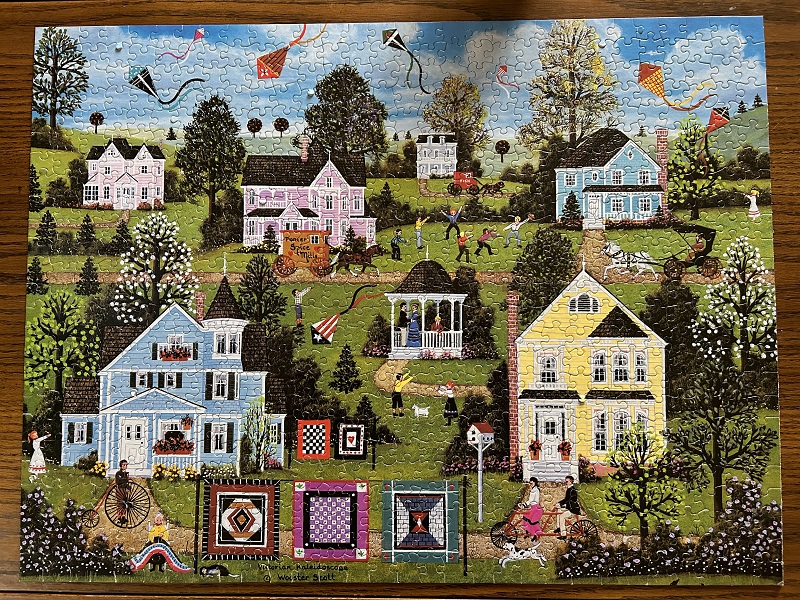
Back when I was doing a lot of puzzles this kind were always my favourite. Because you can pick up almost any piece and from looking at the picture you had a pretty good idea of where it was going to go. We had a few of these folk-art inspired puzzles that I did several times.

Puzzled

Zomnibus

Zomnibus

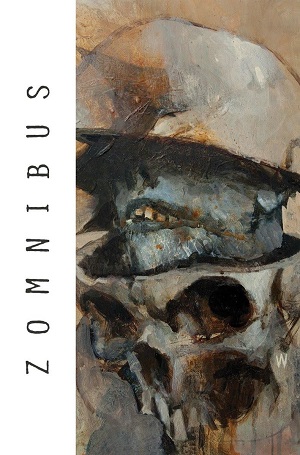
The title actually means something here, as this is an omnibus edition of three very different comic series, all dealing with zombies. It’s a bit unevenly weighted though, as the first two series are pretty standard after-the-apocalypse, Walking Dead kind of stuff, while the third is billed as the “Complete Zombies vs. Robots,” which is something else entirely. So let’s break it down.

Feast!: this was a very meat-and-potatoes zombie story. A busload of dangerous convicts crashes just after the zombie apocalypse, leaving the cops and cons having to work together to survive. They wind up in a small town where some other survivors have boarded up a building hoping to ride things out. The usual small-group dynamics and power struggles ensue as the number of survivors gets whittled down.

Being a fan of all (or most) things zombie, I enjoyed reading it. And the downbeat ending helped give it a bit more punch. Because all things considered, there was nothing exceptional about it.

Eclipse of the Undead: I mentioned in my lede how the first two stories here are standard zombie stuff, and evidence for that includes the way characters in both recognize immediately that they are living in a world already defined by the rules laid down in zombie movies. In “Feast!” the first character to twig to what’s going on says “You fuckers ain’t ever watched the movies? Zombies, man . . . Zombies!” In this story, while nobody knows how it happened, the zombie apocalypse is old news on arrival. “We saw them in the movies, in the funnies, we were almost used to them – a joke like Frankenstein or Dracula – but the fact is . . . the dead came back.” Specifically, George Romero’s living dead came back. Welcome to the metaverse.

The story in “Eclipse” (so titled because there is an eclipse, though I don’t know what the significance of that is) is even more basic than “Feast!” What we have is a bunch of people, abandoned by the military, breaking through the zombies besieging their refugee camp, which has been set up in the Los Angeles Coliseum. The usual small-group dynamics and power struggles ensue. The same good-guys and bad-guys having to work together, or falling out in ways that lead to their destruction.

I guess this was OK, but again there was nothing new about it. Even the old samurai guy seemed like a cliché.

The Complete Zombies vs. Robots: here we have the meat and the brains of this particular zombie feast. A now classic comic written by Chris Wyall and illustrated by Ashley Wood, Zombies vs. Robots is  fun, smart, and looks great. I don’t know if the series is complete even now though, so I don’t know how accurate the title is. What you get here are the first two volumes: Zombies vs. Robots and Zombies vs. Robots vs. Amazons.

This is not a comic you can just breeze through. The first time I read it, which was I guess fifteen years ago, I remember being confused as to what was even going on. There’s a complicated plot that involves time-jumping and the unexplained appearance of mythical beasts to join in the fun. I don’t think there are layers to the story though, and it’s enough to just enjoy the general parallel drawn between “the inhuman and the no-longer-human.” Or as the first page breaks it down: “Zombies! Braindead automatons and rotting reminders of man’s hubris! Robots! Brainless automatons and constructed remainders of man’s potential!” That’s great stuff.

If I were to sort it out a bit, I thought the first volume was the best. I love the possessed warbot that looks like a cross between R2-D2 and a tank, with a Punisher logo for a face. I couldn’t really figure out where the Amazons were coming from in the second volume, and didn’t think they were as interesting as the scientists. But it still played well and I thought it made an original contribution to the annals of zombie lore. Alas, I’ve heard rumours of a movie being in the works, and I don’t see how that will pan out. I guess all we can do is hope for the best.

Graphicalex

Bookmarked! #75: Writers’ Trust

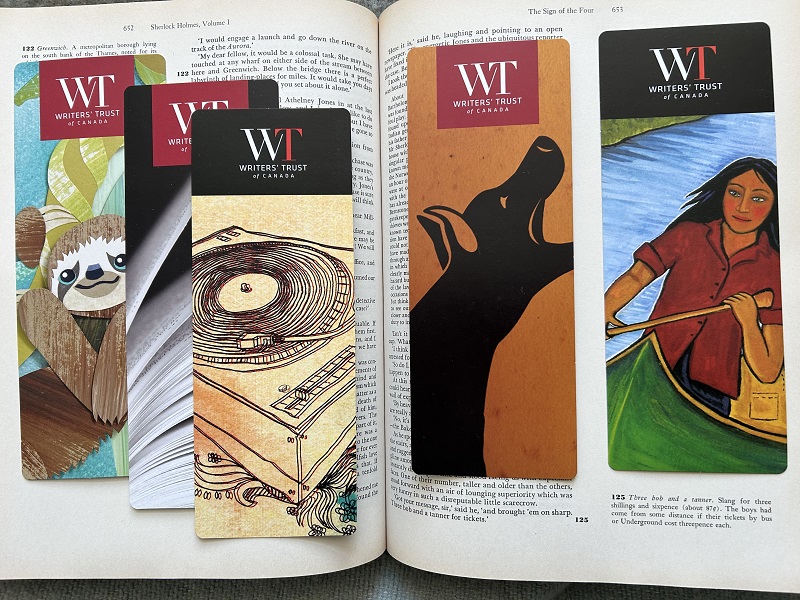
The Writers’ Trust has a bunch of literary prizes that they give out in different categories. The names sometimes change for branding purposes, but here’s a selection I’ve picked up celebrating the winners from previous years. From left to right: 2015 Vicky Metcalf Award for Literature for Young People, 2015 Hilary Weston Writers’ Trust Prize for Nonfiction, 2007 Rogers Writers’ Trust Prize for Fiction, 2015 Rogers Writers’ Trust Prize for Fiction, and the 2017 for Vicky Metcalf Award for Literature for Young People

Book: The Annotated Sherlock Holmes by Sir Arthur Conan Doyle (ed. William S. Baring-Gould)

Bookmarked Bookmarks

Holmes: A Scandal in Bohemia

The first of the Sherlock Holmes short stories and a popular favourite, “A Scandal in Bohemia” introduces us to Irene Adler, “the woman,” and specifically the woman who bests Holmes. Despite only appearing in this story, Adler has gone on to become a kind of feminist icon with a long deuterocanonical afterlife. This is understandable, as she not only gets a jump on Holmes but clearly has fun doing so, even taunting him twice. But if you’d been keeping up with the stories as they were published might you suspect that Holmes wasn’t always as sharp as he makes himself (or Watson makes him) out to be? It was pretty bad how the person disguised as a little old lady fools him completely in A Study in Scarlet. And Ms. Adler is a professional performer.

I’ve had occasion to mention Doyle’s debt to the Dupin stories of Poe a couple of times already, and the link is here again, as Holmes’s mission is very similar to that of Dupin in “The Purloined Letter.” Instead of a letter there is a “cabinet” (roughly 4”x6”) photograph of Adler with the King of Bohemia, the publication of which could cause a scandal. The king has tried to retrieve the letter, ransacking Adler’s home on a couple of occasions, and hasn’t been able to find it. But Holmes has his own method of getting her to give up the secret of its location.

In cutting things down from novel-length to short story Doyle had to tighten everything up, which works wonderfully well. Gone are the lengthy, and tedious, explainers. But the new economy can be felt down to the level of individual sentences. Here’s Holmes, for example, saying good-bye to the king, and then to Watson some time later, all collapsed into one line of dialogue:

“Then, good-night, your Majesty, and I trust that we shall have some good news for you. And good-night, Watson,” he added, as the wheels of the royal brougham rolled down the street.

How much time has passed between the two good-nights? Enough for the king to descend the stairs from Holmes’s apartment, get into his brougham, and drive away.

A similar collapsing of time occurs when Holmes gets back to his apartment, where Watson has been waiting for him. He’s hungry when he gets in, and orders up some cold beef and a glass of beer from the landlady, but Watson wants to hear what he’s been up to. Holmes responds:

“When Mrs. Turner has brought in the tray I will make it clear to you. Now,” he said as he turned hungrily on the simple fare that our landlady had provided, “I must discuss it while I eat, for I have not much time.”

Between the first sentence he utters and the “Now” several minutes at least much have passed, but they’re completely elided.

“A Scandal in Bohemia” was first published in 1891 and I wonder how many literary authors were experimenting this boldly with the presentation of time in their writing. This introduces a deeper question about how avant the avant-garde ever were, and whether more commercial forms of art and literature weren’t already leaving them a bit behind the times (to borrow the title of an excellent book on the subject by Eric Hobsbawm) even before the arrival of what’s known as modernism. If Doyle was borrowing from others he was also blazing new ground.

Holmes index

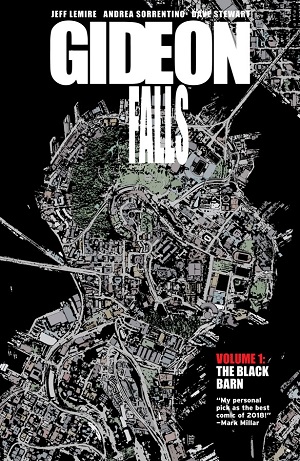
Gideon Falls Volume 1: The Black Barn

Gideon Falls Volume 1: The Black Barn

There are a lot of horror comics out there. I’m not sure why this particular genre should be so popular, but it’s always been a thing from back in the day when EC got into its groove (that is, after giving up on being “Educational Comics”). And while horror comics did suffer a lengthy time out in the doghouse when the censors cracked down, since the Comics Code fell into disuse they’ve been on a tear.

That said, with so many horror titles coming out you can expect a lot of variation in the quality. There are some series I’ve recently really liked and a few I didn’t get into at all. And the blame seems to attach equally to writers and artists when things don’t go right. Either the story makes no sense or the visuals are confusing or indecipherable.

I think Gideon Falls walks up close to this line, but for the most part I was really impressed with it. Jeff Lemire and Andrea Sorrentino team up again after working together on the Old Man Logan series, with results that feel really different but are equally effective. I thought the way Sorrentino’s experimental layouts and how he fragments a page worked really well, especially the double-page spread when Dr. Xu has her vision. It’s disorienting in a way that’s a perfect fit for what she’s experiencing. I might even call it creepy. Let’s face it, most horror comics aren’t actually very scary, but this one had its moments.

The story was vague and a bit generic. The Black Barn seems like the Black Lodge from Twin Peaks, in being an inter-dimensional place of evil that scary things come out of and that you don’t want to visit. One of the heroes is a priest with the usual worldly issues to deal with, and heaven knows that’s a clichéd figure. The business about him needing to reclaim his faith was something I didn’t need. The other main character is a guy whose visions have turned him into a mental patient. Again, the kind of person you expect to meet in this kind of tale, but all the same not unwelcome as a sympathetic figure we can relate to.

So it’s not a story that feels all that original, but I thought Lemire did just enough to make it fresh and interesting. The two threads of the story were, a bit to my surprise, nicely interwoven both visually and with the text, and the plot builds to a satisfying break. It doesn’t end on a cliffhanger, but takes us to a point where I was hooked and wanted to see what comes next.

Graphicalex

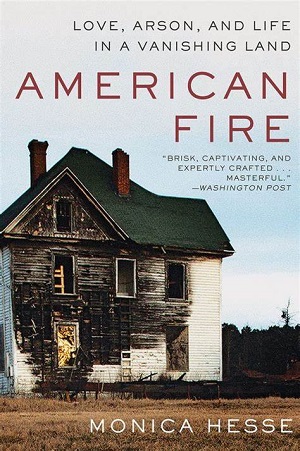
TCF: American Fire

American Fire: Love, Arson, and Life in a Vanishing Land
By Monica Hesse

The crime:

From November 2012 to April 2013 arsonists Charlie Smith and Tonya Bundick went on a rampage through Virginia’s Eastern Shore. They ended up setting over 80 fires, mostly burning down abandoned homes. Upon their arrest, Smith pled guilty while Bundick maintained her innocence. Both were convicted and sentenced to long prison sentences.

The book:

I thought this was a terrific book, shining a light on a crime (arson) that probably doesn’t get as much attention as it deserves. Given just how prolific Smith and Bundick were as fire bugs, however, this was a fairly well reported case and one that tells us a bigger story, which is what drew Hesse to it. “Big-name crimes have a way of becoming big names not only because of the crimes themselves, but because of the story they tell about the country at the moment.”

That story is the familiar one of a rural region suffering from long-term economic decline. This was reflected both in terms of the Eastern Shore’s population, which actually declined nearly 20 percent from 1910 to 2010, as well as in the nature of its industry, with potato farming replaced by chicken processing plants. Compared to the rest of the state, the Eastern Shore had lower numbers of college graduates as well as lower incomes, all of which helped make it a tinder box.

“In November of 2012, the Eastern Shore of Virginia was old. It was long. It was isolated. It was emptying of people but full of abandoned houses. It was dark. It was a uniquely perfect place to light a string of fires.” All you had to do was strike a match and you’d have a story perfectly suited for what political observers were beginning to take note of as one of twenty-first century America’s defining qualities. “America fretted about its rural parts, and the arsons were an ideal criminal metaphor for 2012.” The Eastern Shore was Evan Osnos’s Wildland, or Donald Trump’s landscape of American carnage. It was the land of the left behind, and in this case that meant left behind to burn.

I have to wonder if I would ever have read or heard anything about some of these places if not for being a fan of true crime. The declining population of the Eastern Shore immediately reminded me of the similarly stagnant or falling numbers in South Carolina’s Lowcountry as described in Valerie Bauerlein’s account of the Alex Murdaugh murder case The Devil at His Elbow. Reading both books I found myself having to consult atlases to familiarize myself just with the location of their depressed regions, as I knew nothing at all about them. And I suspect I’m not alone in that. These are places most people don’t even drive through on their way to somewhere else.

In addition to the political allegory, American Fire is also a love story. To be sure a crazy, tragic sort of love story, but then love itself is always a bit bonkers and frequently ends in tears. The specific kind of crazy here wasn’t so much a case of folie à deux or shared criminal conspiracy like Bonnie and Clyde (though these paradigms are discussed) as it was a neo-noir. Seen through this lens, Charlie and Tonya are easily identifiable genre types: the lovestruck, hard-luck loser and the mysterious, corrupting femme fatale.

“The psychologists who study criminal couples have discovered that the partnerships are rarely equal ones. The crimes are usually spurred on by one dominant partner.” And that’s definitely the takeaway here. It was clear not just to everyone but to Charlie himself that Tonya was out of his league. He’d noticed her at bars but wisely “avoided her on purpose. Women like that he always ended up making himself a fool in front of, and it seemed safer to stay away entirely.” Alas, easier said than done, and one fateful night, with only “an eight ball of cocaine in his pocket and a vague plan to kill himself,” they hooked up. You could even say she saved his life.

Things might have worked out, but Tonya seems to have always wanted something more while Charlie’s insecurities developed into performance issues. Inadequacy and low self-esteem led to impotence. Or as he put it, his belief that she was too good for him led to his dick not working. After a while it seemed the only way she could get her kicks with him was by their driving around setting fires together. Arson became a surrogate for sex. And whatever else you want to say about that as a basis for a relationship, it’s basically unsustainable. After a while you’re going to run out of fuel.

It’s this love story that I think is the real selling point for American Fire. Hesse actually makes both Charlie and Tonya into sympathetic figures, though her dislike for Tonya does come through in some uncharitable comments at the end. My own sense was that their love and their crimes were both representative of the human wreckage left behind by the fires that have been burning in America for the past fifty years. And not always burning in such a spectacular fashion, but with Robert Frost’s “slow smokeless burning of decay.”

Noted in passing:

“It’s amazing how boring trials can be. How even the most salacious of crimes committed under the most colorful of circumstances can result in testimony that is tedious and snoozy.”

This is why we have books, and why books have editors.

Takeaways:

As flattering as it is to have a woman who is clearly out of your league taking an interest in you, you need to see it as a red flag. Charlie should have trusted his gut, as it’s safer “to stay away entirely.”

True Crime Files