Holmes: Dr. Jekyll and Mr. Holmes

Sherlock Holmes fandom has always had a thing – lovable or annoying – for treating Holmes and Watson as real historical figures and not fictional characters. I’m not sure why this is, as the way the stories are presented, being the recollections of Dr. John Watson drawn from his contemporary notes on the cases, wasn’t something unique to the Holmes canon. But it’s still something you see a lot. It receives a nod here as well, with an About the Author(s) page with two bios: that of Watson (who, we’re told, died in 1940) and of Loren D. Estleman (who is, as of this writing, still alive).

These two pocket bios are only part of the textual apparatus that surrounds this novel. It was first published in 1979 and most recently republished as part of the Further Adventures of Sherlock Holmes series. This latter is the edition I was reading. It starts with a Foreword written in 1978, where Estleman refers to the following book being “with some slight interference of my own . . . a chronicle of John Watson’s own words.” He spins a yarn about how the manuscript was sold to him by an American gangster who found it when he’d been serving in France in WWII (in a chateau Watson had been stationed at in WWI). This is then followed by a Preface by Watson, dated 1917, that says that Holmes had recently told him he could tell the full, true story of Dr. Jekyll and Mr. Hyde now that enough time had passed since the events in question to not cause any scandal. Then, after the novel proper, there are Acknowledgments where Estleman continues to maintain the conceit that the story is authentic but which also references real sources and debts. And finally we get “A Word After,” which was first published in 2001, where Estleman talks a bit about the experience of writing the book.

Some of this is interesting, though personally I don’t like the conceit of treating fictional characters as real people. But like I say, it’s something that Sherlock fandom likes to indulge, and all these “further adventures” and spin-offs are a kind of fan service. It’ become a tradition. Now on to the book itself . . .

The Further Adventures series likes to mine late-Victorian literary thrillers for new-old villains. In addition to Dr. Jekyll, Holmes would also face off against Dracula (Sherlock Holmes vs. Dracula, an earlier book by Estleman), the Phantom of the Opera, Jack the Ripper, the Martians from The War of the Worlds, and other famous baddies. Going into this one, I actually thought there would be a twist where Holmes discovers that there were two different men involved and that Robert Louis Stevenson (who we meet at the end) made up all the business about chemical transformations. But instead it’s quite faithful to Stevenson’s original story and accepts the fanciful notion that someone can be not only morally and psychologically corrupted but physically transformed, instantly and in a dramatic way, just by drinking a potion. This means that as readers we already know everything that’s going on and we just follow Holmes and Watson around as they piece things together. If you know Stevenson’s novel well though you’ll have fun picking up all the minor references, like Watson calling Hyde his Mr. Fell, and while there are no twists it is a good yarn. Estleman is true to the characters and throws in one epic cab chase through the streets of London that was thrilling in a cinematic way.

Another point of interest is the link that’s come up already several times here between Holmes and Watson and Jekyll and Hyde. I previously noted how the author of the Introduction to the Penguin Classics A Study in Scarlet invoked the Strange Case of Dr. Jekyll and Mr. Hyde in his argument about Holmes and Watson constituting a single “divided being.” I also talked about how the story “The Red-Headed League” related to the Jekyll and Hyde story in the way the pawn shop backs onto the high-street bank: a secret connection between high and low that’s very much in play in Stevenson. In this book Holmes himself accounts for his bond with Watson as being a case of “Opposites attract,” a point that Estleman expands on in his Afterword by contrasting the “ultra-conservative John H. Watson” and the “Bohemian Sherlock Holmes.” “How natural,” then, that they “should find themselves drawn into the two halves of Jekyll’s world.”
Holmes index

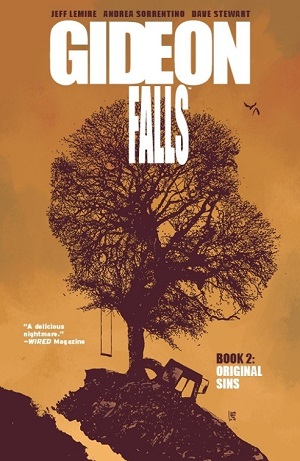
Gideon Falls Volume 2: Original Sins

Gideon Falls Volume 2: Original Sins

This second volume of the Gideon Falls comic feels like marking time. Even the structure repeats that of The Black Barn, with the same slow build to another psychedelic final issue that takes us through the looking glass (or the reassembled doorway) before pulling out and dropping us off in the same desolate locations. Only now there’s been a switcheroo and Father Fred and Norton (really Clara’s missing brother Danny) have crossed over into each other’s worlds. Which really doesn’t feel like it’s moved us forward at all.

There are no new characters aside from the real Norton Sinclair. He’s the Victorian tinkerer who built the thingamajig in his barn that seems to have opened a portal into an evil dimension. There’s still no idea what Norton Sinclair or the Laughing Man or the Bug God or whatever the hell it is might be up to though. If I had to guess I’d say he, or it, is just into doing evil stuff.

I still enjoyed what was going on, but at the same time it felt a bit early for the series to be running out of gas. As I’ve said, they weren’t adding much new here. There are a bunch of elements that felt tired, like seeing the episodes of a couple of the characters as frightened children, Norton strapped into a straitjacket and locked in a padded cell, Doc’s wall of newspaper clippings, and the insect monster breaking out of a human body. Sorrentino’s art didn’t even feel like it was adding much either, aside from the great double-page spread of Gideon Falls turning into Times Square. Maybe the Bug God is an urban developer then. That would actually make a kind of sense. Because if you invented a time machine wouldn’t you want to use it to make some smart investments in real estate?

Worth sticking with then, but at the same time: get on with it!

Graphicalex

Demon Slayer Volume 1: Cruelty

Demon Slayer Volume 1:  Cruelty

Most of the manga I’ve read is of a particular kind, characterized as being full of videogame-style action where the hero proceeds through different challenges or levels, with his adversaries (or level bosses) becoming more powerful as he goes along. That’s the impression I got again here, and I’m not sure how long I’ll stick with the series as these things just tend to go on. They’re not like American comics where you follow individual story arcs through a half-dozen issues or so. It’s more like counting the cars in a long train while you’re waiting for a crossing to clear.

I used to live on a farm that had a freight line running through it. I counted cars a lot when I was a kid.

The setting here is Taisho era Japan, which was in the early twentieth century. I thought we were sometime a lot earlier than that. A kid named Tanjiro who lives in the woods has his family killed by demons. The only survivor is Tanjiro’s sister Nezuko, but she’s been infected by the demons. Tanjiro wants to save her (I guess you have to believe in something) so he sets out carrying her on his back in a basket, with a bit stuck in her mouth so she won’t bite anybody. His goal is to join the elite Demon Slayer Corps, but to do so he has to first go through samurai boot camp.

This combines physical training with a lot of hard-ass hectoring that carries a message I’ve also noticed a fair bit of in the manga I’ve read. This is the presentation of life as an endless and brutal Darwinian struggle, a battle to the death where only the strong survive. So you’d better get tough and not waste time being sentimental or thinking about the meaning of life too much.

I wonder if this is a big thing in contemporary Japanese culture. Is it something picked up from their super-competitive school system? It’s not a theme I’ve noticed reading Japanese novels or watching many Japanese movies (though Battle Royale comes to mind as an exception).

I did find the set-up a bit interesting though, and the line about how “When happiness ends there’s always the smell of blood in the air” stuck with me. I thought the story predictable trash but I may stick with the series for a few volumes anyway. If nothing else, it seems to be a cultural artefact of some weight and so worth taking a look at. From Wikipedia:

By February 2021, the manga had over 150 million copies in circulation, including digital versions, making it one of the best-selling manga series of all time. Also, it was the best-selling manga in 2019 and 2020. The manga has received critical acclaim for its art, storyline, action scenes and characters. The Demon Slayer: Kimetsu no Yaiba franchise is one of the highest-grossing media franchises of all time.

I mean, they made a TV series out of it and then a movie in 2020 that had a budget of $15 million and took in over $500 million! So far I haven’t seen anything to explain that level of popularity, but I’ll try to let it grow on me.

Graphicalex

Holmes: The Boscombe Valley Mystery

A simple story, and not deceptively simple either. Though things do begin with Holmes reminding Watson of his axiom that “The more featureless and commonplace a crime is, the more difficult it is to bring home.”

I don’t think the crime here was featureless or commonplace though. It’s apparent simplicity is that it seems an open-and-shut case, with a young man arrested for the murder of his father. But Holmes sees deeper into these things, and knows how circumstantial evidence can be “a very tricky thing” and lead you astray. “It may seem to point very straight to one thing, but if you shift your own point of view a little, you may find it pointing in an equally uncompromising manner to something entirely different.”

What I mean by calling it a simple story is something different. I mean that as a mystery story, and in particular a Sherlock Holmes story, it doesn’t throw any curves. There’s only one suspect, and the plot follows what had already become a standard script pretty closely. There’s Holmes showing up the police by getting down on the ground with his lens and tracking clues (footprints, tobacco residue) like a bloodhound on the scent. There’s the exercise of his métier of “observation and inference.” There’s the usual backstory involving a crime in a faraway country (in this case Australia), and a pair of young lovers whose path to matrimony has to be made clear. There’s the guilty party who had his reasons, and who is going to expire soon anyway.

I raised an eyebrow at Lestrade calling himself Holmes’s “colleague,” not so much because he’s presuming a lot putting himself on an equal footing with Holmes but because they seem to actually have the same job. Lestrade has been called to Boscombe Valley by some of the locals who believe in the charged man’s innocence. Specifically, he is said to have been “retained.” I’m not sure how that works, or what makes it any different from Holmes’s role as consulting detective. Lestrade’s just not as good at it.

An annotation in the Baring-Gould edition though offers this:

Some have pounced on the word “retained” as used by Holmes to conclude that Lestrade had gone into private practice for a period, but that judgment is not necessarily warranted, for it was not uncommon for Scotland Yarders to aid the provincial police, and Holmes’ use of the word was purely conversational.

This suggests to me that there’s some wiggle room. The line between the police and private practice wasn’t as sharp in the nineteenth century as it is today, and Doyle himself might not have been clear on all the practical distinctions. And some of it can also be attributed to genre logistics. Fifty years later Miss Marple would be routinely given access to crime scenes and even be requested by authorities to conduct official interviews with suspects and witnesses. I just think the conjunction of “retained” with the later use of “colleague,” not to mention the way Holmes is usually employed (retained?) by the police, shows how fluid the boundaries were.

Holmes index

5 Days to Die

5 Days to Die

Version 1.0.0

A hard-as-nails cop named Ray Crisara is in crisis mode. He has a marriage that’s on the skids, and when his car is smashed into by a big rig, killing his wife and seriously injuring his teenage daughter, he becomes obsessed with getting revenge on the drug lord who he thinks is responsible. Also, because of a brain injury he received in the same crash Ray only has five days to live, so the clock is ticking.

You’d be excused for thinking you knew where this was going. The cover has Ray looking like a dead ringer for Marv from Frank Miller’s Sin City, and that neo-noir atmosphere where it’s always night, or it’s raining, or both, is very much the visual style. But there are two wrinkles Andy Schmidt throws into the mix. The first is that Ray, due to his injury, may be hallucinating some of what’s happening. The second is that Ray has to learn something about being a better parent from this experience, and in fact his quixotic mission of vengeance may just be a kind of coping mechanism.

These are interesting ideas to put in play, but in the end I didn’t feel like enough was being done with them. The hallucination angle had horror potential that was unrealized. As for the parenting stuff, maybe I’m being cynical, but noir is nothing if not cynical and the way things wrapped up here struck me as too sentimental. Even the drug lord gets some redemption. I expected, and wanted, something a lot bleaker than that.

Graphicalex