Titans: The Lazarus Contract

Titans: The Lazarus Contract

If you’ve been following along you’ll remember that I’ve taken note of the presence of Deathstroke lurking in the shadows of the previous two Titans books I’ve reviewed (The Return of Wally West and Made in Manhattan). I’d started in on Titans Volume 3 when I found a reference to the team’s battle with Deathstroke in the past tense. Had I missed something?

Turns out I had. But I picked up a big pile of these comics for a dollar each from the library’s overstock sale so I had the missing piece, which is this book. It didn’t have a number because it was part of what’s known as a “crossover event” involving a bunch of different titles, in this case Titans, Teen Titans, and Deathstroke.

This led me to the next question: Was all the build-up worth it?

No.

Basically what you need to know here is that one of Deathstroke’s kids, Grant Wilson, was recruited by H.I.V.E. (ahem: the Hierarchy of International Vengeance and Extermination), who gave him a serum that turned him into the supervillain Ravager but that ultimately brought caused him to have a heart attack while fighting the Teen Titans. Deathstroke sort of blames Grant’s death on the Titans, and decides he’ll use the Flashes’ (Flash and Kid Flash’s) ability to enter into the time force to go back into the past and save his son’s life. Since everyone knows disruptions in the space-time continuum always go wrong, the Titans and Teen Titans team up to stop Deathstroke. This they manage to do and Deathstroke, more disappointed than angry, decides to “retire” by setting up a new team of hero/villains composed of his other kids.

I don’t like most time-travel stories. This one doesn’t work for all the usual reasons. I particularly didn’t care for the blather trying to explain the mechanics of time travel. You see, Deathstroke modified an extractor made by someone for Flash to keep his speed power under control. Deathstroke uses this device to store that energy in battery cells connected to his fancy new “Ikon suit” (complete with lightning bolts!) that has a “gravity sheath” that allows him to move at near-light speed and enter the “time stream.” Then, when the Titans and Teen Titans want to follow Deathstroke they mimic his combination of Kid Flash’s super-speed and the gravitational properties of his costume by joining Jericho’s gravity sheath with Flash’s speed to create a “time vortex” stabilized by Raven’s “chrono-kinesis” and Starfire’s energy, all while being tethered by Raven’s mind-meld to the rest of the team as Flash goes running into the speed force, at least until Raven’s “vast mystical powers” begin to fray and her soul-self is in danger of being trapped in the “speed force,” which is where Deathstroke has looked into the face of God and achieved a higher consciousness.

Enough already. I lost interest in all of this long before the end. It all just seemed like a bunch of sparks and noise, with too many characters involved and not much for most of them to do but stand around barking at each other. Not that I knew who a lot of these people were anyway, or cared. I do know Deathstroke and have found him an interesting character in the past, but he’s a lot less so here, especially when he starts spouting scripture (a lot of scripture) in the epilogue. I think maybe there are fans who like this kind of story but it wasn’t my thing and by the time I finished I was glad that I was done with it, and nearly done with my Titans book haul.


Graphicalex

Bookmarked! #92: Memories of Suzhou 2

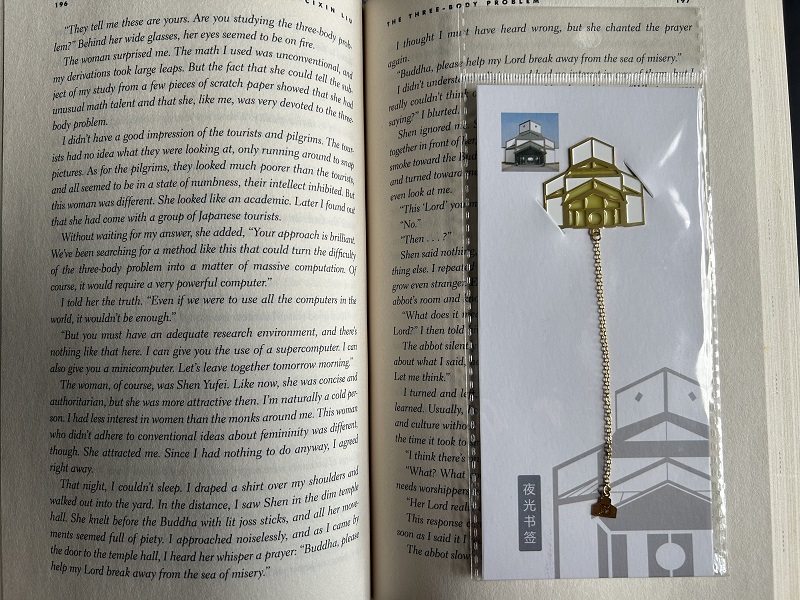
Heading back to the old city of Suzhou again this week. After showcasing a bookmark from their modern museum, here’s one from their famous Lion Grove Garden, a UNESCO World Heritage Site. The garden was built in 1342 by Buddhist monks, and has had to be rebuilt several times in the centuries since. It’s so named because the rock formations are supposed to look like lions, though from the pictures I’ve seen I think that’s a bit of a stretch.

Fun fact: The Suzhou Museum was designed by I. M. Pei. The Lion Grove Garden was previously owned by the Pei family, and I. M. Pei played in it when he was a child.

Book: The Dark Forest by Cixin Liu

Bookmarked Bookmarks

Holmes: The Adventure of the Beryl Coronet

This has the feel of a more traditional mystery, even though there wasn’t much of a tradition yet. A wealthy banker is given a beryl coronet, one of the “most precious public possessions of the empire,” as collateral for a loan. Not trusting to keep it in his bank’s safe, he takes it home with him and locks it in his dresser. Because that’s the kind of thing you did back in the day. He also makes sure to tell his niece and wastrel son what he’s doing. That night he discovers his son apparently in the act of stealing the coronet, and has him arrested by the police as a few gems from the coronet have gone missing.

After being told the story, Holmes is convinced that the son is innocent. He then proceeds to solve the case by the usual method of getting out his magnifying glass to examine evidence like footprints, going out on mysterious nighttime excursions, and employing “an old maxim of mine that when you have excluded the impossible, whatever remains, however improbable, must be the truth.” With regard to that final point, once again I didn’t find this maxim very persuasive, as Holmes never excludes what is impossible but only what is highly unlikely. Few things, after all, are impossible. But as I’ve criticized this maxim enough already, I won’t say more about it here.

I think it’s pretty obvious to most readers what’s going on, as once you’ve excluded the most likely suspect all we’re left with is the niece, who is an emotional girl with a habit of giving herself away. She’s not a bad person, but betrays her uncle the banker because she’s got a crush on a dissolute rake named Burnwell who is in need of money. She loves unwisely and too well. Or as Holmes unhelpfully explains to the uncle, “I have no doubt that she loved you, but there are women in whom the love of a lover extinguishes all other loves, and I think that she must have been one.” I mean, someone has to come first.

It’s a pretty good little mystery, even if nothing stands out about it. I did like how the rake who seduces the niece throws away the gems to a fence for such a low sum. No wonder he’s in such dire straits financially; he doesn’t know the value of anything. I’m afraid Mary has made a bad choice, which inverts the usual way one of these stories ends. And where is poor Mary now? “I think that we may safely say,” returned Holmes, “that she is wherever Sir George Burnwell is. It is equally certain, too, that whatever her sins are, they will soon receive a more than sufficient punishment.” Yikes!

Holmes index

The MAD Book of Mysteries

The MAD Book of Mysteries

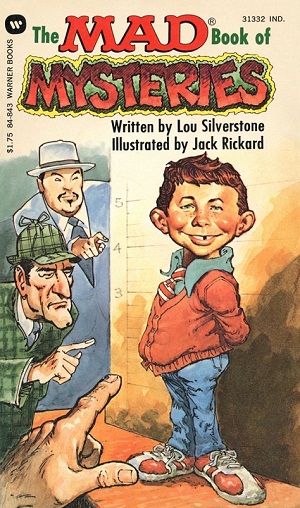
Since I’m a fan of both MAD Magazine and classic detective fiction, a book like this couldn’t really miss. I also like that it’s full of original stories and not a grab-bag of previously published material, and that all the stories have the same author and artist (Lou Silverstone and Jack Rickard, respectively).

So the line-up of crime-solving all-stars here sounds like the cast of Murder by Death. There’s Hercules Pirouette, Archer Spillane Spayed, Shtick Tracer, Allergy Queen, Charlie China, Perry Maceface, and Shamus Holmes. And there’s also a spoof on G-Men movies now and then, a quick trip to Peanuts-land with Chuck Frown, Private Eye, and a bunch of gags about what cops say vs. what they really mean. Alas, there’s no Nero Wolfe or Miss Marple, though they’re on the back cover. I would have loved seeing them.

The gags aren’t terribly funny but Silverstone knows his stuff and the way he pokes fun at the material will make you smile. He takes digs at Poirot’s long, drawn-out and confusing explanations of the crime, and has Number One Son getting back at his dad for all the mean cracks made at his expense. But the style of humour is mainly geared around running a gag-a-page of snappy comebacks. When Shamus Holmes declares that a murder victim lived near a canal Dr. Whatso says “A canal? That’s eerie, Homes.” To which Holmes replies: “No, alimentary, my dear Whatso!” Because the deceased worked at a candy company you see.

Rickard often gives the supporting characters familiar movie-star faces. James Cagney and Robert Redford, for example, as their era’s representative G-Men. I loved the look of all the stories, though MAD‘s house style of square speech bubbles and sans serif lettering seemed out of place. I don’t know why they couldn’t have played around with that more. Lettering matters.

What I took away the most from revisiting this pocketbook today though is how much the cultural landscape has changed. In the late ‘70s-early ‘80s classic detective fiction could be sent up for a mass audience, here or in the aforementioned Murder by Death, because it could be assumed everyone had some familiarity with these characters. Today I think that kind of awareness belongs to a vanishing few older readers. To be sure, golden age detectives still have their cults, but they aren’t household names anymore. And what’s more, nobody has taken their place. Caricature exploits character, and the old guard had plenty of that. But how can you caricature Inspectors Morse, Rebus, or Gamache? They’re more realistic and psychologically grounded but not as memorable, and give satirists a lot less to work with.

Graphicalex

Managed decline

Out on delivery. (CP — Christinne Muschi)

My grandfather was a village postmaster, and my mother had fond memories of working at the post office with him when she was a kid. My father was a stamp collector, and while this wasn’t a hobby I stuck with I did have stamp albums as a boy that I’ve held on to, along with the boxes filled with my father’s highly eclectic (and I’m afraid not very valuable) collection.

When it comes to my affection for all things mail related, however, what stands out the most is the fact that I lived on a farm most of my life and we received rural mail delivery. I was always impressed by the job these people did, even in bad weather on what were the worst of roads. Living in rural isolation, the arrival of the mail was an event that meant a lot to family and neighbours.

But times change. When I was young there were few courier companies and no Amazon delivery vans (much less drones). There was no Internet and email. There were no flyers or junk mail. People sent Christmas cards. In other words, everything came to you through the mail, and if it wasn’t always something you wanted it was at least something you knew was important.

This is no longer the case, which is why Canada Post, the Crown corporation that handles the mail in this country, is facing such a host of problems. Chief among these problems is their high labour costs and the fact that a lot of what made the mail not only useful but essential is gone. The result is a corporation that is, according to one recent study, bankrupt. Apparently they lost $300 million in just the first quarter of 2025. That’s not sustainable.

Last year the Canadian Union of Postal Workers (CUPW) went on strike for a month before being ordered back to work in the hope of finding a solution somewhere down the road. That solution hasn’t materialized and as I write this another strike is expected.

I don’t think anyone on either side, workers or management, is under any illusions as to how grim the future is for Canada Post. That said, I do think the mail has a future. I don’t mind that such a valuable service is operating at a loss. I still think a country, especially one as big as Canada, needs a public, national mail system. What has to be faced though is that a dramatic restructuring of the mail, what it does and how it does it, is going to be required.

And when I say restructuring what I mean primarily is contraction. I probably get more mail than most people. But I don’t need daily mail delivery. If they even cut delivery back to once a week I think I’d be fine.

I don’t know how workable this is, but there have been various studies done and other recommendations made that can be picked from. The bottom line though is that in order to avoid collapse some contraction in service will be necessary. I can’t see the current postal service with its over 70,000 employees surviving long.

There’s a lesson here for other sunset sectors of the economy. I’m thinking in particular of universities. These grew at an unreasonable rate during relatively good economic times, but even back in the 1990s there were reports on how necessary some contraction was. In a period of declining enrolments and now caps put on foreign students (the lifeline that was keeping a lot of higher education afloat in this country) I don’t see a bright future for many of these institutions. And again, the alternative to contraction is collapse: just keeping on doing things the way we have until the whole system breaks down. I know it’s become an expression that’s meant to trigger a fierce reaction, but at this point we have to learn how to manage the decline.

Aliens: Dead Orbit

Aliens: Dead Orbit

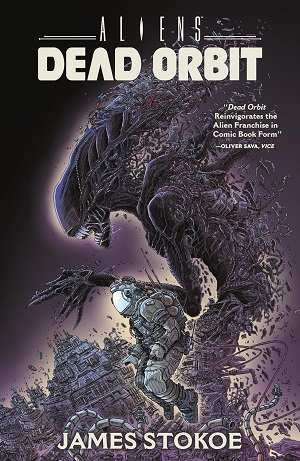
Dead Orbit is a one-man show, being written, drawn, and lettered by Canadian comic artist James Stokoe. It’s impressive when someone can handle all these roles as a comic auteur, but there are times when you think a division of labour might have helped. That’s the feeling I had here anyway. I love Stokoe’s art, which turns a space station into a giant, crumbling oatmeal cookie and sees Xenomorphs hiding in the wicker nests of wiring and machinery. I also liked the visual concept he had of turning the impregnated survivors who are “rescued” being burned to a crisp in their cryo pods so that it looks like rotting zombies are giving birth to chestbursters. That was a great touch, typical of the inventiveness found throughout this comic franchise.

The story, however, is hard to follow. I wasn’t sure of the time scheme, as most of the story is a flashback, but I don’t know how much because within the flashback there are a couple of flashforwards, though not as far forward as the story’s frame. This lost me completely the first time through because I got confused as to when Wascylewski was cocooned by the Xenomorphs. And what happened to the salvagers anyway? It seemed like that might be important, and then it wasn’t.

Things were just moving too fast. At one point there’s even a joke made about how quickly the creatures are growing, which is a poke at Alien that is often picked up on. The point remains however that everything here seems to happen in a rush and even at the end I was still wondering a bit about what was going on and in what order.

The supplemental materials describe Stukoe’s original pitch, which was a much more conventional Aliens story featuring space marines infiltrating a planet infested with Xenomorphs. But at some point he decided to go in a different direction, and this is definitely more like the first film than the second. The crew don’t even have any firearms and have to improvise with whatever tools they can find on the ship. Good luck with that!

Perhaps a little too scrambled in terms of its narrative for its own good, this is still another solid instalment in the Aliens franchise, and not to be missed by franchise fans.

Graphicalex

Marple: The Case of the Perfect Maid

The expression “it’s hard to find good help these days” is the key to unlocking the mystery in this charming story.

We return to the golden days of yesteryear (actually 1942, when a lot of Brits probably had other things on their mind), and a time when hot water bottles were in use (remember them?) and everyone had a maid. Miss Marple has one of course, and the story begins with her maid trying to get Miss Marple to help out her cousin, who is also a maid but who is about to be let go because her employers (spinster sisters) suspect her of having tried to steal a brooch.

Specifically, this maid has been “given notice.” Which is something I don’t understand. I mean, I get that employees should be given notice and that their employers might want to keep them around until they can hire a replacement. That’s the case today in most jobs. But in this case the maid has effectively been fired on suspicion of her being a thief. Why would you want that person in your house for another couple of weeks? Isn’t that just asking for trouble?

Anyway, the unfairly targeted maid is dismissed even though the sisters have been warned that, you know, it’s hard to find good help these days. They luck out, however, and immediately hire a “paragon” of a maid. But is she too good to be true? It seems so when the sisters, and everyone else in the Old Hall they’re renting a flat in, get burgled and the perfect maid disappears.

You don’t win a prize for cottoning on to the fact that the new maid isn’t all that she seems. Miss Marple’s own suspicions are made clear. So what Christie is pulling is the simple trick of throwing suspicion on something that’s not right, in this case the perfect maid, in order to distract us from something that’s also not right, but less obviously so.

A simple trick, but it works. Even knowing Christie’s go-to solutions I still didn’t twig to what was happening. Miss Marple’s trick to catch a thief was a bit too subtle, but the criminal plot actually made sense, which is something I can’t say for all these stories, and I had a good time being played.

Marple index

A bloody pain in the neck

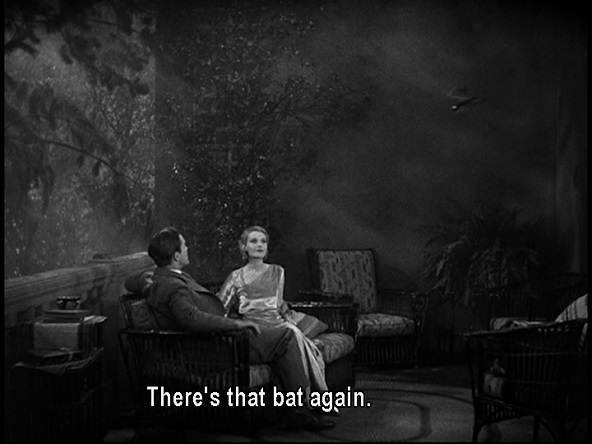
This is an index of some of the vampire movies I’ve reviewed over at Alex on Film. I’ll keep adding to it as I go along.

Nosferatu: A Symphony of Horror (1922)
Dracula (1931)
Vampyr (1932)
Mark of the Vampire (1935)
Dracula’s Daughter (1936)
Son of Dracula (1943)
House of Dracula (1945)
Horror of Dracula (1958)
The Brides of Dracula (1960)
The Kiss of the Vampire (1963)
Orgy of the Dead (1965)
Planet of the Vampires (1965)
Daughters of Darkness (1971)
Requiem for a Vampire (1971)
Dracula’s Dog (1977)
Nosferatu the Vampyre (1979)
The Hunger (1983)
Bram Stoker’s Dracula (1992)
From Dusk till Dawn (1996)
John Carpenter’s Vampires (1998)
Underworld (2003)
Underworld: Evolution (2006)
30 Days of Night (2007)
Let the Right One In (2008)
Let Me In (2010)
Abraham Lincoln: Vampire Hunter (2012)
Afflicted (2013)
Morbius (2022)
The Last Voyage of the Demeter (2023)
Renfield (2023)
Nosferatu (2024)
Sinners (2025)