Druuna: Morbus Gravis II

Druuna: Morbus Gravis II

In my review of Morbus Gravis I I noted parenthetically how Heavy Metal magazine had just recently ceased print publication. This is a real shame, as it was a terrific mag with high standards for art and storytelling throughout most of its history. What it also means though is that these Druuna books have become collector’s items. For a cover image I actually had to take a snap of my own copy of Morbus Gravis II as I couldn’t find one online (sorry for the glare!). On Amazon a copy in the same condition as mine would set you back at least $250.

So everybody’s favourite (well, at least my favourite) post-apocalyptic babe is back, with her boobs out and her red thong only being replaced, as occasion demands, by some vintage lingerie, or nothing at all. Things begin with romantic sex on the beach, followed by some post-coital posing (“I want to admire your body for one last time . . .”), before our hero wakes up and it’s revealed she’s been having some kind of mind-sex with Lewis, the guy who was running the ship before Delta (the computer system) took over. Now he’s just a head floating in a tank, sharing a telepathic link with Druuna, falling in love with her but also dreaming of finally being allowed to die. The story, such as it is, has Lewis sending Druuna on a mission to destroy the “tower of power” that keeps Delta running.

There’s nothing remotely politically correct about any of this. Not only is Druuna raped, but she likes it. Ditto for the bald-and-busty friend she picks up. Which may be meant as empowering but I doubt it. Not when a dominatrix in a leather skirt, wielding a riding crop, shows up and we’re told her name is Seka (the screen name of an actress known in the 1980s as the Platinum Princess of Porn). We know where Serpieri is coming from, and where he’s going to.

But it’s not just sex and violence that are near allied but love and death, Eros and Thanatos still going at it. I do think this is a comic with something to say. And Druuna isn’t just suffering the misfortunes of virtue in this world. She’s a true goddess. “In these times of hunger and death,” one brutal lover says, “the fact that you exist defies reality.” Only in a comic book I guess.
Graphicalex

Bookmarked! #101: Hello, Frank Lloyd Wright

I don’t know if I’ve ever been in a Frank Lloyd Wright building. The only possibility is the Guggenheim Museum in New York. I know I walked past that one, but I can’t remember if I went inside.

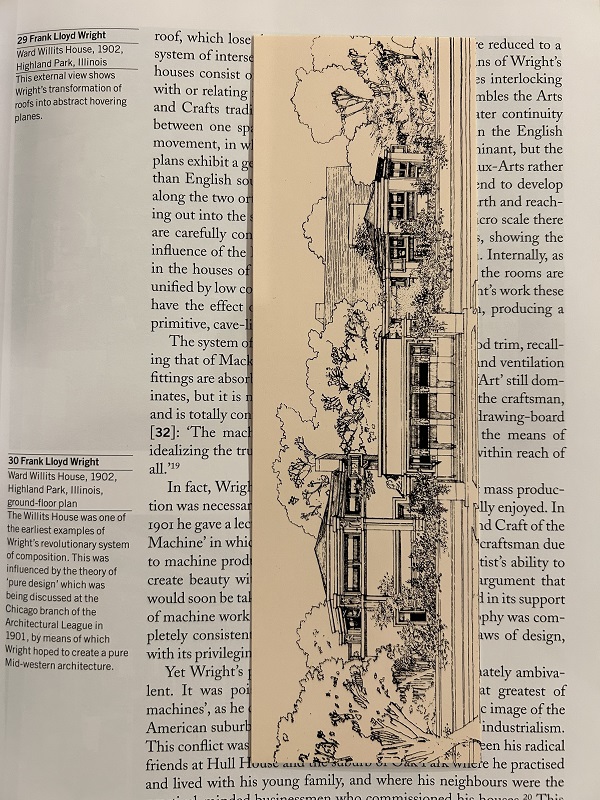
Anyway, this is the Frank Lloyd Wright Home and Studio building in Oak Park, Illinois. I have a friend who’s an architect who visited it and he picked me up a bookmark. Which, as you know, is the next best thing to being there.

Book: Modern Architecture by Alan Colquhoun

Bookmarked Bookmarks

Holmes: The Yellow Face

A story best known today for its progressive views on race. And it still feels progressive well over a hundred years later.

A man named Grant Munro comes to Holmes concerned about the strange behaviour of his wife, Effie. She’d been previously married to a man living in Atlanta, Georgia who she’d had a child with. Both this husband and child had reportedly died in a fire. Munro claims to have seen the death certificate. Or more specifically, he says he’s seen the husband’s death certificate. This is actually a clever bit of clue-dropping. Of course, when we hear that he’s seen the death certificate (actually not in use in Georgia for another twenty years) we immediately think it must be bogus. Because why else mention it? But what we might not register is that he only says he’s seen the husband’s death certificate.

As it turns out the child is alive. Holmes speculates that the wife is being blackmailed by her still-living first husband, who has moved into a nearby cottage. Meanwhile, what’s really happened is that a truculent Scottish governess is living there with Effie’s daughter, who has been seen looking out the second-floor window while wearing a yellow mask.

There are two twists. First, Effie isn’t being blackmailed by her first husband. Second: her daughter is “a little coal-black negress.” Effie had, you see, “cut herself off from my race to wed” a Black man. After overcoming a bit of shock, however, Grant scoops the child up and agrees to adopt her, claiming to be a better man than his wife has credited him with being.

I call the husband’s views progressive, but Wikipedia goes further in finding them “extraordinarily liberal for the 1890s.” Though interracial marriage wasn’t illegal in Britain at the time, I think the reveal here would still have been quite something. For comparison, Thomas Hardy’s Tess of the d’Urbervilles had just come out in 1891. This story was published in 1893. So they’re almost exactly contemporary. In Tess, Angel is so appalled when he finds out Tess had been effectively raped as a sixteen-year-old and had a child who died, that he abandons her and flees to Brazil. Diff’rent strokes indeed.

Watson introduces the story as one of Holmes’s rare failures, even though everything turned out well in the end. He tries to excuse Holmes’s shortcomings by saying that it was “when he was at his wits’ ends that his energy and his versatility were most admirable,” but the fact is that his guess as to the inhabitant of the cottage was nothing but the wildest speculation. Which, in turn, quite undercuts all his boasting about not indulging in a lot of guesswork in the absence of facts. But as regular readers should have known by now, Holmes is actually quite a fantasist, and while most of his solutions turn out to be accurate they are just as often as not lucky shots.

A little point that caught my attention is that when Effie gets up in the middle of the night to visit the cottage, Munro checks the time by taking his watch “from under the pillow.” This triggered very old memories of sleeping with my watch under my pillow. Memories so old now I can’t be sure if this is something I actually ever did. But at least it wasn’t unheard of, back in the day.

Holmes index

Kill or Be Killed: Volume Two

Kill or Be Killed: Volume Two

A mixed bag.

I like how the story is getting thicker, even as I hate all the stuff having to do with Dylan’s improbable love life and I couldn’t understand the way things kept jumping around. Ed Brubaker has to work hard to justify the different points of view while explaining how Dylan, our narrator, knows everything he’s talking about. Dylan’s also still doing that thing where he jumps ahead and then spends the rest of an issue telling us how we got there. And sometimes he’s more than just an issue ahead. At the end of this volume we still aren’t caught up to the gunfight in the brothel where the series began.

Now to be sure a lot of writers do this, and one thing to be said for it is that it shows how much planning went into things. The Chew comics do a lot of this too, for example, and they go even further with the breaking of the fourth wall, albeit with comic intent. But Dylan’s “artistic license” with the storytelling here just confused me. There were more hints dropped in this volume about the demon being Dylan’s imaginary frenemy, his appearance perhaps the result of Dylan going off his meds. But then the demon also seems to know things Dylan can’t, which may be its own version of artistic license.

Otherwise things are escalating nicely, with Dylan’s vigilantism having predictably messy side effects as he keeps skating out onto thinner ice. He’s been lucky so far but the cops and the Russian mafia are closing in, as is the demon. And to be honest, I hope things get worse for him, as I can’t say I like the character at all.

Graphicalex

What does that even mean? Part IV

In the midst of a recent heat wave I went to pick up some drinks for the fridge just in case I wanted something a little stronger than my usual water. They had Gatorade on sale so I picked up a 6-pack of this stuff. Why this particular flavour/colour? Because it was all they had left. For good reason, as I later discovered.

In the store I didn’t even look at the label. I just figured it was blue and so probably had some kind of berry flavour. My bad. I thought it tasted like antifreeze. But then I don’t know what antifreeze tastes like because I don’t have a wife who’s trying to poison me. I had to be really thirsty just to get through one bottle.

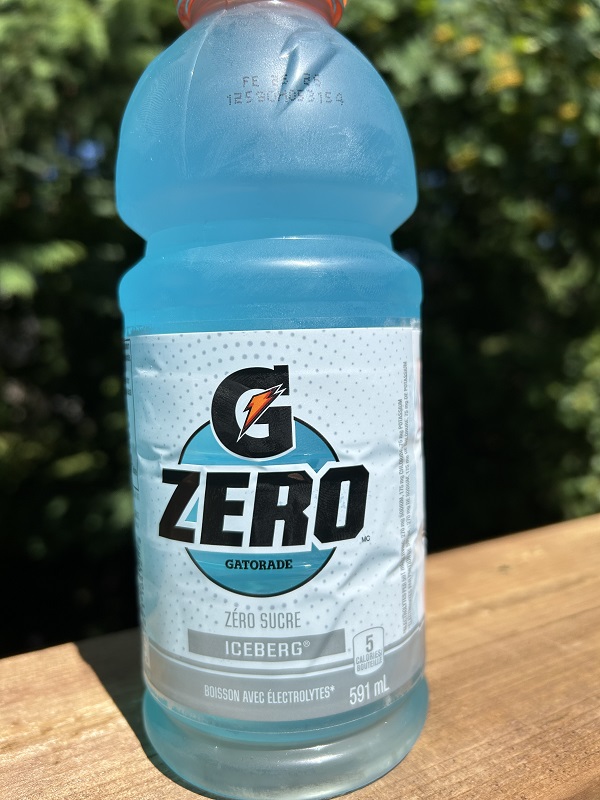
But what was it supposed to taste like? Orange energy drinks are orange flavoured. Purple ones are grape. The red ones may be cherry but are more likely fruit punch. And this is what they’re called on the label.

This is called . . . Glacier Freeze? What does that mean? That it tastes like run-off from the Greenland ice shelf? For what it’s worth, I went online and found this AI slop:

Glacier Freeze Gatorade is widely understood and marketed as a blend of refreshing, subtly sweet citrus and berry flavors with a dominant crisp, cool taste. The exact composition remains a closely guarded secret, but the prevalent consensus points towards notes of lemon-lime combined with a hint of raspberry, creating its signature icy profile.

Unlike some Gatorade flavors that are explicitly tied to a single fruit, Glacier Freeze offers a more complex and abstract flavor experience. This ambiguity is part of its appeal, allowing consumers to project their own interpretation onto the taste. The marketing has also played a key role in shaping perceptions. The “glacier” imagery evokes a sense of icy coolness and cleanness, reinforcing the refreshing quality of the drink. The pale blue color further contributes to this association.

It’s essential to note that taste perception is subjective. Factors like individual taste buds, cultural background, and even the temperature of the drink can influence how someone perceives the flavor of Glacier Freeze. While the majority may identify lemon-lime and raspberry, others might detect subtle nuances of other berries or citrus fruits. Ultimately, the ‘true’ flavor is a personal experience, shaped by individual interpretation.

Yeah. Whatever. I guess it tastes like whatever you think it tastes like then.

Since all labels have to be printed in both English and French in this fair land, I spun the bottle around and found this.

All of which only told me (something I didn’t know) that the French word for “iceberg” is “iceberg.”

Index

Basement Library!

If you’ve been following along with the saga of my basement renovations, turning a totally unfinished space into a library, here are the results. Still not much furniture but otherwise it’s mostly done.

This is how it looked to start. You can click on all the pics to make them bigger.

And here we are today from the same point of view, which is looking north.

And here we are looking south.

Turn the corner to the right at the south end and it wraps around.

And just turning some more to the right. That far wall is DVDs.

That’s about it for now. The island chests of drawers are for displaying and holding my bookmark collection. I haven’t put the bookmarks in yet. And I haven’t got much art up. But I’m getting there.

Next step is doing the upstairs shelves. The basement is for history, politics, and other non-fiction mostly, with comics and SF/mystery at the south end. The more literary stuff is going to go on the main floor and the loft.

Kill or Be Killed: Volume One

Kill or Be Killed: Volume One

Something that I’ve found myself responding to a lot in these Graphicalex notes are comics that will have a great premise that fails in the execution. This happens fairly often and it’s not surprising. Between the idea and the reality falls a shadow.

When things are reversed then it’s all the more worth remarking. This is the case with Kill or Be Killed, another pulp/noir collaboration from the team of writer Ed Brubaker and artist Sean Phillips (with Elizabeth Breitweister as colorist). I thought the concept here was sub-grade, neither interesting nor credible. But somehow they managed to make a decent comic out of it.

So first here’s the pitch: Dylan is “just an average, depressed grad student” (this from the back cover) who tries to kill himself by jumping from the roof of his apartment building but is saved after getting hung up in some laundry lines on the way down. This leads to him being visited by a shadowy demon who tells him that his “second chance” comes with a price: Dylan will have to kill “bad people, people who deserve death . . . one each month” as “rent for the life you tried to throw away.” If he doesn’t, then he’ll be the one to die.

As an origin story I thought this just seemed lazy. How would Dylan know who was a bad person? How bad would they have to be to deserve death? Where had Dylan entered into any contract with the demon, and why should he even credit the existence of such a being, or his threats? In order to prove his reality the demon breaks Dylan’s arm, but I didn’t find that very convincing. I assumed the demon was some sort of psychological projection, but born of what? The whole idea just seemed a brainless way of explaining the lame premise, which is a young man adopting a double life by going on a vigilante murder spree.

Having said that, the actual story was effective once it got going. Dylan is in a moral no-man’s land, both in selecting the bad people for execution and for getting involved in a relationship with his roommate’s girlfriend. Suspense arises from wondering which of these poor life choices will blow up on him first. Phillips’s art is suitably grotty and Brubaker does his best to make Dylan at least a semi-relatable narrator-protagonist. I didn’t like all the foreshadowing, something that even Dylan admits is too much, but I could live with it. And I felt hooked enough to stick with things for another volume at least. Now that they had the rough part out of the way I felt like there were some interesting directions they might go in. So we’ll see.

Graphicalex

Marple: The Unravelling

I’ve complained in some of my reviews of these modern Miss Marple stories (see, for example, here and here) about how they don’t provide any clues to even base a guess on as to whodunit. I didn’t think this one did either, but I still didn’t have any trouble figuring out what was going on. This was because of a couple of external clues.

The first is that in her pocket bio at the back of the book (which I read first), Natalie Haynes is described as a writer and broadcaster who “tours the world speaking on the modern relevance of the classical world” and who has written two books that were “retellings of Greek myth.” This alerts you to the relevance of the epiphany Miss Marple experiences when she has to unravel her work knitting a baby blanket. And throwing in a reference to a high school production of Aeschylus’s Agamemnon (“wives murdering husbands”) was another waving red flag. Because I don’t think many high schools were putting that play on, even back in the day.

The bigger clue for me though came from the fact that I’d read The Return of Martin Guerre, which was the far more obvious literary allusion being made. Add the fact that the suspects were all members of the same family and things seemed pretty obvious, and the question of whoever pulled the trigger (or loosed the arrow) was just by the way.

A decent read that has some fun with a bizarre murder in a cozy village setting. Not a great mystery, but few of Christie’s Marple stories were either.

Marple index

Alien: Thaw

Alien: Thaw

OK, if you’ve read my notes on titles like Aliens: The Original Years, Bloodlines, Revival, and Icarus then you know how high I rate the storytelling chops on display in the Alien series. Whenever I read these comics I can’t help imagining how they would play as movies, and the answer is invariably “Much better than the actual films in the franchise played out, after Aliens.” I’ve loved reading all of them, despite not being blown away by the art (which I’d usually rate as only competent). In fact, digging into a new Alien comic is something I look forward to more than any other title or character out there.

Alien: Thaw doesn’t disappoint in this regard. And that’s remarkable given that there’s nothing all that special about the story. Talbot Engineering has a trio of employees working on the ice moon LV-695, harvesting the ice to satisfy a universal demand for water. And you’ll never guess what they find frozen in the ice! First just a normal facehugger, but then a whole bunch of adult Xenomorphs. Of course, as soon as they make this discovery the evil Weyland-Yutani corporation shows up, having immediately bought out Talbot Engineering. Things look bad for our plucky ice miners, but then the ice starts to melt and everyone’s in even deeper shit because this means the party is on. When you get a full page of an army of Xenomorphs on the march you have to laughingly start quoting Bill Paxton: “It’s game over, man. Game over!

The story moves quickly. Very quickly. From the start of the franchise there have been questions raised about how the Xenomorph grew to such a massive size so quickly on board the Nostromo. But in this comic there’s one Xenomorph that goes from facehugger to chestburster to full-grown adult in something like an hour. How did that work? Well, because things are moving so fast there’s no time to ask questions like that. Or at least to answer them.

All the franchise touchstones are here. The facehugger glomming on to someone. A chestburster scene. A corporate heel (one of the seemingly endless descendants of Paul Reiser’s Carter Burke). Heavily armed space marines getting their asses handed to them by the Xenomorphs. A last girl. There’s even an android reveal that came as a surprise, which was something I have to give them full credit for because I knew it was coming. On the one hand, it’s pure formula by this point. But this is what an Alien story should be, without the weight of all the later mythology. And I enjoyed every page of it.

A final point: I wonder how much thought writers put into onomatopoeic sound effects in comics. Some of them have become iconic, like the SNIKT! of Wolverine’s claws, or the PAF! of Asterix launching a Roman centurion with a single punch. Of course sometimes you have to go with the classics. Like an explosion being some variation on KABOOM! But now ask yourself: how would you render the sound of a Xenomorph’s tail swishing through the air and decapitating someone? It’s not obvious, is it? But it should be something dramatic. I’ll let you think about it, and provide the answer in the comment thread below.

Graphicalex