
The Peepshow: The Murders at Rillington Place
By Kate Summerscale
The crime:
John Reginald Christie lived on the ground floor of a building at 10 Rillington Place in London. In 1949 a man named Timothy Evans lived on the top floor of the same building along with his wife Beryl and newborn daughter Geraldine. When Beryl and Geraldine were discovered to have been strangled, Evans was tried and found guilty of their murder and executed. Christie was a key witness at his trial.
In December 1952 Christie strangled his wife Ethel. In 1953 he would go on to kill another three women, concealing their bodies behind walls in his apartment. Shortly after he moved out the bodies were discovered and after a brief manhunt he was arrested, tried, and convicted of the murder of his wife. He was hanged in 1953. Subsequent investigations strongly suggest that Christie had also played a role in the murder of Beryl and Geraldine Evans, a crime for which Timothy Evans was posthumously pardoned.
 The book:
I want to kick off with a bunch of comments specific to this book.
First: Where are the pictures? I’ve mentioned before in these True Crime Files how photos shouldn’t be considered an extra in a true crime book, any more than maps are in a military history. So why are there none here? Is it because Summerscale finds something prurient or in poor taste about photos? Perhaps in some cases that’s a valid criticism, especially if we’re talking about crime scenes. But why not a picture or two of Christie? Or of the house in Rillington Lane? At a couple of points in the text Summerscale makes reference to pictures, why not show them? We’re told that a newspaper published a panoramic photograph of Rillington Lane, “shadowy and stark as a film noir set.” Don’t just tell us about it! We also have a picture that appeared in the papers at the time described to us as “Christie in his garden, dwarfed by hollyhocks, his cat Tommy on his shoulder and his dog Judy at his feet.” That sounds interesting too. Where is it?
If not including pictures was a conscious decision made for some reason other than expense (and I find that hard to credit since Summerscale is a bestselling author and this is a major hardcover release), it may have been a desire to avoid the “peepshow” or voyeuristic effect. But why is this book even called The Peepshow? The main connection seems to be to a book published by Fryn Tennyson, a crime reporter who covered the case. Otherwise the notion of a peepshow doesn’t have much to do with these killings. Christie did like to take nude pictures of women but there’s no attempt made to build a psychological profile out of this.
Moving past the title, why is the book’s epigraph taken from the story of Bluebeard? Specifically, Bluebeard’s warning to his new bride to stay out of the room containing the bodies of his previous wives. As with the notion of a peepshow, I don’t see the connection to the Christie case. It’s true that at the time at least one newspaper did refer to Christie being “the Bluebeard of Notting Hill,” but this was mere sensationalism. Neither Evans nor Christie were Bluebeard figures. Not even close. And Summerscale doesn’t help her case by attempting to shoehorn in references to the classic fairy tale. After the police left 10 Rillington Place, for example, a pack of neighbourhood women tried to break into the place:
Perhaps their raid on Christie’s house was an act of defiance. Like Bluebeard’s wife, the trespassers wanted to enter the killer’s lair. They wanted to see for themselves the scene of domestic horror in which Ethel Christie had been trapped, and into which those young women had stumbled. Christie’s acts were as irresolvable as a dream or a fairy tale, difficult either to assimilate or to dispel.
An act of defiance? Defiance of what? The property rights of the guy who actually owned the building and was looking to sell it? They were just a bunch of nosey neighbours, destructive rubberneckers looking for a cheap thrill. And what about Christie’s acts made them irresolvable? The bodies were all recovered and Christie was tried, convicted, and executed. This is all just nonsense and again there is no connection to Bluebeard at all.
Moving on from issues I had with The Peepshow to say something about Summerscale more generally as a true crime writer, I’ll confess I’m not a fan of the way she likes to expand her focus in order to take in parts of the story that are only marginal to the main course. Here this takes the form of biographical sketches of two of the reporters covering the case: Harry Procter and the aforementioned Fryn Tennyson. Now these two were interesting characters in their own right, but I didn’t want to read a book about them and in the end they didn’t add anything to my understanding of the Christie case. And once again I was left wondering why Summerscale keeps doing this.
But now back to Rillington Place.
The year was 1953 and England was . . . a very different place. The Second World War took a heavy toll on Britain, and London spent a long time rebuilding from the Blitz. In the U.S. Eisenhower had just been sworn in as president and Leave It to Beaver was only a few years away, political and cultural landmarks of what is now seen in a rosy rearview mirror as a golden age of American greatness. Things weren’t as sunny back in dear old Blighty. Notting Hill and North Kensington have now been gentrified, with Hugh Grant even having a bookshop in the former location, but at the time they were slums. “The ugliest and the most unsafe and the most negro-populated part of London,” in the words of (the progressive, for her time) Fryn Tennyson. “I’ve been in plenty of tough areas in London,” a local business owner said to the Daily Mirror, “but this beats the lot.” I was frankly surprised at the “rank squalor of Rillington Place” described here. 10 Rillington Place was a three-story building (with the confusing British habit of not numbering the ground floor, so the second floor is the first) without electricity so that the rooms were lit with gas. The single lavatory was basically an outhouse. And here’s an account of one of Christie’s victims spending a night at his place, in the company of her boyfriend:
The temperature fell below freezing that night, and they all stayed in the kitchen, the only warm room in the flat. Ina sat in the deckchair strung with rope, Christie perched on a wooden board laid over a coal bucket, and Alex sat in a small wooden armchair. Ina and Christie remained in the kitchen for the next two nights, while Alex slept on the mattress in the bedroom.
Christie’s trial, one paper reported, would reveal a lot of this “shabby underworld of bleak lodgings and even bleaker homes.” But England wasn’t just a primitive, physical wreck. It was also a backward place in its public morality. I mentioned Tennyson’s casual racism, but that is as nothing to what a judge had to say at the trial of a Black man who was renting Christie’s place and also dealing in marijuana a couple of years later. He was arrested in the company of a (white) woman who had some reefers in her handbag. Apparently the man had been showing the flat to curious sightseers. The judge expressed outrage:
“You showed her where the bodies are stored, I suppose. . . . You are a foul beast. It’s a pity we cannot deport you. Very often people like you get hold of these fools of little white girls and supply them with Indian Hemp. Then the girls become the sluts you see in the court from time to time, and later on some of you live on their immoral earnings.”
This from a judge, speaking from the bench! The “little white girl” in the case apparently faced no charges. The man got six months in jail.
The grim social and cultural context doesn’t explain Christie, though it does put his racism into perspective. He was, as Summerscale finally concludes, a figure both familiar and exaggerated, conventional and unique:
Christie was a grotesque cartoon of the old-fashioned Englishman. Like many of his class and generation, he had seemed to adhere to a rigid moral code: he was emotionally reserved, courteous, disapproving of immigrants, prostitutes, pubs and strong liquor, devoted to his pets and his garden, deferential to his social betters, admiring of the police and the army. Because he appeared in many ways so conventional, some commentators were at pains to define his difference. A doctor who attended the Old Bailey trial on behalf of the Daily Herald described him as a “necrophiliac sado-masochist, a hair-fetishist and a psychopath.” A “psychopath,” a term popularised by the psychiatrist Hervey Cleckley in 1941, was an individual who appeared normal but was incapable of feeling love, remorse or shame. To label Christie in this way was to identify him as intrinsically alien, and to distance him from the society that had helped forge him, in the same way that calling him a “monster” or a “creature” discounted him as an exception.
It’s hard, but not impossible I think, to sort this out. The key is in understanding that Christie didn’t just present as a conventional or old-fashioned Englishman but really was one in many if not most ways. Summerscale’s evocation of the blighted nature of life in the ‘hood in 1950s London helps us see how this worked. And it might have worked for a lot longer but for the fact that Christie wasn’t very bright and was largely without resources.
The final point Summerscale addresses, as best she can, is Christie’s culpability in the murder of Beryl and Geraldine Evans. She discusses a note uncovered in her researches containing a report of Christie’s “confession” to a guard to both of their murders, but it’s next to impossible to figure out how much stock to put in this as Christie kept changing his story based on whatever temporary advantage he thought he could gain. That said, I thought Summerscale’s scenario was at least a plausible explanation for what really happened, and at this point plausibility is the best we’re going to get.
Noted in passing:
Christie worked a lot of odd jobs, often as a low-level government functionary, suggesting to me that he wasn’t much good at anything and didn’t get along with others very well. At the time of the murders he was unemployed. For a while during the war he worked as a police auxiliary in London, where the more unpleasant aspects of his personality came out:
When Christie was working for the Metropolitan Police war reserve force, from 1`939 to 1943, he had taken pleasure in his role as a law-enforcer. Mrs. McFadden remembered how bossy he had been, in his high-collared blue uniform and peaked cap. He would chastise neighbours for the slightest chink in their blackout curtains, she said: “He threatened to report practically everybody in the street.” A colleague at the Harrow Road police station agreed that Christie’s uniform “gave him a certain status and a sense of power over ordinary people.” He flashed his warrant card about, said his fellow officer, and boasted about the number of people he had arrested.
Whatever sort of closet case Christie was sexually, he was definitely a closet authoritarian. Give these guys a uniform and they think they’re God. We all know the type.
Takeaways:
Respectability is a front that’s almost always hiding something.
True Crime Files
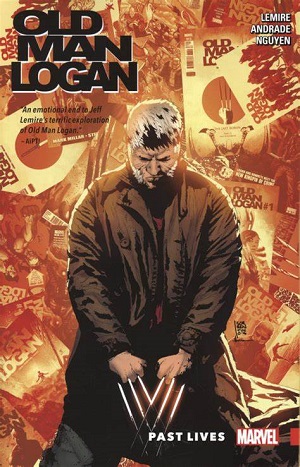 This was the final issue of the Old Man Logan series to be written by Jeff Lemire and it has even more of a retrospective feel to it than usual. As things get started Logan has decided he wants to go back in time and to the specific part of the multiverse where the saga began so that he can save Baby Hulk, and maybe his family too. Unfortunately, none of his friends and enemies want to help (he appeals to the Marvel science-and-sorcery brain trusts, from Doctor Strange and Scarlet Witch to Black Panther and Doctor Doom), so as a last resort he springs a devil-worshipper named Asmodeus from supervillain prison. Asmodeus says he’ll send Logan back into his past, but –surprise! – he’s actually going to double-cross Logan. I don’t know why Logan would have expected anything less. That struck me as silly.



 Alex Good